HomeDiagramsDatabaseMapsForum About
     

Go Back   SkyscraperPage Forum > Regional Sections > Canada


Closed Thread

 
Thread Tools Display Modes
     
     
  #16501  
Old Posted Mar 29, 2022, 10:56 PM
jamincan jamincan is offline
Registered User
 
Join Date: Jul 2020
Location: KW
Posts: 1,890
Quote:
Originally Posted by ssiguy View Post
Light Metro is just a made up word, there is no such thing.

A subway/Metro is a bi-directional, urban, electrified, grade separated rail system. Full stop.

Ottawa LRT is a Metro, Eglinton LRT isn't.
REM is a Metro, CTrain isn't.
SkyTrain is a Metro, LA LRT isn't.
Chongquing Monorail is a Metro, Seattle LINK isn't.

The technology, whether it's at-grade, elevated, underground, or a combination of the 3 doesn't make a hoot of difference.

The easiest way to differentiate a Metro from other systems is whether it can be {at least hypothetically} automated or not.
Is the L in Chicago a metro?
     
     
  #16502  
Old Posted Mar 30, 2022, 12:24 AM
DirectionNorth's Avatar
DirectionNorth DirectionNorth is offline
Registered User
 
Join Date: Oct 2020
Posts: 236
Quote:
Originally Posted by ssiguy View Post
Some of these cities would have been better off with little Personal Rapid Transit systems.

LRT advocates and corporations hate PRT because they often work too well. Look at the posterchild of PRT...................Morgantown W.Virgina. It's a university town with campuses spread out over the city so they tried something new in the 1970s........PRT. It has worked incredible well with a 98% reliability rate and no accidents. It had fallen off so now they are replacing the entire software and fleet to modernize it. The line has 5 stations so is also used for general transit by the citizens of the city.

Over it's 12km length it carries 16,000 passengers a day in a little city of 40,000 with a metro pop of just 150,000. In terms of passenger per km, it blows many of these huge city LRT systems right out of the water and takes you directly from your station to the one you are going to.................it's incredibly fast. You never really wait for the cabs at your station because the little 12km system has 70 cabs.
PRT can work well in some contexts. There are successes (Miami, Morganstown) and failures (Jacksonville, Detroit) in the US. Certainly, Morgantown's PRT is very successful for such a small city.

Quote:
Originally Posted by Doady View Post
You can see all over the US in places like Dallas and St. Louis how spending so much money to build light rail doesn't increase ridership. What a waste. You can see in Canada also, York Region spent huge amount to build a BRT system with high frequencies, all-door boarding scheme, and even some transitways, and the ridership didn't increase. These places built for higher capacity that they didn't need. They needed to increase the ridership first.

When we forget that BRT, light rail, medium rail, and heavy rail is all about increasing capacity, then we will make these mistakes again. Even for basic bus system, higher frequencies follows ridership, not the other way around. The most important thing for high ridership is a complete system, a bus route in every neighbourhood, along every major road, at every hour, every day. Transit systems in their infancy need to focus on filling in the gaps in their networks, not worry about frequent bus service or BRT or rail.

I see it here in Mississauga, they simply extended 39 Britannia along Matheson Blvd to Renforth, further into industrial area, connecting to the Toronto border, and the ridership skyrocketed. Even with 35 minute frequencies, the overcrowding was getting out of control, and articulated buses were put onto the route. Even in the midst of pandemic, the frequencies were gradually increased, now 20 minutes during rush hour, and 25 minutes during midday. Rail, grade separation, all-door boarding scheme, high frequencies, all that stuff is not what gives systems high ridership. It is the high ridership, the need for high capacity, that gives systems all those things, and we cannot forget that.
That is totally untrue. People use transit because it's easy to use and because it gets them where they want to go, at similar speeds to a car. You can't get people to use transit if they have to wait 1/2 hour to go anywhere.

People will use transit because it is:
  • Reliable
  • Fast
  • Safe
  • Convenient
  • Cheap

High frequencies make it reliable and convenient, while all-door boarding speeds it up. An attitude like yours is why so many US systems fail - they think about serving people with the bare minimum rather than making transit convenient, so everybody buys a car as soon as possible.

Your opinion is a cycle of decline: low ridership leads to cuts which leads to low ridership which leads to cuts ...

It's fairly obvious to most of us. Then again, you are the person who wants to cut all transit spending in the 905, so ...
__________________
My YouTube Channel
     
     
  #16503  
Old Posted Mar 30, 2022, 2:09 AM
Nouvellecosse's Avatar
Nouvellecosse Nouvellecosse is online now
Volatile Pacivist
 
Join Date: Aug 2005
Location: Nova Scotia
Posts: 11,101
Quote:
Originally Posted by jamincan View Post
Is the L in Chicago a metro?
Most of it although there's a few sections, particularly on the brown line, that has similarities to light rail due to the grade crossings.
__________________
"The reasonable man adapts himself to the world; the unreasonable one persists in trying to adapt the world to himself. Therefore all progress depends on the unreasonable man." - George Bernard Shaw
Don't ask people not to debate a topic. Just stop making debatable assertions. Problem solved.
     
     
  #16504  
Old Posted Mar 30, 2022, 2:29 AM
Doady Doady is offline
SUSPENDED
 
Join Date: Apr 2004
Posts: 5,166
I provide several examples where high-frequency and rapid transit features failed to result in higher ridership, and the lack thereof not preventing ridership growth, and the retort and argument against it is nothing more than "totally untrue" with no counter evidence and a claim that I advocate for eliminating all transit funding in the 905. That is a good example of what "discussion" even in a discussion forum means nowadays. Evidence doesn't matter anymore on SSP and evidence doesn't matter with a lot of policy makers anymore either. THAT is the real reason so many BRT and light rail systems in the US fail. So many policies and projects not based on any evidence, and York Region Transit fell into the same trap investing so much into their VIVA system instead of investing into the Steeles corridor and filling that huge gap in their network. Steeles Ave, the busiest transit corridor in York Region, and it's not part of the York Region Transit network at all, let alone their VIVA BRT network. Worrying too much about speeds and frequencies before even finishing building a basic network.
     
     
  #16505  
Old Posted Mar 30, 2022, 11:43 AM
DirectionNorth's Avatar
DirectionNorth DirectionNorth is offline
Registered User
 
Join Date: Oct 2020
Posts: 236
Quote:
Originally Posted by Doady View Post
I provide several examples where high-frequency and rapid transit features failed to result in higher ridership, and the lack thereof not preventing ridership growth, and the retort and argument against it is nothing more than "totally untrue" with no counter evidence and a claim that I advocate for eliminating all transit funding in the 905.
I provided logic that you didn't interact with. What a good debater you are.

In case you missed all discussion in the transit community, here are 8 sources ...
https://arxiv.org/ftp/arxiv/papers/2002/2002.02493.pdf
https://www.bizjournals.com/austin/news/2017/10/15/is-frequency-the-key-to-transit-success.html
https://pedestrianobservations.com/2019/02/25/frequency-ridership-spirals/
https://transitcenter.org/theres-a-reason-transit-ridership-is-rising-in-these-7-cities/
https://www.bloomberg.com/news/articles/...rship-depends-on-bus-service-study-finds
https://sgp.fas.org/crs/misc/R45144.pdf
https://www.edmonton.ca/public-files/ass...adsTraffic/transit_factors_ridership.pdf
https://www.nctr.usf.edu/pdf/77607.pdf

I dare you to find a source that says that high frequency does not result in high ridership.
Quote:
Originally Posted by Doady View Post
That is a good example of what "discussion" even in a discussion forum means nowadays. Evidence doesn't matter anymore on SSP and evidence doesn't matter with a lot of policy makers anymore either.
OK, now the evidence is there. And if you don't like the discussion quality, you can improve it or you can leave. I notice that you don't provide evidence.
I'm not forcing you to debate me.

And hey, look at what I found in your post history!

Quote:
Originally Posted by Doady View Post
THAT is the real reason so many BRT and light rail systems in the US fail. So many policies and projects not based on any evidence, and York Region Transit fell into the same trap investing so much into their VIVA system instead of investing into the Steeles corridor and filling that huge gap in their network. Steeles Ave, the busiest transit corridor in York Region, and it's not part of the York Region Transit network at all, let alone their VIVA BRT network. Worrying too much about speeds and frequencies before even finishing building a basic network.
The Steeles route is operated by the TTC, which runs buses at 10 minute frequencies from 6 AM to 11 PM. Just for reference, VIVA Purple's next departure from Richmond Hill is in 18 minutes. During peak hours! Do you really think it's a coincidence that the TTC has
higher ridership? https://www.ttc.ca/routes-and-schedules#/53/0/14684
https://tripplanner.yrt.ca/#/app/nextdepartures/routeheadway/full/603/EASTBOUND/01/04/2022/4:00a.m.
__________________
My YouTube Channel

Last edited by DirectionNorth; Mar 30, 2022 at 1:14 PM.
     
     
  #16506  
Old Posted Mar 30, 2022, 12:54 PM
caltrane74's Avatar
caltrane74 caltrane74 is offline
gettin' rich!
 
Join Date: Aug 2002
Location: Toronto
Posts: 34,204
Quote:
Originally Posted by Innsertnamehere View Post
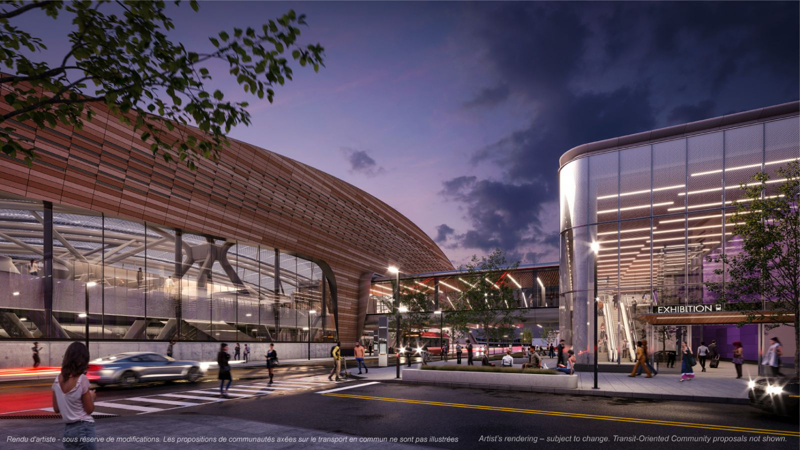
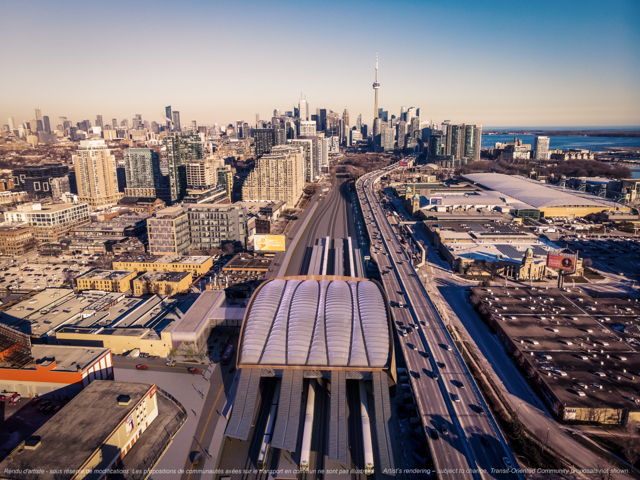
The Ontario Line officially broke ground today, and a bunch of new renderings dropped. A couple:


]
The exhibition station looks to be the most interesting. Like a mini union station in the making.
     
     
  #16507  
Old Posted Mar 30, 2022, 3:21 PM
J.OT13's Avatar
J.OT13 J.OT13 is offline
Moderator
 
Join Date: Mar 2012
Location: Ottawa
Posts: 28,323
Quote:
Originally Posted by caltrane74 View Post
The exhibition station looks to be the most interesting. Like a mini union station in the making.
Will it have an entrance on the south side of the Gardiner? It's not evident in the rendering.
     
     
  #16508  
Old Posted Mar 30, 2022, 3:28 PM
caltrane74's Avatar
caltrane74 caltrane74 is offline
gettin' rich!
 
Join Date: Aug 2002
Location: Toronto
Posts: 34,204
Quote:
Originally Posted by J.OT13 View Post
Will it have an entrance on the south side of the Gardiner? It's not evident in the rendering.
It would have to, because what's the point of calling it exhibition station then.
     
     
  #16509  
Old Posted Mar 30, 2022, 3:33 PM
J.OT13's Avatar
J.OT13 J.OT13 is offline
Moderator
 
Join Date: Mar 2012
Location: Ottawa
Posts: 28,323
Quote:
Originally Posted by caltrane74 View Post
It would have to, because what's the point of calling it exhibition station then.
You would hope so. That said, we have a "Parliament" station that's a 350 meter walk to Parliament Hill, sooo.
     
     
  #16510  
Old Posted Mar 30, 2022, 3:34 PM
MonkeyRonin's Avatar
MonkeyRonin MonkeyRonin is offline
¥ ¥ ¥
 
Join Date: Sep 2006
Location: Vancouver
Posts: 10,590
Quote:
Originally Posted by J.OT13 View Post
Will it have an entrance on the south side of the Gardiner? It's not evident in the rendering.

Yeah, there's one there for the existing GO station already (it's open below: https://goo.gl/maps/mCyT7R4XNvPJj4MM7).
__________________
     
     
  #16511  
Old Posted Mar 30, 2022, 3:43 PM
Mister F Mister F is offline
Registered User
 
Join Date: Jun 2004
Posts: 2,982
Quote:
Originally Posted by J.OT13 View Post
The idea of a DRL has been discussed for over a half century sure, but the Ontario Line has little in common with previous plans. Different routing, light-metro trains as opposed to heavy subway trains of the past, above ground for much of the length.
The line follows a very similar alignment along the same corridor to accomplish the same goals. It built on the work done for the DRTES and the Relief Line (both phases). The big picture planning and even a lot of the details were already done, and the changes made since 2019 are relatively minor. That's why it could start construction in a seemingly short time.
     
     
  #16512  
Old Posted Mar 30, 2022, 9:35 PM
Doady Doady is offline
SUSPENDED
 
Join Date: Apr 2004
Posts: 5,166
Quote:
Originally Posted by DirectionNorth View Post
I provided logic that you didn't interact with. What a good debater you are.
What logic have you provided? That cheap transit is the key? That's why US cities like Dallas and St. Louis have lower ridership than Toronto? High fares? Right.

Here's a list annual transit boardings in 2019 that I recently posted in another thread. See any correlation between higher ridership and lower fares?

Las Vegas, NV - 66,659,100
Pittsburgh, PA - 64,589,700
Victoria, BC - 29,963,300
Cincinatti, OH - 13,471,300
Indianapolis, IN - 9,527,200
Oklahoma City, OK - 3,091,200
Little Rock, AR - 2,576,500

Quote:
In case you missed all discussion in the transit community, here are 8 sources ...
https://arxiv.org/ftp/arxiv/papers/2002/2002.02493.pdf
https://www.bizjournals.com/austin/news/2017/10/15/is-frequency-the-key-to-transit-success.html
https://pedestrianobservations.com/2019/02/25/frequency-ridership-spirals/
https://transitcenter.org/theres-a-reason-transit-ridership-is-rising-in-these-7-cities/
https://www.bloomberg.com/news/articles/...rship-depends-on-bus-service-study-finds
https://sgp.fas.org/crs/misc/R45144.pdf
https://www.edmonton.ca/public-files/ass...adsTraffic/transit_factors_ridership.pdf
https://www.nctr.usf.edu/pdf/77607.pdf

I dare you to find a source that says that high frequency does not result in high ridership.

OK, now the evidence is there. And if you don't like the discussion quality, you can improve it or you can leave. I notice that you don't provide evidence.
I'm not forcing you to debate me.
You are the only one who refuses to debate. Again, higher frequencies and limited stops of YRT with VIVA did not result in ridership gains as I said before. 19 million riders expected 2006 but they only got 17 million. Don't even have to compare to TTC, just compare YRT/VIVA to Mississauga and Brampton Transit, YRT and VIVA was much more ambitious with the speed and frequencies, but ridership remains low.

In low ridership systems like YRT and Milton Transit, speed and travel times are simply not the problem. The speed of a typical TTC, Mississauga, Brampton bus is not as fast as a typical YRT or Milton Transit bus. The York and Milton buses are already faster. The buses are already fast when they are empty. Empty buses are not stopping much anyways, so rapid transit features - high frequencies, limited stops, all-door boarding, signal priority, and grade separation - aren't going to do much. That's the simple, basic principle that people like you who advocate for rapid transit to solve low ridership cannot understand.


Quote:
And hey, look at what I found in your post history!
lol

Quote:
The Steeles route is operated by the TTC, which runs buses at 10 minute frequencies from 6 AM to 11 PM. Just for reference, VIVA Purple's next departure from Richmond Hill is in 18 minutes. During peak hours! Do you really think it's a coincidence that the TTC has
higher ridership? https://www.ttc.ca/routes-and-schedules#/53/0/14684
https://tripplanner.yrt.ca/#/app/nextdepartures/routeheadway/full/603/EASTBOUND/01/04/2022/4:00a.m.
VIVA Purple was 10 minutes when it was introduced, just like Green, Pink and Orange. But Green, Pink and Orange service got cut back due to lack of ridership. The high frequency did not result in high ridership. I remember Purple doing okay, the service didn't increase but it didn't get cut either. Perhaps a certain pandemic resulted in recent cuts. Only VIVA Blue was successful, but that was taking over existing successful GO bus service and the normal 99 Yonge bus.

Weekday boardings, 2012:

VIVA Blue 21,547
VIVA Purple 9,238
VIVA Orange 2,420
VIVA Pink 2,026
VIVA Green 873

Compare these numbers, especially Orange and Pink to that of some regular, non-BRT, slow, low frequency bus routes in Mississauga that same year:

42 Derry 5,913
61 Mavis 4,864
7 Airport 4,637
23 Lakeshore 4,139
13 Glen Erin 3,743
10 Bristol-Britannia 3,618
51 Tomken 3,298
20 Rathburn 3,253

http://dmg.utoronto.ca/pdf/tts/2011/validation2011.pdf
     
     
  #16513  
Old Posted Mar 30, 2022, 10:45 PM
DirectionNorth's Avatar
DirectionNorth DirectionNorth is offline
Registered User
 
Join Date: Oct 2020
Posts: 236
Quote:
Originally Posted by Doady View Post
What logic have you provided? That cheap transit is the key? That's why US cities like Dallas and St. Louis have lower ridership than Toronto? High fares? Right.

Here's a list annual transit boardings in 2019 that I recently posted in another thread. See any correlation between higher ridership and lower fares?

Las Vegas, NV - 66,659,100
Pittsburgh, PA - 64,589,700
Victoria, BC - 29,963,300
Cincinatti, OH - 13,471,300
Indianapolis, IN - 9,527,200
Oklahoma City, OK - 3,091,200
Little Rock, AR - 2,576,500
Las Vegas metro area population: 2.3 million
Las Vegas per capita annual ridership: 29

Pittsburgh metro area population: 2.4 million
Pittsburgh per capita ridership: 27

Victoria metro population: 400,000
Victoria per capita ridership: 74

Cincinnati metro population: 2.2 million
Cincinnati per capita ridership: 6

Indianapolis metro population: 2 million
Indianapolis per capita ridership: 4.7

Oklahoma City metro population: 1.4 million
Oklahoma City per capita ridership: 2.2

Little Rock metro population: 750,000
Little Rock per capita ridership: 3.5

Nice try.

Quote:
Originally Posted by Doady View Post
You are the only one who refuses to debate.
Yep, I didn't explain why low frequency affects peoples' willingness to use transit, and I provided zero sources to back my claim. Wait a second ...

Quote:
Originally Posted by Doady View Post
Again, higher frequencies and limited stops of YRT with VIVA did not result in ridership gains as I said before. 19 million riders expected 2006 but they only got 17 million.
It's universally recognized that VIVA is a failure!

Quote:
Originally Posted by Doady View Post
Don't even have to compare to TTC,
Weren't you the one comparing the low-ridership VIVA to the Steeles bus route?
Quote:
Originally Posted by Doady View Post
just compare YRT/VIVA to Mississauga and Brampton Transit, YRT and VIVA was much more ambitious with the speed and frequencies, but ridership remains low.
Oh look, another source on why frequency affects ridership.
http://ottwatch.ca/meetings/file/393658

Quote:
Originally Posted by Doady View Post
In low ridership systems like YRT and Milton Transit, speed and travel times are simply not the problem. The speed of a typical TTC, Mississauga, Brampton bus is not as fast as a typical YRT or Milton Transit bus. The York and Milton buses are already faster. The buses are already fast when they are empty. Empty buses are not stopping much anyways, so rapid transit features - high frequencies, limited stops, all-door boarding, signal priority, and grade separation - aren't going to do much. That's the simple, basic principle that people like you who advocate for rapid transit to solve low ridership cannot understand.

VIVA Purple was 10 minutes when it was introduced, just like Green, Pink and Orange. But Green, Pink and Orange service got cut back due to lack of ridership. The high frequency did not result in high ridership. I remember Purple doing okay, the service didn't increase but it didn't get cut either. Perhaps a certain pandemic resulted in recent cuts. Only VIVA Blue was successful, but that was taking over existing successful GO bus service and the normal 99 Yonge bus.

Weekday boardings, 2012:

VIVA Blue 21,547
VIVA Purple 9,238
VIVA Orange 2,420
VIVA Pink 2,026
VIVA Green 873

Compare these numbers, especially Orange and Pink to that of some regular, non-BRT, slow, low frequency bus routes in Mississauga that same year:

42 Derry 5,913
61 Mavis 4,864
7 Airport 4,637
23 Lakeshore 4,139
13 Glen Erin 3,743
10 Bristol-Britannia 3,618
51 Tomken 3,298
20 Rathburn 3,253

http://dmg.utoronto.ca/pdf/tts/2011/validation2011.pdf
If you want me to continue to believe that you're arguing in good faith, you're going to have to provide some sources that directly state that frequency doesn't affect ridership.
__________________
My YouTube Channel
     
     
  #16514  
Old Posted Apr 2, 2022, 6:00 AM
superelevation superelevation is offline
Registered User
 
Join Date: Oct 2020
Posts: 50
Quote:
Originally Posted by MonkeyRonin View Post
That's exciting to see. Gerrard station looks cool, and I like that they're turning Exhibition into a proper transit hub.

Anyone know what the Ontario Line's rolling stock is intended to be? The renderings seem to indicate LRVs with overhead catenary?
5 Car 100M Subway Trains with Overhead wire power (note the various catenary fixtures in the renders) plus oh wire power is just the way of the world when possible these days

Quote:
Originally Posted by J.OT13 View Post
Will it have an entrance on the south side of the Gardiner? It's not evident in the rendering.
Yes, and a much larger one - right under the Gardiner
     
     
  #16515  
Old Posted Apr 2, 2022, 10:16 PM
Doady Doady is offline
SUSPENDED
 
Join Date: Apr 2004
Posts: 5,166
Quote:
Originally Posted by DirectionNorth View Post
Las Vegas metro area population: 2.3 million
Las Vegas per capita annual ridership: 29

Pittsburgh metro area population: 2.4 million
Pittsburgh per capita ridership: 27

Victoria metro population: 400,000
Victoria per capita ridership: 74

Cincinnati metro population: 2.2 million
Cincinnati per capita ridership: 6

Indianapolis metro population: 2 million
Indianapolis per capita ridership: 4.7

Oklahoma City metro population: 1.4 million
Oklahoma City per capita ridership: 2.2

Little Rock metro population: 750,000
Little Rock per capita ridership: 3.5

Nice try.
How does that refute the point I was make? Are you ever going to respond to anything I said? Anything at all?

Quote:
Originally Posted by DirectionNorth View Post
Yep, I didn't explain why low frequency affects peoples' willingness to use transit, and I provided zero sources to back my claim. Wait a second ...
Yes, you didn't explain anything. All you did was post a whole bunch of links.

This is board for discussion. You discuss something, then you provide sources. Like, how increasing frequency from 20 minutes to 10 minutes to save average 5 minutes or 17% from a 30 minute trip, and why that is so much effective than another 20 minute route to reduce the walking distances, then you provide the evidence for that.

Quote:
Originally Posted by DirectionNorth View Post
It's universally recognized that VIVA is a failure!
Exactly.


Quote:
Originally Posted by DirectionNorth View Post
Weren't you the one comparing the low-ridership VIVA to the Steeles bus route?
No, I wasn't. That was you.


Quote:
Originally Posted by DirectionNorth View Post
Oh look, another source on why frequency affects ridership.
http://ottwatch.ca/meetings/file/393658


If you want me to continue to believe that you're arguing in good faith, you're going to have to provide some sources that directly state that frequency doesn't affect ridership.
Arguing in good faith? When are going to argue in good faith? When are you going to respond to anything I said? Anything at all?
     
     
  #16516  
Old Posted Apr 3, 2022, 12:10 AM
DirectionNorth's Avatar
DirectionNorth DirectionNorth is offline
Registered User
 
Join Date: Oct 2020
Posts: 236
Quote:
Originally Posted by Doady View Post
How does that refute the point I was make? Are you ever going to respond to anything I said? Anything at all?
OK, I misinterpreted your post. I still stand by what I said - the most important things in a transit system are:
- speed
- convenience
- reliability
- safety
- cheaper (I meant compared to car ownership)

People will drive if transit cannot get them to where they want to go, quickly, safely, and conveniently.

Quote:
Originally Posted by Doady View Post
Yes, you didn't explain anything. All you did was post a whole bunch of links.

This is board for discussion. You discuss something, then you provide sources. Like, how increasing frequency from 20 minutes to 10 minutes to save average 5 minutes or 17% from a 30 minute trip, and why that is so much effective than another 20 minute route to reduce the walking distances, then you provide the evidence for that.
You refute what I said with:


But let's go now. Let's say you will walk to the nearest arterial to take the bus in the direction you want to go (doesn't matter N/S, E/W). Average walk is 8 minutes (destinations are typically on major arterials) - at about 1 km distance, that's 1 km of walking in 15 minutes (a typical person will do that in 12, there's an advantage for you), averaged throughout the neighborhood. Providing bus service in the center of neighborhoods brings that down to 0 minutes (this is very generous). Let's say you need one transfer for both trips (some neighborhood routes will terminate with few destinations on route). Let's use your frequencies, 10 minutes for my side, 20 minutes for your side (in reality neighborhood routes are often less frequent than that).

With your ideas, that's 0 walking time + 10 minutes waiting (average) + travel times + 10 minutes waiting (for a transfer).

20 extra minutes

With my ideas, that's 7.5 minutes walking time + 5 minutes waiting (average) + travel times + 5 minutes waiting (for a transfer).

17.5 extra minutes of travel time, ignoring the speed advantages that you disagree with, and with different advantages that I gave you.

Your idea works better without transfers. Mine is more suited to a grid system - but if we work on a one-seat ride principle, frequency gets stretched even more, especially in a sprawling region like York Region.

Quote:
Originally Posted by Doady View Post
No, I wasn't. That was you.
Look at this:


But if you consistently forget what you've posted in the past (the second time in four posts), I can't help you.
__________________
My YouTube Channel
     
     
  #16517  
Old Posted Apr 3, 2022, 4:21 AM
Doady Doady is offline
SUSPENDED
 
Join Date: Apr 2004
Posts: 5,166
Quote:
Originally Posted by DirectionNorth View Post
OK, I misinterpreted your post. I still stand by what I said - the most important things in a transit system are:
- speed
- convenience
- reliability
- safety
- cheaper (I meant compared to car ownership)

People will drive if transit cannot get them to where they want to go, quickly, safely, and conveniently.


You refute what I said with:


But let's go now. Let's say you will walk to the nearest arterial to take the bus in the direction you want to go (doesn't matter N/S, E/W). Average walk is 8 minutes (destinations are typically on major arterials) - at about 1 km distance, that's 1 km of walking in 15 minutes (a typical person will do that in 12, there's an advantage for you), averaged throughout the neighborhood. Providing bus service in the center of neighborhoods brings that down to 0 minutes (this is very generous). Let's say you need one transfer for both trips (some neighborhood routes will terminate with few destinations on route). Let's use your frequencies, 10 minutes for my side, 20 minutes for your side (in reality neighborhood routes are often less frequent than that).

With your ideas, that's 0 walking time + 10 minutes waiting (average) + travel times + 10 minutes waiting (for a transfer).

20 extra minutes

With my ideas, that's 7.5 minutes walking time + 5 minutes waiting (average) + travel times + 5 minutes waiting (for a transfer).

17.5 extra minutes of travel time, ignoring the speed advantages that you disagree with, and with different advantages that I gave you.

Your idea works better without transfers. Mine is more suited to a grid system - but if we work on a one-seat ride principle, frequency gets stretched even more, especially in a sprawling region like York Region.
Where did I say not to increase frequencies and also not to add new routes at the same time?

My whole point was how YRT/Viva lacks a complete network due to the lack of Steeles service. My whole point was the importance of a more complete network, including a finished grid, for YRT/Viva by adding a route along Steeles, York Region's only continuous east-west corridor south of the Rutherford Road/16th Avenue corridor. Steeles is the only direct/straight corridor too, so it would be much faster route than the convoluted service the VIVA Purple service along the Highway 7/Centre Street/Bathurst Street/Highway 7/Warden Avenue/Enterprise Boulevard/Kennedy Road/Highway 7 corridor.

Look at the 6km gap south of the Rutherford/16th corridor in York Region that is mostly only filled by Viva Purple in the Highway 7/Centre Street/Bathurst Street/Highway 7/Warden Avenue/Enterprise Boulevard/Kennedy Road/Highway 7 corridor, overlapping with regular YRT routes 1 Highway 7 and 77 Centre, and not much else. Compare the 2011 ridership of those east-west routes to that of the east-west routes of Brampton Transit between Sandalwood Parkway and Queen Street (5.5m apart) or the east-west routes of Mississauga Transit between Eglinton Avenue and The Queensway (6km apart).

York Region Transit
85 Rutherford/16th Avenue 4,546
Viva Purple 9,238
1 Highway7 2,187
77 Highway7/Centre 4,672
2 Milliken 2,625

Brampton Transit
23 Sandalwood 2,344
5 Bovaird 7,862
29 Williams 2,177
9 Vodden/Williams 1,505
501 Zum Main 15,883
1 Queen 6,360

Mississauga Transit
35 Eglinton 6,397
109 Meadowvale Express 1,380
20 Rathburn 3,253
26 Burnhamthorpe 9,482
76 City Centre-Subway 1,966
3 Bloor 8,040
1 Dundas 15,478
101 Dundas Express 2,546
4 Sherway Gardens 1,265

http://dmg.utoronto.ca/pdf/tts/2011/validation2011.pdf

YRT prioritized higher frequencies and faster buses over filling in those gaps and completing the network, and they expanded their service before Brampton and Mississauga Transit did, and it just didn't work.

Higher frequencies might be important for small systems, because the travel distances are smaller, but YRT is just way too big a system, serving way too big an area, people travelling way too long distances, for frequency to make a huge difference on ridership. If someone wants to travel 30 minutes on a bus route, an increase of frequency from 20 minutes to 10 minutes to save 5 minutes, or 17% lower travel time.

A typical bus route that is 60 minutes long is going to need 6 buses for 20 minute frequency, so 6 buses more for 10 minute frequency. From 6 operators to 12 operators as well. Double both the capital and labour costs, but double the ridership and fare revenue as well? Somehow I doubt it.

Remember that if these buses are empty because no one likes using them, and that's why we increase their frequency, then if the ridership only grows as fast as the service, then the buses remain empty, and therefore still not be able to recover their costs, the operating costs still increase even if ridership matches the buses added to the route. Therefore the increased frequency needs to come after ridership growth, not before.

For extreme low frequency like 60 minutes for a 60 minutes long route, even just adding one bus would be huge increase in frequency, to 40 minutes, a 20 minute difference, so an average savings in travel time of 10 minutes. That is 33% less time for someone travelling 30 minutes. But that is still an 50% increase in operating costs. That might attract many new riders, result in faster ridership growth than 50%, and buses get crowded. But if the buses get more crowded, what happens? The buses stop more and more often, the take longer let people on/off, so they get slower and slower, a 60 minute long route might become 65 minutes, so 40 minute frequency with 3 buses would become 42 minute frequency, and 4 buses would be needed for 33 minute frequency.

This is why a ridership growth strategy based so much on increasing frequencies doesn't make sense. Ridership growth is not likely to match the improved frequencies, and ridership growth matching the improved frequencies is not enough, and ridership growth that exceeds expectations hurts their frequencies.

Same problem with a ridership growth strategy based on rapid transit. Buses are already fast on a low ridership system, because they are not stopping for riders. Ridership growth slows down the buses. Rapid transit, like higher frequencies, is a solution for ridership for that is too high, not for ridership that is too low. That is the fundamental mistake YRT made, just like many agencies in the US also made.


Quote:
Originally Posted by DirectionNorth View Post
Look at this:


But if you consistently forget what you've posted in the past (the second time in four posts), I can't help you.
I am looking at it, and I still fail to see where exactly I compared VIVA service to TTC Steeles in any way.

     
     
  #16518  
Old Posted Apr 3, 2022, 12:21 PM
DirectionNorth's Avatar
DirectionNorth DirectionNorth is offline
Registered User
 
Join Date: Oct 2020
Posts: 236
Quote:
Originally Posted by Doady View Post
Where did I say not to increase frequencies and also not to add new routes at the same time?

My whole point was how YRT/Viva lacks a complete network due to the lack of Steeles service. My whole point was the importance of a more complete network, including a finished grid, for YRT/Viva by adding a route along Steeles, York Region's only continuous east-west corridor south of the Rutherford Road/16th Avenue corridor. Steeles is the only direct/straight corridor too, so it would be much faster route than the convoluted service the VIVA Purple service along the Highway 7/Centre Street/Bathurst Street/Highway 7/Warden Avenue/Enterprise Boulevard/Kennedy Road/Highway 7 corridor.
Steeles already has bus service (it's called the TTC), and I don't think YRT is allowed to run buses eastbound on Steeles because it's in Toronto and they're legally not allowed unless the City of Toronto allows them to (minutiae like this - do you know whether the York/Toronto boundary is the exact middle of Steeles or whether it's on the north side or the south side?).

I will agree that VIVA Purple's routing has always seemed to be a development service rather than a people service. If GO integration was the goal, why not move Unionville GO to Hwy 7?

After you get a basic grid of service is where the disagreements begin ...

Quote:
Originally Posted by Doady View Post
Look at the 6km gap south of the Rutherford/16th corridor in York Region that is mostly only filled by Viva Purple in the Highway 7/Centre Street/Bathurst Street/Highway 7/Warden Avenue/Enterprise Boulevard/Kennedy Road/Highway 7 corridor, overlapping with regular YRT routes 1 Highway 7 and 77 Centre, and not much else. Compare the 2011 ridership of those east-west routes to that of the east-west routes of Brampton Transit between Sandalwood Parkway and Queen Street (5.5m apart) or the east-west routes of Mississauga Transit between Eglinton Avenue and The Queensway (6km apart).

York Region Transit
85 Rutherford/16th Avenue 4,546
Viva Purple 9,238
1 Highway7 2,187
77 Highway7/Centre 4,672
2 Milliken 2,625

Brampton Transit
23 Sandalwood 2,344
5 Bovaird 7,862
29 Williams 2,177
9 Vodden/Williams 1,505
501 Zum Main 15,883
1 Queen 6,360

Mississauga Transit
35 Eglinton 6,397
109 Meadowvale Express 1,380
20 Rathburn 3,253
26 Burnhamthorpe 9,482
76 City Centre-Subway 1,966
3 Bloor 8,040
1 Dundas 15,478
101 Dundas Express 2,546
4 Sherway Gardens 1,265

http://dmg.utoronto.ca/pdf/tts/2011/validation2011.pdf

YRT prioritized higher frequencies and faster buses over filling in those gaps and completing the network, and they expanded their service before Brampton and Mississauga Transit did, and it just didn't work.
I can post random TTC ridership numbers in a 5.5 km line and claim that frequency -> ridership. I wouldn't have made a strong case.

Where would you propose putting an E-W bus route between Steeles and Rutherford? Centre and Hwy 7 both have routes already (no, the diversion onto Bathurst still counts as E-W. There's no advantage to running in a transit wasteland).

Quote:
Originally Posted by Doady View Post
Higher frequencies might be important for small systems, because the travel distances are smaller, but YRT is just way too big a system, serving way too big an area, people travelling way too long distances, for frequency to make a huge difference on ridership. If someone wants to travel 30 minutes on a bus route, an increase of frequency from 20 minutes to 10 minutes to save 5 minutes, or 17% lower travel time.
YRT's service area is large, so the waiting time doubles (on average) each time you make a transfer, which will happen more often with the large service area.

Quote:
Originally Posted by Doady View Post
A typical bus route that is 60 minutes long is going to need 6 buses for 20 minute frequency, so 6 buses more for 10 minute frequency. From 6 operators to 12 operators as well. Double both the capital and labour costs, but double the ridership and fare revenue as well? Somehow I doubt it.
Eliminate the silly milk runs that YRT loves so much.

Here's a list of possible contenders for elimination, courtesy of Urban Toronto: https://urbantoronto.ca/forum/threads/york-region-transit-viva-service-thread.7055/post-1796821

Quote:
Originally Posted by Doady View Post
Remember that if these buses are empty because no one likes using them, and that's why we increase their frequency, then if the ridership only grows as fast as the service, then the buses remain empty, and therefore still not be able to recover their costs, the operating costs still increase even if ridership matches the buses added to the route. Therefore the increased frequency needs to come after ridership growth, not before.
False premise.

The frequency-to-ridership ratio is not a straight line. If you increase frequency from 60 minutes to 45 minutes, you probably won't see much ridership change.

If you double frequency from 20 minutes to 10 minutes, people will start using your service, because it is now convenient. You will see the greatest increases in the 10 - 20 minute range, because lower headways and you're mainly increasing capacity, and increase headways and your service isn't convenient.

You're using math words to try and refute my case. Nice try.

Quote:
Originally Posted by Doady View Post
For extreme low frequency like 60 minutes for a 60 minutes long route, even just adding one bus would be huge increase in frequency, to 40 minutes, a 20 minute difference, so an average savings in travel time of 10 minutes. That is 33% less time for someone travelling 30 minutes. But that is still an 50% increase in operating costs. That might attract many new riders, result in faster ridership growth than 50%, and buses get crowded. But if the buses get more crowded, what happens? The buses stop more and more often, the take longer let people on/off, so they get slower and slower, a 60 minute long route might become 65 minutes, so 40 minute frequency with 3 buses would become 42 minute frequency, and 4 buses would be needed for 33 minute frequency.
Let's get every route on 2 hour frequencies, then no one will use the service and it will be faster, right?

You're making the mistake of comparing the new transit service to the old transit service and assuming riders will make choices based on that. Riders will compare the transit service (at whatever level it is at) to driving a car.

Also, you were saying that my scenario would not create ridership, and now frequency will increase ridership and that's a bad thing?

Quote:
Originally Posted by Doady View Post
This is why a ridership growth strategy based so much on increasing frequencies doesn't make sense. Ridership growth is not likely to match the improved frequencies, and ridership growth matching the improved frequencies is not enough, and ridership growth that exceeds expectations hurts their frequencies.
It won't increase ridership which is a bad thing, then it will increase ridership and that's a negative consequence, then it won't increase ridership ... with no explanation as to why any of these scenarios will happen. You still haven't told me why people with a car will use a low frequency service.

Quote:
Originally Posted by Doady View Post
Same problem with a ridership growth strategy based on rapid transit. Buses are already fast on a low ridership system, because they are not stopping for riders. Ridership growth slows down the buses. Rapid transit, like higher frequencies, is a solution for ridership for that is too high, not for ridership that is too low. That is the fundamental mistake YRT made, just like many agencies in the US also made.
I fail to understand the bolded section. You think ridership growth is a bad thing because it slows down buses?

That being said, I agree that basic improvements is better than rapid transit until there is enough demand in the general area (including feeder buses like on the TTC) to warrant the capacity. Painted bus lanes (like on Eglinton East) should do until then if you need speed.

Quote:
Originally Posted by Doady View Post
I am looking at it, and I still fail to see where exactly I compared VIVA service to TTC Steeles in any way.

You said that "Steeles Ave, the busiest transit corridor in York Region", implying a comparison with every route in YRT. You say that Steeles is higher ridership than any YRT route, I offer explanation why Steeles so busy, you try to change the topic. How convenient.

Let's summarize my position: VIVA was a waste of money, higher frequency is not a waste of money.
__________________
My YouTube Channel
     
     
  #16519  
Old Posted Apr 4, 2022, 3:38 PM
FrAnKs's Avatar
FrAnKs FrAnKs is offline
Registered User
 
Join Date: Jul 2005
Location: Ville de Québec / Quebec city
Posts: 5,919
They just released a fantastic video showcasting Québec City's Tramway...have a look.

Video Link
__________________
PROVINCE OF QUEBEC ==> 9 050 000
MONTREAL METRO ==> 4 600 000
QUEBEC CITY METRO ==> 900 000
     
     
  #16520  
Old Posted Apr 6, 2022, 3:40 PM
J.OT13's Avatar
J.OT13 J.OT13 is offline
Moderator
 
Join Date: Mar 2012
Location: Ottawa
Posts: 28,323
Some significant new developments on the Rail Fans Canada Transit Map:
  • TTC Streetcar has been added.
  • I believe all TTC subway/lrt extensions/new lines are now available.
  • General routing of the Montreal Metro and Quebec City tramway have been added.
  • Blue Line extension to Anjou available.
  • A search bar can now bring you to any line, station or yards on the map.

https://map.railfans.ca/#6.58/45.212/-76.189

More on the updates:

https://twitter.com/RailFansCanada/status/1511141431548780549?cxt=HHwWioC5jYXI0_gpAAAA
     
     
This discussion thread continues

Use the page links to the lower-right to go to the next page for additional posts
 
 
Closed Thread

Go Back   SkyscraperPage Forum > Regional Sections > Canada
Forum Jump


Forum Jump


All times are GMT. The time now is 9:27 PM.

     
SkyscraperPage.com - Privacy Statement - Top

Powered by vBulletin® Version 3.8.7
Copyright ©2000 - 2026, vBulletin Solutions, Inc.