Quote:
Originally Posted by fredinno

Is the Whistler Station even still around? I'm looking at the site on Lake Placid Dr. on Google Earth, and it's a gravel lot now. Either way, it looks like it was at a terrible location...
|
The be clear, the Rocky Mountaineer still DOES STOP in Whistler. You just can't terminate a trip there. So, there's no CHEAP overnight trips to Whistler... which is a shame for locals.
Quote:
Originally Posted by fredinno
My question was about Maglev vs UHSR
|
Maglev is kind of a technology umbrella term... and sometimes it's branded as UHSR...
There are different types of Maglev technology and not all are high-speed... but the currently used systems are EMS and EDS. Nagoya has an urban people mover that uses Magnetic attraction (EMS) with a max speed of 100 km/h. Shanghai also uses magnetic attraction (EMS) to levitate. EMS currently requires extremely tight tolerances of 1cm with a max design speed of 500km/h ( though Shanghai Maglev has a cruising speed of ~430km/h. ). It's always levitating at all speeds.
The Chuo line under construction between Tokyo and Nagoya uses Superconducting Magnets (EMS) and levitates at speeds over ~100km/h... but it levitates 10cm above track.
It's generally considered more complex and expensive, but Japan felt it was necessary due to the risk of earthquakes to have a little more buffer room than 1cm. This technology currently holds the record for the FASTEST train in the world. at 603km/h.
Quote:
|
... because I didn't believe the 50mi/h difference would be that big a deal for the extra cost.
|
So... I assume you mean the current speeds of 220mph (350km/h) vs. 270mph (434km/h) mentioned in that PDF. They're using the current cruising speed of the Shanghai Maglev for current speed.
The problem with that is that train is designed for a 500km/h cruising speed but it's limited by track length. The track between Shanghai and its airport is only 30 km long. It only takes 8 minutes to make the trip and it has to accelerate and decelerate in that time. Going faster would shave a few seconds off of that.
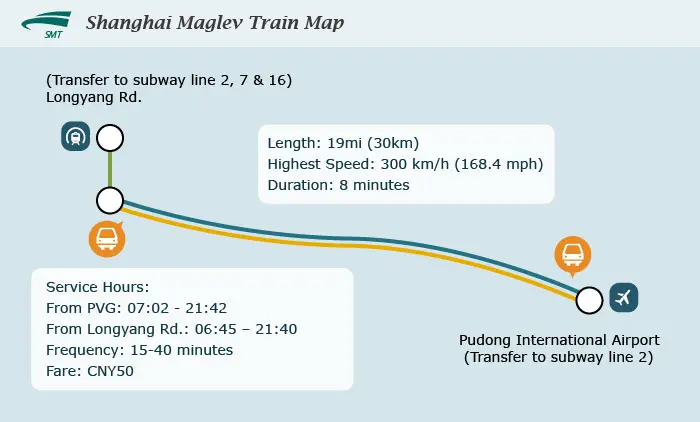
That does bring up a good point and a KEY advantage to Maglev... acceleration. The
Shanghai Maglev takes 3 minutes to reach 430km/h spends about 2 minutes at top speed and then decelerates. A conventional HSR train could NOT achieve 430km/h on a 30km track.
The L0-series Maglev running on the Yamanashi track (42.8 km ) regularly reaches cruising speed of 500km/h in 3 minutes and 15km:
https://www.youtube.com/watch?v=5CKwchJKTYU
Although, I've seen videos of it doing it
in about 75-80 seconds.
By comparison, The highest speed conventional rail record was in France at 574km/h but it was using a non-revenue beefed-up trainset the V150, pulling one carriage, going slightly downhill, along a 120km brand new piece of track... and it did it just once. I know it didn't accelerate the whole time, but still it would require a much longer track than 42km all the same.
It was a pretty impressive accomplishment, but meaningless in terms of actual real-world application. The track and wires needed work afterwards before putting trains on the track.
And herein lies Maglev's MAIN advantage... acceleration and deceleration. As doesn't rely on friction to propel or slow the train, it can accelerate much more quickly than conventional rail.
Trains make the
MOST difference when they're running at full speed.
ANYHOW... assuming the following:
Code:
+----------------------------------+--------+-----+
|                                  | Maglev | HSR |
+----------------------------------+--------+-----+
| Cruising Speed                   |    500 | 300 |
| Time to reach Cruising Speed (s) |    180 | 480 |
| Distance to cruising speed (km)  |     15 |  20 |
+----------------------------------+--------+-----+
a cruising speed of 500km/h is reached in 15km and 3 minutes that means:
Vancouver-Seattle ( 236km ) takes about
30 minutes on Maglev vs.
55 minutes on HSR.
Code:
+-----------------------------------+-------+--------------+-----------+
|              Segment              | Stops | Maglev (min) | HSR (min) |
+-----------------------------------+-------+--------------+-----------+
| Vancouver - Seattle               |     0 | 30.7         | 55.2      |
| Vancouver - BEL - EVE - Seattle   |     2 | 35.5         | 71.2      |
| VAC - SUR - BEL - MTV - EVE - SEA |     4 | 40.3         | 87.2      |
+-----------------------------------+-------+--------------+-----------+
Now you may think... so what's an extra 25 minutes. It's still faster than driving or flying. You'd be right... but apart from the obvious ( it's still almost twice as quick ), you'd be able to make more stops without affecting trip time as much. 4 stops moves HSR to almost 90 minutes... whereas Maglev still is about 40. I didn't calculate dwell times at stations... but that shouldn't change for each one... so you'd have add at LEAST 60 seconds for each stop ( realistically, 2–3 minutes in North America )
Also, this assumes full acceleration but in urban areas, we wouldn't have full acceleration, and Maglev pulls out ahead in these cases as well.
But why is Maglev cheaper? There are a few reasons.
1) Less maintenance is required.
Fewer moving parts means less track issues. No caternary wires to fix and maintain and replace.
2) Fewer trainsets. This is a big one.
If you're travelling in half the time, you're able to move more people with only 1 trainset. 90 minute service between Vancouver and Seattle could theoretically be done with 1 trainset including turn arounds.
You MIGHT even be able to get away with single-tracking the line into Vancouver. And considering any line that fast is likely to be tunneled for much of its length (The Chuo line will be 80% tunneled... partly due to having to tunnel through the Japanese Alps ), that's a huge cost savings.
Maglev is apparently much cheaper to operate ( like Skytrain is cheaper to operative due to the LIM motors ) but I guess we'll soon find out if it lives up to the hype in 2023 when the first intercity Maglev opens its doors between Tokyo and Nagoya.
Quote:
|
A Station in Surrey or Richmond somewhere would make sense to make car-to-HSR transport easier, getting to Pacific Central is a pain on a car.
|
Sure, it's a pain... but that's why you don't drive to the station. There's a SkyTrain station right out front. It's also a pain to get to and park at YVR, but people do it all the time... or they take SkyTrain.





 Prev
Prev



 Ambleside in particular, is a pain, with wealthy high-density buildings fronting the rail line.


 Linear Mode
