HomeDiagramsDatabaseMapsForum About
     

Go Back   SkyscraperPage Forum > Regional Sections > Canada > Alberta & British Columbia > Vancouver > Transportation & Infrastructure


Reply

 
Thread Tools Display Modes
     
     
  #1881  
Old Posted Jan 11, 2019, 10:14 PM
fredinno's Avatar
fredinno fredinno is offline
Registered User
 
Join Date: Jan 2012
Posts: 2,317
Quote:
Originally Posted by BCPhil View Post
If there is any change the WCE needs, it's more trains. That thing is packed every day leaving Waterfront. I haven't really been on the early trains, but the 5, 5:30 and 6:20 trains usually leave with every seat taken.

Not only is the WCE faster for a lot of downtown to suburb trips (especially if you are going to Port Coquitlam and beyond), but the level of comfort is unmatched on the rest of Translink. It's a premium service that attracts premium riders: people who have more than enough money to drive, and wouldn't be caught dead on Skytrain.


Walnut Grove does have a giant park and ride, with Express bus service direct to Lougheed station on HOV lanes with dedicated, direct exits. Pretty sweet.

It's funny how when we talk about Skytrain we are obsessed with TOD, but why not pair TOD and commuter/intercity rail as a conversation?

The long term promise of the Evergreen line might have encouraged planners in the Tri Cities to zone for high density, but without the WCE people would not have been as willing to buy into it.

People usually aren't interested sacrificing years of their lives on the hopes that promises will be fulfilled and they will have reliable transit. The WCE was an attractive service that allowed for TOD style development around WCE stations and planned Evergreen line stations for decades.

As great as the upgrades to the Sea to Sky are, it is still an unreliable road that can't handle much more traffic volume if there were a population boom in Squamish.

Squamish has a lot of developable land and is well situated to be a vibrant exurb/suburb of the lower Mainland. There is a decent local economy, and the proximity to winter sporting venues could make it an attractive location for University satellite campuses.

But you can't really start dropping thousands more people there without infrastructure. Further upgrading the highway could cost billions. Whereas decent speed intercity/commuter rail could be quite affordable.

If the service was extended to Whistler, then trains travelling regularly in both directions would serve commuters travelling to the city, Whistler workers living in Squamish, and tourists looking for an easy way to visit Sea to Sky.

In my opinion, waiting for there to be a problem before fixing it is the same as planning on people making poor decisions.

If we want more places for people to live in the region (like Squamish) then we have do things to encourage it, not hope people make a bad personal decision then reward their mistakes decades later with the infrastructure they always needed.

If we don't want to encourage and help people to live in places like Squamish, then the alternative is ever skyrocketing real estate prices or the consumption of more ALR lands.
Except there's studies on both Commuter Rail out to the Fraser Valley and Squamish, showing it to be an unprofitable service.

https://1drv.ms/b/s!AphyHYpEjmp-gppfX1FXQe7_SB5OOQ
https://1drv.ms/b/s!AphyHYpEjmp-gppgBou5Rp3HwtQQfw

That doesn't make it worthless, but Translink has only so much cash to burn, and it likes to make money, and there's the constant nagging from the municipality about their own preferred transit projects.

It's one of those things that gets stuck on the 'eh, maybe later' backburner as a result. Note that even very high ROI and cheap projects like the BMG are on the backburner.


I think the line to Whistler would actually be the first one to be built though, unprofitable or not, there's not much room to expand the Upper Levels at its narrowest point in North Van without destroying housing. That, and the connections across the Inlet, not the Sea-to-Sky, is the big limiting factor to Squamish's growth. Seabus needs to be turned into some sort of 3rd crossing.

So it becomes a necessity to divert people off the Freeway, regardless of profitability.


Abbotsford can do what Langley is trying with Carvloth once the HOV is extended there. Not possible under the NDP, but Gateway left provisions for its eventual extension. https://sfb.nathanpachal.com/2013/11/the-carvolth-neighbourhood-plan.html


TBH, not sure how well it's actually being followed, the area is developed as mid-density auto-oriented so far. It is a long-term plan, though. https://cb8de5fc-a-90652bf5-s-sites.goog...P69-aCmx_x5k18AjMAG7VImza&attredirects=1

Last edited by fredinno; Jan 11, 2019 at 11:48 PM.
Reply With Quote
     
     
  #1882  
Old Posted Jan 12, 2019, 6:52 PM
scryer scryer is offline
Registered User
 
Join Date: Feb 2014
Posts: 1,964
Quote:
I think the line to Whistler would actually be the first one to be built though, unprofitable or not, there's not much room to expand the Upper Levels at its narrowest point in North Van without destroying housing.
I would imagine that commuter rail to Whistler would be incredibly profitable and popular. So many tourists and locals would use it.... hell tourists would probably choose it over Rocky Mountaineer.
Reply With Quote
     
     
  #1883  
Old Posted Jan 13, 2019, 7:48 AM
twoNeurons twoNeurons is offline
loafing in lotusland
 
Join Date: Aug 2002
Location: Lotusland
Posts: 6,123
Quote:
Originally Posted by scryer View Post
I would imagine that commuter rail to Whistler would be incredibly profitable and popular. So many tourists and locals would use it.... hell tourists would probably choose it over Rocky Mountaineer.
Of course they would. The rocky mountaineer (Whistler Mountaineer) doesn’t do whistler return trips any longer. It’s just longer more expensive 3-4 days trips.

But that doesn’t mean a whistler commuter line makes sense or would be profitable. It might make sense to run a non-stop ski train as a trial in the winter 🥶 but even then, the station in Whistler isn’t even really that convenient. It’s too bad it’s not closer to the village.
Reply With Quote
     
     
  #1884  
Old Posted Jan 13, 2019, 8:18 AM
twoNeurons twoNeurons is offline
loafing in lotusland
 
Join Date: Aug 2002
Location: Lotusland
Posts: 6,123
Quote:
Originally Posted by fredinno View Post
Ok, I've been looking at the HSR report, and I can't reconcile myself with the fact that Maglev is somehow supposed to hit break-even before HSR despite its higher costs.

http://leg.wa.gov/JTC/Meetings/Documents...17%20Meeting/WSDOTUltraHighSpeedRail.pdf

Is Maglev going to attract that many more people?


Also, anyone have access to the detailed study?
Mag lev CAN be a game changer... and it does best to connect two cities directly with NO stops in between... just like airplanes. It’s funny how Bellingham residents don’t complain about hourly planes between YVR and SEA that skip over their city but if you tried to run rail past them they’d cry out that it wasn’t fair.

MOST people travel from city to city on HSR. The 285km line from Tokyo to Nagoya will have one station in each pf 4 prefectures (similar to a county). However it’s presumed 5 of the 6 trains per hour will run direct with NO stops (Currently MOST trains in the Tokaido line skip most stations).. Slowing down and accelerating to top speed of 505km/h, even for a fast acceleration Maglev still adds a not insignificant amount of time. More than you might think. I recall something like

A bullet train between Yokohama and Nagoya maxes out at 285km/h and non stop is 77 minutes. All stops (8 of them) add 60 minutes. And these trains are some of fastest accelerating trainsets currently in service and make stops usually no more than 60-90 seconds long.

If a line ever DID get built between Vancouver and Tacoma... (which is a similar distance as Tokyo Nagoya) stopping pattern to the new Chuo Maglev would have to be stations in Bellingham Everett and Seattle... but the majority of trains would be Vancouver to Seattle nonstop. I doubt a station at SeaTac would be built. Rather that’s for local transit.

Anyhow...the point of UHSR would be to replace air travel between the two cities... so the cities would have to have an established set of commuting already. SF - LA has this pattern already. Maglev would be a perfect fit for that corridor.
Reply With Quote
     
     
  #1885  
Old Posted Jan 13, 2019, 9:42 AM
fredinno's Avatar
fredinno fredinno is offline
Registered User
 
Join Date: Jan 2012
Posts: 2,317
Quote:
Originally Posted by scryer View Post
I would imagine that commuter rail to Whistler would be incredibly profitable and popular. So many tourists and locals would use it.... hell tourists would probably choose it over Rocky Mountaineer.
It would, but the WCE doesn't fully pay off its own operating costs as is. Probably partially due to sharing the rail lines with CN, but still.

That study I linked before showed that it wouldn't be profitable.

There's also the bottleneck of getting across the inlet, and the fact that the entire section of rail from Lions' Gate Bridge to Whistler is single-tracked. Space to build another track is limited, so you'd basically be building another track in the backyards of wealthy NIMBYs... Ambleside in particular, is a pain, with wealthy high-density buildings fronting the rail line.

Cut-and-cover would be possible (the line isn't used that much for cargo), and provide a compromise for those West Vancouverites who wanted to get rid of the rail line, but a pain for obvious cost reasons.

And leaving it without a second track is going to result in about 2h minimum frequency- assuming no cargo trains.

So it'd end up being more an option once the Upper Levels is expanded to its 6-lane maximum, to solve congestion in the North Shore.

Because after that, none of the options are cheap.

Quote:
Originally Posted by twoNeurons View Post
Of course they would. The rocky mountaineer (Whistler Mountaineer) doesn’t do whistler return trips any longer. It’s just longer more expensive 3-4 days trips.

But that doesn’t mean a whistler commuter line makes sense or would be profitable. It might make sense to run a non-stop ski train as a trial in the winter 🥶 but even then, the station in Whistler isn’t even really that convenient. It’s too bad it’s not closer to the village.
Is the Whistler Station even still around? I'm looking at the site on Lake Placid Dr. on Google Earth, and it's a gravel lot now. Either way, it looks like it was at a terrible location...


To get the station to Whistler Village, you'd have to cut a new Spur alongside 99 from Wayside Park- possible, but to build the station at Village Gate Blvd, you'd have to also relocate the Whistler Golf Course Parking Lot.

Though, there seems to only be space for one due to housing at Alta Vista, which would become a problem for its potential capacity.


Quote:
Originally Posted by twoNeurons View Post
Mag lev CAN be a game changer... and it does best to connect two cities directly with NO stops in between... just like airplanes. It’s funny how Bellingham residents don’t complain about hourly planes between YVR and SEA that skip over their city but if you tried to run rail past them they’d cry out that it wasn’t fair.

MOST people travel from city to city on HSR. The 285km line from Tokyo to Nagoya will have one station in each pf 4 prefectures (similar to a county). However it’s presumed 5 of the 6 trains per hour will run direct with NO stops (Currently MOST trains in the Tokaido line skip most stations).. Slowing down and accelerating to top speed of 505km/h, even for a fast acceleration Maglev still adds a not insignificant amount of time. More than you might think. I recall something like

A bullet train between Yokohama and Nagoya maxes out at 285km/h and non stop is 77 minutes. All stops (8 of them) add 60 minutes. And these trains are some of fastest accelerating trainsets currently in service and make stops usually no more than 60-90 seconds long.

If a line ever DID get built between Vancouver and Tacoma... (which is a similar distance as Tokyo Nagoya) stopping pattern to the new Chuo Maglev would have to be stations in Bellingham Everett and Seattle... but the majority of trains would be Vancouver to Seattle nonstop. I doubt a station at SeaTac would be built. Rather that’s for local transit.

Anyhow...the point of UHSR would be to replace air travel between the two cities... so the cities would have to have an established set of commuting already. SF - LA has this pattern already. Maglev would be a perfect fit for that corridor.
My question was about Maglev vs UHSR, because I didn't believe the 50mi/h difference would be that big a deal for the extra cost.


A Station in Surrey or Richmond somewhere would make sense to make car-to-HSR transport easier, getting to Pacific Central is a pain on a car.
Reply With Quote
     
     
  #1886  
Old Posted Jan 14, 2019, 9:41 PM
twoNeurons twoNeurons is offline
loafing in lotusland
 
Join Date: Aug 2002
Location: Lotusland
Posts: 6,123
Quote:
Originally Posted by fredinno View Post
Is the Whistler Station even still around? I'm looking at the site on Lake Placid Dr. on Google Earth, and it's a gravel lot now. Either way, it looks like it was at a terrible location...
The be clear, the Rocky Mountaineer still DOES STOP in Whistler. You just can't terminate a trip there. So, there's no CHEAP overnight trips to Whistler... which is a shame for locals.

Quote:
Originally Posted by fredinno View Post
My question was about Maglev vs UHSR
Maglev is kind of a technology umbrella term... and sometimes it's branded as UHSR...

There are different types of Maglev technology and not all are high-speed... but the currently used systems are EMS and EDS. Nagoya has an urban people mover that uses Magnetic attraction (EMS) with a max speed of 100 km/h. Shanghai also uses magnetic attraction (EMS) to levitate. EMS currently requires extremely tight tolerances of 1cm with a max design speed of 500km/h ( though Shanghai Maglev has a cruising speed of ~430km/h. ). It's always levitating at all speeds.

The Chuo line under construction between Tokyo and Nagoya uses Superconducting Magnets (EMS) and levitates at speeds over ~100km/h... but it levitates 10cm above track.

It's generally considered more complex and expensive, but Japan felt it was necessary due to the risk of earthquakes to have a little more buffer room than 1cm. This technology currently holds the record for the FASTEST train in the world. at 603km/h.
Quote:
... because I didn't believe the 50mi/h difference would be that big a deal for the extra cost.
So... I assume you mean the current speeds of 220mph (350km/h) vs. 270mph (434km/h) mentioned in that PDF. They're using the current cruising speed of the Shanghai Maglev for current speed.

The problem with that is that train is designed for a 500km/h cruising speed but it's limited by track length. The track between Shanghai and its airport is only 30 km long. It only takes 8 minutes to make the trip and it has to accelerate and decelerate in that time. Going faster would shave a few seconds off of that.
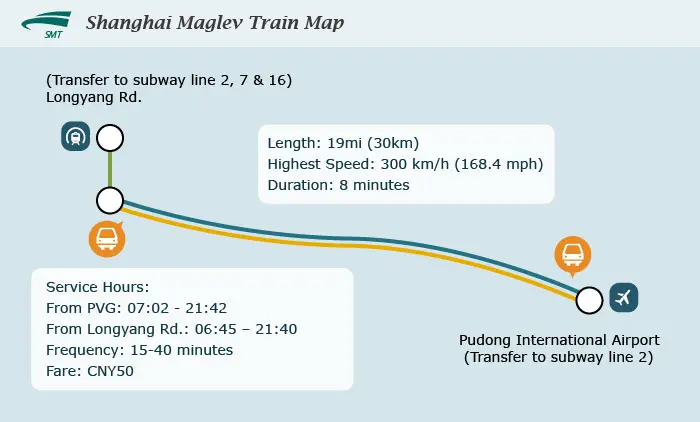

That does bring up a good point and a KEY advantage to Maglev... acceleration. The Shanghai Maglev takes 3 minutes to reach 430km/h spends about 2 minutes at top speed and then decelerates. A conventional HSR train could NOT achieve 430km/h on a 30km track.

The L0-series Maglev running on the Yamanashi track (42.8 km ) regularly reaches cruising speed of 500km/h in 3 minutes and 15km:
https://www.youtube.com/watch?v=5CKwchJKTYU

Although, I've seen videos of it doing it in about 75-80 seconds.

By comparison, The highest speed conventional rail record was in France at 574km/h but it was using a non-revenue beefed-up trainset the V150, pulling one carriage, going slightly downhill, along a 120km brand new piece of track... and it did it just once. I know it didn't accelerate the whole time, but still it would require a much longer track than 42km all the same.

It was a pretty impressive accomplishment, but meaningless in terms of actual real-world application. The track and wires needed work afterwards before putting trains on the track.

And herein lies Maglev's MAIN advantage... acceleration and deceleration. As doesn't rely on friction to propel or slow the train, it can accelerate much more quickly than conventional rail.

Trains make the MOST difference when they're running at full speed.

ANYHOW... assuming the following:
Code:
+----------------------------------+--------+-----+
|                                  | Maglev | HSR |
+----------------------------------+--------+-----+
| Cruising Speed                   |    500 | 300 |
| Time to reach Cruising Speed (s) |    180 | 480 |
| Distance to cruising speed (km)  |     15 |  20 |
+----------------------------------+--------+-----+
a cruising speed of 500km/h is reached in 15km and 3 minutes that means:
Vancouver-Seattle ( 236km ) takes about 30 minutes on Maglev vs. 55 minutes on HSR.
Code:
+-----------------------------------+-------+--------------+-----------+
|              Segment              | Stops | Maglev (min) | HSR (min) |
+-----------------------------------+-------+--------------+-----------+
| Vancouver - Seattle               |     0 | 30.7         | 55.2      |
| Vancouver - BEL - EVE - Seattle   |     2 | 35.5         | 71.2      |
| VAC - SUR - BEL - MTV - EVE - SEA |     4 | 40.3         | 87.2      |
+-----------------------------------+-------+--------------+-----------+
Now you may think... so what's an extra 25 minutes. It's still faster than driving or flying. You'd be right... but apart from the obvious ( it's still almost twice as quick ), you'd be able to make more stops without affecting trip time as much. 4 stops moves HSR to almost 90 minutes... whereas Maglev still is about 40. I didn't calculate dwell times at stations... but that shouldn't change for each one... so you'd have add at LEAST 60 seconds for each stop ( realistically, 2–3 minutes in North America )

Also, this assumes full acceleration but in urban areas, we wouldn't have full acceleration, and Maglev pulls out ahead in these cases as well.

But why is Maglev cheaper? There are a few reasons.
1) Less maintenance is required.

Fewer moving parts means less track issues. No caternary wires to fix and maintain and replace.

2) Fewer trainsets. This is a big one.

If you're travelling in half the time, you're able to move more people with only 1 trainset. 90 minute service between Vancouver and Seattle could theoretically be done with 1 trainset including turn arounds.

You MIGHT even be able to get away with single-tracking the line into Vancouver. And considering any line that fast is likely to be tunneled for much of its length (The Chuo line will be 80% tunneled... partly due to having to tunnel through the Japanese Alps ), that's a huge cost savings.

Maglev is apparently much cheaper to operate ( like Skytrain is cheaper to operative due to the LIM motors ) but I guess we'll soon find out if it lives up to the hype in 2023 when the first intercity Maglev opens its doors between Tokyo and Nagoya.

Quote:
A Station in Surrey or Richmond somewhere would make sense to make car-to-HSR transport easier, getting to Pacific Central is a pain on a car.
Sure, it's a pain... but that's why you don't drive to the station. There's a SkyTrain station right out front. It's also a pain to get to and park at YVR, but people do it all the time... or they take SkyTrain.

Reply With Quote
     
     
  #1887  
Old Posted Jan 15, 2019, 12:17 AM
fredinno's Avatar
fredinno fredinno is offline
Registered User
 
Join Date: Jan 2012
Posts: 2,317
Quote:
Originally Posted by twoNeurons View Post
The be clear, the Rocky Mountaineer still DOES STOP in Whistler. You just can't terminate a trip there. So, there's no CHEAP overnight trips to Whistler... which is a shame for locals.


Maglev is kind of a technology umbrella term... and sometimes it's branded as UHSR...

There are different types of Maglev technology and not all are high-speed... but the currently used systems are EMS and EDS. Nagoya has an urban people mover that uses Magnetic attraction (EMS) with a max speed of 100 km/h. Shanghai also uses magnetic attraction (EMS) to levitate. EMS currently requires extremely tight tolerances of 1cm with a max design speed of 500km/h ( though Shanghai Maglev has a cruising speed of ~430km/h. ). It's always levitating at all speeds.

The Chuo line under construction between Tokyo and Nagoya uses Superconducting Magnets (EMS) and levitates at speeds over ~100km/h... but it levitates 10cm above track.

It's generally considered more complex and expensive, but Japan felt it was necessary due to the risk of earthquakes to have a little more buffer room than 1cm. This technology currently holds the record for the FASTEST train in the world. at 603km/h.

So... I assume you mean the current speeds of 220mph (350km/h) vs. 270mph (434km/h) mentioned in that PDF. They're using the current cruising speed of the Shanghai Maglev for current speed.

The problem with that is that train is designed for a 500km/h cruising speed but it's limited by track length. The track between Shanghai and its airport is only 30 km long. It only takes 8 minutes to make the trip and it has to accelerate and decelerate in that time. Going faster would shave a few seconds off of that.


That does bring up a good point and a KEY advantage to Maglev... acceleration. The Shanghai Maglev takes 3 minutes to reach 430km/h spends about 2 minutes at top speed and then decelerates. A conventional HSR train could NOT achieve 430km/h on a 30km track.

The L0-series Maglev running on the Yamanashi track (42.8 km ) regularly reaches cruising speed of 500km/h in 3 minutes and 15km:
https://www.youtube.com/watch?v=5CKwchJKTYU

Although, I've seen videos of it doing it in about 75-80 seconds.

By comparison, The highest speed conventional rail record was in France at 574km/h but it was using a non-revenue beefed-up trainset the V150, pulling one carriage, going slightly downhill, along a 120km brand new piece of track... and it did it just once. I know it didn't accelerate the whole time, but still it would require a much longer track than 42km all the same.

It was a pretty impressive accomplishment, but meaningless in terms of actual real-world application. The track and wires needed work afterwards before putting trains on the track.

And herein lies Maglev's MAIN advantage... acceleration and deceleration. As doesn't rely on friction to propel or slow the train, it can accelerate much more quickly than conventional rail.

Trains make the MOST difference when they're running at full speed.

ANYHOW... assuming the following:
Code:
+----------------------------------+--------+-----+
|                                  | Maglev | HSR |
+----------------------------------+--------+-----+
| Cruising Speed                   |    500 | 300 |
| Time to reach Cruising Speed (s) |    180 | 480 |
| Distance to cruising speed (km)  |     15 |  20 |
+----------------------------------+--------+-----+
a cruising speed of 500km/h is reached in 15km and 3 minutes that means:
Vancouver-Seattle ( 236km ) takes about 30 minutes on Maglev vs. 55 minutes on HSR.
Code:
+-----------------------------------+-------+--------------+-----------+
|              Segment              | Stops | Maglev (min) | HSR (min) |
+-----------------------------------+-------+--------------+-----------+
| Vancouver - Seattle               |     0 | 30.7         | 55.2      |
| Vancouver - BEL - EVE - Seattle   |     2 | 35.5         | 71.2      |
| VAC - SUR - BEL - MTV - EVE - SEA |     4 | 40.3         | 87.2      |
+-----------------------------------+-------+--------------+-----------+
Now you may think... so what's an extra 25 minutes. It's still faster than driving or flying. You'd be right... but apart from the obvious ( it's still almost twice as quick ), you'd be able to make more stops without affecting trip time as much. 4 stops moves HSR to almost 90 minutes... whereas Maglev still is about 40. I didn't calculate dwell times at stations... but that shouldn't change for each one... so you'd have add at LEAST 60 seconds for each stop ( realistically, 2–3 minutes in North America )

Also, this assumes full acceleration but in urban areas, we wouldn't have full acceleration, and Maglev pulls out ahead in these cases as well.

But why is Maglev cheaper? There are a few reasons.
1) Less maintenance is required.

Fewer moving parts means less track issues. No caternary wires to fix and maintain and replace.

2) Fewer trainsets. This is a big one.

If you're travelling in half the time, you're able to move more people with only 1 trainset. 90 minute service between Vancouver and Seattle could theoretically be done with 1 trainset including turn arounds.

You MIGHT even be able to get away with single-tracking the line into Vancouver. And considering any line that fast is likely to be tunneled for much of its length (The Chuo line will be 80% tunneled... partly due to having to tunnel through the Japanese Alps ), that's a huge cost savings.

Maglev is apparently much cheaper to operate ( like Skytrain is cheaper to operative due to the LIM motors ) but I guess we'll soon find out if it lives up to the hype in 2023 when the first intercity Maglev opens its doors between Tokyo and Nagoya.


Sure, it's a pain... but that's why you don't drive to the station. There's a SkyTrain station right out front. It's also a pain to get to and park at YVR, but people do it all the time... or they take SkyTrain.

Ah, thanks. I don't know what happened to the station, though.


YVR is way easier to get to by car, though, the problem is the fact that all that car traffic from 91 and 99 is funnelled into Bridgeport and Sea Island Way.

One would wonder why a connection from Alderbridge Way to Dunsmuir Bridge has still not been made.


Pacific Central is only accessible from the Expo Line (the proposed Great Northern Way Millennium Line Station is still 15 minutes away from Pacific Central- not that convenient). You'd be funnelling everyone into a Skytrain Line that would start maxing out its ultimate theoretical maximum capacity (w/75s headways) by the 2060s-2070s, or a similar time scale to when this thing would actually be built.

Maybe you could build the station at the current location of the VPD tactical centre (so it's accessible from both the Expo and Millennium), or near Emily Carr, at Great Northern Way.


A station at Sapperton could offer a similar purpose, allowing people to transfer from the suburbs via bus from Hwy 1, as well.
Reply With Quote
     
     
  #1888  
Old Posted Jan 15, 2019, 3:32 AM
WestCoastEcho WestCoastEcho is offline
Registered User
 
Join Date: Jul 2018
Posts: 395
Quote:
Originally Posted by fredinno View Post
It would, but the WCE doesn't fully pay off its own operating costs as is. Probably partially due to sharing the rail lines with CN, but still.

That study I linked before showed that it wouldn't be profitable.

There's also the bottleneck of getting across the inlet, and the fact that the entire section of rail from Lions' Gate Bridge to Whistler is single-tracked. Space to build another track is limited, so you'd basically be building another track in the backyards of wealthy NIMBYs... Ambleside in particular, is a pain, with wealthy high-density buildings fronting the rail line.

Cut-and-cover would be possible (the line isn't used that much for cargo), and provide a compromise for those West Vancouverites who wanted to get rid of the rail line, but a pain for obvious cost reasons.

And leaving it without a second track is going to result in about 2h minimum frequency- assuming no cargo trains.

So it'd end up being more an option once the Upper Levels is expanded to its 6-lane maximum, to solve congestion in the North Shore.

Because after that, none of the options are cheap.
A tunnelled route for most of the journey won't fly with travellers, as part of the attraction of going to Squamish and Whistler is the scenic route while driving up the Sea to Sky Highway.

A rail route would at least have to replicate that somehow to draw customers.
Reply With Quote
     
     
  #1889  
Old Posted Jan 15, 2019, 7:51 AM
fredinno's Avatar
fredinno fredinno is offline
Registered User
 
Join Date: Jan 2012
Posts: 2,317
Quote:
Originally Posted by WestCoastEcho View Post
A tunnelled route for most of the journey won't fly with travellers, as part of the attraction of going to Squamish and Whistler is the scenic route while driving up the Sea to Sky Highway.

A rail route would at least have to replicate that somehow to draw customers.
At Ambleside? I never proposed tunneling all of it.
Reply With Quote
     
     
  #1890  
Old Posted Jan 15, 2019, 10:21 AM
officedweller officedweller is offline
Registered User
 
Join Date: Jul 2001
Location: Vancouver
Posts: 41,782
Quote:
Originally Posted by fredinno View Post
One would wonder why a connection from Alderbridge Way to Dunsmuir Bridge has still not been made.
That's Dinsmore Bridge, but agreed - it should be an easy connection to Alderbridge Way.
Reply With Quote
     
     
  #1891  
Old Posted Jan 15, 2019, 11:18 PM
Rico Rico is offline
Registered User
 
Join Date: Feb 2012
Posts: 319
Quote:
Originally Posted by fredinno View Post
Ah, thanks. I don't know what happened to the station, though.


YVR is way easier to get to by car, though, the problem is the fact that all that car traffic from 91 and 99 is funnelled into Bridgeport and Sea Island Way.

One would wonder why a connection from Alderbridge Way to Dunsmuir Bridge has still not been made.


Pacific Central is only accessible from the Expo Line (the proposed Great Northern Way Millennium Line Station is still 15 minutes away from Pacific Central- not that convenient). You'd be funnelling everyone into a Skytrain Line that would start maxing out its ultimate theoretical maximum capacity (w/75s headways) by the 2060s-2070s, or a similar time scale to when this thing would actually be built.

Maybe you could build the station at the current location of the VPD tactical centre (so it's accessible from both the Expo and Millennium), or near Emily Carr, at Great Northern Way.


A station at Sapperton could offer a similar purpose, allowing people to transfer from the suburbs via bus from Hwy 1, as well.
Nothing is ever straight forward. For a lot of people YVR is easy to get to with Skytrain, for others it really does not work. When the Millenium line connects to the Canada line the number of people who find the Canada line easy to get to YVR will go way up.
One reason to get going and build the Broadway skytrain line already that lots of people don't realize is that it will divert a lot of Expo line trips North of Broadway/Commercial. It is forecast to divert several thousand people per hour per direction North of Broadway/Commercial. That will go a long way to reducing congestion on the Expo line even without more or larger trains that will soon be coming.
Reply With Quote
     
     
  #1892  
Old Posted Jan 16, 2019, 1:36 AM
Sheba Sheba is online now
Registered User
 
Join Date: Jan 2015
Location: BC
Posts: 4,595
Quote:
Originally Posted by Rico View Post
One reason to get going and build the Broadway skytrain line already that lots of people don't realize is that it will divert a lot of Expo line trips North of Broadway/Commercial. It is forecast to divert several thousand people per hour per direction North of Broadway/Commercial. That will go a long way to reducing congestion on the Expo line even without more or larger trains that will soon be coming.

Of course there will be less people on the Expo Line in downtown Van once the Millennium and Canada lines meet. It's a no-brainer among people I've talked to.
Reply With Quote
     
     
  #1893  
Old Posted Jan 16, 2019, 8:25 AM
fredinno's Avatar
fredinno fredinno is offline
Registered User
 
Join Date: Jan 2012
Posts: 2,317
Quote:
Originally Posted by Rico View Post
Nothing is ever straight forward. For a lot of people YVR is easy to get to with Skytrain, for others it really does not work. When the Millenium line connects to the Canada line the number of people who find the Canada line easy to get to YVR will go way up.
One reason to get going and build the Broadway skytrain line already that lots of people don't realize is that it will divert a lot of Expo line trips North of Broadway/Commercial. It is forecast to divert several thousand people per hour per direction North of Broadway/Commercial. That will go a long way to reducing congestion on the Expo line even without more or larger trains that will soon be coming.
It's still not exactly wise to funnel people onto the Expo if you can avoid it.
Reply With Quote
     
     
  #1894  
Old Posted Jan 16, 2019, 7:05 PM
lokyin lokyin is offline
Registered User
 
Join Date: Jul 2003
Posts: 61
Hey guys, it looks like Washington State Department of Transportation is conducting a survey on the study for ultra high speed rail for Vancouver-Seattle-Portland. Might wanna complete it to support the Vancouver side of the project!

Survey Link: https://steer.sawtoothsoftware.com/cascadian/cgi-bin/ciwweb.pl
Survey Code: WSDOT
Reply With Quote
     
     
  #1895  
Old Posted Jan 17, 2019, 4:42 AM
swimmer_spe swimmer_spe is offline
BANNED
 
Join Date: Apr 2014
Posts: 10,743
For those thinking of Rocky Mountaineer doing anything for Whistler.... They do not even run in the winter.
Reply With Quote
     
     
  #1896  
Old Posted Jan 17, 2019, 8:01 PM
fredinno's Avatar
fredinno fredinno is offline
Registered User
 
Join Date: Jan 2012
Posts: 2,317
Quote:
Originally Posted by swimmer_spe View Post
For those thinking of Rocky Mountaineer doing anything for Whistler.... They do not even run in the winter.
Well, they better, otherwise, that ruins the point...
Reply With Quote
     
     
  #1897  
Old Posted Jan 18, 2019, 1:34 AM
aberdeen5698's Avatar
aberdeen5698 aberdeen5698 is offline
Registered User
 
Join Date: May 2010
Posts: 4,803
Quote:
Originally Posted by fredinno View Post
Well, they better, otherwise, that ruins the point...
You're completely missing the point of the Rocky Mountaineer. It's a sightseeing train, not a transportation service. It's like the difference between a cruise ship and a ferry.
Reply With Quote
     
     
  #1898  
Old Posted Jan 18, 2019, 4:40 AM
VancouverOfTheFuture's Avatar
VancouverOfTheFuture VancouverOfTheFuture is offline
Registered User
 
Join Date: Apr 2014
Posts: 3,481
the problem with a train to Whistler is it is too far from the Village/Hills to be super useful.
Reply With Quote
     
     
  #1899  
Old Posted Jan 18, 2019, 4:47 AM
swimmer_spe swimmer_spe is offline
BANNED
 
Join Date: Apr 2014
Posts: 10,743
Quote:
Originally Posted by VancouverOfTheFuture View Post
the problem with a train to Whistler is it is too far from the Village/Hills to be super useful.
It is about 500m to the Creakside base. I'd say that is pretty close. Also, there is transit that goes to the station area and throughout the town. If a regular train ran there, it could work, especially for the younger people or those who do not drive.
Reply With Quote
     
     
  #1900  
Old Posted Jan 18, 2019, 8:29 AM
fredinno's Avatar
fredinno fredinno is offline
Registered User
 
Join Date: Jan 2012
Posts: 2,317
Quote:
Originally Posted by aberdeen5698 View Post
You're completely missing the point of the Rocky Mountaineer. It's a sightseeing train, not a transportation service. It's like the difference between a cruise ship and a ferry.
Ah, read it wrong, I was still thinking about the commuter service.

Quote:
Originally Posted by VancouverOfTheFuture View Post
the problem with a train to Whistler is it is too far from the Village/Hills to be super useful.
There may be room for a spur to the Village along 99, next to the golf course.
Reply With Quote
     
     
This discussion thread continues

Use the page links to the lower-right to go to the next page for additional posts
 
 
Reply

Go Back   SkyscraperPage Forum > Regional Sections > Canada > Alberta & British Columbia > Vancouver > Transportation & Infrastructure
Forum Jump


Forum Jump


All times are GMT. The time now is 6:18 PM.


Powered by vBulletin® Version 3.8.7
Copyright ©2000 - 2026, vBulletin Solutions, Inc.