Quote:
Originally Posted by DenverInfill

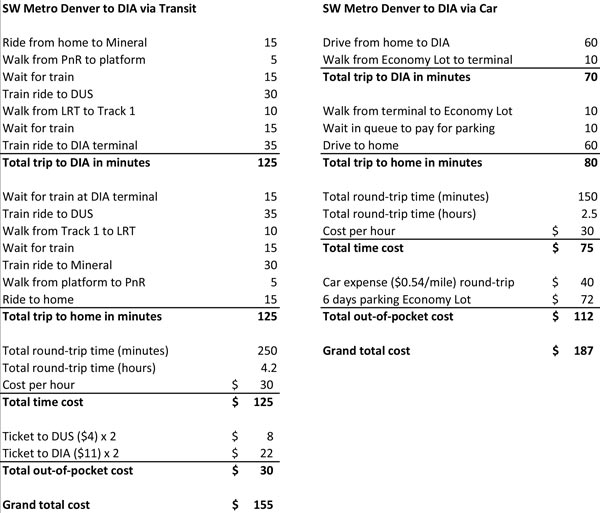
You're right, Wizened, in that the shorter the trip, the more advantageous driving is--from a cost perspective, with mostly the parking being the key variable.
Certainly, the analysis would change depending on the "home" starting point relative to DIA. There are also other adjustments. Parking in a Remote Shuttle Lot vs. the Economy Lot or in the Garage can add or decrease cost inversely to the time to get to the terminal, taking a tollway vs non-tolled roads, etc.
Another couple of variables on the transit side: With a bit of planning ahead or just getting lucky, one could arrive at the four transit stations and wait, say, only 5 minutes instead of the 15 minute average, slicing off 40 minutes of wait time. The opposite, of course, is true and you might arrive just minutes after a train had left. Also, if one has a monthly pass or an EcoPass, the transit cost is reduced to close to nothing (well, sort of). Lots of variables...
While everyone ultimately makes their own personal cost/benefit analysis on getting to DIA, one thing I think we can all agree on, is that the train gives people a really viable new choice; one that eliminates weather, accidents, and traffic congestion from the drive calculation, and one that is relatively safe, comfortable, and convenient. I've talked to a few people who have said that, due to their particular circumstances, they will rarely take the train to DIA, but that they LOVE the fact that they live in a city with that option.
|
The question is always time spent, weather, and, cost.
Time can slice both ways (the example I used is the quickest and best long distance run in Denver to this point- I am a train fan). For example, the C train does not run much of the day (another one of my gripes, which I believe is related to DUS Light having capacity problems in part) and when the traveler is returning there is a strong aggravation factor relating to having to transfer a 2nd time (E to Broadway, D to Mineral). Any transfer naturally adds to the aggravation factor and multiple transfers even more.
Weather cuts both ways, of course, as there are many days, particularly in the mornings and evenings, when the place is cold for the pedestrian. On cold morning and evenings when it is not snowing road travel to DIA is far preferable to standing outside 10 to 30 minutes. (There are relatively few days when driving is dangerous due to snow conditions). Rainy days, too, can be miserable for almost any light rail user waiting for a train, outside the DUS Light Station. Likewise, when it is hot- say 95 F, many will prefer to use their car (granted they will have to walk at least part of the distance to the terminal from the $12.00 parking lot even if they take the shuttle).
I think that the DIA line, particularly the interface to the airport could have been designed better as the approach into the terminal hinders the use of the DIA line by those who work for companies that have operations outside the terminal (a good bus interface for RTD or private buses to shuttle workers would have been nice. A partial remedy would be running such buses through the rent-a-car company shuttle bus approaches, but, then again, we are dealing with the transfer and time problem.) As it is, the DIA line will be a great way for those to commute to DIA who work at the terminal, if such workers receive a DIA line pass as part of their compensation.
I also believe that a serious mistake was made from a "sales" perspective- by not doing the simple upgrade to 110 mph from the terminal to the first street crossing. As the line is being built from scratch the additional costs- at least for that segment- would have been rather low. The one track segment pretty much eliminates this option.
I think that from a PR perspective a one stop train that stops at Peoria would be great on the DIA line. The great airport trains that exist today in Japan and China, if not express, have the express option, and, I believe international travelers will expect such service. (The issue is not the 5 or 6 minutes saved, but, the issue of an incoming traveling being considered "special." Numerous examples exist on Youtube.) This would demand one station, perhaps two, with same direction passing, which, IMO, should at least include Peoria. (Express service, Ken, is done world wide, and, the issue is not scheduling difficulties but the commitment.)
I do believe, Ken, that the key to making the DIA pay to better pay for itself (most airport lines are huge money losers, particularly when construction expense is amortized in addition to operating expenses) are the use of stations from Peoria west as commuter stations. This, IMO, needs to be developed as a separate piece from the airport access function, particular from the Peoria Station. I think that Peoria Station should have platform to platform boarding with west bound DIA traffic (a tunnel or pedestrian overpass would be nice), as well as an extra track or two to provide 7.5 minute or 15 minute frequencies over the segment to DUS. I think while the room is available this is critical. At the very least make the room for such options need to be made available long term. After all, based upon other longer distance downtown to airport train lines, most revenue is generated by ridership not going to the airport.
I would say that those who I interact with have mixed feelings about the DIA line. Those that are transit and train savvy, who have traveled outside of the US, know what good airport to downtown rail (and monorail) lines are and how good downtown stations function on a world wide basis, are having serious doubts.
I would say that my peers and I are warily optimist about the DIA line. No LOVE here, maybe a little, "Well, you know. That's just how Denver is."






 Prev
Prev




 Linear Mode
