HomeDiagramsDatabaseMapsForum About
     

Go Back   SkyscraperPage Forum > Regional Sections > United States > Mountain West


Reply

 
Thread Tools Display Modes
     
     
  #7161  
Old Posted Jun 17, 2014, 11:25 PM
DenverInfill's Avatar
DenverInfill DenverInfill is offline
mmmm... infillicious!
 
Join Date: Jan 2004
Location: Lower Highland, Denver
Posts: 3,357
Thanks, duderino, for your comments, and welcome to the forum!

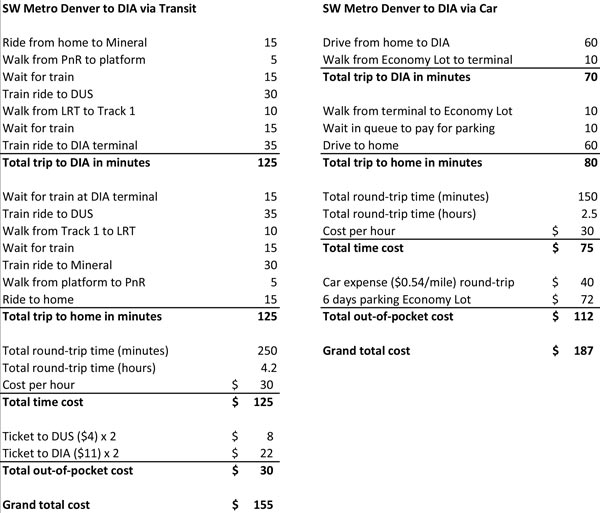
While a simple analysis, this is still a good exercise in comparing the options.

Wong--I agree that 60 minutes is pretty doable using the tollway, but the time savings is roughly offset by the tolls.

Let's talk intangibles.

The degree of variation in the 125 minute trip time via transit is pretty minimal, I'd say maybe up to 10%. Trains occasionally run late or have a stuck door or something that causes a delay, but you'd rarely see that 125 minute trip end up much longer than, say, 140 minutes.

Driving to DIA, however, is another story. I'd say the 60 minute trip time has a degree of variation anywhere up to 100%. A sudden downpoor or hailstorm, rain turning to ice or snow, a big accident, major rush-hour traffic, a flat tire... all of these things could easily turn that 60 minute trip to 1.5 or even 2 hours.

During the transit time, the transit rider can relax, review their vacation brochures, check their email, read a book, etc. The driver = zero productive time.

Regarding Wizened's intangible "costs" to transit: A) Irritation due to waiting for a train while toting luggage; B) Missing trains due to stoppages or bad memory; C) Fatigue... those are mostly silly.

Irritation while waiting for a train? I'd say driving for an hour on Denver's highways is a LOT more irritating than standing at a train platform for a few minutes. Missing your train? That's your own damn fault, not the fault of the train. Fatigue? Ever lug your baggage from the Economy Lot to the terminal? That's fatigue! By the way, the walking distance from the center of either the east or west economy lots is about twice the distance than it is from the LRT platforms to Track 1 at DUS.

Seems to me that, using this simple analysis, transit wins on both cost and intangibles, and that's from a part of the metro area farthest from the airport.
__________________
~ Ken

DenverInfill Blog
DenverUrbanism
Reply With Quote
     
     
  #7162  
Old Posted Jun 18, 2014, 1:18 AM
Wizened Variations's Avatar
Wizened Variations Wizened Variations is offline
Registered User
 
Join Date: Apr 2008
Posts: 1,611
Quote:
Originally Posted by DenverInfill View Post
I don't believe I made a math error. I think Wizened did in his original analysis.

Let's look at this in a straight-forward side-by-side cost tabulation:


I modified Wizened's assumptions slightly (which actually made it worse for transit). Transit still comes out ahead.
I admit defeat on my figures. I add the $60.00 saving for driving, which had already been discounted. This would have given me figures quite close to yours, around -$20.00.

Whoops. But, I do have somewhat of a come back, as we both made an assumption or two.

The length of time to Drive. We both assumed by our times that X lived either west or south of Mineral Station. Had the X driven 15 minutes west to get to the station, rather than east, the numbers will change, as the time to drive to DIA would intuitively decrease by 20 or so minutes each way.

This $15.00 or $20.00 reduction also affects mileage ($.54/mile).

Basically, using your example we have a series of fixed costs which do not change, and, variable costs related to distance, and to a lesser extent average speed.

Using all of your tables info, the break even point- where driving is cheaper than DIA route occurs when there is a reduction of more than $32 ($187-155 or $32). At $12.00/day flat rate the loss point occurs at 4th day and there after. Trips up to three days parking long are best served by the automobile.

Likewise, the break even point shifts as you decrease the distance. If you save 30 minutes driving time total, the break even point extends an extra day, i.e., loss point is 5 days rental under the above conditions.


Anyway, I appreciate your attention, and, as always will be vigilant.
__________________
Good read on relationship between increasing number of freeway lanes and traffic

http://www.vtpi.org/gentraf.pdf

Last edited by Wizened Variations; Jun 18, 2014 at 1:32 AM.
Reply With Quote
     
     
  #7163  
Old Posted Jun 18, 2014, 2:15 AM
DenverInfill's Avatar
DenverInfill DenverInfill is offline
mmmm... infillicious!
 
Join Date: Jan 2004
Location: Lower Highland, Denver
Posts: 3,357
You're right, Wizened, in that the shorter the trip, the more advantageous driving is--from a cost perspective, with mostly the parking being the key variable.

Certainly, the analysis would change depending on the "home" starting point relative to DIA. There are also other adjustments. Parking in a Remote Shuttle Lot vs. the Economy Lot or in the Garage can add or decrease cost inversely to the time to get to the terminal, taking a tollway vs non-tolled roads, etc.

Another couple of variables on the transit side: With a bit of planning ahead or just getting lucky, one could arrive at the four transit stations and wait, say, only 5 minutes instead of the 15 minute average, slicing off 40 minutes of wait time. The opposite, of course, is true and you might arrive just minutes after a train had left. Also, if one has a monthly pass or an EcoPass, the transit cost is reduced to close to nothing (well, sort of). Lots of variables...

While everyone ultimately makes their own personal cost/benefit analysis on getting to DIA, one thing I think we can all agree on, is that the train gives people a really viable new choice; one that eliminates weather, accidents, and traffic congestion from the drive calculation, and one that is relatively safe, comfortable, and convenient. I've talked to a few people who have said that, due to their particular circumstances, they will rarely take the train to DIA, but that they LOVE the fact that they live in a city with that option.
__________________
~ Ken

DenverInfill Blog
DenverUrbanism

Last edited by DenverInfill; Jun 18, 2014 at 2:26 AM.
Reply With Quote
     
     
  #7164  
Old Posted Jun 18, 2014, 4:21 AM
TakeFive's Avatar
TakeFive TakeFive is online now
Registered User
 
Join Date: Jun 2010
Posts: 8,398
bunt_q ... Is that you?

Quote:
Originally Posted by bunt_q View Post
I don't care about hail, I'm not that prissy and I drive a big already-ugly truck. Bring it, mother nature.
__________________
Cool... Denver has reached puberty.
Reply With Quote
     
     
  #7165  
Old Posted Jun 18, 2014, 11:52 AM
TakeFive's Avatar
TakeFive TakeFive is online now
Registered User
 
Join Date: Jun 2010
Posts: 8,398
Quote:
Originally Posted by enjo13 View Post
This!!! I fly out of DIA once or twice a week usually. I groan every time I end up on a flight that gets in between 4-6 PM (which is often). Getting back downtown can take anywhere from 45 minutes to better than an hour.
Worth noting is that shortly after the East Line to DIA starts rolling CDOT will be breaking ground on the Great $1.8 billion I-70 rebuild from Brighton Blvd. to Colorado Blvd. assuming funding etc.

Side Topic: Interesting to hear Adam Johnson's anecdotal reference this morning on Bloomberg Surveillance about how full the planes and the busy airline traffic in and out of DIA from his recent visit to Denver. The crew was discussing the health of the airlines.
__________________
Cool... Denver has reached puberty.
Reply With Quote
     
     
  #7166  
Old Posted Jun 18, 2014, 12:48 PM
Wizened Variations's Avatar
Wizened Variations Wizened Variations is offline
Registered User
 
Join Date: Apr 2008
Posts: 1,611
Quote:
Originally Posted by DenverInfill View Post
You're right, Wizened, in that the shorter the trip, the more advantageous driving is--from a cost perspective, with mostly the parking being the key variable.

Certainly, the analysis would change depending on the "home" starting point relative to DIA. There are also other adjustments. Parking in a Remote Shuttle Lot vs. the Economy Lot or in the Garage can add or decrease cost inversely to the time to get to the terminal, taking a tollway vs non-tolled roads, etc.

Another couple of variables on the transit side: With a bit of planning ahead or just getting lucky, one could arrive at the four transit stations and wait, say, only 5 minutes instead of the 15 minute average, slicing off 40 minutes of wait time. The opposite, of course, is true and you might arrive just minutes after a train had left. Also, if one has a monthly pass or an EcoPass, the transit cost is reduced to close to nothing (well, sort of). Lots of variables...

While everyone ultimately makes their own personal cost/benefit analysis on getting to DIA, one thing I think we can all agree on, is that the train gives people a really viable new choice; one that eliminates weather, accidents, and traffic congestion from the drive calculation, and one that is relatively safe, comfortable, and convenient. I've talked to a few people who have said that, due to their particular circumstances, they will rarely take the train to DIA, but that they LOVE the fact that they live in a city with that option.
The question is always time spent, weather, and, cost.

Time can slice both ways (the example I used is the quickest and best long distance run in Denver to this point- I am a train fan). For example, the C train does not run much of the day (another one of my gripes, which I believe is related to DUS Light having capacity problems in part) and when the traveler is returning there is a strong aggravation factor relating to having to transfer a 2nd time (E to Broadway, D to Mineral). Any transfer naturally adds to the aggravation factor and multiple transfers even more.

Weather cuts both ways, of course, as there are many days, particularly in the mornings and evenings, when the place is cold for the pedestrian. On cold morning and evenings when it is not snowing road travel to DIA is far preferable to standing outside 10 to 30 minutes. (There are relatively few days when driving is dangerous due to snow conditions). Rainy days, too, can be miserable for almost any light rail user waiting for a train, outside the DUS Light Station. Likewise, when it is hot- say 95 F, many will prefer to use their car (granted they will have to walk at least part of the distance to the terminal from the $12.00 parking lot even if they take the shuttle).

I think that the DIA line, particularly the interface to the airport could have been designed better as the approach into the terminal hinders the use of the DIA line by those who work for companies that have operations outside the terminal (a good bus interface for RTD or private buses to shuttle workers would have been nice. A partial remedy would be running such buses through the rent-a-car company shuttle bus approaches, but, then again, we are dealing with the transfer and time problem.) As it is, the DIA line will be a great way for those to commute to DIA who work at the terminal, if such workers receive a DIA line pass as part of their compensation.

I also believe that a serious mistake was made from a "sales" perspective- by not doing the simple upgrade to 110 mph from the terminal to the first street crossing. As the line is being built from scratch the additional costs- at least for that segment- would have been rather low. The one track segment pretty much eliminates this option.

I think that from a PR perspective a one stop train that stops at Peoria would be great on the DIA line. The great airport trains that exist today in Japan and China, if not express, have the express option, and, I believe international travelers will expect such service. (The issue is not the 5 or 6 minutes saved, but, the issue of an incoming traveling being considered "special." Numerous examples exist on Youtube.) This would demand one station, perhaps two, with same direction passing, which, IMO, should at least include Peoria. (Express service, Ken, is done world wide, and, the issue is not scheduling difficulties but the commitment.)

I do believe, Ken, that the key to making the DIA pay to better pay for itself (most airport lines are huge money losers, particularly when construction expense is amortized in addition to operating expenses) are the use of stations from Peoria west as commuter stations. This, IMO, needs to be developed as a separate piece from the airport access function, particular from the Peoria Station. I think that Peoria Station should have platform to platform boarding with west bound DIA traffic (a tunnel or pedestrian overpass would be nice), as well as an extra track or two to provide 7.5 minute or 15 minute frequencies over the segment to DUS. I think while the room is available this is critical. At the very least make the room for such options need to be made available long term. After all, based upon other longer distance downtown to airport train lines, most revenue is generated by ridership not going to the airport.

I would say that those who I interact with have mixed feelings about the DIA line. Those that are transit and train savvy, who have traveled outside of the US, know what good airport to downtown rail (and monorail) lines are and how good downtown stations function on a world wide basis, are having serious doubts.

I would say that my peers and I are warily optimist about the DIA line. No LOVE here, maybe a little, "Well, you know. That's just how Denver is."
__________________
Good read on relationship between increasing number of freeway lanes and traffic

http://www.vtpi.org/gentraf.pdf

Last edited by Wizened Variations; Jun 18, 2014 at 1:15 PM.
Reply With Quote
     
     
  #7167  
Old Posted Jun 18, 2014, 1:00 PM
bunt_q's Avatar
bunt_q bunt_q is offline
Provincial Bumpkin
 
Join Date: Aug 2002
Location: Denver, CO
Posts: 13,203
I think you put far too much emphasis on transfers. Especially on a suburb-to-suburb line. Those lines rarely do well even in the world's best transit cities. To think that Peoria will have any more than a handful of transfers seems to not follow the patterns we see basically anywhere else. And I expect (like everything else Denver does, relative to transit in other places) it'll be even worse here. The 225 line will be slow, very slow. It doesn't really have any worthwhile destinations. It'll take a very long time to get to Peoria. I am not sure what trip-types you see really utilizing the transfer, except for the occasional airport trip? I still think most downtown traffic (what little there is) will go south. With the reconfiguration away from Fitz, I think that'll generate very little ridership except for as an employment destination for some. So where are these transfers you predict coming from?
Reply With Quote
     
     
  #7168  
Old Posted Jun 18, 2014, 2:34 PM
Wizened Variations's Avatar
Wizened Variations Wizened Variations is offline
Registered User
 
Join Date: Apr 2008
Posts: 1,611
Quote:
Originally Posted by bunt_q View Post
I think you put far too much emphasis on transfers. Especially on a suburb-to-suburb line. Those lines rarely do well even in the world's best transit cities. To think that Peoria will have any more than a handful of transfers seems to not follow the patterns we see basically anywhere else. And I expect (like everything else Denver does, relative to transit in other places) it'll be even worse here. The 225 line will be slow, very slow. It doesn't really have any worthwhile destinations. It'll take a very long time to get to Peoria. I am not sure what trip-types you see really utilizing the transfer, except for the occasional airport trip? I still think most downtown traffic (what little there is) will go south. With the reconfiguration away from Fitz, I think that'll generate very little ridership except for as an employment destination for some. So where are these transfers you predict coming from?
I am somewhat optimistic for that segment of the DIA line from Peoria to DUS as well as about a 10 to 15 minute time distance segment of the I-225 light rail line. (This, regrettably, will be cover the shortest segment of the I-225, perhaps covering the segment from Aurora City Center to Peoria.) Likewise, I am somewhat optimistic for each of the Central Park, 40th and Colorado, and 38th and Blake Stations with the caveat that the time distance values decrease for each station west of Peoria (40th Ave Station being a less likely candidate due to positioning.)

I am not sure what the trip times will be into Denver from Peoria, Central Park, 40th and Colorado, and, the 38th and Blake Station will be, which complicates my off the cuff analysis. I do know that the Peoria Station, particularly if the I-225 line interface is designed correctly (I have doubts), is the sweet spot, due to the combination of distance from DUS and the I-225 feeder line. The I-225 line's 15 minute time distance includes Fitz, and, East Colfax. For buses, running the 15L to the Peoria Station would be ideal for 1 transfer to DIA or downtown, but even the Colfax station stop would be somewhat tolerable (2 transfers, YUCK). The key here would be beating the 40 minute bus commute time from Colfax to Civic Station if one were working near Civic Street Station and ~50 minutes, if one worked near DUS.

For stations closer to DUS than Peoria Station the key is where they work downtown. For those that work a total of, say, 10 minutes from DUS, then one time distance limitation might a considered; for those working near Civic Station another. For the extreme example, passengers going to DUS from the 38th and Blake Station will need to consider whether to use the extended Central Rail line if the time distance from the 38th and Blake Station plus the time distance from the 16th Street Station is less than from DUS plus the to DUS time distance.

Basically, Bunt, there appear to be two sets of metrics that determine the time distance for commuters to DUS who use the DIA for all or part of their commute: the time required to get to their offices from either the Civic Street or DUS station. Those that are closer to Civic Street Station will have to deal with extra time from DUS, and, visa versa. This time element and number of transfers within this time distance factor become increasingly important the closer the east side commuter is to downtown.

Hopefully, the train will average 40 mph from Peoria into DUS. The slower the average speed, the shorter the time distance to each station is for all of these stations.

As I said, I am somewhat optimistic.

After thought: IMO, the dogleg to the Aurora City Center was primarily a politically inspired design. I think, too, that the running time from the 2nd and Abilene Station could have been improved. These two segments destroy I-225 line's average speed.
__________________
Good read on relationship between increasing number of freeway lanes and traffic

http://www.vtpi.org/gentraf.pdf

Last edited by Wizened Variations; Jun 18, 2014 at 2:59 PM.
Reply With Quote
     
     
  #7169  
Old Posted Jun 18, 2014, 3:24 PM
Wizened Variations's Avatar
Wizened Variations Wizened Variations is offline
Registered User
 
Join Date: Apr 2008
Posts: 1,611
Quote:
Originally Posted by bunt_q View Post
I think you put far too much emphasis on transfers. Especially on a suburb-to-suburb line. Those lines rarely do well even in the world's best transit cities.
Transfers are known anger points for users worldwide. Transferring and waiting create even more angst than slow orders, as a rule.

Transfer points have to be extremely well designed to minimize ridership anger, and, to encourage ridership.

The rules are simple:

1. Minimize the number of them
2. When a transfer point is created, give the rider the maximum number of transfer options. A classic example of a poorly designed (for whatever reason) transfer point is the W and Auraria Westlight rail station, where no connection without an additional transfer exists to go to the 30th and Downing line.
3. Make the physical transfer as easy as possible, through platform level boarding, platform to platform transfer, and, shortest walking distance (the most efficient transfer points are stacked X double tracks, with connecting escalators world wide.)
4. Synchronize train schedules to handle a bit lower than average pedestrian time distances between transfer locations. Ideally, in a stacked station for example, such schedules should be 3 or 4 minutes apart between trains on different levels of the stack, with the train with the more frequent schedule arriving before the train with the less frequent schedule.
__________________
Good read on relationship between increasing number of freeway lanes and traffic

http://www.vtpi.org/gentraf.pdf
Reply With Quote
     
     
  #7170  
Old Posted Jun 18, 2014, 11:29 PM
bunt_q's Avatar
bunt_q bunt_q is offline
Provincial Bumpkin
 
Join Date: Aug 2002
Location: Denver, CO
Posts: 13,203
Quote:
Originally Posted by Wizened Variations View Post
I think that carless young adults will increasingly take the bus, once more realize just how affordable short distance travel is on a bus.
Young people aren't going to do anything that requires them to have $2.25 in cash sitting in their pockets.

Quote:
Originally Posted by Wizened Variations View Post
(Branded bus, etc., show be directed to those people who need a bus to travel light rail stop distances. I imagine a "0x" bus that would stop maybe 6 or seven times between Civic Station and the Highlands Ranch terminus, including stops at Broadway Light Rail. Have the local 0 serve stations such as Evans, and Englewood.)
Isn't that exactly what the 0L does today? Branding isn't going to get you anywhere, though, if you don't have the frequency to back it up. I made the mistake of trying the 0L once. On a map, it seems like the perfect route - it terminates at my office door, for crying out loud. Except it runs like three times per day or something absurd.

Branding is like TOD - you don't create demand from thin air just by doing it. You take pre-existing demand and make it work even better and grow it.
Reply With Quote
     
     
  #7171  
Old Posted Jun 19, 2014, 12:55 AM
PLANSIT's Avatar
PLANSIT PLANSIT is offline
ColoRADo
 
Join Date: May 2004
Location: Denver
Posts: 2,317
Quote:
Originally Posted by bunt_q View Post
Young people aren't going to do anything that requires them to have $2.25 in cash sitting in their pockets.


Isn't that exactly what the 0L does today? Branding isn't going to get you anywhere, though, if you don't have the frequency to back it up. I made the mistake of trying the 0L once. On a map, it seems like the perfect route - it terminates at my office door, for crying out loud. Except it runs like three times per day or something absurd.

Branding is like TOD - you don't create demand from thin air just by doing it. You take pre-existing demand and make it work even better and grow it.

Runs 24 times a day in the peak hour.
Reply With Quote
     
     
  #7172  
Old Posted Jun 19, 2014, 2:11 AM
Cirrus's Avatar
Cirrus Cirrus is offline
cities|transit|croissants
 
Join Date: Jul 2001
Location: Washington, DC
Posts: 18,718
Quote:
Originally Posted by bunt_q View Post
Young people aren't going to do anything that requires them to have $2.25 in cash sitting in their pockets.
You're right. But smart cards eliminate that problem.
__________________
writing | twitter | bluesky | flickr | instagram | ssp photo threads
Reply With Quote
     
     
  #7173  
Old Posted Jun 19, 2014, 2:27 AM
bunt_q's Avatar
bunt_q bunt_q is offline
Provincial Bumpkin
 
Join Date: Aug 2002
Location: Denver, CO
Posts: 13,203
Quote:
Originally Posted by PLANSIT View Post
Runs 24 times a day in the peak hour.
Not to the end of line it doesn't. That's only to I-25 and Broadway. Are we so downtown-centric on here now that there be dragons... in... Platt Park? For the 99% of people who live farther out than that, it runs 3 times per day. (Reverse peak), 6 or 7 times peak direction. And Wizened was talking about Highlands Ranch.
Reply With Quote
     
     
  #7174  
Old Posted Jun 19, 2014, 2:28 AM
bunt_q's Avatar
bunt_q bunt_q is offline
Provincial Bumpkin
 
Join Date: Aug 2002
Location: Denver, CO
Posts: 13,203
Quote:
Originally Posted by Cirrus View Post
You're right. But smart cards eliminate that problem.
True, but we will have warp drive before RTD figures out how to roll that out.
Reply With Quote
     
     
  #7175  
Old Posted Jun 19, 2014, 1:52 PM
Wizened Variations's Avatar
Wizened Variations Wizened Variations is offline
Registered User
 
Join Date: Apr 2008
Posts: 1,611
Quote:
Originally Posted by bunt_q View Post
true, but we will have warp drive before rtd figures out how to roll that out.
A Canuck from Alberta who spoke Russian as 2nd language once told me that the most mysterious aspect about working in Russia during the Soviet years was accepting the reality of how so many brilliant people working together could be so mediocre. He continually was struck by the thoughtfulness, the quick wittedness, and, the logical abilities of individuals, and, confounded by how these very talented people working together were a bland collection of "yes men."
__________________
Good read on relationship between increasing number of freeway lanes and traffic

http://www.vtpi.org/gentraf.pdf
Reply With Quote
     
     
  #7176  
Old Posted Jun 19, 2014, 2:29 PM
wong21fr's Avatar
wong21fr wong21fr is offline
Reluctant Hobbesian
 
Join Date: Feb 2002
Location: Denver
Posts: 13,120
Quote:
Originally Posted by bunt_q View Post
True, but we will have warp drive before RTD figures out how to roll that out.
Gah, is that ever true.
__________________
"You don't strike, you just go to work everyday and do your job real half-ass. That's the American way!" -Homer Simpson

All of us who are concerned for peace and triumph of reason and justice must be keenly aware how small an influence reason and honest good will exert upon events in the political field. ~Albert Einstein

Reply With Quote
     
     
  #7177  
Old Posted Jun 19, 2014, 2:51 PM
RyanD's Avatar
RyanD RyanD is offline
Fast. Fun. Frequent.
 
Join Date: Aug 2010
Location: Denver, Colorado
Posts: 2,988
If we figure out warp drives / interstellar space travel, and start colonizing other worlds before RTD figures out the smart card system, I'm not really going to care about smart cards.

I'm going to be focused on building a kick ass transit system on Kepler-186f. You'll pay with the implant in your wrist. None of this card stuff, too easy to lose.
__________________
DenverInfill
DenverUrbanism
--------------------
Latest Photo Threads: Los Angeles | New Orleans | Denver: 2014 Megathread | Denver Time-Lapse Project For more photos check out: My Website and My Flickr Photostream
Reply With Quote
     
     
  #7178  
Old Posted Jun 19, 2014, 3:25 PM
Wizened Variations's Avatar
Wizened Variations Wizened Variations is offline
Registered User
 
Join Date: Apr 2008
Posts: 1,611
Quote:
Originally Posted by bunt_q View Post
Isn't that exactly what the 0L does today? Branding isn't going to get you anywhere, though, if you don't have the frequency to back it up. I made the mistake of trying the 0L once. On a map, it seems like the perfect route - it terminates at my office door, for crying out loud. Except it runs like three times per day or something absurd.

Branding is like TOD - you don't create demand from thin air just by doing it. You take pre-existing demand and make it work even better and grow it.
Yes that would be the Ox The route is designed primarily to be an express from Hampden north that serves buses on cross streets. The three tweaks the route needs, IMO, would be to eliminate the Streets at Southglenn terminus*, end the route at the Mineral Station instead, and, extend express service to the Mineral Station. Run the OL more frequently- do the develop demand method used by RTD to build traffic on the W light rail line (a different color scheme- maybe a big decal on the front of the bus to let local bus riders see at a distance that this is the OL bus that likely will not stop for them).

As to responding to demand and creating demand.

That is a tough question to answer. I do know that the essence of advertising a new product often is to "educate" (through persistent low level messages) target markets into thinking that that the product is essential. Mass marketers try to use surveys to narrow down the demographic targeted, but, in the end, advertising often has to be used to create the demand. Run the buses more often- do the developing the market technique RTD is using for building traffic on the W light rail line.

A problem with bus route design and scheduling (this applies to all public transportation) is that user demand is defined "looking down", much in the manner that city planners "look down" at a map. Potential demand might be color coded on a map, and, a large scale view created to define demographics and probabilities of use. However, IMO, as I have brought up in other contexts, such methodologies does not spend enough time on the "street" at eye level. Bus usage on the street level is defined by pedestrians whose movements vary based upon a local matrix of human needs. Functions such as shopping for food and carrying the food home interact with how much of the total travel distance must be walked.

For example, your work space fits into a movement space on Broadway that has it's own matrix of potential bus riders. As you have an office on or near Broadway and are located north of Belleview, the sidewalks in front of your office facility have street traffic. This street traffic consists of worker bees that work in the area , shoppers, clients, wholesale suppliers, restaurant users, the bar bunch, the lower class with their own domiciles, commuters returning to residences from other work locations, and, street people without legal residences.

This complexity extends the length of Broadway (or Colfax or Federal, etc.) and the matrix of these variables changes as one travels the length of the street.**

Frankly, I believe that not enough footwork is done to define potential ridership demand on public transportation demand. Surveys along don't cut it as walking the length of a street like Broadway a few times at different hours and riding the bus (talk to the drivers) will do more good than a slew of surveys.

*Create a 24L

**Split the length of Broadway into 2 halves. On each end of the defined segments have a person down the street towards the person walking towards him or her from the other end. Take a lot of pictures. Walk into stores and talk with proprietors and sales people. Walk into offices and just ask about how business is and get people's feelings about the "street." Do this at multiple times of day a few times.
__________________
Good read on relationship between increasing number of freeway lanes and traffic

http://www.vtpi.org/gentraf.pdf

Last edited by Wizened Variations; Jun 19, 2014 at 3:37 PM.
Reply With Quote
     
     
  #7179  
Old Posted Jun 19, 2014, 4:43 PM
balugajames balugajames is offline
Registered User
 
Join Date: Apr 2012
Posts: 158
As someone who often picks people up from the airport. That will cease once the train is complete. Ill drop them off and pick them up from downtown instead. Much quicker.
Reply With Quote
     
     
  #7180  
Old Posted Jun 19, 2014, 5:24 PM
PLANSIT's Avatar
PLANSIT PLANSIT is offline
ColoRADo
 
Join Date: May 2004
Location: Denver
Posts: 2,317
Quote:
Originally Posted by balugajames View Post
As someone who often picks people up from the airport. That will cease once the train is complete. Ill drop them off and pick them up from downtown instead. Much quicker.
This will be a huge component. Kiss-n-ride, taxi, Uber/Lyft, etc will provide the "Last/First Mile" connection. And it will happen at several of the stations on the East Line. Not just DUS. Big ones probably include 40th/Colorado, Central Park, Peoria and 40th/Airport. Some of those will also provide long-term parking options. Something that Central Park already provides and is heavily used.
Reply With Quote
     
     
This discussion thread continues

Use the page links to the lower-right to go to the next page for additional posts
 
 
Reply

Go Back   SkyscraperPage Forum > Regional Sections > United States > Mountain West
Forum Jump


Forum Jump


All times are GMT. The time now is 4:10 PM.


Powered by vBulletin® Version 3.8.7
Copyright ©2000 - 2026, vBulletin Solutions, Inc.