HomeDiagramsDatabaseMapsForum About
     

Go Back   SkyscraperPage Forum > Regional Sections > United States > Texas & Southcentral > Austin


Reply

 
Thread Tools Display Modes
     
     
  #1161  
Old Posted Feb 3, 2009, 4:15 PM
alexjon's Avatar
alexjon alexjon is offline
Bears of antiquity
 
Join Date: Dec 2005
Location: Downtown/First Hill, Seattle, WA
Posts: 8,160
Quote:
Originally Posted by rhoby13 View Post
I'm so confused...What are we even arguing about now?
M1EK is mad that Austin won't ever have LRT.
__________________
"The United States is in no way founded upon the Christian religion." -- George Washington & John Adams in a diplomatic message to Malta
Reply With Quote
     
     
  #1162  
Old Posted Feb 3, 2009, 4:50 PM
Saddle Man Saddle Man is offline
Registered User
 
Join Date: Aug 2005
Posts: 1,149
Keep going M1EK.
Reply With Quote
     
     
  #1163  
Old Posted Feb 4, 2009, 6:47 AM
KevinFromTexas's Avatar
KevinFromTexas KevinFromTexas is offline
Meh
 
Join Date: Jul 2001
Location: Austin,TX<-->Dripping Springs,TX<-->Birmingham, AL<-->Warm Springs,GA
Posts: 57,054
I moved the airline posts to the ABIA update thread.

http://forum.skyscraperpage.com/showthread.php?t=140690
__________________
My girlfriend has a poodle named Kevin.
Reply With Quote
     
     
  #1164  
Old Posted Feb 4, 2009, 9:13 AM
electricron's Avatar
electricron electricron is offline
Registered User
 
Join Date: Aug 2008
Location: Granbury, Texas
Posts: 3,611
Lightbulb

Quote:
Originally Posted by M1EK View Post
electricon insists that DMUs are the way to go - because they're cheap - even though they can't run directly to where people actually want to go, thus requiring transfers, which, my argument, hardly any choice commuters will tolerate, since we're not and never will be Manhattan.

He insists Austin could never have afforded light rail and can't now, despite the fact that the 2000 LRT proposal had a valid financing plan that matched what other successful light rail starts of similar vintage had managed to achieve.

Both he and alexjon insist that streetcars running in shared guideway are good enough to fill in the gaps (to hit the parts of town that any saner city would have served FIRST with rail transit). Which, for anybody who has ridden a bus by UT knows, is ludicrous. SecretAgentMan, who insists he knows lots of stuff that I don't but won't identify himself while in the process of attacking my credibility, at least appears to understand that shared-lane operation there would be incredibly stupid.
I never wrote that CapMetro couldn't afford light rail. I wrote and meant that CapMetro couldn't afford 30+ miles of light rail.

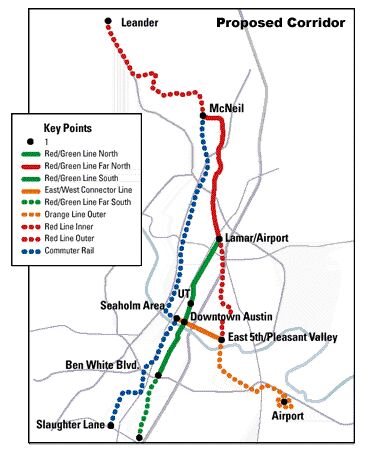
The original proposal for light rail ran 8+ miles on the then Green Line. Half of that was south of the Colorado River, so it only proceeded north around 4 miles. Not even as far out as Austin's city limits, the 2000 Green Line only reached as far north as Lamar and Airport, not even to US 183. And some are surprised why the northern and eastern suburbs declined to vote for it?
http://www.lightrailnow.org/features/f_aus006.htm


The only changes to CapMetro's 2000 plans have been is to drop the Green Line completely, and build the Red and connecting Orange line using light Stadler GTW DMUs vs using light rail on the existing CapMetro owned ROW. That is, drop the first rail line corrridor choice and choose the second rail line corridor to be built first. I've suggested building the 2000 Green Line using streetcars in shared lanes in city streets vs using light rail, because it is cheaper, the 2000 Green Line is fairly short, and streetcars are easier to fit into existing narrow streets and counter-corner intersections.

Even the City of Austin, in its latest streetcar proposals has dropped the Green Line, now instead Austin favors building the streetcar line up San Jacinto to the new Mueller development first, then another to the Airport along Riverside second.

CapMetro's plans next building another completely different Green Line to Manor and possibly to Elgin using Stadler GTW DMUs again.

The Blue Line in the drawing is Austin-San Antonio's commuter rail project that so far has no capacity to lay a tax to raise any funds. Presently, they're hoping Amtrak might initiate some more service than the existing twice a day (one train north and south) Texas Eagle.
2009 possible expansion map:

Last edited by electricron; Feb 4, 2009 at 9:23 AM.
Reply With Quote
     
     
  #1165  
Old Posted Feb 4, 2009, 3:20 PM
M1EK's Avatar
M1EK M1EK is offline
Registered User
 
Join Date: Jul 2006
Posts: 2,194
electricron, you are posting from a position of ignorance again.

The city of Austin brought forth the CAMPO TWG plan because they understand that streetcars running in shared lanes are useless for commuters - and we can no longer justify taking away lanes on Guadalupe when the prospective ridership is now much lower (not as many people would be willing to transfer from commuter rail to LRT as would have been willing to take LRT all the way in; to say nothing of the fact that commuter rail's max capacity is far lower). Had we the option of taking lanes on Guadalupe, we'd be doing that instead - the city has 'dropped' precisely nothing. In fact, the original Rapid Bus proposal for this corridor was blocked by our City Council members who wanted to preserve the option of rail here instead.

The councilmembers I have talked to, as well as everybody local who understands transit, knows that the original Green Line is the most important transit corridor in the city, period. All of the current density and almost all of the likely future density in our city is on that corridor, not the useless DMU line.

The CAMPO TWG plan can optimistically be viewed as an attempt to eventually get there with reserved-guideway streetcar after building strong ridership from the south and east which may eventually be high enough to justify taking lanes. The key difference between this and Capital Metro's awful original circulator proposal is that the city pushed hard for reserved guideway, and for the construction of the East Riverside branch to bring in some commuters in what some euphemistically call 'line-haul' service - because the city knows, as I do, that a line which just tries to circulate DMU passengers is a waste of time. That's all Capital Metro's original proposal did - it ran from Mueller past one Red Line station, through downtown, and then stopped at the other Red Line station and Seaholm. And Mueller even at build-out doesn't have remotely as many people as East Riverside does now, to say nothing of down the road.

Streetcar in shared lane on Guadalupe near UT would just be a pretty, parked, bus. You have precisely no clue what you're talking about.

As for the vote in 2000, again, it passed in the city of Austin, in a rigged election (forced upon Capital Metro before they were completely ready by Mike Krusee in a successful attempt to torpedo it even though most of his constituents weren't in the service area and hence didn't pay taxes). Don't attempt to rewrite history when you weren't here the first time.
Reply With Quote
     
     
  #1166  
Old Posted Feb 4, 2009, 7:42 PM
electricron's Avatar
electricron electricron is offline
Registered User
 
Join Date: Aug 2008
Location: Granbury, Texas
Posts: 3,611
Lightbulb

Quote:
Originally Posted by M1EK View Post
electricron, you are posting from a position of ignorance again.

The city of Austin brought forth the CAMPO TWG plan because they understand that streetcars running in shared lanes are useless for commuters - and we can no longer justify taking away lanes on Guadalupe when the prospective ridership is now much lower (not as many people would be willing to transfer from commuter rail to LRT as would have been willing to take LRT all the way in; to say nothing of the fact that commuter rail's max capacity is far lower). Had we the option of taking lanes on Guadalupe, we'd be doing that instead - the city has 'dropped' precisely nothing. In fact, the original Rapid Bus proposal for this corridor was blocked by our City Council members who wanted to preserve the option of rail here instead.

The councilmembers I have talked to, as well as everybody local who understands transit, knows that the original Green Line is the most important transit corridor in the city, period. All of the current density and almost all of the likely future density in our city is on that corridor, not the useless DMU line.

The CAMPO TWG plan can optimistically be viewed as an attempt to eventually get there with reserved-guideway streetcar after building strong ridership from the south and east which may eventually be high enough to justify taking lanes. The key difference between this and Capital Metro's awful original circulator proposal is that the city pushed hard for reserved guideway, and for the construction of the East Riverside branch to bring in some commuters in what some euphemistically call 'line-haul' service - because the city knows, as I do, that a line which just tries to circulate DMU passengers is a waste of time. That's all Capital Metro's original proposal did - it ran from Mueller past one Red Line station, through downtown, and then stopped at the other Red Line station and Seaholm. And Mueller even at build-out doesn't have remotely as many people as East Riverside does now, to say nothing of down the road.

Streetcar in shared lane on Guadalupe near UT would just be a pretty, parked, bus. You have precisely no clue what you're talking about.

As for the vote in 2000, again, it passed in the city of Austin, in a rigged election (forced upon Capital Metro before they were completely ready by Mike Krusee in a successful attempt to torpedo it even though most of his constituents weren't in the service area and hence didn't pay taxes). Don't attempt to rewrite history when you weren't here the first time.
If a streetcar on Guadalupe will be in effect a parked bus, so would light rail trains. Dedicated lanes don't turn traffic signals green sooner by themselves. Traffic signal priority can be had whether the light rail trains or streetcars are in dedicated or shared lanes.

And I agree streetcars are useless for commuters from the suburbs. But neither did the original proposed 2000 Light Rail Green Line that never went to the suburbs. To be useful for commuters, the train has to get to the suburbs, and go further than 4 miles north of downtown Austin!


Dart's Red and Blue Line light rail trains are full, beyond seating capacity, before leaving the suburbs. I doubt they would be as full if they never reached the suburbs.
Reply With Quote
     
     
  #1167  
Old Posted Feb 4, 2009, 7:57 PM
hookem hookem is offline
Registered User
 
Join Date: Apr 2007
Posts: 1,565
Jumping off the train topic briefly, I have a silly question. I'm sure there is some obvious answer, but maybe the Austin transportation experts can give me the definitive word.

Why isn't there at least 1 bus that runs along 360?

Now, I understand that much of that corridor isn't city of Austin, and the residents probably would never use the bus... but there are millions of square feet of office space along 360, and AFAIK all of it is meant as offices for people (not manufacturing/warehouse etc). So there has to be 10s of thousands of people who work off 360 and live in Austin or other areas served by Capital Metro (the workers far outnumber the actual residents along the corridor, by my estimation). Wouldn't it be beneficial to at least run a bus along the route for commuters? I know traffic is terrible during rush hour, but a bus with wifi for people to work... It would be filled every work day. And on the weekend, when traffic is dramatically less, it could be a great "shopping route" that connects The Domain, Arboretum, and Barton Creek Mall -- all to benefit people who are in the Capital Metro service area.

So what's stopping them from running a bus there? Is it not legal or something? Does 360 have some weight/size limit? Can neighborhoods somehow stop it, and that's what they are afraid of?
Reply With Quote
     
     
  #1168  
Old Posted Feb 4, 2009, 8:25 PM
M1EK's Avatar
M1EK M1EK is offline
Registered User
 
Join Date: Jul 2006
Posts: 2,194
electicron, once again, please stop posting as if you have some degree of knowledge of the 2000 plan.

In 2000, the Red Line and what they called the Green Line in some documents were the same thing - trains would run from the suburbs and then through the city without requiring transfers. It was often referred to as the Red/Green line for this reason.

This matches what every other successful light rail start has done. Hit the suburbs, or at least a big park-and-ride on the edge, and then pick up walk-up traffic in the urban core, and make sure people can walk to work from the train station.

Our DMU debacle, on the other hand, hits ONLY the suburbs; NEVER hits any urban walk-up traffic; and then requires that every passenger transfer to a shuttle-bus to get to their office.

Get it?
Reply With Quote
     
     
  #1169  
Old Posted Feb 4, 2009, 8:26 PM
M1EK's Avatar
M1EK M1EK is offline
Registered User
 
Join Date: Jul 2006
Posts: 2,194
hookem, because a lot of 360 isn't in the service area; and because the road itself is awful for transit service - although the long-range plans have always had a city bus route running out there.

It would probably take Westlake and Rollingwood rejoining the service area AND gas being $6/gallon to make this actually happen, though.
Reply With Quote
     
     
  #1170  
Old Posted Feb 4, 2009, 8:59 PM
electricron's Avatar
electricron electricron is offline
Registered User
 
Join Date: Aug 2008
Location: Granbury, Texas
Posts: 3,611
Lightbulb

Quote:
Originally Posted by M1EK View Post
electicron, once again, please stop posting as if you have some degree of knowledge of the 2000 plan.

In 2000, the Red Line and what they called the Green Line in some documents were the same thing - trains would run from the suburbs and then through the city without requiring transfers. It was often referred to as the Red/Green line for this reason.

This matches what every other successful light rail start has done. Hit the suburbs, or at least a big park-and-ride on the edge, and then pick up walk-up traffic in the urban core, and make sure people can walk to work from the train station.

Our DMU debacle, on the other hand, hits ONLY the suburbs; NEVER hits any urban walk-up traffic; and then requires that every passenger transfer to a shuttle-bus to get to their office.

Get it?
Look where the solid lines were in the 2000 plans map. They don't get to Leander. And as I have already wrote, won't for another 50 years! CapMetro doesn't have the revenues to build light rail lines that far.
Reply With Quote
     
     
  #1171  
Old Posted Feb 4, 2009, 9:13 PM
M1EK's Avatar
M1EK M1EK is offline
Registered User
 
Join Date: Jul 2006
Posts: 2,194
electricon, you're absolutely wrong, and you're doing the readers here a great disservice by spreading misinformation.

1. The 2000 LRT plan had an INITIAL SEGMENT from Howard to downtown. Eventual build-out to Leander in the same ROW as commuter rail. No switch from one train to another (in case you're still 'confused'). Just like the pattern of most other good rail starts in this country in the last 30 years, it ran in its own ROW in suburban areas, and ran in reserved guideway in the middle of the street in urban areas - something DMUs are unable to feasibly do.

2. The Feds were willing to kick in 50% or so of the cost. We scored very highly on their metrics at the time, even before the Triangle was built and West Campus densified.

3. Of course, NOW that Cap Metro spent $120 million of their own money (because the Feds wouldn't have kicked in a cent anyways), and now that commuter rail is squatting like a festering pile of garbage on top of most of its ROW, we'd have an awfully hard time building the part of the 2000 LRT plan from Lamar/Airport to downtown. But that's because we've pissed away the possibility of Federal help by destroying the bang for the buck on that corridor (many people won't transfer from one train to another train; commuter rail would never have enough capacity to deliver enough people even if they did). I have my doubts whether the Feds will even kick in for the CAMPO TWG plan given the relatively lower cost-effectiveness of that corridor compared to the home-run 2000 corridor, too, but it's the best shot we have - the Feds aren't going to kick in for another useless DMU line to Elgin or to double-track the useless DMU Red Line.

Get it yet?

The 2000 LRT plan followed the tried and true starter-line strategy of cities all over the country - all of whom have succeeded at getting people out of their cars.

The 2004 DMU plan follows the strategy of Tri-Rail, which after hundreds MORE millions invested in double-track and more cars, still underperforms and is a laughingstock in South Florida.

Last edited by M1EK; Feb 4, 2009 at 9:36 PM.
Reply With Quote
     
     
  #1172  
Old Posted Feb 5, 2009, 3:34 AM
electricron's Avatar
electricron electricron is offline
Registered User
 
Join Date: Aug 2008
Location: Granbury, Texas
Posts: 3,611
Lightbulb

Quote:
Originally Posted by M1EK View Post
electricon, you're absolutely wrong, and you're doing the readers here a great disservice by spreading misinformation.

1. The 2000 LRT plan had an INITIAL SEGMENT from Howard to downtown. Eventual build-out to Leander in the same ROW as commuter rail. No switch from one train to another (in case you're still 'confused'). Just like the pattern of most other good rail starts in this country in the last 30 years, it ran in its own ROW in suburban areas, and ran in reserved guideway in the middle of the street in urban areas - something DMUs are unable to feasibly do.

2. The Feds were willing to kick in 50% or so of the cost. We scored very highly on their metrics at the time, even before the Triangle was built and West Campus densified.

3. Of course, NOW that Cap Metro spent $120 million of their own money (because the Feds wouldn't have kicked in a cent anyways), and now that commuter rail is squatting like a festering pile of garbage on top of most of its ROW, we'd have an awfully hard time building the part of the 2000 LRT plan from Lamar/Airport to downtown. But that's because we've pissed away the possibility of Federal help by destroying the bang for the buck on that corridor (many people won't transfer from one train to another train; commuter rail would never have enough capacity to deliver enough people even if they did). I have my doubts whether the Feds will even kick in for the CAMPO TWG plan given the relatively lower cost-effectiveness of that corridor compared to the home-run 2000 corridor, too, but it's the best shot we have - the Feds aren't going to kick in for another useless DMU line to Elgin or to double-track the useless DMU Red Line.

Get it yet?

The 2000 LRT plan followed the tried and true starter-line strategy of cities all over the country - all of whom have succeeded at getting people out of their cars.

The 2004 DMU plan follows the strategy of Tri-Rail, which after hundreds MORE millions invested in double-track and more cars, still underperforms and is a laughingstock in South Florida.
I seriously doubt CapMetro was going to extend the 2000 Green Line onto the Red Line without needing a transfer. Look at how all the other transit agencies in America use colors to signify where each train runs. If two lines converge onto the same tracks, they use the two different colors to show both lines using those tracks. I don't see two colors above Airport and Lamar on CapMetro's 2000 map. All I see is RED. Therefore, I don't assume both lines would had ran above Airport and Lamar.
CapMetro's 2000 Map


Dart map


Bart map


Trimet's map
Reply With Quote
     
     
  #1173  
Old Posted Feb 5, 2009, 4:48 AM
PartyLine PartyLine is offline
Registered User
 
Join Date: Sep 2008
Posts: 507
I would think something like a cable car would be cool like downtown or up and down the drag like in San Francisco some of their roads if not all are fairly narrow.
Reply With Quote
     
     
  #1174  
Old Posted Feb 5, 2009, 2:32 PM
rhoby13 rhoby13 is offline
Registered User
 
Join Date: Jul 2008
Posts: 32
So which candidate for the upcoming Mayoral race is sold on light rail in central Austin?
Reply With Quote
     
     
  #1175  
Old Posted Feb 5, 2009, 3:21 PM
M1EK's Avatar
M1EK M1EK is offline
Registered User
 
Join Date: Jul 2006
Posts: 2,194
electicron, again, you are dead wrong. The proposal in 2000 was for what was sometimes called the Red/Green Line - using the northern 2/3 of the current Red Line, and then continuing down Lamar, Guadalupe, and then Congress (or Colorado, depending on who you ask).

You should stop posting on this topic if you have no idea what you're talking about.

I'm trying to pack up quickly and get back on a plane back home, but here's a short link to explain what you've apparently missed (or don't want to believe):

Quote:
Why wouldn't we be voting on it anyway?
Since its creation in 1985, Capital Metro has had the authority to levy up to one cent of sales tax to pay for whatever transit system it deems appropriate. Voting for light rail on Nov. 7 will not raise your taxes or subject you to long-term bond debt. (There is a chance that, in the future, Cap Met will ask you for permission to issue long-term revenue bonds, but that still wouldn't raise taxes.) The authority could have approved light rail without a referendum -- until the Lege intervened.
Why don't we have all the details?
Capital Metro wants the federal government to pay for half of its system, and this means it needs to do a federally prescribed "preliminary engineering and environmental impact study (PE/EIS)," just like highway builders do. The authority had already started moving toward this stage before the 1997 coup d'état, but when the dust settled the new Cap Metro decided to make substantial changes to that project, which slowed everything down. The first draft of the PE/EIS probably will be ready in February.
What changed?
The 1997 plan would have started with the Red Line from East Austin to Leander along rail right-of-way that Cap Met already owns. The current plan starts with the "Red/Green Line" -- that same route from Howard Lane south to Lamar and Airport, but then an alignment south along the Lamar/Guadalupe corridor past UT, the Capitol, and into downtown. That's the route the PE/EIS is studying. That was also the route, more or less, of the original Cap Met rail plan from back in 1992, and because it goes past the heaviest traffic generators in Austin, it's the route the feds apparently wanted to see.


From "Same as it ever was"...

Quote:
Despite thousands of Austinites saying they "want all the details," there really aren't that many details to share. The referendum is asking for your up-or-down vote on light rail in general, not on a specific plan. The details we do know haven't changed that much over the years. The starter segment that Cap Met is currently planning -- the "Red/Green Line" from Howard Lane to downtown -- is the same route, through the same neighborhoods, that the authority floated back in 1992.

As Cap Met defines it, the initial phase also includes the east/west (to MLK) and southern (to Ben White) connections shown on the map in light blue. Everything else is a future phase that, right now, is nothing but a line on the map. All Cap Metro says is that the the full system will be built by 2025 and should cost a few bucks shy of $2 billion in today's dollars.

Initial phases (Opening between 2007 and 2009):

Starter Segment (Howard Lane to downtown) 14 miles

Phase 1B (MLK and Ben White extensions) 7 miles

Future phases (All future phases opening by 2025, sequence yet to be determined):

Howard Lane to Leander 16 miles

MLK to Lamar/Airport 4 miles

East Austin to Bergstrom 7 miles

Ben White to Slaughter Lane 4 miles

Total cost estimate: $1.9 billion in today's dollars. Initial estimates for the Red/Green line, made public by Capital Metro last year, pegged the cost at around $970 million.
The key difference between the 2004 plan and the 2000 plan isn't that there wouldn't have eventually been trains running in East Austin on the rest of the Red Line; it's that there can now never be direct service from downtown, UT, and the Capitol to Northwest Austin because DMUs are an awful technology that can't realistically run in the city where all the travel demand actually exists.
Reply With Quote
     
     
  #1176  
Old Posted Feb 6, 2009, 4:38 AM
electricron's Avatar
electricron electricron is offline
Registered User
 
Join Date: Aug 2008
Location: Granbury, Texas
Posts: 3,611
Lightbulb

Important sentence in your last resonse :

"The referendum is asking for your up-or-down vote on light rail in general, not on a specific plan."

CapMetro has issued so many plans in the past, no wonder CapMetro voters were and I am confused. The lack of a specific plan didn't help many citizens to vote yea. Many voted nay for precisely that reason.

Light rail trains can't use the same tracks as freight trains, and as you can see from this recent video in the following link, freight trains use the Red Line tracks which was planned to be used for the 2000 Red/Green ROW north of Lamar and Airport.

http://www.statesman.com/news/conten...tid=9487586001

Light rail trains aren't FRA compliant just like the Stadler GTW trains CapMetro is using. Therefore, the light rail service would have been limited to morning and evening rush hours too. Or CapMetro would have had to build all brand new tracks separated from the existing freight tracks by 35 feet to use non-FRA conpliant trains in the same ROW.

City of Austin barely passed the 2000 Light Rail plan by 50.6%. The entire CapMetro service area voted it down. Maybe taxpayers thought it was too expensive and would never ever get to them in Williamson County.

Here we are 8 years later, the cheaper DMU commuter train vote passed, costs are $120 million or so for 31 miles, compared to the 2000 plan that was projected to cost $970 million for the initial phase of 14 miles of phase 1, with all phases of light rail costing $1.9 billion.

Interesting, because CapMetro now reports they need outside help financing another $200 million Line to Manor and Elgin. Where did CapMetro expect to find $970 million, or $1.9 billion from in 2000?

The answer was simple, the ability to sell long term bonds. Of course, that would have required another vote, which may or may not have passed once voters discovered that the 2000 rail plan wasn't fully funded.

Another few interesting sentences in your last response:
"Voting for light rail on Nov. 7 will not raise your taxes or subject you to long-term bond debt. (There is a chance that, in the future, Cap Met will ask you for permission to issue long-term revenue bonds, but that still wouldn't raise taxes.)"

Long term debt means to most voters that it'll take forever to extend these planned 2000 lines into Williamson County. I've looked at the taxes CapMetro has collected last year in an earlier response, and the math for building a $1.9 billion light rail system by 2025 just doesn't add up!

Which brings us back to what CapMetro may have done with the 2000 light rail vote if it had passed. With political pressure to reach Williamson County faster, a commuter rail line on the Red Line so freight trains could continue to use it, and a light rail line for the 2000 Green Line. Most transit agencies, believe it or not, consider streetcars as light rail trains. Is it possible CapMetro may had used streetcars on the 2000 Green Line? You bet it was possible after completing the in-depth planning and environmental studies.

Interesting, that is still possible today, but with more revenues from somewhere yet to be identified. Do I think it will not be long for CapMetro to ask voters for the ability to sell long term bonds? You bet! The demand for more rail projects sooner will force the vote. But will it pass? We'll have to wait and see.


Last edited by electricron; Feb 6, 2009 at 8:37 AM.
Reply With Quote
     
     
  #1177  
Old Posted Feb 6, 2009, 1:37 PM
nixcity's Avatar
nixcity nixcity is offline
Registered User
 
Join Date: Jul 2006
Location: Austin, TX.
Posts: 768
Even if the cost would have been 10 times as you say, the projected ridership at the time (before major west campus and triangle growth) was way more than 10 times of the lovely 2,000 projected mark of what we have. Cost per rider would have been way cheaper, although that shouldn't be the driving factor in these kinds of major projects. COME ON MAN, 2,000 passengers, are you serious???What a fu#4ing waste.
Reply With Quote
     
     
  #1178  
Old Posted Feb 6, 2009, 4:30 PM
M1EK's Avatar
M1EK M1EK is offline
Registered User
 
Join Date: Jul 2006
Posts: 2,194
electricron, once again, you have no idea what you're talking about.

The 2000 proposal did not propose running on the existing freight tracks; it called for building new doubletrack with caternary wire throughout the entire route.

Get it yet?

And yes, the plan wasn't fully done - as you can see from the map, there were several small sections where route alternatives were under discussion (Crestview/Wooten versus on 183; the final downtown alignment). Why was it brought to the voters, then? Simple: Mike Krusee forced them to the polls before they were ready, because he knew that the voters who would come out to vote for W would also vote against any transit initiative.

As for financing, the 1% sales tax was expected to be able to handle the starter segment, and perhaps the entire line, without additional funding. At the time, the bus system was using about 2/3 of a cent, and Capital Metro was sitting on some large reserves. All of that is history, now, of course, since Cap Metro had to blow $120M of Austin's money running commuter trains that only benefit Leander (and barely, at that). Again, read the articles - unlike most other transit starts that required voter approval, we were not proposing a plan that would have required additional funding via taxes or other means - the money was there, and the plan was sound.
Reply With Quote
     
     
  #1179  
Old Posted Feb 6, 2009, 8:18 PM
rhoby13 rhoby13 is offline
Registered User
 
Join Date: Jul 2008
Posts: 32
So what's your solution to this problem?
Reply With Quote
     
     
  #1180  
Old Posted Feb 6, 2009, 8:21 PM
Jdawgboy's Avatar
Jdawgboy Jdawgboy is offline
Representing the ATX!!!
 
Join Date: Jan 2003
Location: Austin
Posts: 5,838
There is no solution WE'RE ALL DOOOOOOMED!!!!!!! DOOOOOOOOOOOMED I TELL YA!!!
__________________
"GOOD TIMES!!!" Jerri Blank (Strangers With Candy)
Reply With Quote
     
     
This discussion thread continues

Use the page links to the lower-right to go to the next page for additional posts
 
 
Reply

Go Back   SkyscraperPage Forum > Regional Sections > United States > Texas & Southcentral > Austin
Forum Jump


Forum Jump


All times are GMT. The time now is 10:46 AM.

     
SkyscraperPage.com - Privacy Statement - Top

Powered by vBulletin® Version 3.8.7
Copyright ©2000 - 2026, vBulletin Solutions, Inc.