Important sentence in your last resonse :
"The referendum is asking for your up-or-down vote on light rail in general, not on a specific plan."
CapMetro has issued so many plans in the past, no wonder CapMetro voters were and I am confused. The lack of a specific plan didn't help many citizens to vote yea. Many voted nay for precisely that reason.
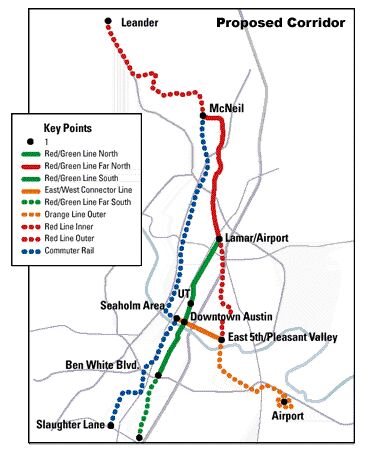
Light rail trains can't use the same tracks as freight trains, and as you can see from this recent video in the following link, freight trains use the Red Line tracks which was planned to be used for the 2000 Red/Green ROW north of Lamar and Airport.
http://www.statesman.com/news/content/mu...162514&bclid=1461295911&bctid=9487586001
Light rail trains aren't FRA compliant just like the Stadler GTW trains CapMetro is using. Therefore, the light rail service would have been limited to morning and evening rush hours too. Or CapMetro would have had to build all brand new tracks separated from the existing freight tracks by 35 feet to use non-FRA conpliant trains in the same ROW.
City of Austin barely passed the 2000 Light Rail plan by 50.6%. The entire CapMetro service area voted it down. Maybe taxpayers thought it was too expensive and would n
ever ever get to them in Williamson County.
Here we are 8 years later, the cheaper DMU commuter train vote passed, costs are $120 million or so for 31 miles, compared to the 2000 plan that was projected to cost $970 million for the initial phase of 14 miles of phase 1, with all phases of light rail costing $1.9 billion.
Interesting, because CapMetro now reports they need outside help financing another $200 million Line to Manor and Elgin. Where did CapMetro expect to find $970 million, or $1.9 billion from in 2000?
The answer was simple, the ability to sell long term bonds. Of course, that would have required another vote, which may or may not have passed once voters discovered that the 2000 rail plan wasn't fully funded.
Another few interesting sentences in your last response:
"Voting for light rail on Nov. 7 will not raise your taxes or subject you to long-term bond debt. (There is a chance that, in the future, Cap Met will ask you for permission to issue long-term revenue bonds, but that still wouldn't raise taxes.)"
Long term debt means to most voters that it'll take forever to extend these planned 2000 lines into Williamson County. I've looked at the taxes CapMetro has collected last year in an earlier response, and the math for building a
$1.9 billion light rail system by 2025 just doesn't add up!
Which brings us back to what CapMetro may have done with the 2000 light rail vote if it had passed. With political pressure to reach Williamson County faster, a commuter rail line on the Red Line so freight trains could continue to use it, and a light rail line for the 2000 Green Line. Most transit agencies, believe it or not, consider streetcars as light rail trains. Is it possible CapMetro may had used streetcars on the 2000 Green Line? You bet it was possible after completing the in-depth planning and environmental studies.
Interesting, that is still possible today, but with more revenues from somewhere yet to be identified. Do I think it will not be long for CapMetro to ask voters for the ability to sell long term bonds? You bet! The demand for more rail projects sooner will force the vote. But will it pass? We'll have to wait and see.





 Prev
Prev










 Linear Mode
