HomeDiagramsDatabaseMapsForum About
     

Go Back   SkyscraperPage Forum > Regional Sections > Canada > Manitoba & Saskatchewan


Reply

 
Thread Tools Display Modes
     
     
  #201  
Old Posted Aug 23, 2026, 1:53 PM
EastK EastK is offline
Registered User
 
Join Date: Nov 2008
Posts: 158
Quote:
Originally Posted by davequanbury View Post
Its an intersting comparison you make between rail relocation and Portage place or MTS. I think it might be worth noting that Portage Place and MTS were expected to generate spin off economic activity that improved downtown where as the rail relocation is expected to create fresh greenfield-ish development porperties within the city in order to build housing and or commercial services. Not exactly apples to apples in terms of mega projects.

I always cringe when big develpments get pitched as 'revitalization.' I'm pretty sceptical about those claims too. Rail relocation arguably has more going for it in respect to improving social issues due to the potential for new housing in areas adjacent to current poverty.

As for ER wait times, I don't think that money spent on rail relocation studies is taken from the health care budget.
From what I understand, and I was not around when it was built, revitalization was a big goal of Portage Place. It seems like another case of throwing money at a problem that requires a lot more thought and effort. Creating actual opportunities for people in these neighbourhoods and hope for youth and better access to education and increased security will still be needed even if you move the rails. As far as housing goes there are hundreds of abandoned homes around the area that could be made available as well. Land is already accessible and very affordable compared to the rest of the city.

It might not be from the health budget but it's all from the same pot.

There are vastly cheaper ways to improve housing access
Reply With Quote
     
     
  #202  
Old Posted Aug 23, 2026, 5:18 PM
Andy6's Avatar
Andy6 Andy6 is offline
Starring as himself
 
Join Date: Mar 2002
Location: Toronto Yorkville
Posts: 9,764
Quote:
Originally Posted by EastK View Post
From what I understand, and I was not around when it was built, revitalization was a big goal of Portage Place. It seems like another case of throwing money at a problem that requires a lot more thought and effort.
Portage Place was revitalization of a retail district that had become seedy and it was proceeded with after years of pretty intense public debate about what to do about the north side of Portage. Crime and social problems, on the scale that we now associate with downtown, were not really a significant part of this. It was more that the street was starting to look shabby as Winnipeggers increasingly shopped at suburban malls rather than on Portage Avenue. The solution was to replicate the mall experience by building a mall between Eaton’s and the Bay and linking it all up via the skywalks. The problem was that Portage Place didn’t offer much that Polo Park didn’t already offer and, in addition, was harder to get to and park at. So it never took off, although I can’t say it was a complete failure. The Holt Renfrew lasted for 15 years or so, and people went to the IMAX.
Reply With Quote
     
     
  #203  
Old Posted Aug 23, 2026, 5:29 PM
biguc's Avatar
biguc biguc is offline
Registered User
 
Join Date: Mar 2003
Location: pinkoland
Posts: 11,905
Quote:
Originally Posted by EastK View Post
It is a rejection of the mentality we have had here for decades that if you complete some massive project like say Portage Place, MTS Center and so on it would somehow improve an area that has some of the worst social problems in the country. The problems these neighbourhoods face have almost nothing to do with the railway's location. Big infrastructure projects are supposed to create a positive lasting impact and this will do nothing of the sort. Say we move the rails, the day the project is completed all the poverty, homelessness, crime, addiction, trauma and abandoned buildings are all still there.
Furthermore in a have-not province that has 10 hour ER wait times and craters in its roads the priority should not be to dump 2-5 billion on rail movement.
You should actually read some if the articles posted. Nobody is making the argument you're fighting against.

What Axworthy has said is pretty simple.
60 % of rail traffic in the city does not originate or terminate in the city. It delivers no benefit to the city.

Given that this rail traffic is noisy, potentially dangerous, and snarls traffic, there's a case to divert this traffic around the city. Much like we already do with truck traffic.

Knock-on benefits like redeveloping land or using right of ways for transit come later.

The latter point is particularly compelling as CP and CN have proven uncooperative on running rapid transit down rail ROWs, nevermind on existing tracks.

Besides missing the upstream benefits, "it would somehow improve an area that has some of the worst social problems in the country" is a clownishly poor argument that literally nobody is making.

For what it's worth, I don't think you care about fixing those social problems. "Muh tax dollers" and "put everything on the back burner until we fix social problems" aren't compatible positions. Unless you want the social problems to persist as an excuse to do nothing.

Reply With Quote
     
     
  #204  
Old Posted Aug 23, 2026, 6:50 PM
Luisito's Avatar
Luisito Luisito is offline
Registered User
 
Join Date: Dec 2018
Posts: 1,899
Quote:
Originally Posted by EastK View Post
From what I understand, and I was not around when it was built, revitalization was a big goal of Portage Place. It seems like another case of throwing money at a problem that requires a lot more thought and effort. Creating actual opportunities for people in these neighbourhoods and hope for youth and better access to education and increased security will still be needed even if you move the rails. As far as housing goes there are hundreds of abandoned homes around the area that could be made available as well. Land is already accessible and very affordable compared to the rest of the city.

It might not be from the health budget but it's all from the same pot.

There are vastly cheaper ways to improve housing access
While I do support the rail relocation, You make very good points also. I agree, there is already a lot of vacant lots and abandoned homes that could be fixed up and used for housing. Sadly this is also a growing problem. I think if we want to get serious about housing we need to do something about the abandoned homes and vacant lots avaible now. We shouldn't wait several decades down the road for rail to be moved when we have this issue that needs to be addressed now.

I personally would like to see the rail relocated but I also would like to see some of that rail space remain so it can also be used for urban rail transit. Lets get the freights out of the city, lets use some of that space for an LRT.
Reply With Quote
     
     
  #205  
Old Posted Sep 3, 2026, 5:16 PM
Wpg_Guy's Avatar
Wpg_Guy Wpg_Guy is offline
Moderator
 
Join Date: Aug 2002
Location: Winnipeg, Manitoba
Posts: 8,676
Quote:
‘Rail relocation is not going to happen’: Should Winnipeg’s train tracks be relocated outside the city?
Peter Caulfield September 3, 2026


The growth and development of Winnipeg outward from where the Red and Assiniboine rivers meet has been shaped in large part by its rail lines and massive marshalling yards, where freight trains are put together and taken apart.

Winnipeg remains one of Canada’s most rail-dense urban centres, with over 240 kilometres of active lines and roughly 50 trains moving through residential and commercial areas every day.

But some Winnipeggers say the rails and the train traffic they carry have become too much of a good thing.

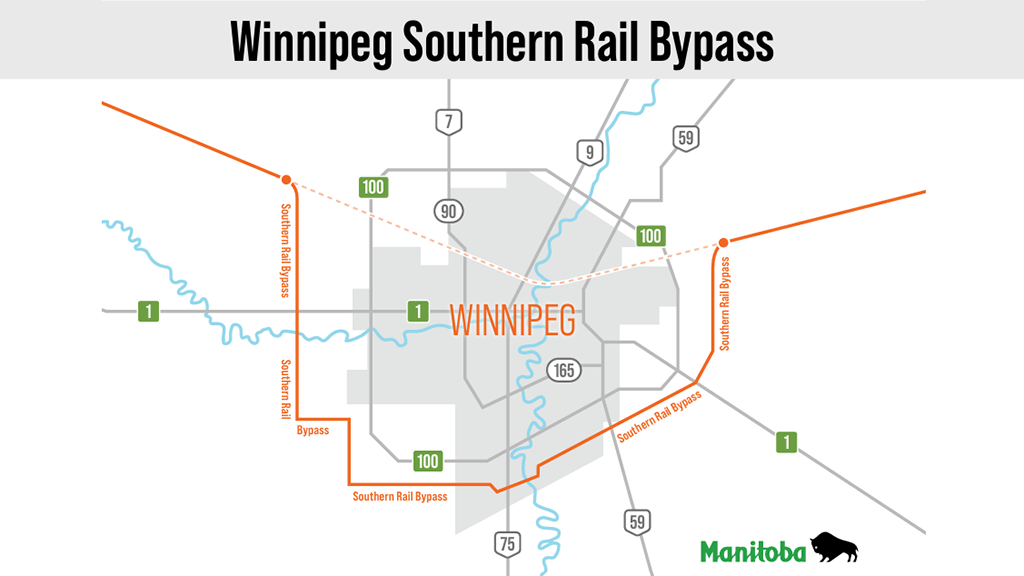
The Government of Manitoba is studying a proposal led by retired politician Lloyd Axworthy to build a rail bypass around the city.

The idea behind rail relocation is to reduce urban traffic bottlenecks and relocate major rail yards.

The government recently launched a 90-day feasibility study and proof-of-concept consultation to test the idea.

Proponents say moving freight rail traffic out of Winnipeg’s urban core would improve the movement of goods, reduce dirt, noise and delays in residential neighbourhoods, and open new opportunities for housing and economic development.

The study will not involve detailed engineering or financial estimates.

The work builds on the Winnipeg Rail Relocation and Renewal Study that was launched in 2024.

The 90-day study will explore the feasibility of a route along Manitoba Hydro’s southern transmission corridor, which is on Crown land that has been cleared, serviced and ready for use.

Said Axworthy in an announcement: “This is an opportunity to think ahead about the kind of city we want Winnipeg to become.

“We have a chance to plan for growth in a way that brings communities together, protects the land around us and leaves future generations a stronger, more connected city.”

Manitoba Premier Wab Kinew says the study team will work with railway companies whose tracks and rail yards would be affected (Canadian Pacific Kansas City, Canadian National and Burlington Northern Santa Fe railways) to ensure a business case exists for the proposed relocation.

Kinew said the proposed bypass would also strengthen Manitoba’s north-south and east-west trade connections, and benefit CentrePort Canada Inc (CPC), the industrial park near the Winnipeg airport.

Carly Edmundson, CPC president and CEO, says rail relocation will “definitely” be positive for Winnipeg, Manitoba and Canada.

“It will help build a stronger rail network and move more freight more efficiently,” says Edmundson. “It will also help create a more deliberate division between a more residential central Winnipeg and more economic activity outside the centre.”

Ahmed Shalaby, professor of civil engineering at the University of Manitoba, says relocation of freight rail lines and yards can be a way to reconnect neighbourhoods on both sides of the tracks and transform industrial zones into urban and suburban spaces.

It also provides new development opportunities and removes the need for grade crossing.

“(However), rail relocation is a massive undertaking requiring land acquisition, new crossings and new grade separations,” says Shalaby. “The construction cost together with any potential disruption to rail operations can be cost-prohibitive.”

Christopher Adams, adjunct professor of political science at the University of Manitoba, says he is cautiously optimistic about rail relocation.

“It could have a comparable impact on Winnipeg and the surrounding region as the Red River Floodway, which has saved the city many times from flooding,” says Adams. “It will require a lot co-ordination with the railroads and a lot of government money, and there is already a lot of pressure on provincial and federal government finances.”

In rail relocation’s favour is that Kinew is a “bold” premier, who is very different from previous Progressive Conservative premiers.

“They were more cautious about spending money,” says Adams.

On the other hand, Manitoba Heavy Construction Association president and CEO, and life-long Winnipegger, Chris Lorenc says, “The train has left the station. Rail relocation is not going to happen.”

But rail rationalization, which involves rail abandonment, might make sense.

“Anyway, there are many other transportation needs in Winnipeg that need to be addressed first, and they can be done faster than rail relocation, which would take decades to bring off,” says Lorenc. “And are the railways interested? Whenever the subject of rail relocation has come up in the past they’ve been very reluctant.”

CPKC spokesman Terry Cunha says, “Evaluating the feasibility of relocating railway infrastructure is an enormously complex matter. The challenges inherent with any proposal to relocate railway infrastructure are vast, complex and should not be underestimated.”

Cunha says the challenges of rail relocation are too often underestimated.

“Given the magnitude of the challenges and costs with any such proposal, we have generally cautioned governments against rail relocation,” he says.

“Such proposals would invariably require significant public dollars to rebuild infrastructure that already exists.”
canada.constructconnect.com
Reply With Quote
     
     
  #206  
Old Posted Sep 22, 2026, 8:47 AM
Wpg_Guy's Avatar
Wpg_Guy Wpg_Guy is offline
Moderator
 
Join Date: Aug 2002
Location: Winnipeg, Manitoba
Posts: 8,676
Quote:
Railways, costs and benefits — the long view
By: Barry E. Prentice
Tuesday, Sep. 22, 2026

A railway bypass route for Winnipeg has been endorsed by Premier Wab Kinew for further feasibility study. Naturally, critics have emerged that question the economics of a railway bypass.

Doubters want to be convinced that the benefits exceed the costs, and quite rightly.

So, how should we be thinking about costs and benefits?

It is always easier to estimate the costs of large infrastructure projects than it is to measure benefits. Rail contractors can provide cost estimates of the kilometres of rail bed construction and rails required, plus the additional switches, overpasses and a railway trestle that will be needed. Land acquisition is a major cost and time delay.

The proposed railway bypass can share the Manitoba Hydro right-of-way for about 80 per cent of the route. This is a huge cost avoidance.

Regardless, the construction cost is large; is the cost-benefit ratio positive?

Public cost/benefit studies are different than the calculations made by the private sector. A corporation need only consider whether the investment’s net revenues after taxes meets their profit expectations.

Government must consider positive and negative externalities, as well as the direct economic returns from infrastructure investments.

The railway bypass will have efficiency benefits that can be measured in terms of increased traffic flows and speed, and reduced time making interchanges between the railways. Time savings and improved utilization can be monetized for the analysis.

These benefits are likely to be significant because more than 60 per cent of rail traffic is neither destined for, nor originating in, Winnipeg. Long unit trains roll through the city carrying oil, grain, potash and lumber, stopping only to refuel and change crews. The railyards sort cars and containers that subsequently travel east, west, and south from Winnipeg.

Governments have a responsibility for public safety. The railways are highly focused on safety, rules and regulations, too. They welcome opportunities to be safer still by substantially reducing risks. The railway bypass is a safety enhancement, but the safety benefit is likely to be modest, barring some catastrophic accident.

A critical element in a cost/benefit calculation is the time horizon. The costs occur at the construction phase, while the public benefits are spread out over long periods. To equate costs and benefits over time, dollars are converted to their net present values based on a discount rate. The mathematics is essentially the inverse of compounding interest. Money today is worth more than money received later.

Depending on the discount rate, benefits received after 20 years tend to add little to the cost/benefit calculation.

This underestimates the benefits of railway infrastructure that can last centuries. The work around is to add a salvage value as a benefit in the 20th year. In this case, the salvage value would be the cost of replacing the railway bypass.

Positive externalities are benefits received indirectly. Building the railway bypass is like knocking over a row of dominos. The bypass creates the potential to relocate rail operations and repurpose the rights-of-way within the city. Economics would encourage the shift of aging railyards to modern facilities with better access to the railway bypass.

Some lightly used rail lines could be shared with commuter services like the Go Train does in Ontario. Commuter rail service to surrounding communities, like Selkirk and Niverville, would reduce highway traffic congestion.

In other cases, such as the Brooklands, the former right-of-way could become a recreational path like the Northeast Pioneers Greenway that parallels Gateway.

Areas that are criss-crossed with rail lines or divided by rail yards could be redeveloped as residential areas. St. Boniface and River Heights come to mind in this regard. The benefits of redevelopment are hard to put a number on, but they may provide the largest financial benefits in the form of land sales, tax revenues, and new amenities.

Also, the railway bypass could eliminate the need to build grade separations at busy locations on Lagimodiere and the Perimeter Highway, not to mention replacing the Arlington bridge.

Critics want to see a hard analysis, but public cost/benefit deals with benefits that have no market prices, such as the time wasted waiting for a train to pass on Grant or the other 120+ level crossings in the city. The remedy is to use shadow prices, to estimate congestion benefits based on a proxy. The closest proxy for the railway bypass is the Perimeter Highway truck bypass that was also constructed by public money.

Cost-benefit analysis is a useful tool for ranking projects, but it is not always necessary to make an informed decision. No one needs a cost/benefit analysis to decide when to change the tires on their car.

The railway bypass creates the opportunity to modernize Winnipeg’s rail hub and permanently transform the urban environment.

The benefits will continue to mount long after the cost is repaid.

Barry E. Prentice is director of the Transport Institute at the Asper School of Business, University of Manitoba.
Free Press
Reply With Quote
     
     
  #207  
Old Posted Sep 29, 2026, 12:02 PM
Wpg_Guy's Avatar
Wpg_Guy Wpg_Guy is offline
Moderator
 
Join Date: Aug 2002
Location: Winnipeg, Manitoba
Posts: 8,676
Quote:
Could rail relocation transform Winnipeg's North End?

Video Duration 4:43
The proposed relocation and redevelopment of the CPKC railyards in Winnipeg would create a vibrant neighbourhood with businesses, greenspace, homes and transit, says urban living contributor Ben Farr.
CBC News

• Video Link

Last edited by Wpg_Guy; Sep 29, 2026 at 2:57 PM.
Reply With Quote
     
     
End
 
 
Reply

Go Back   SkyscraperPage Forum > Regional Sections > Canada > Manitoba & Saskatchewan
Forum Jump


Forum Jump


All times are GMT. The time now is 1:55 AM.


Powered by vBulletin® Version 3.8.7
Copyright ©2000 - 2026, vBulletin Solutions, Inc.