‘Rail relocation is not going to happen’: Should Winnipeg’s train tracks be relocated outside the city?
Peter Caulfield September 3, 2026
The growth and development of Winnipeg outward from where the Red and Assiniboine rivers meet has been shaped in large part by its rail lines and massive marshalling yards, where freight trains are put together and taken apart.
Winnipeg remains one of Canada’s most rail-dense urban centres, with over 240 kilometres of active lines and roughly 50 trains moving through residential and commercial areas every day.
But some Winnipeggers say the rails and the train traffic they carry have become too much of a good thing.
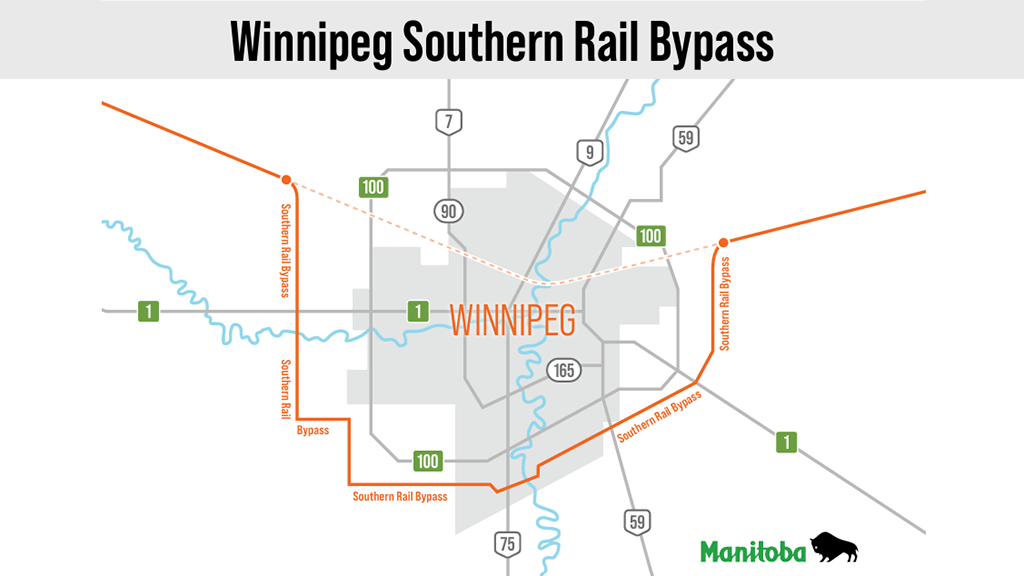
The Government of Manitoba is studying a proposal led by retired politician Lloyd Axworthy to build a rail bypass around the city.
The idea behind rail relocation is to reduce urban traffic bottlenecks and relocate major rail yards.
The government recently launched a 90-day feasibility study and proof-of-concept consultation to test the idea.
Proponents say moving freight rail traffic out of Winnipeg’s urban core would improve the movement of goods, reduce dirt, noise and delays in residential neighbourhoods, and open new opportunities for housing and economic development.
The study will not involve detailed engineering or financial estimates.
The work builds on the Winnipeg Rail Relocation and Renewal Study that was launched in 2024.
The 90-day study will explore the feasibility of a route along Manitoba Hydro’s southern transmission corridor, which is on Crown land that has been cleared, serviced and ready for use.
Said Axworthy in an announcement: “This is an opportunity to think ahead about the kind of city we want Winnipeg to become.
“We have a chance to plan for growth in a way that brings communities together, protects the land around us and leaves future generations a stronger, more connected city.”
Manitoba Premier Wab Kinew says the study team will work with railway companies whose tracks and rail yards would be affected (Canadian Pacific Kansas City, Canadian National and Burlington Northern Santa Fe railways) to ensure a business case exists for the proposed relocation.
Kinew said the proposed bypass would also strengthen Manitoba’s north-south and east-west trade connections, and benefit CentrePort Canada Inc (CPC), the industrial park near the Winnipeg airport.
Carly Edmundson, CPC president and CEO, says rail relocation will “definitely” be positive for Winnipeg, Manitoba and Canada.
“It will help build a stronger rail network and move more freight more efficiently,” says Edmundson. “It will also help create a more deliberate division between a more residential central Winnipeg and more economic activity outside the centre.”
Ahmed Shalaby, professor of civil engineering at the University of Manitoba, says relocation of freight rail lines and yards can be a way to reconnect neighbourhoods on both sides of the tracks and transform industrial zones into urban and suburban spaces.
It also provides new development opportunities and removes the need for grade crossing.
“(However), rail relocation is a massive undertaking requiring land acquisition, new crossings and new grade separations,” says Shalaby. “The construction cost together with any potential disruption to rail operations can be cost-prohibitive.”
Christopher Adams, adjunct professor of political science at the University of Manitoba, says he is cautiously optimistic about rail relocation.
“It could have a comparable impact on Winnipeg and the surrounding region as the Red River Floodway, which has saved the city many times from flooding,” says Adams. “It will require a lot co-ordination with the railroads and a lot of government money, and there is already a lot of pressure on provincial and federal government finances.”
In rail relocation’s favour is that Kinew is a “bold” premier, who is very different from previous Progressive Conservative premiers.
“They were more cautious about spending money,” says Adams.
On the other hand, Manitoba Heavy Construction Association president and CEO, and life-long Winnipegger, Chris Lorenc says, “The train has left the station. Rail relocation is not going to happen.”
But rail rationalization, which involves rail abandonment, might make sense.
“Anyway, there are many other transportation needs in Winnipeg that need to be addressed first, and they can be done faster than rail relocation, which would take decades to bring off,” says Lorenc. “And are the railways interested? Whenever the subject of rail relocation has come up in the past they’ve been very reluctant.”
CPKC spokesman Terry Cunha says, “Evaluating the feasibility of relocating railway infrastructure is an enormously complex matter. The challenges inherent with any proposal to relocate railway infrastructure are vast, complex and should not be underestimated.”
Cunha says the challenges of rail relocation are too often underestimated.
“Given the magnitude of the challenges and costs with any such proposal, we have generally cautioned governments against rail relocation,” he says.
“Such proposals would invariably require significant public dollars to rebuild infrastructure that already exists.”