HomeDiagramsDatabaseMapsForum About
     

Go Back   SkyscraperPage Forum > Regional Sections > Canada > Ontario > Ottawa-Gatineau > Transportation


Reply

 
Thread Tools Display Modes
     
     
  #721  
Old Posted Aug 20, 2026, 6:04 PM
Luker Luker is offline
Registered User
 
Join Date: May 2008
Posts: 377
Quote:
Originally Posted by DarthVader_1961 View Post
Options based on VIA and CN not having to share tracks, options include:

1 - VIA rail could run faster on tracks it did not have to share with existing rolling stock.

2 - you could rip up existing VIA rail tracks and do the whole high speed rail in the corridor that VIA currently uses.
lol at least you tried and followed up with “options”. With that said:

Option 1 gains you 10-15% efficiency and speed with very substantival costs to reroute the cargo network - which your fellow NIMBYs would just as well protest against

Option 2 - shut down rail travel in the busiest corridor of Canada for years to all Canadians to perform an upgrade in place. I’m sure you can see the selfish problematic approach to this. Not to mention the existing corridor is not wide enough, or straight enough to accommodate HSR…

Appreciate the deep thinking on these options!

I too was in lanark /Frontenac county last week and saw the many anti alto signs as well as a protest on the highway near Westport. As noted above, some rural v urban divide. The greater good for many is obvious and well outweighs the bad. This how democratic societies operate and progress.

The point above about well informed and uninformed stands out. Hearing the protesters arguments and signs on the weekend makes it very clear that they are driven by fear mongering and NIMBY self entitlements.

I have some (little) patience for nimbys in general as it relates to urban development and high rises near SFH. But the level of selfish entitlement on a nation building transportation project is just one bridge too far me.

The route shall be where it is optimal, and we shall take into account property rights and easements to the best of our collectivity abilities. Beyond that no one deserves a personal veto card on a project of this scale and significance… IMHO…
Reply With Quote
     
     
  #722  
Old Posted Aug 20, 2026, 6:32 PM
DarthVader_1961 DarthVader_1961 is offline
Registered User
 
Join Date: Jun 2009
Posts: 473
Smile

Quote:
Originally Posted by Luker View Post
lol at least you tried and followed up with “options”. With that said:

Option 1 gains you 10-15% efficiency and speed with very substantival costs to reroute the cargo network - which your fellow NIMBYs would just as well protest against

Option 2 - shut down rail travel in the busiest corridor of Canada for years to all Canadians to perform an upgrade in place. I’m sure you can see the selfish problematic approach to this. Not to mention the existing corridor is not wide enough, or straight enough to accommodate HSR…

Appreciate the deep thinking on these options!

I too was in lanark /Frontenac county last week and saw the many anti alto signs as well as a protest on the highway near Westport. As noted above, some rural v urban divide. The greater good for many is obvious and well outweighs the bad. This how democratic societies operate and progress.

The point above about well informed and uninformed stands out. Hearing the protesters arguments and signs on the weekend makes it very clear that they are driven by fear mongering and NIMBY self entitlements.

I have some (little) patience for nimbys in general as it relates to urban development and high rises near SFH. But the level of selfish entitlement on a nation building transportation project is just one bridge too far me.

The route shall be where it is optimal, and we shall take into account property rights and easements to the best of our collectivity abilities. Beyond that no one deserves a personal veto card on a project of this scale and significance… IMHO…
I’m aware that neither of my options were any good and pretty laughable.
Reply With Quote
     
     
  #723  
Old Posted Aug 20, 2026, 6:35 PM
Truenorth00 Truenorth00 is offline
Registered User
 
Join Date: May 2017
Posts: 28,948
Quote:
Originally Posted by lrt's friend View Post
Details of available options?
There are none. As usual on anything complex, it's a bunch self-educated "experts" who studied at the colleges of Wikipedia and Facebook.
Reply With Quote
     
     
  #724  
Old Posted Aug 20, 2026, 7:53 PM
Richard Eade Richard Eade is offline
Registered User
 
Join Date: Mar 2008
Location: Nepean
Posts: 2,629
No need, Lurker, to be sarcastic. If someone comes up with an idea, it can be discussed intelligently.

In the case of using the existing VIA Rail corridor (or part thereof) between Ottawa and Montreal, there could be some merit. For example, you mention that the existing corridor is only 100’ wide, and ALTO is looking for a 200’-wide path. By using the existing route (or part thereof), the actual NEW property requirement might be cut drastically. That is, taking 50’ more property on each side might be better than taking a new 200’ swath, and still keeping the 100’ existing one.

Part of the reasoning for needing a very wide corridor is to mitigate environmental effects – including wind and noise. By having extra space on either side, the tracks can be more separated (to reduce the ‘buffeting’ that occurs between passing trains) and the wind and noise are diminished by the time they reach the property edge. However, it might also leave room for slower trains closer to the borders, within the property envelope. In that case, existing VIA Rail trains might be simply moved to new tracks which could be laid while existing VIA Rail service continues.

Another benefit might be to improve connectivity across the existing rail corridor by adding underpasses and fly-overs.

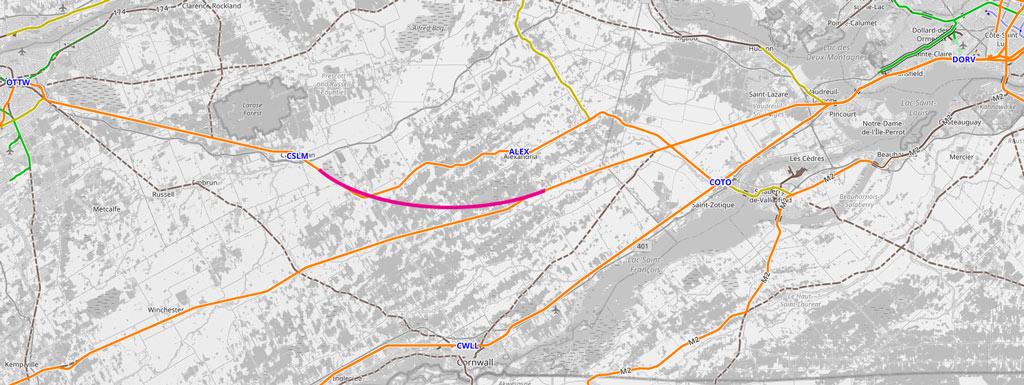
Absolutely, the existing tracks between Ottawa and Montreal are not straight enough, in places, for high-speed rail. There would need to be some straightening required – which would add some extra property requirement, but much less than an entirely new corridor. For example, how about this?


That routing misses Laval (A place which was included for reasons I don’t understand.), but could connect to P.E.Trudeau Airport, which is getting a REM connection. I also have previously suggested that ALTO take the south shore between Montreal and Quebec City, crossing into Quebec City on a new ‘Third Link’.

At this stage (selecting a route), I don’t think that any ideas should be ruled out – although ALTO appears to have started with very myopic vision.
Reply With Quote
     
     
  #725  
Old Posted Aug 21, 2026, 2:43 AM
Badlands Badlands is offline
Registered User
 
Join Date: Aug 2011
Location: Ottawa
Posts: 46
Quote:
Originally Posted by Luker View Post

... we shall take into account property rights and easements to the best of our collectivity abilities. …
We? Our?


LOL.
Reply With Quote
     
     
  #726  
Old Posted Aug 21, 2026, 3:51 AM
YOWetal YOWetal is offline
Registered User
 
Join Date: Oct 2006
Posts: 7,701
Quote:
Originally Posted by Truenorth00 View Post
There are none. As usual on anything complex, it's a bunch self-educated "experts" who studied at the colleges of Wikipedia and Facebook.
There are of course other options. Not sure what problem he is trying to solve for but if it's disturbing landowners than yes using the existing Via CN network avoids that. You could build a new right of way with expropiation next to current route. Build a tunnel out of Montreal and maybe into Toronto. It won't be straight enough to be high speed. Might cost as much as current plan. But marginal farmland won't be impacted if that's our priority. I guess the businesses and residents who live along the current route don't matter. Or we can take out the waterfront park that runs along a lot of the GTA route.

Ottawa is then not in the Toronto route but actually the Montreal-Ottawa route is pretty sparse and could be sped up a lot especially with a new tunnel to Dorval to avoid the long backing out of the station. Not sure a 90 minute train is much of a game changer considering the cost though.
Reply With Quote
     
     
  #727  
Old Posted Aug 21, 2026, 4:40 AM
FrostyMug FrostyMug is offline
Registered User
 
Join Date: Jul 2023
Location: Ottawa
Posts: 103
Quote:
Originally Posted by YOWetal View Post

Ottawa is then not in the Toronto route but actually the Montreal-Ottawa route is pretty sparse and could be sped up a lot especially with a new tunnel to Dorval to avoid the long backing out of the station. Not sure a 90 minute train is much of a game changer considering the cost though.
90 minutes is a game changer though if you consider the amount of time wasted clearing security, arriving early at the airport and the slow process of getting on and off a plane via one door.
Reply With Quote
     
     
  #728  
Old Posted Aug 21, 2026, 6:00 AM
YOWetal YOWetal is offline
Registered User
 
Join Date: Oct 2006
Posts: 7,701
Quote:
Originally Posted by FrostyMug View Post
90 minutes is a game changer though if you consider the amount of time wasted clearing security, arriving early at the airport and the slow process of getting on and off a plane via one door.
I meant 90 minutes Montreal to Ottawa and nobody is flying from Montreal to Ottawa. It's a 2 hour drive which gets you door to door. For those without a car or going downtown to downtot the $25 bus is 3 hours. The $50 bus is 2.5 hours. The current $75 train is 2 hours. A $100 90 minute train will struggle and doesn't make commuting or day trips viable at scale.
Reply With Quote
     
     
  #729  
Old Posted Aug 21, 2026, 7:11 AM
Truenorth00 Truenorth00 is offline
Registered User
 
Join Date: May 2017
Posts: 28,948
Quote:
Originally Posted by YOWetal View Post
I meant 90 minutes Montreal to Ottawa and nobody is flying from Montreal to Ottawa. It's a 2 hour drive which gets you door to door. For those without a car or going downtown to downtot the $25 bus is 3 hours. The $50 bus is 2.5 hours. The current $75 train is 2 hours. A $100 90 minute train will struggle and doesn't make commuting or day trips viable at scale.
You'd be right if we completely ignore experience from the rest of the world on similar corridors.

The Japanese were able to mathematically model demand changes on their HSR system down to the minute.

For someone who claims to be all about economics, you really seem to struggle with comprehending economic activity from growth. Make these cities an exurban commute and there will be a slow, but steady growth in people who do it. We don't even have to go to Japan to see this. Just check out the edges of the GO network in Toronto or VIA's commuters.

Also, why do you assume the fare is exactly the same for a frequent user in a system that is a lot more frequent (higher asset utilization)?
Reply With Quote
     
     
  #730  
Old Posted Aug 21, 2026, 8:01 AM
Truenorth00 Truenorth00 is offline
Registered User
 
Join Date: May 2017
Posts: 28,948
Quote:
Originally Posted by FrostyMug View Post
90 minutes is a game changer though if you consider the amount of time wasted clearing security, arriving early at the airport and the slow process of getting on and off a plane via one door.
60 mins is an even bigger game changer. Which is Alto's projected travel time from Ottawa to Montreal.

90 mins was the old HFR proposal.
Reply With Quote
     
     
  #731  
Old Posted Aug 21, 2026, 1:49 PM
Truenorth00 Truenorth00 is offline
Registered User
 
Join Date: May 2017
Posts: 28,948
Alto's Economic Case:

https://www.altotrain.ca/sites/default/f...-opportunity-of-high-speed-rail-alto.pdf

And for those who keep talking about alternatives. Notably HFR:

Quote:
The most frequently cited alternative, a dedicated “high-frequency” rail system, would still require largely new, grade-separated, and electrified infrastructure, at a capital cost of $45 to $75 billion, close to the $60 to $90 billion estimated for high-speed rail. Yet it would generate one fifth of the economic impact: a 0.2% GDP uplift, versus 1.1% for high-speed rail. The relevant question is not which option costs less. It is why Canada would spend nearly as much for a fraction of the benefits.
Reply With Quote
     
     
  #732  
Old Posted Aug 21, 2026, 3:52 PM
FrostyMug FrostyMug is offline
Registered User
 
Join Date: Jul 2023
Location: Ottawa
Posts: 103
Quote:
Originally Posted by YOWetal View Post
I meant 90 minutes Montreal to Ottawa and nobody is flying from Montreal to Ottawa. It's a 2 hour drive which gets you door to door. For those without a car or going downtown to downtot the $25 bus is 3 hours. The $50 bus is 2.5 hours. The current $75 train is 2 hours. A $100 90 minute train will struggle and doesn't make commuting or day trips viable at scale.
I counted I believe 9 direct flights from Ottawa to Montreal via a quick search. So there are very clearly people who fly that route.
Reply With Quote
     
     
  #733  
Old Posted Aug 21, 2026, 5:27 PM
Truenorth00 Truenorth00 is offline
Registered User
 
Join Date: May 2017
Posts: 28,948
Quote:
Originally Posted by FrostyMug View Post
I counted I believe 9 direct flights from Ottawa to Montreal via a quick search. So there are very clearly people who fly that route.
That's mostly to connect to other flights at YUL. And they are all regional jets or turboprops with less than 80 seats. At best, only 1-2 of those are going away post Alto. And maybe if possible, airlines might deploy 50 seaters instead.

But with no Dorval connection scrapping all those flights is very difficult.
Reply With Quote
     
     
  #734  
Old Posted Aug 21, 2026, 10:22 PM
Ottawacurious Ottawacurious is offline
Registered User
 
Join Date: Mar 2022
Location: Ottawa
Posts: 563
Yep, you are right. I'm not a team of dedicated train experts with a 200 million budget so, I'm just another opinionated person out there. I'm not a NIMBY anyway. I just respond to reason so, shoot holes in these ideas The idea(s) I'm exploring has 3 phases and costs less than the 90 billion. As far as my NIMBY'ism goes, I get their argument. They are paying the most costs (financial and life impact) with the least benefit. I'm also aware that 1000 farmers might be upset but only a small percent of those farmers would actually be impacted (look at France or Germany use cases).

The proposal I'm describing is essentially a"higher-speed rail through incremental corridor conversion" approach rather than ALTO-style greenfield high-speed rail.

Phase 1: Expropriate the CN rail corridor land

The federal government would acquire ownership of the rail right-of-way that CN currently owns.
CN would continue operating freight trains, potentially under long-term access arrangements.
This avoids the need to acquire an entirely new 200-foot-wide corridor across eastern Ontario and Quebec.

Phase 2: Extend passing tracks / sidings

Lengthen and add enough passing sidings so VIA trains no longer have to sit and wait for freight traffic.
Build additional double-track sections at bottlenecks.
Install modern signalling and dispatching that prioritizes passenger service. (yep, willing to let CN have priority in the short term but we need to be realistic about the impact this has on the schedule. Eventually, there will be enough sidings where this becomes a non-issue.)
Doing this will bring you within 75 minutes of alto.

Phase 3: Dedicated passenger tracks where justified

Over time, construct parallel passenger tracks beside the existing corridor in the busiest sections / where trains intersect the most often.
Separate freight and passenger movements gradually rather than all at once.
Focus first on the parts of the corridor that generate the largest delays.
It'll bring you to within 45 minutes of Alto.

What Problem It Solves

The biggest issue facing VIA today is not necessarily the train's top speed. From what I've gathered, it is freight priority,
single-track bottlenecks, waiting in sidings for opposing traffic, and slow approaches into major cities. Some of this is due to old tracks and tight curves.

So yes, I'm suggesting that eliminating those delays could produce a substantial improvement without building a completely new ALTO corridor.

Using AI to help me with some math, the expected Performance:

Today: Ottawa-Toronto: ~4h15m to 4h45m
Today: Ottawa-Montreal: ~2h

toward something closer to:

Ottawa-Toronto: about 3 to 3.5 hours
Ottawa-Montreal: roughly 1.5 hours or somewhat less

Those numbers were never true high-speed rail, but they would be significantly better than today.

It's not high speed rail - it's higher speed rail.


My proposal is effectively:

Spend less money initially, use existing transportation corridors, reduce expropriation of new farmland, improve service in stages, and achieve "higher-speed rail." ALTO's argument is essentially the opposite - a dedicated, electrified, grade-separated corridor must be built anyway, spend the additional money and get full high-speed rail benefits. To my idea, , you can run dedicated direct / no-stop trains from Toronto to Ottawa / Ottawa-Montreal. You can also still go through all the collector towns too and collect other folks on different trains. Win-win.

When I look at what the next 30-100 years brings in terms of technology, I think we should consider leap frogging technologies. The 90 billion is a lot. I personally don't feel the 15-30 minutes saved from Ottawa to Montreal is worth it. VIA rail and CN will need to modernize and you'll be spending double to maintain two systems - unless VIA rail goes the way of the dodo too. AI is saying this plan - to implement everything - will cost between $33B-68B dollar.

So yep, I don't think Alto will be anywhere near the 60-90B and I'd rather spend the money (again this is a B) elsewhere. We can do a lot of things with that many B's.


Last edited by Ottawacurious; Aug 21, 2026 at 11:01 PM.
Reply With Quote
     
     
  #735  
Old Posted Aug 21, 2026, 10:45 PM
Ottawacurious Ottawacurious is offline
Registered User
 
Join Date: Mar 2022
Location: Ottawa
Posts: 563
I should also add, I'm considering the 30+ billion saved and doing another dedicated lane for trucks from Toronto to Montreal and along the 416 to Ottawa. Truck companies could pay useage fees helping to offset costs. This will improve the safety on the highways.

Similar, I also thought of dedicated autonomous truck lanes with charging capabilities since they operate on predictable routes, consume far more energy, reducing battery size would help overall economy, and economic benefit is easier to justify. Could readily charge for that (pun intended). In 30-50 years, I expect most trucks to be autonomous driven. Platoons of trucks can drive faster at speed safely.
Reply With Quote
     
     
  #736  
Old Posted Yesterday, 1:07 AM
lrt's friend lrt's friend is offline
Registered User
 
Join Date: Dec 2006
Posts: 12,788
What happens in locations where there is no space for additional sidings? Aren't these the most likely to be the choke points?

The goal of Alto, is to provide dedicated passenger trackage to eliminate interaction between passenger and freight trains. Are we in a position to do this on the Lakeshore route and particularly on the approaches into Toronto and Montreal? Without dedicated trackage, how do really provide reliable service?

It seems to me, that this kind of approach of gradually improving the existing corridor was attempted previously and proved to be an expensive dismal failure. No passenger benefits were delivered and the project lost momentum. Aren't we repeating the same process and expecting a different outcome?

There is also the issue of dealing with slower GO Trains between Toronto and Oshawa. At least, Alto was directing trains northward on a less busy corridor.

I am not sure how reasonable it is to expropriate a huge private business in order to switch freight and passenger priority that will likely make CN less efficient at least in the short term. Is this really nation building?
Reply With Quote
     
     
  #737  
Old Posted Yesterday, 1:32 AM
acottawa acottawa is offline
Registered User
 
Join Date: Aug 2009
Posts: 18,847
Quote:
Originally Posted by Truenorth00 View Post
You'd be right if we completely ignore experience from the rest of the world on similar corridors.

The Japanese were able to mathematically model demand changes on their HSR system down to the minute.

For someone who claims to be all about economics, you really seem to struggle with comprehending economic activity from growth. Make these cities an exurban commute and there will be a slow, but steady growth in people who do it. We don't even have to go to Japan to see this. Just check out the edges of the GO network in Toronto or VIA's commuters.

Also, why do you assume the fare is exactly the same for a frequent user in a system that is a lot more frequent (higher asset utilization)?
There are very few places where people commute regularly on a high speed trains. It is far too expensive. For an hour long trip in Japan (say Tokyo Karuizawa) a FREX pass costs about 100k per month. Gemini says the average take home pay in Japan is 260-300k per month. In Japan employers often subsidize commuting, so this might make it more feasible but Canada has no tradition of this.

On most popular HSR routes in Europe, the cheapest trains of the day are usually 6-7 am, which would not be the case if commuting was common (there would be high demand for these early morning departures).
Reply With Quote
     
     
  #738  
Old Posted Yesterday, 11:54 AM
Truenorth00 Truenorth00 is offline
Registered User
 
Join Date: May 2017
Posts: 28,948
Quote:
Originally Posted by acottawa View Post
There are very few places where people commute regularly on a high speed trains. It is far too expensive. For an hour long trip in Japan (say Tokyo Karuizawa) a FREX pass costs about 100k per month. Gemini says the average take home pay in Japan is 260-300k per month. In Japan employers often subsidize commuting, so this might make it more feasible but Canada has no tradition of this.

On most popular HSR routes in Europe, the cheapest trains of the day are usually 6-7 am, which would not be the case if commuting was common (there would be high demand for these early morning departures).
Commuting a long distance anywhere will be expensive. However,

1) Nobody is paying retail as a commuter. There are usually discounted passes. At minimum some kind of bulk ticket discount.

2) Most people who do HSR commutes are not 5 days a week plebs. These strawman arguments multiplying full retail at 10 trips a week don't apply.

3) A lot of folks who commute short term get their travel paid for by their employer. An example would be a consultant hired from Montreal by the feds.
Reply With Quote
     
     
  #739  
Old Posted Yesterday, 11:59 AM
Truenorth00 Truenorth00 is offline
Registered User
 
Join Date: May 2017
Posts: 28,948
Quote:
Originally Posted by Ottawacurious View Post
Yep, you are right. I'm not a team of dedicated train experts with a 200 million budget so, I'm just another opinionated person out there. .....The idea(s) I'm exploring has 3 phases and costs less than the 90 billion.
Right. We don't need to listen to your opinions. You know what they say about opinions.

Would rather listen to the people who actually have expertise and know what they are doing.
Reply With Quote
     
     
  #740  
Old Posted Yesterday, 12:05 PM
Truenorth00 Truenorth00 is offline
Registered User
 
Join Date: May 2017
Posts: 28,948
Quote:
Originally Posted by lrt's friend View Post
What happens in locations where there is no space for additional sidings?
A better question is what happens when the federal government refuses to expropriate from two large national champions?

All these chuds simply start with the assumption that the feds will magically be happy to irreparably harm two large national champions who each carry more freight than several European national rail companies combined.

Any "option" that starts with "Let's just expropriate CN/CP's main corridor...." is ignorant nonsense that should be dismissed.
Reply With Quote
     
     
This discussion thread continues

Use the page links to the lower-right to go to the next page for additional posts
 
 
Reply

Go Back   SkyscraperPage Forum > Regional Sections > Canada > Ontario > Ottawa-Gatineau > Transportation
Forum Jump


Forum Jump


All times are GMT. The time now is 7:15 AM.


Powered by vBulletin® Version 3.8.7
Copyright ©2000 - 2026, vBulletin Solutions, Inc.