Yep, you are right. I'm not a team of dedicated train experts with a 200 million budget so, I'm just another opinionated person out there. I'm not a NIMBY anyway. I just respond to reason so, shoot holes in these ideas

The idea(s) I'm exploring has 3 phases and costs less than the 90 billion. As far as my NIMBY'ism goes, I get their argument. They are paying the most costs (financial and life impact) with the least benefit. I'm also aware that 1000 farmers might be upset but only a small percent of those farmers would actually be impacted (look at France or Germany use cases).
The proposal I'm describing is essentially a"higher-speed rail through incremental corridor conversion" approach rather than ALTO-style greenfield high-speed rail.
Phase 1: Expropriate the CN rail corridor land
The federal government would acquire ownership of the rail right-of-way that CN currently owns.
CN would continue operating freight trains, potentially under long-term access arrangements.
This avoids the need to acquire an entirely new 200-foot-wide corridor across eastern Ontario and Quebec.
Phase 2: Extend passing tracks / sidings
Lengthen and add enough passing sidings so VIA trains no longer have to sit and wait for freight traffic.
Build additional double-track sections at bottlenecks.
Install modern signalling and dispatching that prioritizes passenger service. (yep, willing to let CN have priority in the short term but we need to be realistic about the impact this has on the schedule. Eventually, there will be enough sidings where this becomes a non-issue.)
Doing this will bring you within 75 minutes of alto.
Phase 3: Dedicated passenger tracks where justified
Over time, construct parallel passenger tracks beside the existing corridor in the busiest sections / where trains intersect the most often.
Separate freight and passenger movements gradually rather than all at once.
Focus first on the parts of the corridor that generate the largest delays.
It'll bring you to within 45 minutes of Alto.
What Problem It Solves
The biggest issue facing VIA today is not necessarily the train's top speed. From what I've gathered, it is freight priority,
single-track bottlenecks, waiting in sidings for opposing traffic, and slow approaches into major cities. Some of this is due to old tracks and tight curves.
So yes, I'm suggesting that eliminating those delays could produce a substantial improvement without building a completely new ALTO corridor.
Using AI to help me with some math, the expected Performance:
Today: Ottawa-Toronto: ~4h15m to 4h45m
Today: Ottawa-Montreal: ~2h
toward something closer to:
Ottawa-Toronto: about 3 to 3.5 hours
Ottawa-Montreal: roughly 1.5 hours or somewhat less
Those numbers were never true high-speed rail, but they would be significantly better than today.
It's not high speed rail - it's higher speed rail.
My proposal is effectively:
Spend less money initially, use existing transportation corridors, reduce expropriation of new farmland, improve service in stages, and achieve "higher-speed rail." ALTO's argument is essentially the opposite - a dedicated, electrified, grade-separated corridor must be built anyway, spend the additional money and get full high-speed rail benefits. To my idea, , you can run dedicated direct / no-stop trains from Toronto to Ottawa / Ottawa-Montreal. You can also still go through all the collector towns too and collect other folks on different trains. Win-win.
When I look at what the next 30-100 years brings in terms of technology, I think we should consider leap frogging technologies. The 90 billion is a lot. I personally don't feel the 15-30 minutes saved from Ottawa to Montreal is worth it. VIA rail and CN will need to modernize and you'll be spending double to maintain two systems - unless VIA rail goes the way of the dodo too. AI is saying this plan - to implement everything - will cost between $33B-68B dollar.
So yep, I don't think Alto will be anywhere near the 60-90B and I'd rather spend the money (again this is a B) elsewhere. We can do a lot of things with that many B's.





 Prev
Prev


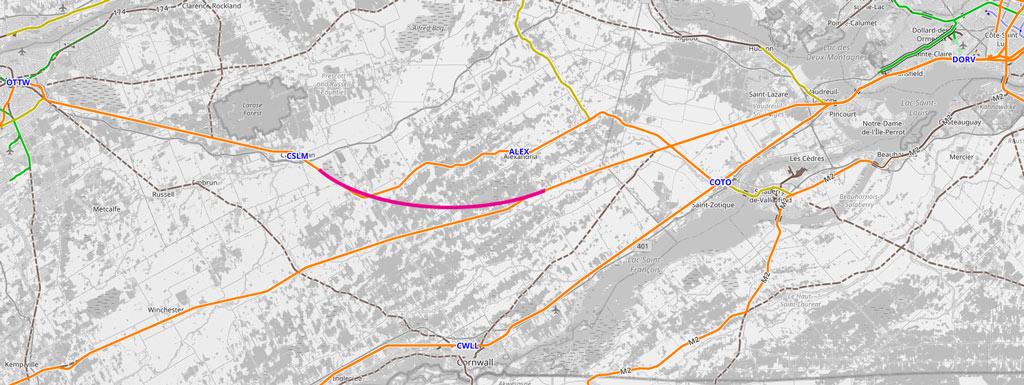
 In 30-50 years, I expect most trucks to be autonomous driven. Platoons of trucks can drive faster at speed safely.


 Linear Mode
