 Posted Sep 19, 2025, 12:54 AM
|
 |
Registered User
|
|
Join Date: Jul 2011
Posts: 473
|
|
https://archive.ph/1JvFG
Waterloo Region is growing ‘extraordinarily fast’ and showing the strain as well-being frays
Residents feel less connected and less like they belong in the wake of nation-leading growth, a new Vital Signs report from the Waterloo Region Community Foundation shows.
Quote:
Sept. 10, 2025 - Growth pains are showing in a region that’s now the nation’s youngest and fastest-growing, a new report has found.
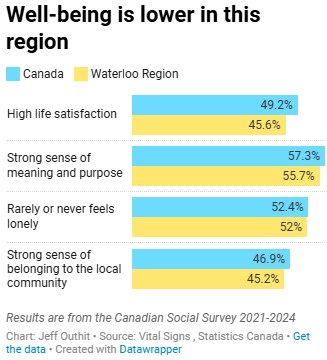
People are losing their sense of belonging. Residents feel less connected. Well-being is fraying.
“We’ve been stressed by this race to grow,” said Eric Avner, president of the charitable Waterloo Region Community Foundation that aims to help people thrive. “Places where we would normally come together aren’t resonating in the same way as they have.”
The foundation’s Vital Signs report for 2025, released Wednesday, highlights the impact of massive population change.
The 80-page report is meant to focus public debate, inspire civic engagement and help people and groups take action with the greatest impact.
The foundation proposes a solution: build better “social infrastructure.” It defines this as shared spaces, shared experiences and shared resources that help people connect in meaningful ways.
...
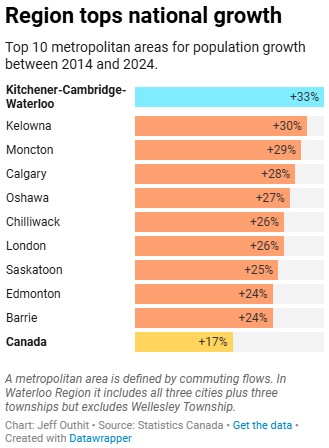
This region contains the fastest-growing metropolitan area in the country after the population grew 33 per cent in a decade.
That’s almost twice the national growth rate. It’s seven times faster than average growth in most high-income countries.
...
By 2024 the metropolitan population of the region (excluding Wellesley Township) reached almost 700,000 — up more than 170,000 in 10 years.
...
But planners still see the region growing to an estimated population of one million by 2050.
...
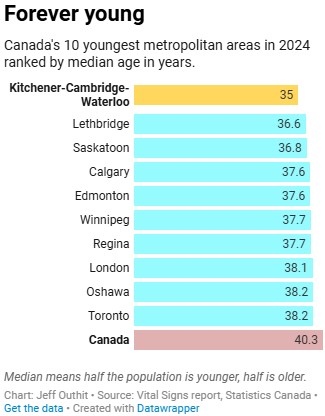
A surge in young adults aged 20 to 34 has helped make the metropolitan population the youngest in the nation. Half the population is younger than 35, which is more than five years younger than Canada’s median age.
...
Only 46 per cent of residents in this region said they are highly satisfied with life, according to national well-being data collected between 2021 and 2024. That’s about four percentage points below the national average.
Since before the COVID-19 pandemic, no other part of the country has seen a sharper decline in life satisfaction, other data shows.
The region’s population surge has not been accompanied by a surge in support for key pieces of social infrastructure, the report shows.
Arts funding and attendance have yet to recover after plunging during the pandemic. People are less likely to use community or recreation centres than they were.
Libraries are seeing fewer in-person visits and reduced attendance for programs. Volunteering rates are down along with donations.
Only parks are reporting a surge in use...
|

|




 Threaded Mode