Quote:
Originally Posted by Architype

Is there a chart for seat representation, if allocated according to population alone? I guess PEI might have one, maybe two seats. Then, based on that, you could see if the outcome of the election would be different.
|
Easy tp figure out.
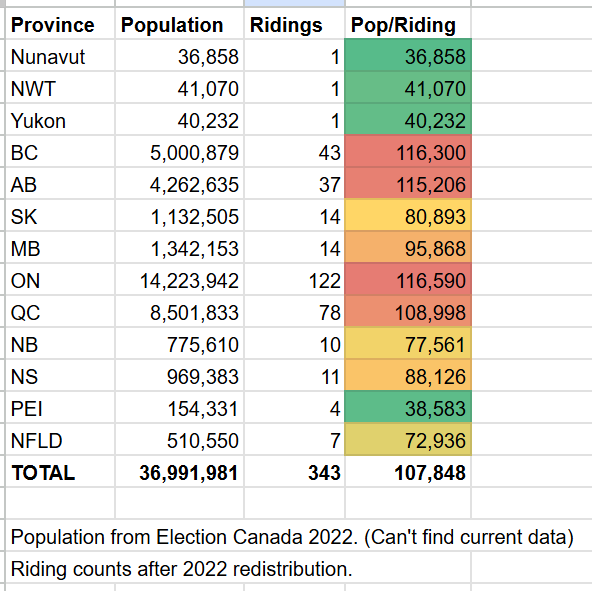
There are 343 federal parliamentary ridings.
The population of Canada (population clock) is 41,630,918
This would give an average population per riding of 121,573
The seat allocation based on pure population (rounded) therefore would be:
ON - 134 seats (122 seats) +12 seats
QC - 75 seats (78 seats)
-3 seats
BC - 47 seats (43 seats) +4 seats
AB - 41 seats (37 seats) +4 seats
MB - 12 seats (14 seats)
-2 seats
SK - 10 seats (14 seats)
-4 seats
NS - 9 seats (11 seats)
-2 seats
NB - 7 seats (10 seats)
-3 seats
NL - 5 seats (7 seats)
-2 seats
PE - 2 seats ((4 seats)
-2 seats
NT - 1 seat N/C
YT - 1 seat N/C
NU - 1 seat N/C
TOTAL - 345 seats (343 seats)
Consequences:
- Ontario would make out like a bandit, further centralizing power in the GTHA, mostly for the benefit of the Liberals.
- BC and AB would have improved representation, but, the gains for the CPC would only be modest if any (most new seats in BC would be in the lower mainland which is LPC/NDP territory).
- All other provinces would lose representation, making the federation even more unbalanced than it already is. In Atlantic Canada, the seat count would go down to 23 seats from 32 seats which would be catastrophic in terms of having regional voices heard in Ottawa. MB and SK would lose 6 seats which would mean large rural ridings becoming even bigger with less cohesion and commonality than before.
Is this worth it to give Alberta a measly four extra seats in Ottawa? I can't imagine it would make any difference in Alberta's political power at the federal level.





 Prev
Prev


 It's the whole point.


 Linear Mode
