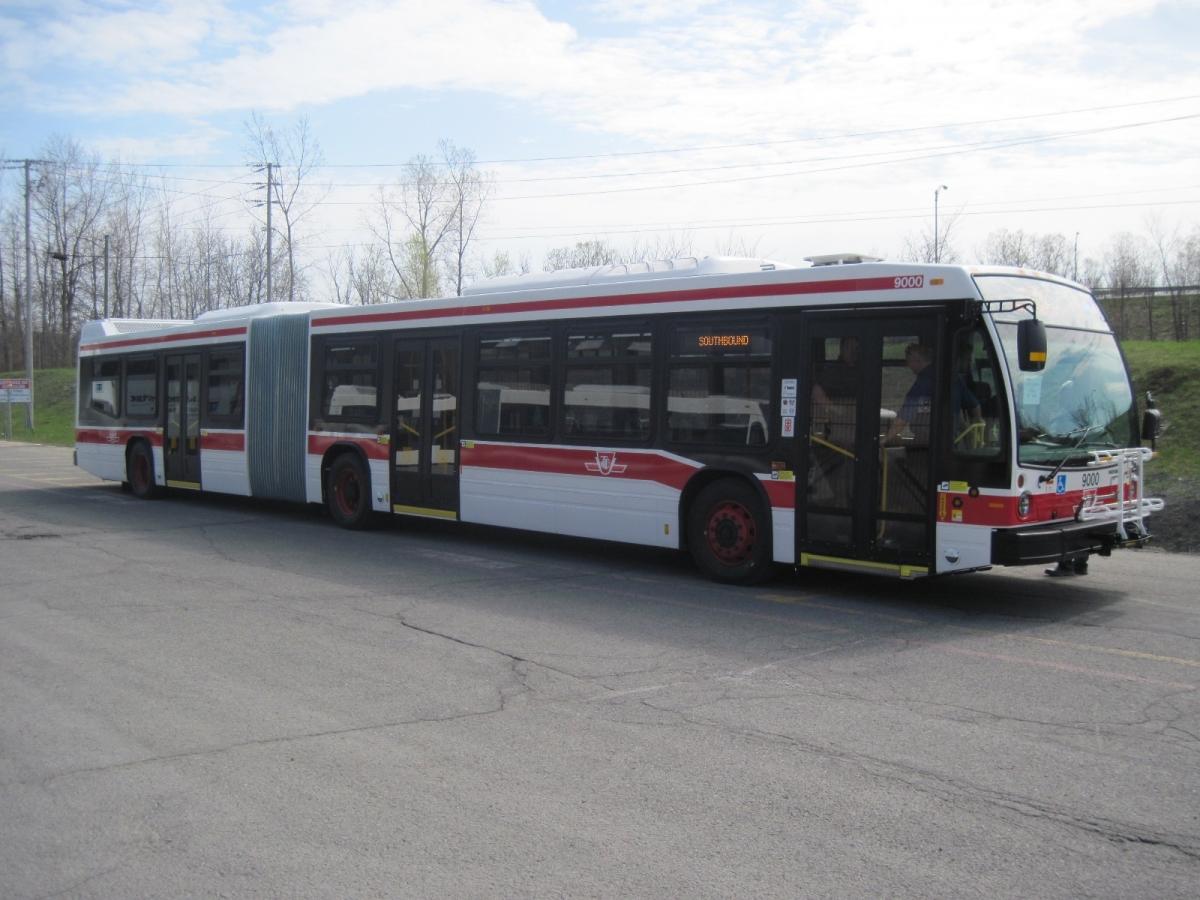
TORONTO - Transit Developments


Mississauga actually spends more per capita on public transit than Brampton does and MiWay's revenue service hours per capita is significantly higher than that of Brampton Transit.

I find that hard to believe. Is that is the case, then one would be able to access all areas of Mississauga from morning until late night seven days a week. But the fact is that is not the case.

You guys can go on and on all you want about Mississauga being utopia. But the fact is that without a car entire ares of Mississauga are off limits to you outside of peak hours. Or you have to wait 60 minutes for a bus.

Are you aware that I can't even visit my friend in Erin Mills in the evening with knowing he can drive me to the train station, as the Mississauga Transit bus service is so poor.

Miketoronto only chooses the data that fits this picture he's trying to draw of Mississauga providing less transit service than Brampton and York Region, but the reality is Mississauga is on a whole other level transit-wise compared to the rest of the 905.

I am not trying to paint anything. I am showing the facts. And the fact is that Brampton provides better coverage and better service to its residents than Mississauga, regardless of hours per capita.
 
Scarborough subway revival wanted by TTC chair Stintz, councillors

http://www.theglobeandmail.com/news/toronto/ttc-chair-stintz-councillors-want-scarborough-subway-revived/article11586060/

A group of Toronto city councillors, including TTC chair Karen Stintz, is pushing the province to revive plans for a Scarborough subway as part of talks on new fees and taxes for building transit.

Converting the aging Scarborough Rapid Transit line to an extension of the Bloor-Danforth subway is back on the table, several councillors say, and informal talks with Queen’s Park have begun. Plans are in the works to introduce the subway project as part of an expected debate on transit funding at the next council meeting. It’s a move that could put Mayor Rob Ford in a bind by linking a Scarborough subway – one of his long-held ambitions – to the new transit taxes he abhors.
 
GO is very much a 905 service and relatively few people in the city itself take it and much of this is because it is damn expensive and many figure that the shorter distances they travel, it really isn't worth it.
Not true. Most of the stations on the Lakeshore East line are in 416 (City of Toronto). There are rush-hour trains that only run to Pickering, which means that all their stops are in 416, except the final one.

There is good usage of both the Lakeshore East and Lakeshore West lines within the City of Toronto.
 
yuZj1lw.jpg
 
TTC Chair proposes making Queen Street or King Street - Streetcar Only

20111104ttc1-640x474.jpg


http://toronto.ctvnews.ca/ttc-head-floats-streetcar-corridor-on-king-or-queen-1.1333645

The head of Toronto’s public transit agency is floating a bold idea to address downtown streetcar congestion, but the proposal may irritate motorists who are fed up with clogged roads.

TTC CEO Andy Byford wants the city to consider taking cars off a stretch of downtown King Street or Queen Street to create a corridor for streetcars, at least during the morning rush.

In an interview with CP24, Byford said a car-free zone on King or Queen - two busy routes where rumbling streetcars share the road with vehicles and cyclists - would help to prevent problematic bunching that result in gaps and service delays for riders


New Low Floor Street Cars Coming to Spadina and Bathurst First

Streetcar_Test_1a.jpg


TTC riders on Spadina and Bathurst will be the first to ride the city’s long-anticipated new streetcars when they roll out next year. Kingston Rd. and Carlton car riders, however, will be waiting until 2018 to 2019 for their turn.

An implementation plan for the new fleet of accessible, air-conditioned Bombardier streetcars shows that some routes will have less frequent service in the rush hours. In some cases riders will wait more than an extra two minutes.

http://www.thestar.com/news/gta/tra...spadina_as_first_line_for_new_streetcars.html
 
Innsertnamehere:6107229 said:
Scarborough subway revival wanted by TTC chair Stintz, councillors

http://www.theglobeandmail.com/news/toronto/ttc-chair-stintz-councillors-want-scarborough-subway-revived/article11586060/

A group of Toronto city councillors, including TTC chair Karen Stintz, is pushing the province to revive plans for a Scarborough subway as part of talks on new fees and taxes for building transit.

Converting the aging Scarborough Rapid Transit line to an extension of the Bloor-Danforth subway is back on the table, several councillors say, and informal talks with Queen’s Park have begun. Plans are in the works to introduce the subway project as part of an expected debate on transit funding at the next council meeting. It’s a move that could put Mayor Rob Ford in a bind by linking a Scarborough subway – one of his long-held ambitions – to the new transit taxes he abhors.

I definiitly thin it was a mistake to use the propriorty ALRT technology. It's expensive and hard to upgrade since the new cars dont run on the STC. It seemed to catch on in Vancouver. Good to see extention talks on the bloor line revived.
 
they have been called off again haha. The line currently has a funded replacement with LRT trains, the same kind that will be used on the other Toronto LRT lines, so it is silly (to me) to rip up all those plans to try to get something else, 4 years in.
 
Paris transit plans eclipse Toronto

Read More: http://www.theglobeandmail.com/news/toronto/in-paris-a-different-vision-for-subways/article12901813/

.....

In an epic project dubbed “Pharaonic” for its scale, Paris is soon to start digging 200 kilometres of subway tunnels that will finally give the city’s sprawling suburbs proper transit. The work is being driven by the national government, on the premise that the economic vitality of the capital region is crucial to the country as a whole.

- Visions differ dramatically in Toronto and Paris. The French capital’s subway system will be more than six times as long as Toronto’s once both cities are finished their currently planned transit lines. But the French project offers food for thought to the Toronto area as it ponders its own plans.

- Although digging has not begun, the first line is to open by 2020, and all the new routes are scheduled to be operational a decade later. It’s an ambitious goal and the group is planning to borrow against future revenue streams to get the tunnel-boring machines into the ground as quickly as possible.

- The project will be funded through four main revenue sources, all applied in the Paris area only. They include an increase in the tax on office space, a levy on every resident in the region, a contribution from the state-owned public transit operator and a user fee paid by the company that will operate the new system. Together these will generate 800 to 900-million euros annually. This will be used to pay down the debt. “Within 30 years, we’re done,” said Mr. Missoffe, brushing his hands briskly together.

- In Ontario, where Metrolinx has proposed a sweeping transit plan for the Toronto area, remarkably similar numbers are being floated. The provincial agency says it will cost about $34-billion for its “next-wave” network of subways, light rail and bus rapid transit. But it remains to be seen the extent to which Metrolinx will borrow to speed up construction. John Howe, vice-president of investment strategy and project evaluation with Metrolinx, said they can’t make any such decisions until they know the extent and stability of annual funding.

- Although the city’s transit service is updating its subway signalling to allow computer control of the trains, there will continue to be an operator in the cab. And for the foreseeable future, trains will continue to have a second person on board to man the doors. Management would like to phase out that role, but the union has indicated it will oppose such a change on safety grounds. The subway system in Toronto is also tiny compared to Paris.

- In Toronto, Metrolinx is determined to build a network system that connects suburbs to each other. This is a break from older transit thinking, which is usually based on a radial system that funnels people into the downtown. In the same way, the new Paris plan links together residents in outlying areas, most of whom now drive. Residents of Clichy-sous-Bois, the suburb with high unemployment that spawned widespread rioting in 2005, will no longer have to go almost all the way into Paris before changing trains and returning to job options at the international airport, only a few kilometres from their homes.

- Andy Byford, the head of the TTC, has said he will go to Ottawa in person to advocate for funding, and Metrolinx CEO Bruce McCuaig, speaking after the agency’s board meeting this week, reiterated that the federal government needs to step up and pay 30 per cent of transit capital costs. One day earlier, Ontario Premier Kathleen Wynne called for federal transportation support, “not only to unlock gridlock, but to invest in jobs and economic prosperity in our time.”

.....


metro29to1.JPG
 
GO Transit moves to 30-minute Lakeshore route service

http://www.thestar.com/news/gta/2013/06/28/go_transit_moves_to_30minute_lakeshore_service.html


The largest service expansion in GO’s history adds 263 runs to the 137 existing GO trips, said Murray.

The $7.7 million additional operating cost is being paid for within existing provincial funds. But Murray stressed that new revenue sources will be needed for further service extensions.

Calling it a “monumental event,” GO president Gary McNeil said, “We really are transforming the way this region moves.”

The new trains are expected to gradually add about 12,000 riders daily in off-peak hours on the east and west lakeshore lines — a 50 per cent increase in non-rush-hour passengers.


GO-Transit-train-full-3.jpg
 
:previous: Awesome. And Lakeshore has a fair amount of freight, right? I’d love to see half-hourly off-peak service here in Chicago (Metra’s fairly similar to GO in a lot of ways).
 
:previous: Awesome. And Lakeshore has a fair amount of freight, right? I’d love to see half-hourly off-peak service here in Chicago (Metra’s fairly similar to GO in a lot of ways).

Yes, lots of frieght uses the lakeshore line, mainly automotive frieght. Brand New Cars bound for the USA built in the Toronto Suburbs of Oakville, Oshawa, and Brampton built by Chrysler, Ford, and GM.
 
:previous: Awesome. And Lakeshore has a fair amount of freight, right? I’d love to see half-hourly off-peak service here in Chicago (Metra’s fairly similar to GO in a lot of ways).

This is true, but Lakeshore East/West are also part of the Windsor-Quebec corridor, so a better analogy is to the NEC. I say this because it seems like most of the frequency upgrade was made possible through VIA Rail's third-track project, which is a Federal investment.

They also have higher ridership than any Metra line save BNSF (Lakeshore West>BNSF>Lakeshore East).
 
Why are you surprised to learn that Paris transit lines will be 6 times longer when it has twice the population, and no body of water in half the directions from its CBD?

Per Wiki:
Paris metro is 12.1 million, Toronto metro is 5.5 million.

So because its 2x as big the transit should be 6x. Seems off to me, maybe it should be 2x as big as well, shows how lacking TO really is.
 
This is true, but Lakeshore East/West are also part of the Windsor-Quebec corridor, so a better analogy is to the NEC. I say this because it seems like most of the frequency upgrade was made possible through VIA Rail's third-track project, which is a Federal investment.

They also have higher ridership than any Metra line save BNSF (Lakeshore West>BNSF>Lakeshore East).

GO does own the corridors, and you are correct that a third track made this possible. I think it was funded by GO though, not VIA.

The Vast majority of usage on the corridor is passenger trains, as most freight bypasses the corridor using a freight only corridor in the northern Toronto suburbs.
 
So because its 2x as big the transit should be 6x. Seems off to me, maybe it should be 2x as big as well, shows how lacking TO really is.

That's silly logic. You're basically saying all cities should have the same amount of rail per capita. Why is that? There are other metro areas of 5-6 million people that have a fraction that amount of rail transit as Toronto. Why should Toronto have 1/2 as much rail transit mileage just because it has half the population? That makes no sense at all. Different regions (and different countries) have different transportation networks. You can't just compare the populations and say that such and such a city should have this many miles.


Back
Top