Continued from my previous thread on Denver’s Five Points ….Part II
LINK TO PART I -
Denver - Historic Five Points Neighborhood Part I
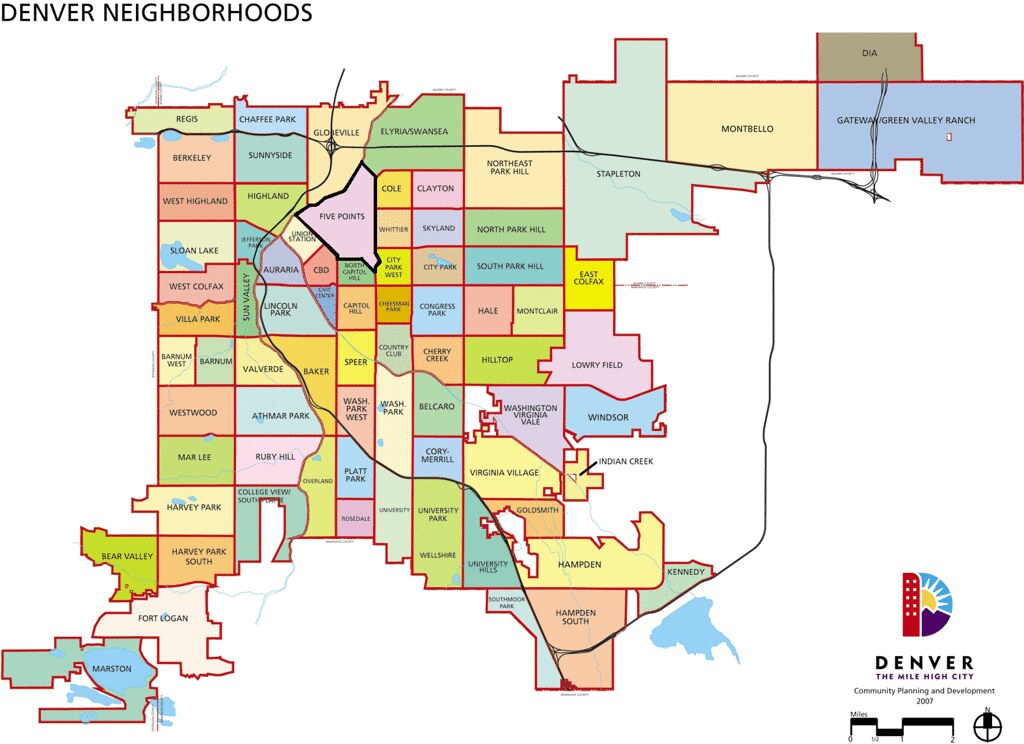
“Five Points” was the name given to the neighborhoods surrounding the intersection of Washington Street, 27th Street, 26th Avenue and Welton Street, located northeast of downtown Denver. The coming together of the downtown diagonal grid and the rectangular grid of the East Denver neighborhoods causes this intersection to be five-way, hence the name. As one of the city's oldest neighborhoods, Five Points came to prominence in the 1860s. Some of Denver’s oldest and most established other neighborhoods are situated within the larger Five Points neighborhood, including: Curtis Park, Whittier, Cole, Clayton San Rafael, and Ballpark neighborhoods.
The Curtis Park neighborhood is featured prominently in this thread and was named for the city park within its midst. Created in 1868 it was Denver’s first public park. In 1871 Curtis Park became the first of Denver’s many ‘street car suburbs’ with horse-drawn street cars running up Champa Street. The neighborhood flourished during the city’s first golden age between 1870 and 1893 when the silver crash brought an end to that early prosperity. An out-migration was already well under way by 1890, however, and those that could afford to moved to the newer, more fashionable Capitol Hill area.
First - as always a map for orientation -

 Lydon house - (architect John J. Huddart) 1891. This eclectic style home features stone course work that radiates out from the first floor window, above which an elaborate oriel window rests on a massive sandstone support. The steep roofline is flanked by stepped walls in the Dutch fashion.


 Queen Anne style town homes - (architect Henry Dozier) 1889. A rusticated stone terrace with curved two-story bays, turrets with finials as well as pedimented entry porches.


 Cole Junior High School - (architect William N. Bowman) 1925 Colonial Revival. Features three-story Tuscan columns and red brick with Indiana limestone trim.


 Scott United Methodist Church - 1889 Gothic Revival - architect Franklin E. Kidder. In 1927, this church was renamed for pioneer black Methodist Bishop Isaiah B. Scott after its African-American congregation acquired the property. Currently the Sanctuary Lofts condominiums.
 Fritz Thies house / The Gertrude Apartments - (architect Frederick C. Eberly) 1880 Italianate. Originally a single family residence, the house was sub-divided and became the Gertrude. This home is much larger than this photo portrays - it runs all the way to the alley.


 Kramer house - 1879 Second Empire - This home has come all the way back from when it stood empty for many years , its first floor completely gutted.


 My lone photo of Curtis Park (the actual park not the neighborhood) - not the best, there’s actually a city pool that I neglected to photograph.


 Nice rehab on an up-and-down duplex - I‘m really curious as to what the porch will look like


 Gebhard house - 1883 Italianate/Second Empire combination.


 1879 - Second Empire - (architect Matthew John McBird)

 First German Methodist Episcopal Church - 1887 Gothic Revival - Served as the Japanese Methodist Church from 1935 to 1963.


 Another rehab opportunity


 These sidewalks are predominate in Denver’s historic neighborhoods. Mayor Speer championed granite curb and gutter and sandstone sidewalks - wise move as they have outlasted cheaper concrete.

 This modern home has a bit of a nostalgic look.


 St. Ignatius Loyola Catholic Church 1923 - Gothic Revival - architects Frank W. Frewen Jr. and Frederick J. Mountjoy. Modeled after a church in Cork, Ireland.


 Two-story Italianate duplex - (architect Walter J. Swift) 1883. This double residence features two front bays that rise from wraparound porches resting on a rusticated stone foundation. The unique triple-gabled crowns sport a mansard roof and elaborately bracketed friezes and cornices.


 Queen Anne - 1885. The oriel window at the front of the second-floor addition is a distinctive feature in a unique interpretation of the Queen Anne style.
 Italianate - 1885 - A perfectly symmetrical grand Italianate with a double-bay front with the entrance in the middle, a fairly uncommon architectural arrangement at the time of its construction when most Italianates had entries to one side.
 Cleo Parker Robinson Dance Theatre - Formerly the Shorter African Methodist Episcopal Church.

 A rehab nearing completion right off of Welton Street


 1889 - Italianate bay-fronted duplex

 American Woodmen Life Building - 1950 - architect Gordon White. White terracotta wraps much of the exterior of this Streamline Moderne building. Founded in 1901, the American Woodmen became a leading African-American fraternal, charitable, and insurance society with a national membership. Today it houses an architectural practice
 Ballin house - 1879 Italianate - architect Emmet Anthony
 Diamond Lil’s - 1899 - architect Carl Eberely. The former Kopper’s Hotel and Saloon is one of the few surviving representatives of Denver’s early ethnic saloons and working class hotels.
 Miller house - 1902 Foursquare - architect Robert Russell. Heavy stonework and intricate carved details show the influence of the Romanesque Revival style. Note Russell’s typical use of gargoyles peering from the roofline.


 1885 - Second Empire - architect John F. Adams. The cornice that once wrapped the front bay has been lost , but the home is otherwise intact.
 Since photographed this structure has started a rehab.
 Van Stone Terrace - 1890 Victorian Eclectic - architects Van Stone Brothers. This three unit stone terrace combines elements derived from many styles and includes complex massing.


 Calvary Baptist Church/Zion Baptist Church - 1890 Romanesque Revival - architects Frank H. Jackson and George E. Rivinius. Zion Baptist was established in Denver in 1865 by former slaves and is the oldest African-American congregation west of the Mississippi River. Zion Baptist purchased this rusticated rhyolite stone church in 1913.


 1891 Queen Anne - architects Balcomb and Rice. Most unusual are the solid arched supports flanking the offset porch entry. Romanesque influences are evidenced in the narrow eyebrow dormer in the roof peak. Balcom and Rice purchased four lots on this corner in McCullough’s Additon in 1879 and the next photo is one of their designs as well.


 Cody House - 1892 Queen Anne - architect Arthur Hughes. William F. “Buffalo Bill” Cody died in this house on January 10, 1917. This was the house of May Cody Decker - The sister of William Cody. Cody is best remembered for his Buffalo Bill’s Wild West shows that toured both in the U.S. and abroad for two decades.
 David Dryden designed the two hip-roofed Queen Annes on the left from 1886-1889.
 Double Row House - 1890 Queen Anne - architect Franklin Goodnow. Two mirror image rowhouses that share a highly decorated center gambrel roof.
 1889 - Queen Anne duplex - architects Balcomb and Rice.
 This guy was painting Denver Nugget center Chris “Bird Man” Anderson.


 Scobey House 1883 - A classic assemblage of high Victorian architectural elements.


 1885 Queen Anne. With its main entry porch off to the side, the front mass of this tall example of the Queen Anne style thrusts dramatically upward.


 ca1885 - Second Empire - The only raised double in Curtis Park, with units up and down, this unique structure was rescued by Historic Denver. Was boarded up and used as storage space for a garage that stood next door for many years.


 1890 Queen Anne double residence.


 ca1890 - Former Epworth United Methodist Church.
 Manatt house - 1882 Classic Corner Italianate. By the 1970’s this home had been standing empty and derelict for years. Purchased in 1975 for $10,000, the house had been stripped bare.

 McPhee and McGinnity paint factory buiding 1923 - Styros building. The brick building, an important variation of Commercial Style architecture, is distinguished by its prominent clock tower. Currently the Clock Tower Lofts.


 Thirteenth Avenue Presbyterian Church (Currently God In Christ Church) 1883 Gothic Revival.

 Zint House - 1889 Queen Anne - architects Balcomb and Rice. This house features symmetrically placed corbelled porches in an otherwise asymmetric design.


 Kinneavy Terrace - 1889 Queen Anne/Eclectic - architect John J. Huddart. Although the Kinneavy has lost its wonderful row of front porches it still manages to capture the eye. The photo below is from 1983.


Denver Public Library, Western History Collection.
These modern row houses are my favorite of the many new rows in the area..


 1910 Greek Revival - architect Samuel W. Atkins. Full height Corinthian columns and a full-facade porch across the entire front are among the many features of this duplex.

 This house was hard to shoot - I couldn’t get a good angle due to the foliage, but it really is amazing - a real life gingerbread house.


 Anyhow - it appears I must quit posting here if anyone is to open this thread as it’s getting pretty massive. I’ll leave you with the ‘Chief” Thanks for viewing and commenting!
 MORE THREADS
Denver - Capitol Hill Neighborhood Part I
Denver - Capitol Hill Neighborhood Part II
Denver - Highlands Neighborhood
Chicago
NEW ORLEANS PART I
NEW ORLEANS PART II
Mt. Evans Scenic Byway
MORE THREADS
Denver - Capitol Hill Neighborhood Part I
Denver - Capitol Hill Neighborhood Part II
Denver - Highlands Neighborhood
Chicago
NEW ORLEANS PART I
NEW ORLEANS PART II
Mt. Evans Scenic Byway







 Linear Mode
