|
DENVER - Capitol Hill Neighborhood - *** PART II ***
Continuing from my previous thread on Denver's Capitol Hill hood.
PART DEUX
Capitol Hill was founded in the 1880s as a new residential suburb for Denver’s wealthiest families, who built extravagant Victorian, Tudor and Greek revival mansions using sandstone, granite and other materials native to Colorado. Through the years, Capitol Hill evolved, seeing everything from millionaire’s row to skid row, and many of those mansions met the wrecking ball. Today it’s one of Denver’s most diverse, urban, and intriguing neighborhoods, with its historic apartment buildings, converted mansions, high-rises, and single family homes all sharing the same blocks. The Colorado State Capitol building–dedicated in 1890–stands on the neighborhood’s far west side at Colfax Avenue & Lincoln Street. The area’s longstanding popularity is due in large part to its proximity to outstanding transportation infrastructure, parks, and unique retail and entertainment opportunities as well as its diverse housing stock. The average year of construction for buildings in the Capitol Hill neighborhood is 1920 contributing to its attractive and historic character.
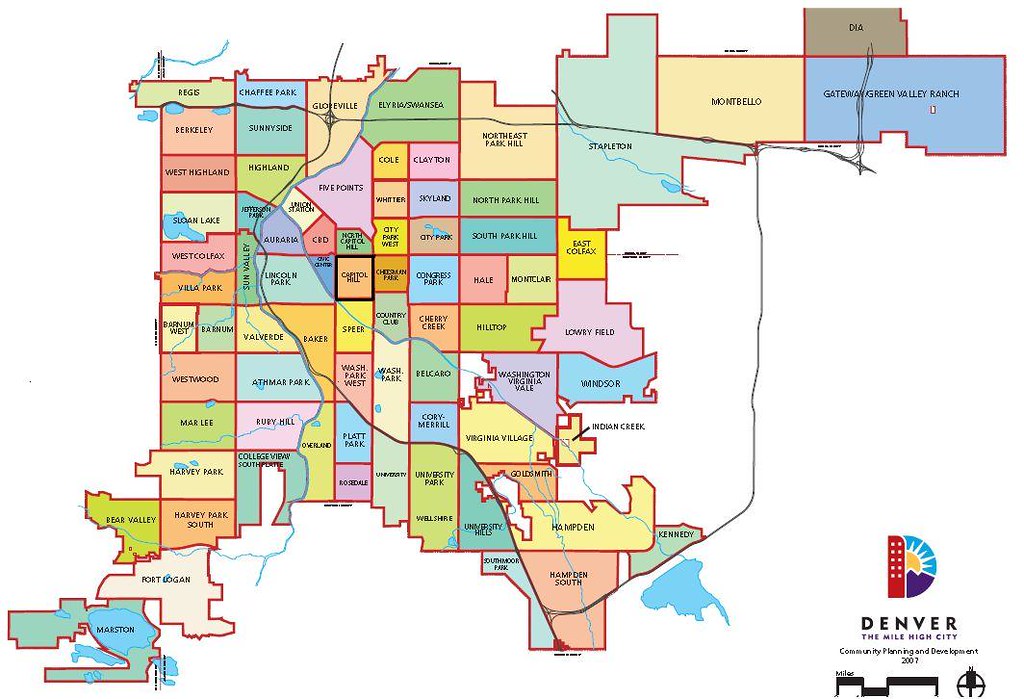
A map for orientation -
All photos were taken between May and December 2010.


 The Cornwall - 1901 - created by architect Walter T. Rice, the Cornwall reflected Italian and other Mediterranean influences. This three-story building contained 18 apartments of six or seven rooms, each with its own porch or loggia. Two roof gardens were connected to the roof top ballroom by a 250-foot promenade with a panoramic view from Pikes Peak to Longs Peak. This fantastic building was in the final stages of a renovation when I shot these next few photos.


 The Hill Mansion - 1902-1904 - Architects Boal and Harnois built this 17,000 square-foot showplace for Crawford and Louise Hill. In 1947, The Town Club, a Jewish businessmen’s club purchased the mansion and the members children enjoyed accompanying their fathers to the mansion where they could play in the large backyard pool. The house is now occupied by a large law firm.

 Louise Hill leaving her home circa 1907

CA 1907 - Denver Public Library, Western History Collection


 Temple Emanuel - designed in 1898 by John Humphrey in a Moorish style. Its acoustically superb auditorium seats 1,000 and features a rare Estey Manual pipe organ and Saracenic art motifs in both wood work and ceiling stenciling. Temple Emanuel thrived until 1957, when the congregation abandoned Capitol Hill for the Hilltop Neighborhood.


 Morey Middle School - Built by architects Fisher and Fisher in 1921, the school was named after Chester S. Morey who was a veteran of the Civil War. He made his fortune through mining and investments in Leadville. Morey was a member of the school board from 1892-1895. The building is designed in the Renaissance Style and features terra cotta and tinted stucco detailing on the second floor and a swimming pool. The ethnic diversity of the neighborhood is reflected in the racial make-up of the school - 39% White, 25% Hispanic, 25% Black, 8% Asian, and 1% Native American.

 Built in 1907 as the Mammoth Roller Rink, the Fillmore Auditorium has a long and storied history as an entertainment venue. As Mammoth Gardens and Mammoth Events Center, the building hosted sporting events, parties and shows for over sixty years. In 1968 the building was re-named Mammoth Gardens and hosted concerts by the decade's leading artists including Jimi Hendrix, The Doors, The Who, The Grateful Dead and Joe Cocker. After a multi-million dollar renovation in 1999, the venue re-opened as the Fillmore Auditorium with décor reminiscent of Bill Graham’s famous Fillmore in San Francisco and has hosted many of the world’s most famous music acts from Bob Dylan to Coldplay as well as dignitaries including President Obama.


 The Fisher Mansion - 1896 - Built by William Garrett Fisher, co-founder of the Daniels and Fisher department stores. Following several owners the house was purchased by architect David Owen Tryba, who redesigned the ballroom as his studio(which can be seen three photos down).


 The Cathedral of St. John in The Wilderness Episcopal Church. Construction began in 1909 on this English Gothic design. Architects Gordon, Tracy, and Swarthwout of New York won a nationwide design competition and published their plan for the structure in the New York Architect in December 1908.


 1908 home - a favorite of mine.


 The Elmar - 1903 - wears elegant terra cotta and wrought iron ornament.


 The Cathedral Basilica of the Immaculate Conception is home to the Archdiocese of Denver. The cathedral building, designed by Detroit architect Leon Coquard in the French Gothic Style, was constructed from 1900-1911. Influenced by the the 13th century collégiale Saint-Nicolas of Munster, Moselle, France--the birth village of bishop Nicholas Chrysostom Matz, who supervised its construction--the cathedral is made of Indiana Bedford limestone and features Carrara marble altars illuminated by 36 exquisite stained glass windows made by F. X. Zetter Studios in Munich. Its twin spires rise to 210 feet. Its inaugural mass was held on October 27, 1912 and consecration in 1921. The cathedral was raised to the status of minor basilica by the Vatican on Christmas Day, 1979--one of only 29 American Cathedrals with that title.
 The statue of Pope John Paul II, designed by Polish sculptor Jacek Osadczuk, was installed outside the Cathedral Basilica of the Immaculate Conception on April 2, 2009, the fourth anniversary of the pontiff's death, and dedicated on May 17, 2009. The statue commemorates the event of Pope John Paul II holding mass at the cathedral for World Youth Day on August 13-14, 1993.


 The Eugene Henry Weckbaugh home - 1908 - This formal, French style townhouse with steep-hipped roof and arched side dormers was built by John Kernan Mullen, the founder of the Colorado Milling and Elevator Company. Mullen built the home as a wedding gift for his daughter Ella and likewise built houses for his other three daughters when they married - all within a block of each other.


 The Perrenoud - 1901 - the classical simplicity of the Frank Snell designed four story exterior belies the elegantly appointed apartments. The building contains twenty-four apartments, six to a floor, each boasting six to eight rooms. Perrenoud apartments were arranged around four light courts so all rooms would have windows. The Perrenoud came complete with a bellboy, janitor, garage attendants, and other uniformed staff for the billiard room, bowling alley, and ballroom. The main entrance leads into a grand hallway with marble wainscoting, French plate glass mirror walls, and a Tiffany skylight. The central rotunda has a fireplace and an ornate, brass grille elevator cage. The building went condo in 1985.


 1890 row houses - on Humboldt Street.


 Poets Row Apartments contains nine three-story buildings with poetic names. The two oldest structures, built in 1931, are the Robert Frost and Louisa May Alcott and feature terra cotta surrounds and inset panels. The Robert Browning (1937), the Thomas Carlyle (1936), and the James Russell Lowell (1936) all reflect the Art Deco influence in the verticality of brick piers and in the heavy use of terra cotta spandrels and door surrounds. Art Moderne touches include the contrasting horizontal brick bands between stories, rounded corners, and glass brick panels. The entries of the Mark Twain (1937) and the Eugene Field (1937) are emphasized by projecting, rectangular surrounds of dark ceramic brick with a high glaze.


 Built in 1889 - this townhouse was another William Lang design.


 The Zell - surviving apartments on Sherman Street directly across from where the Guggenheim House (pictured below) once stood.
 The Guggenheim house - Simon Guggenheim moved to Denver in 1892 and lived in this home on Sherman Street. The son of Meyer Guggenheim and Barbara Guggenheim, Simon worked as the chief ore buyer for his father's mining and smelting operation, M. Guggenheim’s Sons. To commemorate the birth of their first child, John Guggenheim, in 1905, Simon donated $80,000 to the Colorado School of Mines to build a namesake building, Guggenheim Hall. Later Guggenheim was elected Republican senator for Colorado from 1907 to 1913. The passage of time has not been particularly kind to this stretch of Sherman north of Colfax as most of the historic structures are gone.

1948 - Denver Public Library, Western History Collection.


 The J. M. Kuykendall house 1910 - A.A. Fisher Architect. Built of white cement.


 The Corona School - 1889 - Architect Robert Roeschlaub. Renamed the Dora Moore School.


 Built in 1919, the Neoclassical State Office Building was designed by architect William Norman Bowman. Bowman is credited with many other well known Denver landmarks such as the Mountain States Telephone Building, the Continental Oil Building, and the Colburn and Cosmopolitan hotels. The building now houses the Colorado Department of Education.


 Completed in 1885, the Emerson School is the oldest remaining school in the state designed by Robert Roeschlaub, who is widely considered Colorado’s first master architect. After serving for nearly a century as an elementary school, the Emerson School closed in 1979, reopening later to serve a variety of uses, including a senior center, geriatric clinic, dental clinic and church.The National Trust For Historic Preservation has acquired the school to serve as the new home for the National Trust’s Mountains/Plains Regional Office, as well as two of Colorado’s leading nonprofit preservation organizations, Colorado Preservation, Inc. and Historic Denver, Inc.
 Opened in 1918, the Ogden Theatre was a vaudeville house before it transformed into a second-run movie theater, which it remained until closing in 1990. In 1993, Doug Kauffman of Nobody in Particular Presents re-opened the Ogden as a concert venue, forever fusing rock and roll with the theater’s storied history: In its eighty-eight year existence, the Ogden has hosted everyone from Harry Houdini to Iggy Pop, Jackson Brown to the Smashing Pumpkins.


Well that’s all for now - thanks for staying until the end - pretty long thread. Stay tuned for my next thread featuring Denver’s Five Points/Curtis Park neighborhood.
MORE THREADS
Denver - Capitol Hill Neighborhood Part I
Denver - Highlands Neighborhood
Chicago
Last edited by CPVLIVE; Apr 23, 2011 at 9:10 PM.
|





 Prev
Prev


 Linear Mode
