Quote:
Originally Posted by Scott Wood

I don't see how you can evaluate the former outside the context of the latter. $110 million would be really cheap for a high-ridership line. It's pretty expensive for something that draws fewer riders than a lot of local bus routes.
When I buy something and it turns out to be junk, that it was cheaper than the good alternative is small comfort. It's good that the mistake was not more expensive than it was, but it's not cheap compared to the value it brings.
|
But you'd be singing a different tune if the cost to implement your better alternative is out of your price range. If $110 Million almost put CapMetro into bankruptcy, I guarantee a $1 Billion light rail line would!
Quote:
|
Yes, and it's better to measure that end result (ridership) than just one of the inputs in isolation.
|
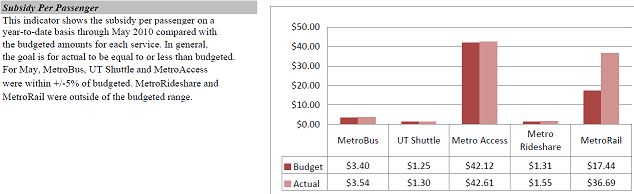
I sincerly disagree. Ridership is not the end all of transit. Subsidies are. Not subsidy per passenger, but overall subsidy.
Quote:
|
That does not make it a good comparison for statements such as "Norfolk's Tide light rail still costs almost 7 times more, which is not projected to have 7 times more riders by 2030...."
|
You must have not followed entirely what I wrote. While you quoted that sentence correctly, you still took it out of context. An earlier sentence contained if the Red Line capital costs were twice than $110 Million
Therefore, what I meant in actuality, "Norfolk's Tide light rail costs 14 times more, which is not projected to have 7 times more riders by 2030.
Quote:
|
DART's Green Line is on the high side for typical LRT lines, but even there the capital cost per daily rider is lower. $1.8B divided by a projected 30,000 daily trips comes out to about $60,000 each.
|
I don't disagree. But to be fair, I also included the low side for typical LRT lines with Norfolk's Tide.
By the way, what ever happen to cost per ride? That 30,000 daily trips on the Green Line over 30 years with 260 weekdays per years should be 234,000,000 trips.
The capital cost per weekday trip will be $7.69.
Quote:
|
$110 million divided by 1000 daily rides is $110,000. Even if the original projections on the Red Line were true and it got 2000 daily rides, that would be only slightly less than Dallas's Green Line. And I bet the per-ride operating subsidy on the latter is substantially lower.
|
Again with the per daily ride costs. Let's do some assumptions.....
(a)Capital cost for equipment that should last 30 years.
(b)There's a maximum of 260 weekdays in a year (52x5)
So, the capital costs per ride over 30 years should be......
$110,000,000 / 30 / 260 / 1,000 =
$14.10
If the Red Line eventually increases ridership to 2,000 per day, the capital cost per rider over 30 years falls to
$7.05 per ride. That would be less than DART's Green Line, even though DART's line gets 15 times more riders.
But freight trains are also using the tracks, and buses are also using the stations. How do we distribute some of these capital costs off the passenger trains?
CapMetro yearly train operating costs is $10,600.
The operating costs per ride should be
$10,600,000 /260 /1,000 = $40.76
These are operating costs, not subsidy statistics.
Drop the riders, you can find the costs to run all 6 trains a day; $40,769 a day. Divide that by 6 trains; $6,794 per train per day.
Assuming each train runs 8 hours a day; $849 per train per hour.
That includes the fuel, all inclusive insurance policy, train operator salary and benefits, maintenance crew salary and benefits, train dispatcher salary and benefits, and CapMetro support staff salary and benefits.
The train itself really doesn't care how many passengers are onboard; the costs to operate the train hourly, daily, weekly, monthly, and yearly is the same.
I've discuss this before, what's important whether a transit agency can afford a project is its total yearly subsidy. Look at the statistics DART puts out for bus, light rail, and commuter rail yearly subsidies again.
You're not looking at how Minneapolis subsidizes it.
http://eastaustinvoice.wordpress.com/2010/02/10/the-hiawatha-light-rail-disaster-»-the-antiplanner/
38% by fares, 31% by local taxes, and 31% from State taxes. CapMetro doesn't have the luxury of the State supporting transit in Austin.
The $715 Million to build this line was the total after cost overruns. The initial projected costs was projected to be only $480 Million. It came in 49% overbudget, by a whopping $235 Million. Just the cost overruns was more than twice the Red Line's cost. CapMetro can run it's trains over 20 years with this $235 Million. I'm sure the Feds reviewed the total costs and the projected ridership, which by the way was projected to be just 9,000 rides a day, not the 30,000 they have.
So the Feds got it wrong twice.
Quote:
|
From Capital Metro's 2011 budget, the operating costs of the Red Line are around $10.6 million. 1000 daily riders every weekday is 260,000 rides per year (let's ignore the few days a year of Saturday service -- it won't change much). Even if they all pay full $2.75 fare (many probably have passes instead), that's only $715,000, yielding an operating subsidy of around $38 per ride
|
Again you included subsidy per ride but forgot to include total subsidy. Which is less than $10.6 Million. If your math is correct, the yearly subsidy is less than $10 Million. CapMetro expects to get $140 Million this year in tax revenues, so less than 10% of its revenues will be used subsidizing rail. I wonder what the other 90% subsidizes? DART by comparison total subsidy is 284.2 Million in FY10, subsidizing buses $193.8 Million (68%) and trains 90.3 Million (32%).
Quote:
|
What's the expected <DCTA> ridership?
|
DCTA EIS projected ~8,000 trips per day by 2030. They project yearly operational costs this year was set for $8.72 million, but that was before delaying startup of train services for the entire line back to late June.
Also, that's using Budd RDCs this first year instead of Stadler GTWs, which are not scheduled to start service until September 2012.
So, using my math, the operating cost per trip should be
Math = $8,720,000/8,000/260 = $4.19/trip
DCTA's capital cost per trip over 30 years would be
$310,000,000/8,000/260/30 = $4.97/trip
Again, that's not the subsidies per trip, it's costs per trip.
More than just operating costs must be calculated to find the subsidy per trip. But does this statistic really mean anything?
Costs per rider doesn't mean anything to an agency trying to balance its budget. How much each rider is subsidize may be fun for bean counters, it's the total subsidy and the bottom line that counts more to determine what they're doing is affordable or not.





 Prev
Prev




 Linear Mode
