HomeDiagramsDatabaseMapsForum About
     

Go Back   SkyscraperPage Forum > Regional Sections > United States > Texas & Southcentral > Austin


Reply

 
Thread Tools Display Modes
     
     
  #2221  
Old Posted Feb 17, 2011, 7:10 PM
KevinFromTexas's Avatar
KevinFromTexas KevinFromTexas is offline
Meh
 
Join Date: Jul 2001
Location: Austin,TX<-->Dripping Springs,TX<-->Birmingham, AL<-->Warm Springs,GA
Posts: 57,205
Yes, but people will actually use the bridge. Ha!

And actually, the writer for the article got it wrong. The bridge extension is actually around 375 feet long. The entire bridge, including the section that was built 10 years ago, is 990 feet long. Also the construction included more than just the bridge extension itself. It needed an embankment to support it, and also has new landscaping and sidewalks around it.

I went to go take photos of the new extension and also the views from it. It had only been open a week at that point and was already being used by a lot of people. I almost got clipped a few times by bicycles on the bridge and there were plenty of pedestrians even after dark when it started to get cold.

I'm convinced that it's money well spent.
__________________
My girlfriend has a poodle named Kevin.
Reply With Quote
     
     
  #2222  
Old Posted Feb 17, 2011, 7:11 PM
M1EK's Avatar
M1EK M1EK is offline
Registered User
 
Join Date: Jul 2006
Posts: 2,194
Quote:
Originally Posted by electricron View Post
That's $16,908.21 per foot for the Pfluger extension.
Meanwhile, the often criticized Red Line trains capital costs were just $651.04 per foot....

Math:
$3,500,000 / 207 ft = $16,908.21
$110,000,000 Million / 32 miles / 5280 ft/mile = $651.04

Note: This was just the cost of extending the Pfluger Bridge, it doesn't include the costs for the entire bridge, nor its length. I wonder who is going to count the numbers using the Pfluger bridge and determined if it was worth the cost of building?
The original Pfluger bridge carries more people in a day, I'd wager, than the Red Line does in a month. Not sure how many will use the extension, but it has a far stronger track record.

Your numbers for the Red Line are also way too small. It's requiring huge operating subsidies - the originally budgeted numbers were bad enough, but we actually ended up subsidizing passengers at more than $30/ride before the service expansion in January. Operating cost of the Pfluger bridge is essentially zero.

Nice try.
__________________
Crackplog: M1EK's Bake-Sale of Bile
Twitter: @mdahmus
Reply With Quote
     
     
  #2223  
Old Posted Feb 17, 2011, 7:17 PM
KevinFromTexas's Avatar
KevinFromTexas KevinFromTexas is offline
Meh
 
Join Date: Jul 2001
Location: Austin,TX<-->Dripping Springs,TX<-->Birmingham, AL<-->Warm Springs,GA
Posts: 57,205
Here are three of the photos I took on the bridge. I didn't (and couldn't) take a single photo without at least one person or more in the shot. The temperature was about 38F degrees when I took these.

And also, there are parts of 12 buildings in this shot. 10 of them are residential. The bridge will get plenty of usage.


__________________
My girlfriend has a poodle named Kevin.
Reply With Quote
     
     
  #2224  
Old Posted Feb 17, 2011, 7:19 PM
arbeiter's Avatar
arbeiter arbeiter is offline
passion for patterns
 
Join Date: Apr 2004
Location: San Francisco
Posts: 10,336
Your "watermarks" are damaging otherwise decent photos!
__________________
you should know that I'm womanly wise
my website/blog. or, my flickr site.
Reply With Quote
     
     
  #2225  
Old Posted Feb 17, 2011, 7:23 PM
KevinFromTexas's Avatar
KevinFromTexas KevinFromTexas is offline
Meh
 
Join Date: Jul 2001
Location: Austin,TX<-->Dripping Springs,TX<-->Birmingham, AL<-->Warm Springs,GA
Posts: 57,205
Quote:
Originally Posted by arbeiter View Post
Your "watermarks" are damaging otherwise decent photos!
Thanks. I hate having to put them on there, but I see my photos popping up on sites (for companies) without my permission, and on other forums that I intentionally do not post on.
__________________
My girlfriend has a poodle named Kevin.
Reply With Quote
     
     
  #2226  
Old Posted Feb 18, 2011, 1:32 AM
electricron's Avatar
electricron electricron is offline
Registered User
 
Join Date: Aug 2008
Location: Granbury, Texas
Posts: 3,611
Lightbulb

Quote:
Originally Posted by M1EK View Post
It's requiring huge operating subsidies - the originally budgeted numbers were bad enough, but we actually ended up subsidizing passengers at more than $30/ride before the service expansion in January. Operating cost of the Pfluger bridge is essentially zero.
All rail lines and busways require operating subsidies. Someone is going to have to sweep or pickup the litter on the trail too. So, it will also require some operating subsidies, although not as huge as rail.
At the cost of the bike-trail construction, the capital costs for the 32 mile Red Line is probably cheaper than Austin building a 32 mile long bike-trail....

Let's take a well known bike-trail in Dallas....
Katy (MKT) trail in Dallas = $23 Million @ 3.5 miles = 6,571,428.57/mile or $1,244.59/foot
That's twice the per mile capital costs for the Red Line...
If the MKT trail in Dallas was 32 miles long, it would cost over $210 Million.

Source: http://en.wikipedia.org/wiki/Katy_Trail_(Dallas)


Photo credits: Rich Patterson

I'm not in the slightest suggesting building bike trails is a waste of money. But I'm not the one suggesting CapMetro spent far too much money on the Red Line either.
Everything is relative...
Reply With Quote
     
     
  #2227  
Old Posted Feb 18, 2011, 12:33 PM
KevinFromTexas's Avatar
KevinFromTexas KevinFromTexas is offline
Meh
 
Join Date: Jul 2001
Location: Austin,TX<-->Dripping Springs,TX<-->Birmingham, AL<-->Warm Springs,GA
Posts: 57,205
http://www.bizjournals.com/austin/pr...and-money.html
Quote:
Downtown Austin project needs more time and money

Downtown Austin project needs more time and money

Austin Business Journal - by Jacob Dirr, ABJ Staff
Date: Friday, February 18, 2011, 5:00am CST - Last Modified: Thursday, February 17, 2011, 2:54pm CST

The Brazos Street reconstruction project downtown, already over budget and behind schedule, needs more money, according to city records.

Staff asked the Austin City Council this week for another $688,500 for water-filled traffic barriers and vibration monitors, bringing the total contract to $11.8 million, which is 11.5 percent over budget, according to records.
__________________
My girlfriend has a poodle named Kevin.
Reply With Quote
     
     
  #2228  
Old Posted Feb 18, 2011, 2:12 PM
M1EK's Avatar
M1EK M1EK is offline
Registered User
 
Join Date: Jul 2006
Posts: 2,194
Quote:
Originally Posted by electricron View Post
All rail lines and busways require operating subsidies.
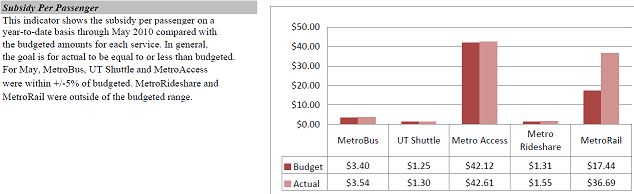
You're trying to make your favorite technology look like less of a disaster for Austin than it really is. Nobody claimed it was supposed to be subsidy-free; but a good light rail line requires operating subsidies of a few bucks/ride, on the order of what we currently pay for buses. The Red Line budgeted more like 17 bucks/ride and ended up north of 36 bucks/ride.


larger version
__________________
Crackplog: M1EK's Bake-Sale of Bile
Twitter: @mdahmus
Reply With Quote
     
     
  #2229  
Old Posted Feb 19, 2011, 2:17 AM
electricron's Avatar
electricron electricron is offline
Registered User
 
Join Date: Aug 2008
Location: Granbury, Texas
Posts: 3,611
Lightbulb

Did you read the small text on the left in your image?

"This indicator shows the subsidy per passenger on a year-to-year basis through May 2010 compared with the budgeted amounts for each service."

Let's recall when the Red Line service began? Monday, Mar 21, 2010.

So you're looking at data for an entire year after just two months of operation and expect the data to mean anything? The testing and correcting startup problems contributed much to the delays to the rail service, delays causing higher operating costs while not at the same time receiving fare revenues. The data you want to use will not mean anything until after the first year of train service. Who are you trying to fool? Pre-Kindergarten students?

Let's wait for later and more consistent data before making judgements....

From your favorite author Ben Wear:
http://www.statesman.com/news/local/...s-1237189.html
"First of all, MetroRail (are you sitting down?) is doing better since the agency added midday service about three weeks ago. Not wowzer-huge, not transformative to Central Texas transportation and still well under original first-year projections, but noticeably better.
The agency late last week released boarding figures for the first nine days after the Jan. 18 addition of about a dozen once-an-hour trains in each direction running between 9 a.m. and 3 p.m. on weekdays. The average boardings: 1,191 a day, with a high of 1,390 on Jan. 26.
That's up from monthly averages in the vicinity of 850 a day since MetroRail opened in March, or about a 40 percent jump. Not bad."

Still not the projected 2,000 riders per day goal often brought up, but the number of riders seem to be increasing with more frequent services. That same article also mentioned more issues extending the bike trail under the UP tracks as well.....

Great testing protocols often find problems that require fixing. Here's three other transit examples within the last year.....
MTA North (Commuter Rail new M8 trains)
http://www.myfoxny.com/dpp/traffic/m...rvice-20110218
SEPTA (Commuter Rail new Silverliner V trains)
http://planphilly.com/septa-issues-n...erliner-v-cars
Tide (New light rail line in Norfolk)
http://www.wvec.com/news/HRT-may-go-...114750469.html
http://www.newgeography.com/content/...ve-rising-tide
"The Virginian Pilot reports that the cost of the Hampton Roads (Virginia Beach-Norfolk metropolitan area) “Tide” light rail line has now escalated to nearly $340 million. This is up nearly one-half from the estimates made when the project was approved by the Federal Transit Administration. According to federal documentation, the line will carry 7,100 daily passengers in 2030. This means that the capital cost alone will amount to an annual subsidy of approximately $6,500 per daily passenger (using Office of Management and Budget discount rates), plus an unknown additional operating subsidy."

An additional data that can be found on the "net" is this light rail line's length of 7.4 miles....
Similar math used earlier:
$340,000,000 / 7.4 mi / 5280 ft/mi = $8,701.88/ft
That's not including any operating subsidies.

Reviewing data for direct comparisons....
CapMetro Red Line = $651.04/ft
Norfolk Tide = $8,701.88/ft

Even if you doubled the capital costs for the Red Line, I doubt the Red Line costed that much, Norfolk's Tide light rail still costs almost 7 times more, which is not projected to have 7 times more riders by 2030....
The Tide is just a shorter version of the Austin 2000 light rail plan, running in city streets downtown, a train station near a University, and running in an abandoned freight rail corridor to the suburbs, so it should make a good comparison. Yet, the Tide's capital cost overruns far exceed the total capital cost for the Red Line...Now, imagine what the cost overruns of an incompetent CapMetro managed light rail line would have been?

Last edited by electricron; Feb 19, 2011 at 8:02 PM.
Reply With Quote
     
     
  #2230  
Old Posted Feb 19, 2011, 6:24 AM
KevinFromTexas's Avatar
KevinFromTexas KevinFromTexas is offline
Meh
 
Join Date: Jul 2001
Location: Austin,TX<-->Dripping Springs,TX<-->Birmingham, AL<-->Warm Springs,GA
Posts: 57,205
http://impactnews.com/central-austin...rvice-for-sxsw
Quote:
Capital Metro extends MetroRail service for SXSW

By Amy Deis

Friday, 18 February 2011

AUSTIN — Capital Metro is extending its Friday MetroRail hours and adding Saturday service for easier access to South by Southwest events.

Spokeswoman Misty Whited said the Capital Metro board of directors had approved in its fiscal year 2011 budget to extend service on four Friday nights for all nine stations between downtown Austin and Leander and add three days of Saturday service for all but the Leander station.

The extended Friday service will be for March 4, 11, 18 and 25 and the special Saturday service will be March 12 and 19 as well as May 7, the day of the spring Pecan Street Festival.
__________________
My girlfriend has a poodle named Kevin.
Reply With Quote
     
     
  #2231  
Old Posted Feb 20, 2011, 4:18 PM
electricron's Avatar
electricron electricron is offline
Registered User
 
Join Date: Aug 2008
Location: Granbury, Texas
Posts: 3,611
Lightbulb

To show just how cheap construction of the Red Line was, I have compared it with other projects locally and nationally...

Let's review some I posted earlier...
CapMetro Red Line = $651.04/ft
Katy (MKT) Trail in Dallas = $1,244.59/ft
Norfolk Tide Light Rail = $8,701.88/ft

And I would like to add San Antonio's Fredericksburg Road Rapid Bus Line to this list.
Per the EIS http://viabrt.net/Documents/DraftEA/...%20Summary.pdf

$57,200,000 / 9 miles / 5,280ft/mi = 1,203.70/ft

Yes, CapMetro's Red Line costs half as much as Via's Rapid Bus Primo Line.
Why?

Answer: The rail corridor already existed. Improvements were required to initiate passenger train services; better signaling for both trains and autos, laying some new tracks, buying the trains, building trains stations and building parking lots.

And as this exercise has proved, starting a rapid commuter train service over an existing rail corridor is relatively cheaper to implement. Cheaper than new rapid bus, cheaper than a new bike trail, and cheaper than new light rail.
Reply With Quote
     
     
  #2232  
Old Posted Feb 20, 2011, 7:29 PM
Somnio Somnio is offline
BANNED
 
Join Date: Feb 2011
Posts: 93
I'd still say it wasn't money well spent, though. I would have rather seen Capital Metro come back with a scaled back version of the original light rail plan from the election in 2000.

I think they should have sought approval for the 14.6 mile, 16 station minimum operable segment from the original plan.


This would have been a fantastic starter line, and I suspect wildly successful.
Reply With Quote
     
     
  #2233  
Old Posted Feb 21, 2011, 1:14 AM
Scott Wood Scott Wood is offline
Registered User
 
Join Date: Jul 2009
Location: Austin, Texas
Posts: 56
Quote:
Originally Posted by electricron View Post
To show just how cheap construction of the Red Line was, I have compared it with other projects locally and nationally...

Let's review some I posted earlier...
CapMetro Red Line = $651.04/ft
Katy (MKT) Trail in Dallas = $1,244.59/ft
Norfolk Tide Light Rail = $8,701.88/ft
Yeah, stuff like the Red Line is cheap *per foot*. But the goal isn't "length of track", it's moving people. A 100% rural line on existing tracks with one stop one each end, between distant points in the middle of nowhere, would be pretty cheap per foot, but useless.

So, the metric should be cost per passenger. Possibly also cost per passenger-mile, though that only makes sense if you're looking at the transportation solution in isolation, rather than in conjunction with land use planning that can reduce the number of miles people need to travel -- you need to be comparing cities with similar development patterns after any effect from the rail.

And don't forget operating costs.

Quote:
Norfolk's Tide light rail still costs almost 7 times more, which is not projected to have 7 times more riders by 2030....
There are LRT lines with much better ridership than what's being projected for Norfolk. Why not compare to Houston, Dallas, Portland, Minneapolis, Denver, etc.?
Reply With Quote
     
     
  #2234  
Old Posted Feb 21, 2011, 5:34 AM
electricron's Avatar
electricron electricron is offline
Registered User
 
Join Date: Aug 2008
Location: Granbury, Texas
Posts: 3,611
Lightbulb

Quote:
Originally Posted by Scott Wood View Post
So, the metric should be cost per passenger. Possibly also cost per passenger-mile, though that only makes sense if you're looking at the transportation solution in isolation, rather than in conjunction with land use planning that can reduce the number of miles people need to travel -- you need to be comparing cities with similar development patterns after any effect from the rail. And don't forget operating costs.
There are LRT lines with much better ridership than what's being projected for Norfolk. Why not compare to Houston, Dallas, Portland, Minneapolis, Denver, etc.?
I'll agree cost per passenger mile makes more sense for transit projects. But, I don't think you will ever find an agreement on how to figure that for a bike trail, since no one ever counts that. In fact, no transit agency really counts that for any transit project.
You find passenger trips per day counted. Only a few can count each and every trip, only those using smart cards where the passenger swipes a card reader while boarding and unboarding transit vehicles. Those using the smart cards can get close to counting passengers per mile, but since the fares are by zones and not by mile, don't quite reach that level of detail you desire. So, lets not expect data on what isn't achievable.
The best CapMetro can do is provide trip counts. We'll have to wait to see if CapMetro's recent jump in ridership is steady or not before calculating it. Likewise with the other projects listed earlier. Norfolk's Tide and San Antonio's Primo service haven't entered service yet. Not all of the Dallas Katy trail is completed either. The only data for all of these projects listed earlier is the desired length and projected capital costs. And that's what I have provided in my comparisons....

If CapMetro has been significantly wrong with the Red Line ridership projections, what makes you think they would be more accurate with Light Rail ridership projections? It's been my experience ridership projections are never correct, mainly because those projecting assume future growth incorrectly. They counted a real estate project that never materializes, or is only partially built. Or another real estate project is built nearby that competes with the project they counted. It's best to wait and see actual ridership figures, then only used after they have reach a steady state.

The main point of my earlier recent responses is to suggest that building the Red LIne wasn't all that expensive. Not whether it was a wise investment or not. Additionally, the length of a corridor isn't unimportant. Who is going to walk or bike a trail 32 miles twice a day? The longer the transit corridor, the more stations it has, the location of the stations, the easier access to the stations, and the higher speed of the vehicles, the more riders it will attract. While the length of the corridor is just one of the many factors, but it's just as important as the others.

I used the Norfolk light rail system for comparison purposes because, while 50% overbudget, it's the cheapest light rail system to be built per distance in the last 10 years. DART's recent Green LIne, much closer choice to Austin, has significant aerial sections driving up its cost. Here's its scarry numbers.....
$1,800,000,000 / 28 miles / 5280 ft/mile = $12,175.32/ft
About 50% higher than Norfolk's Tide....

DCTA's A-Train commuter train is also located in Texas (Will be using Stadler GTWs like CapMetro):
$310,000,000 / 21 miles / 5280 ft/mile = $2,795.81/ft
Sort of makes the CapMetro's $651/ft look much better, doesn't it?

And I will agree the 2000 Light Rail project would attract far more riders, even though it didn't go all the way to Leander. Never-the-less, I strongly believe it would have bankrupted CapMetro to build it, if what I've read that the far cheaper to build Red Line almost did. An additional consideration to consider, which I believe many have overlooked, is that higher ridership for transit also means higher subsidies.

Let's look at some DART numbers.
From http://www.dart.org/about/aboutdart.asp
FY10 bus subsidy per passenger = $5.10 (38.0 million passenger trips) = $193.8 Million
FY10 light rail subsidy per passenger = $4.21 (17.8 million passenger trips) = $74.9 Million
FY10 TRE subsidy per passenger = $6.19 (2.5 million passenger trips) = $15.4 Million
The total TRE yearly subsidy is significantly smaller although it has the higher per passenger subsidy. Why? It has far few passengers getting that subsidy. The idea that a more heavily used 2000 Light Rail line would need less total subsidy than the Red Line is not necessarily true. Per DART's experience, Light Rail requires a higher yearly subsidy.

My last observation and point:
If CapMetro can't afford to subsidize the Red Line, it can't afford to subsidize Light Rail either.

Last edited by electricron; Feb 21, 2011 at 6:29 AM.
Reply With Quote
     
     
  #2235  
Old Posted Feb 21, 2011, 5:55 PM
M1EK's Avatar
M1EK M1EK is offline
Registered User
 
Join Date: Jul 2006
Posts: 2,194
Quote:
Originally Posted by electricron View Post
If CapMetro has been significantly wrong with the Red Line ridership projections, what makes you think they would be more accurate with Light Rail ridership projections?
Because their projections for the 2000 light rail line were vetted by the Feds, and actually mesh with reality (i.e. they don't predict vastly higher numbers than similar lines in similar cities).

Are you really this out of touch on this stuff?
__________________
Crackplog: M1EK's Bake-Sale of Bile
Twitter: @mdahmus
Reply With Quote
     
     
  #2236  
Old Posted Feb 23, 2011, 3:21 AM
Scott Wood Scott Wood is offline
Registered User
 
Join Date: Jul 2009
Location: Austin, Texas
Posts: 56
Quote:
Originally Posted by electricron View Post
The main point of my earlier recent responses is to suggest that building the Red LIne wasn't all that expensive. Not whether it was a wise investment or not.
I don't see how you can evaluate the former outside the context of the latter. $110 million would be really cheap for a high-ridership line. It's pretty expensive for something that draws fewer riders than a lot of local bus routes.

When I buy something and it turns out to be junk, that it was cheaper than the good alternative is small comfort. It's good that the mistake was not more expensive than it was, but it's not cheap compared to the value it brings.

Quote:
Originally Posted by electricron View Post
Additionally, the length of a corridor isn't unimportant. Who is going to walk or bike a trail 32 miles twice a day? The longer the transit corridor, the more stations it has, the location of the stations, the easier access to the stations, and the higher speed of the vehicles, the more riders it will attract. While the length of the corridor is just one of the many factors, but it's just as important as the others.
Yes, and it's better to measure that end result (ridership) than just one of the inputs in isolation.

Quote:
Originally Posted by electricron View Post
I used the Norfolk light rail system for comparison purposes because, while 50% overbudget, it's the cheapest light rail system to be built per distance in the last 10 years.
That does not make it a good comparison for statements such as "Norfolk's Tide light rail still costs almost 7 times more, which is not projected to have 7 times more riders by 2030...."

Quote:
Originally Posted by electricron View Post
DART's recent Green LIne, much closer choice to Austin, has significant aerial sections driving up its cost. Here's its scarry numbers.....
$1,800,000,000 / 28 miles / 5280 ft/mile = $12,175.32/ft
About 50% higher than Norfolk's Tide....
That's on the high side for typical LRT lines, but even there the capital cost per daily rider is lower. $1.8B divided by a projected 30,000 daily rides comes out to about $60,000 each.

$110 million divided by 1000 daily rides is $110,000. Even if the original projections on the Red Line were true and it got 2000 daily rides, that would be only slightly less than Dallas's Green Line. And I bet the per-ride operating subsidy on the latter is substantially lower.

Let's try another example -- Minneapolis's Hiawatha line. $715 million -- including a tunnel under the airport and an underground station. Around 30,000 actual (not projected) weekday riders. That comes out to around $20,000 in capital costs per weekday ride. Operating costs were budgeted at $25.7 million in 2010, with over 38% covered by fares, leaving an operating subsidy of $15.8 million. Divide by 9.9 million yearly rides, and you get an operating subsidy of $1.60 per ride.

From Capital Metro's 2011 budget, the operating costs of the Red Line are around $10.6 million. 1000 daily riders every weekday is 260,000 rides per year (let's ignore the few days a year of Saturday service -- it won't change much). Even if they all pay full $2.75 fare (many probably have passes instead), that's only $715,000, yielding an operating subsidy of around $38 per ride.

60% more total operating subsidy for 30 *times* the ridership.

Quote:
Originally Posted by electricron View Post
DCTA's A-Train commuter train is also located in Texas (Will be using Stadler GTWs like CapMetro):
$310,000,000 / 21 miles / 5280 ft/mile = $2,795.81/ft
Sort of makes the CapMetro's $651/ft look much better, doesn't it?
What's the expected ridership?

Quote:
Originally Posted by electricron View Post
An additional consideration to consider, which I believe many have overlooked, is that higher ridership for transit also means higher subsidies.
Not nearly in proportion to the increase in benefit.
Reply With Quote
     
     
  #2237  
Old Posted Feb 23, 2011, 5:05 AM
electricron's Avatar
electricron electricron is offline
Registered User
 
Join Date: Aug 2008
Location: Granbury, Texas
Posts: 3,611
Lightbulb

Quote:
Originally Posted by M1EK View Post
Because their projections for the 2000 light rail line were vetted by the Feds, and actually mesh with reality (i.e. they don't predict vastly higher numbers than similar lines in similar cities).

Are you really this out of touch on this stuff?
No, I'm not out of touch? Are you so stupid?
The Feds don't project ridership numbers, but they do review them..
The Feds rely upon the local agency's EIS to compute those numbers, which they review. There's lots of new light and commuter rail lines that the Feds had reviewed that have been way off. I don't believe a Feds review guarantees accurate projections.
Reply With Quote
     
     
  #2238  
Old Posted Feb 23, 2011, 8:15 AM
electricron's Avatar
electricron electricron is offline
Registered User
 
Join Date: Aug 2008
Location: Granbury, Texas
Posts: 3,611
Lightbulb

Quote:
Originally Posted by Scott Wood View Post
I don't see how you can evaluate the former outside the context of the latter. $110 million would be really cheap for a high-ridership line. It's pretty expensive for something that draws fewer riders than a lot of local bus routes.
When I buy something and it turns out to be junk, that it was cheaper than the good alternative is small comfort. It's good that the mistake was not more expensive than it was, but it's not cheap compared to the value it brings.
But you'd be singing a different tune if the cost to implement your better alternative is out of your price range. If $110 Million almost put CapMetro into bankruptcy, I guarantee a $1 Billion light rail line would!
Quote:
Yes, and it's better to measure that end result (ridership) than just one of the inputs in isolation.
I sincerly disagree. Ridership is not the end all of transit. Subsidies are. Not subsidy per passenger, but overall subsidy.
Quote:
That does not make it a good comparison for statements such as "Norfolk's Tide light rail still costs almost 7 times more, which is not projected to have 7 times more riders by 2030...."
You must have not followed entirely what I wrote. While you quoted that sentence correctly, you still took it out of context. An earlier sentence contained if the Red Line capital costs were twice than $110 Million Therefore, what I meant in actuality, "Norfolk's Tide light rail costs 14 times more, which is not projected to have 7 times more riders by 2030.
Quote:
DART's Green Line is on the high side for typical LRT lines, but even there the capital cost per daily rider is lower. $1.8B divided by a projected 30,000 daily trips comes out to about $60,000 each.
I don't disagree. But to be fair, I also included the low side for typical LRT lines with Norfolk's Tide. By the way, what ever happen to cost per ride? That 30,000 daily trips on the Green Line over 30 years with 260 weekdays per years should be 234,000,000 trips. The capital cost per weekday trip will be $7.69.
Quote:
$110 million divided by 1000 daily rides is $110,000. Even if the original projections on the Red Line were true and it got 2000 daily rides, that would be only slightly less than Dallas's Green Line. And I bet the per-ride operating subsidy on the latter is substantially lower.
Again with the per daily ride costs. Let's do some assumptions.....
(a)Capital cost for equipment that should last 30 years.
(b)There's a maximum of 260 weekdays in a year (52x5)
So, the capital costs per ride over 30 years should be......
$110,000,000 / 30 / 260 / 1,000 = $14.10
If the Red Line eventually increases ridership to 2,000 per day, the capital cost per rider over 30 years falls to $7.05 per ride. That would be less than DART's Green Line, even though DART's line gets 15 times more riders.

But freight trains are also using the tracks, and buses are also using the stations. How do we distribute some of these capital costs off the passenger trains?

CapMetro yearly train operating costs is $10,600.
The operating costs per ride should be
$10,600,000 /260 /1,000 = $40.76
These are operating costs, not subsidy statistics.
Drop the riders, you can find the costs to run all 6 trains a day; $40,769 a day. Divide that by 6 trains; $6,794 per train per day.
Assuming each train runs 8 hours a day; $849 per train per hour.
That includes the fuel, all inclusive insurance policy, train operator salary and benefits, maintenance crew salary and benefits, train dispatcher salary and benefits, and CapMetro support staff salary and benefits.

The train itself really doesn't care how many passengers are onboard; the costs to operate the train hourly, daily, weekly, monthly, and yearly is the same.

I've discuss this before, what's important whether a transit agency can afford a project is its total yearly subsidy. Look at the statistics DART puts out for bus, light rail, and commuter rail yearly subsidies again.
Quote:
Let's try another example -- Minneapolis's Hiawatha line.
You're not looking at how Minneapolis subsidizes it.
http://eastaustinvoice.wordpress.com...e-antiplanner/
38% by fares, 31% by local taxes, and 31% from State taxes. CapMetro doesn't have the luxury of the State supporting transit in Austin.
The $715 Million to build this line was the total after cost overruns. The initial projected costs was projected to be only $480 Million. It came in 49% overbudget, by a whopping $235 Million. Just the cost overruns was more than twice the Red Line's cost. CapMetro can run it's trains over 20 years with this $235 Million. I'm sure the Feds reviewed the total costs and the projected ridership, which by the way was projected to be just 9,000 rides a day, not the 30,000 they have. So the Feds got it wrong twice.
Quote:
From Capital Metro's 2011 budget, the operating costs of the Red Line are around $10.6 million. 1000 daily riders every weekday is 260,000 rides per year (let's ignore the few days a year of Saturday service -- it won't change much). Even if they all pay full $2.75 fare (many probably have passes instead), that's only $715,000, yielding an operating subsidy of around $38 per ride
Again you included subsidy per ride but forgot to include total subsidy. Which is less than $10.6 Million. If your math is correct, the yearly subsidy is less than $10 Million. CapMetro expects to get $140 Million this year in tax revenues, so less than 10% of its revenues will be used subsidizing rail. I wonder what the other 90% subsidizes? DART by comparison total subsidy is 284.2 Million in FY10, subsidizing buses $193.8 Million (68%) and trains 90.3 Million (32%).


Quote:
What's the expected <DCTA> ridership?
DCTA EIS projected ~8,000 trips per day by 2030. They project yearly operational costs this year was set for $8.72 million, but that was before delaying startup of train services for the entire line back to late June.
Also, that's using Budd RDCs this first year instead of Stadler GTWs, which are not scheduled to start service until September 2012.
So, using my math, the operating cost per trip should be
Math = $8,720,000/8,000/260 = $4.19/trip
DCTA's capital cost per trip over 30 years would be
$310,000,000/8,000/260/30 = $4.97/trip
Again, that's not the subsidies per trip, it's costs per trip.

More than just operating costs must be calculated to find the subsidy per trip. But does this statistic really mean anything?
Costs per rider doesn't mean anything to an agency trying to balance its budget. How much each rider is subsidize may be fun for bean counters, it's the total subsidy and the bottom line that counts more to determine what they're doing is affordable or not.


Last edited by electricron; Feb 23, 2011 at 5:11 PM.
Reply With Quote
     
     
  #2239  
Old Posted Feb 24, 2011, 6:13 AM
Scott Wood Scott Wood is offline
Registered User
 
Join Date: Jul 2009
Location: Austin, Texas
Posts: 56
Quote:
Originally Posted by electricron View Post
But you'd be singing a different tune if the cost to implement your better alternative is out of your price range. If $110 Million almost put CapMetro into bankruptcy, I guarantee a $1 Billion light rail line would!
Well, the light rail would have gotten partial federal funding, CapMetro wouldn't have had to give a quarter of their tax revenue to the city, and perhaps other sources of funding could be found (e.g. city bonds, as is now being planned for Austin's urban rail).

I assume there was some sort of plan when they put the thing up for a vote.

Quote:
Originally Posted by electricron View Post
I sincerly disagree. Ridership is not the end all of transit. Subsidies are. Not subsidy per passenger, but overall subsidy.
Subsidy is not the "end all of transit". It is the cost of transit. Ridership is the reason for paying that cost.

If you're specifically interested in whether the bills can be paid, which is certainly important, the length of the line isn't particularly relevant either.

One thing to take into consideration as well, is that when you get ridership substantially higher than what the Red line gets, you can start looking at how much you save in road construction/maintenance, air quality non-compliance, etc. It could spawn denser new development, costing less per capita (and per property tax dollar) to provide services to, etc. It could raise the value, and thus property tax revenue, of new and existing construction. This wouldn't be out of CapMetro's budget, but it could be a justification for using city funds to help build the rail (and in theory state funds, though that's a long shot in Texas).

A rail line that actually moves a lot of people can also replace a decent number of existing buses.

Quote:
Originally Posted by electricron View Post
You must have not followed entirely what I wrote. While you quoted that sentence correctly, you still took it out of context.
Sorry, didn't mean to -- must have read too quickly.

Quote:
Originally Posted by electricron View Post
(a)Capital cost for equipment that should last 30 years.
Is there really an expectation that the residual value of this capital investment will be zero after 30 years? The trains might not last much more than that, but I'd hope the rail itself (especially any bridges and such that need to be done for it) would last longer than that (with maintenance, yes, but full replacement cost?). And ROW acquisition (especially relocation of the existing freight line) would be a one-time cost.

Quote:
Originally Posted by electricron View Post
So, the capital costs per ride over 30 years should be......
$110,000,000 / 30 / 260 / 1,000 = $14.10
If the Red Line eventually increases ridership to 2,000 per day, the capital cost per rider over 30 years falls to $7.05 per ride. That would be less than DART's Green Line, even though DART's line gets 15 times more riders.
So what happens when you add the capital cost and operating subsidy? CapMetro Red Line's per-ride operating subsidy is more than DART LRT's 30-year capital cost and operating subsidy combined.

Quote:
Originally Posted by electricron View Post
Again you included subsidy per ride but forgot to include total subsidy. Which is less than $10.6 Million. If your math is correct, the yearly subsidy is less than $10 Million.
For brevity, I assumed that it was obvious that "around 10 million" minus "negligible" is still "around 10 million".

Quote:
Originally Posted by electricron View Post
CapMetro expects to get $140 Million this year in tax revenues, so less than 10% of its revenues will be used subsidizing rail. I wonder what the other 90% subsidizes?
The other 90% subsidizes buses and paratransit -- around 130,000 riders per day, over 99%.
Reply With Quote
     
     
  #2240  
Old Posted Feb 25, 2011, 4:53 AM
electricron's Avatar
electricron electricron is offline
Registered User
 
Join Date: Aug 2008
Location: Granbury, Texas
Posts: 3,611
Lightbulb

Quote:
Originally Posted by Scott Wood View Post
Well, the light rail would have gotten partial federal funding, CapMetro wouldn't have had to give a quarter of their tax revenue to the city, and perhaps other sources of funding could be found (e.g. city bonds, as is now being planned for Austin's urban rail). I assume there was some sort of plan when they put the thing up for a vote.
Light rail lost the vote, so CapMetro suggested commuter rail 4 years later, which won. Who made that decision to have commuter rail instead of light rail, CapMetro or your neighbors?
Quote:
Is there really an expectation that the residual value of this capital investment will be zero after 30 years? The trains might not last much more than that, but I'd hope the rail itself (especially any bridges and such that need to be done for it) would last longer than that (with maintenance, yes, but full replacement cost?). And ROW acquisition (especially relocation of the existing freight line) would be a one-time cost.
Nope. I used 30 years because that's the expected life of the trains themselves. I completely agree that the rail, structures, signals, crossing gates, train stations, park & ride lots, and maintenance facility will have a longer life. Although I'm not surehow many years CapMetro can issue bonds, I'm certain longer than 30 years isn't likely. I was suggesting that capital costs don't have to be paid in the first year, or on the very first day.
Quote:
So what happens when you add the capital cost and operating subsidy? CapMetro Red Line's per-ride operating subsidy is more than DART LRT's 30-year capital cost and operating subsidy combined.
I don't know how you figured that?
Green Line (not the Red, Blue, or Orange lines) costs DART $1.8 Billion in capital costs alone.
The Red Line cost CapMetro $110 Million, with a yearly subsidy around $10 Million. It would take 169 years for the Red Line to cost as much as just the capital costs of DART's Green Line. And I haven't even included the yearly subsidies for DART's Green Line, which by the way will be significantly larger.
Math:
1,800,000,000 - 110,000,000 = 1,690,000,000
1,690,000,000 / 10,000,000 = 169
Reply With Quote
     
     
This discussion thread continues

Use the page links to the lower-right to go to the next page for additional posts
 
 
Reply

Go Back   SkyscraperPage Forum > Regional Sections > United States > Texas & Southcentral > Austin
Forum Jump


Forum Jump


All times are GMT. The time now is 5:43 PM.

     
SkyscraperPage.com - Privacy Statement - Top

Powered by vBulletin® Version 3.8.7
Copyright ©2000 - 2026, vBulletin Solutions, Inc.