This list of issues from Richard seems poorly informed.
Quote:
Originally Posted by Richard Eade

Ah . . . where to start with the staff’s Final Design?
Drawbacks: - Despite the lower speed limit, the lanes widen in front of the station accesses – which will encourage drivers to speed up.
|
The lanes don't widen - they shift outwards to permit a median with the same width. This will actively reduce the perceptive width of the road, and the speed.
Quote:
- There is a concrete central barricade that restricts mid-bridge crossing to a ‘Beg-Button’-controlled crosswalk.
|
A median does not restrict crossing, it makes it easier. Those who choose to cross away from the crosswalk now have a refuge to stand on and only have to cross one lane at a time.
Quote:
- There will need to be ‘Beg-Buttons’ at the sidewalks and on the medians that contain the bus platforms.
|
A PXO does not have a "Beg-Button". In Ontario, vehicles approaching a PXO are obligated to stop for pedestrians in the roadway, until the pedestrian has crossed all lanes. While there may be additional lights (RRFBs) with button activation to draw attention to the crossing, they carry no additional legal meaning, pedestrians are not obligated to activate them, and if they do activate them, they come on immediately. This is very different than the operation of a signalized intersection.
Quote:
- Cyclists must cycle past the station access, and between the bus platform and sidewalk to reach the bike parking. This increases bike / pedestrian interactions.
|
A design with cyclists only moving in one direction on each side of the bridge, segregated from pedestrians is much easier for pedestrians to navigate. The bike lane on Booth Street at Pimisi works just fine with the bus stop there.
Quote:
- Those using the bus will need to cross bike lanes to access the station. There are ‘Shark Teeth’ shown in the illustration for the pedestrian crossing of the bike lanes. Are these ‘Beg-Button’ activated? Are cyclists legally obligated to stop?
|
Same as before, a PXO has full legal force regardless of the lights. PXOs apply to all vehicles, including people on bicycles.
Quote:
- The bus platforms are narrow – which could make maneuvering a wheel chair more difficult.
|
The cycle track would be level with the sidewalk for the length of the platform, so there would be plenty of room for a person in a wheelchair to manoeuvre to and from a bus ramp.
Quote:
- The stop for the north-bound bus is oddly far from the eastern station access. (I expect that this is so that a ‘platoon’ of buses can stop without blocking the crosswalk. A surprising requirement since there is currently a single bus route passing every half-hour.)
|
On the ground, the bus stops are steps away from the station. Others have covered the comment on bus frequency, but it's clear that it'll be increased.
Quote:
- Although traffic will be temporarily stopped behind buses, both buses and traffic will, likely, be much more inconvenienced by the crosswalk. The 20 seconds of bus dwell time every half-hour will be dwarfed compared to the 20 second pedestrian crossing time that will happen on a random basis, likely linked with the much more frequent movements of the LRT.
|
A crosswalk is critical. The number of people who cross the street at Pimisi is significant, many people find it challenging to orient themselves when they step off the train and head for the exit. No amount of signage will send people to the correct side of the street.
Quote:
- The Drop Off areas have very narrow medians between them and the bike lanes. Will an open car door interfere with the bike lane, since approaching bike will be coming from behind? i.e., is there the possibility of a cyclist getting ‘Doored’ or a passenger stepping out and into the bike lane? Will the person who is dropped off walk along the median to get to the crosswalk or station? Will they need to push a ‘Beg-Button’ to cross the bike lane?
|
What? The dooring issue is a concern, but cyclists will be moving more slowly uphill. The comment about walking on the median is asinine, they'll step across the bike lane to the sidewalk just like any other cycle track in Ottawa.
Quote:
OK, I’ll stop there, but I’m sure that I haven’t listed all of the drawbacks. Basically, this does not appear to be an improvement on the Initial Design. It has the potential to be much more disruptive to traffic of all kinds – bikes, cars, and buses – while providing few increased benefits over the Initial Design.
Since the additional bike lanes along Orleans Boulevard are only recommended to be added to the TMP, I suspect that they do not exist yet. This gives the opportunity to push them onto the east side, creating a bidirectional bikeway. The Initial Design used this concept. Expanding on that, and trying to combine the best features of the two presented designs, I suggest an alternative design (that I illustrate with an edited version of the staff’s images).
|
There's significant improvement. The buses no longer have to enter/exit bus bays, people on bicycles move predictably and they're spaced away from the station entrance to reduce conflicts. The design aligns with guidelines so it's predictable. The only group significantly negatively affected are vehicles, and that aligns with policy and good design principles.
Bidirectional cycle facilities need to be evaluated carefully. They lead to situations where people on bicycles aren't coming from where drivers expect them, and they can make intersections challenging when compared to a normal design.
Quote:
An Alternative Design:
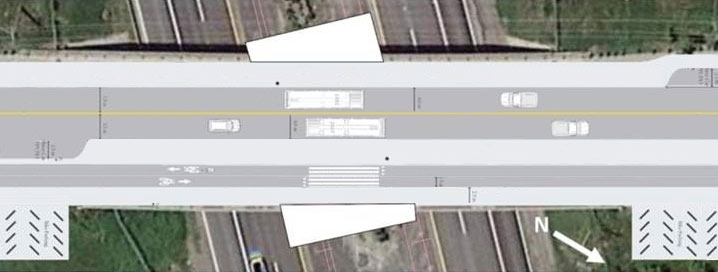
Although not perfect, I would suggest that it is an improvement over the staff’s Final Design.
Benefits:- The car / bus travel lanes are straight and predictable.
|
Straight and predictable so drivers can go fast, a critical design criteria when building mass transit.
Quote:
- The lanes are narrow, with the recaptured space dedicated to pedestrians.
|
You propose the same width, so you recapture a bit of median and that's it.
Quote:
- I would suggest that the speed limit still be reduced to 40 KPH in this area.
- There is a sidewalk on each side of the bridge.
|
No change.
Quote:
- There is no central barrier to crossing mid-bridge, but the requirement to cross has been reduced, or eliminated. If crossing is required then the distance is only two narrow lanes, and the traffic speed is slow. (A central barricade might also restrict the passage of an emergency vehicle, if vehicles block the way.)
|
There is still a significant need to cross the street, except now people have to run across two lanes of moving traffic or walk in front of a bus.
Quote:
- The bus stops are situated immediately in front of the station accesses.
- The bus platforms are wide and long enough to provide space for multiple buses to stop at a time, if the need arises.
|
No real change.
Quote:
- Crossing of a bikeway is only required on the east side, and it could be a signal-controlled crossing – although that might not be necessary.
|
Pedestrians now need to cross a bikeway with bidirectional traffic, a more significant barrier.
Quote:
- Bike parking is off of the bridge, allowing it to be easily expanded, if needed.
|
Sure, but that can be done with any design. It's further away from the station and perception of safety now though.
Quote:
- Those arriving by bicycle can park before they reach the station, reducing potential conflicts.
- Returning home by bike does not require crossing the road, as the bikeway is bidirectional. Cyclists will predominantly use the east station access for arriving and leaving.
- The north-bound Drop-Off area is still a narrow median away from the bikeway, but the bike traffic in the closest lane (the lane that would be affected the most by an open car door) is approaching from the front, and, therefore, more easily seen.
|
These points are valid, but I think the impact is overstated.
Quote:
But, of course, there are also drawbacks:- There is only one general vehicle travel lane per direction – reduced from the four total lanes before the LRT extension.
- There are no bus bays so traffic will need to wait for buses which are stopped at the station. However, the delays for traffic, assuming status quo bus service, will only be about 20 seconds every half-hour, since the crosswalk has been removed. Buses are not delayed more than by a stop-request.
Sometimes there is a benefit to Keeping It Simple.
|
The reduction in lanes isn't necessarily a drawback. That road has always seemed overbuilt to me. The emergency vehicle impact you mention also seems overblown - the median is short and would have minor impact compared to the benefit.
Quote:
Originally Posted by OCCheetos
Another use case: what if someone exits the station at the wrong entrance? If they need to catch the bus going the other way, that would mean re-entering the station to cross to the other side, possibly paying another fare along the way.
More generally though, why can't the pedestrian crossover just exist by default? I think a lot of the arguing about the need for the crossover is (unintentionally) car-centric.
|
I mention this above, but I very much agree. The PXO is a great addition.





 Prev
Prev





 Linear Mode
