Quote:
Originally Posted by laniroj

There is a place. Go to the clerk and recorder's office, they should be able to grab the recorded mylars for the site development plan or they'll already have them available electronically for you to look at.
|
Thanks for the advice, I might try that out one of these days.
Now, re the "Growth" Discussion:
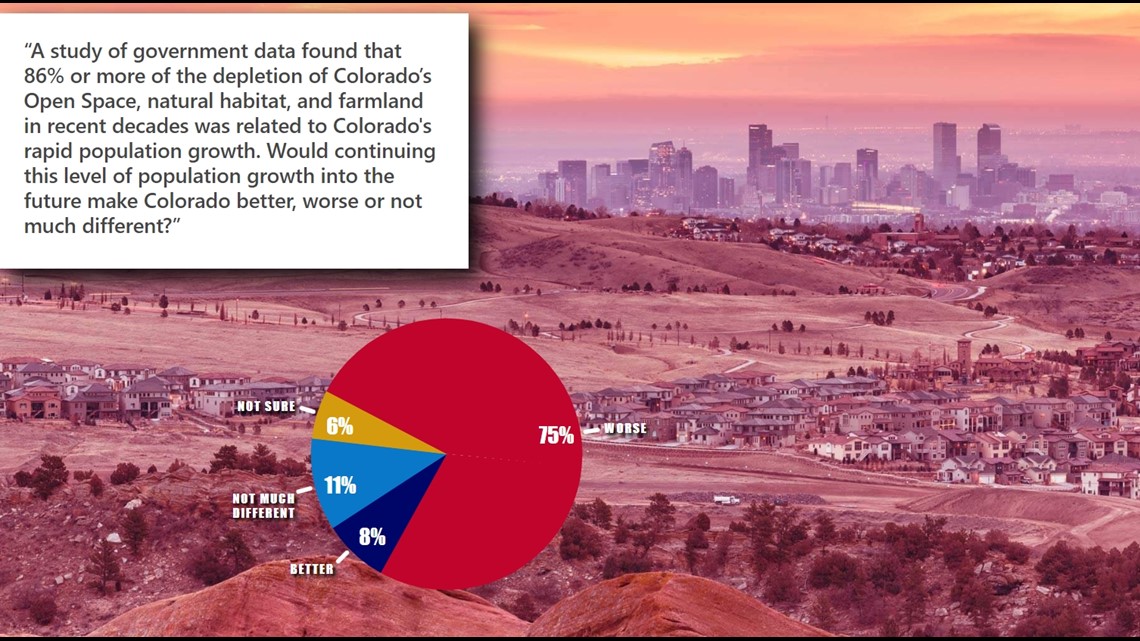
Here's some of my thoughts on this issue: there are "good" kinds of growth and "bad" kinds of growth, and it seems to me that "anti-growth" people usually are the kind of people who can't tell the difference.
I think "bad growth" means the uncontrolled sprawl of suburban areas, which has negative impacts like destroying the local environment (even seemingly empty grasslands can still be home to native fauna and flora), encouraging dependence on cars, increasing commute times, and also increases wildfire risk by putting more people in the Wildland-Urban Interface (case-in-point, the Marshall Fire).
The kind of "growth" that I support is densification within current urban boundaries, growing up rather than out. When I look at the map of how sprawling the Denver area is, I wonder if we could easily accommodate three or four times as many people here if every neighborhood, from Brighton to Highlands Ranch, were as densely-packed and built up as the area around Union Station.
With that in mind, here's my "wish-list" for some of the policies I would love to see implemented:
- Eliminate single-family zoning in its entirety.
- Eliminate any and all height maximums. In fact, I would go further and introduce legislation establishing height minimums in some areas.
- Eliminate parking minimums, similar to the above.
- Increase the frequency (and reliability) of RTD services; restore all pre-pandemic services and introduce new services as well. This can be funded at least in-part by increasing DMV fees, highway tolls, and fines for traffic offenses.
- Offer free RTD passes to property-owners (to be funded in-whole or in-part by an increase in property taxes).
- Disincentivize property-owners from keeping properties vacant and sitting empty. If a person owns more than 1 home in the Metro Area, they should at least rent out that 2nd (or 3rd, or 4th...) home, thereby increasing the supply of available housing.
- Disincentivize water-intensive lawns (maybe through a "water tax" based on square-footage of a lawn) and incentivize more xeriscaping (maybe by exempting xeriscaped gardens from the aforementioned "water tax").
- Offer incentives for developers to build more housing, parks, amenities, etc. on top of interstates and railroads, like the "Central-70" project in Denver (built on top of I-70), or "The Squaire" in Frankfurt (built on top of a train station). I'm sure that if you added up the land surface area of all the railroads and highways in Denver, you would easily find at least a few square miles of land ripe for development.
I know some of these goals are a little lofty and unrealistic with the current political climate, and would definitely outrage a lot of NIMBYs, but I think that all of the above would help address many of the issues the Front Range has.





 Prev
Prev




 Linear Mode
