DENVER | Main Development Thread #7


The People Have Spoken

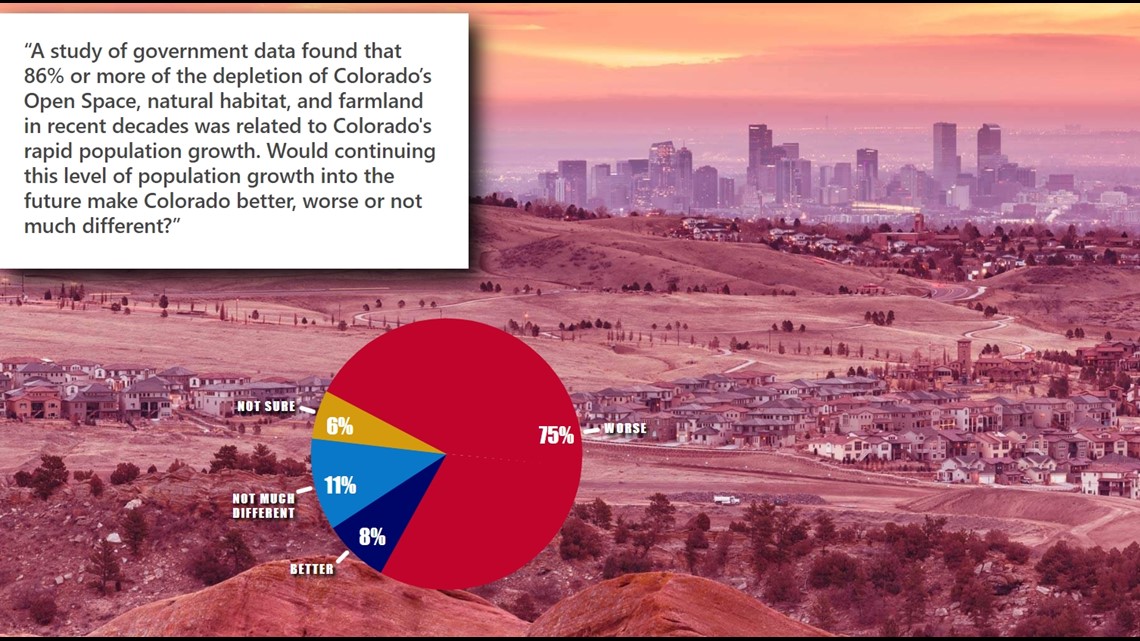
and 75% of da people want an immediate moratorium on all growth.

dc334849-8921-49db-bc1b-90e8704a48bb_1140x641.jpg


https://www.9news.com/article/news/...prawl/73-4661937c-b7a4-433e-866f-1df03612a7d8
Citing increased traffic, the loss of open space, and a strain on the water supply, 75% of Coloradans surveyed said urban sprawl .. is making Colorado a worse place to live. Of those surveyed, 70% said water should not be diverted away from agriculture in favor of supporting further urban development.

Rebecca Mitchell, Director of the Colorado Water Conservation Board, said even with a stable or reduced population, there still may not be enough water.

“We as a society, and the Western world in general, have got to find ways to have long-term sustainable prosperity that doesn’t depend on population growth,” said Leon Kolankiewicz, the science director for NumbersUSA
Coloradoans are NOT drought happy.
 
The People Have Spoken

and 75% of da people want an immediate moratorium on all growth.

First of all, the wording of that survey question is idiotic. “Recent studies have found that population growth causes nothing but problems for Colorado. Do you think more population growth will be good for Colorado?”

Secondly, there was no mention of an “immediate moratorium,” so that’s quite the misleading leap you took there.

On a side note, this simplistic “piece” is not the first time I’ve seen a seemingly intelligent person say something along the lines of “there’s got to be a way we can have economic growth and prosperity without the population growth,” without providing any suggestions for how that might somehow be possible. And yet I can sense the chorus of enthusiastic agreement from the credulous mob.
 
Shame on 9News for publicizing this garbage.

The organization that conducted this study is NumbersUSA. Here's what Wikipedia has to say about NumbersUSA:

"NumbersUSA is an anti-immigration advocacy organization that seeks to reduce both legal and illegal immigration to the United States. It advocates for immigration reduction through user-generated fax, email, and direct mail campaigns. Roy Beck is the founder and president of the organization, which was conceived by white nationalist John Tanton as the "grassroots arm for the anti-immigrant movement" according to the Southern Poverty Law Center."
 
Not sure I disagree, with nuance.

The barely-managed race to the bottom spread out farm-and-water-sucking growth we have is bad for Colorado. Every house that goes up in Weld County or Elbert County is bad for Colorado.

Growth without infrastructure investment to support it is bad for Colorado. Or rather, the cognitive disconnect between the type of growth our state leadership wishes we had (dense) and the infrastructure that our leadership is willing to support (mobility hubs and buses), versus the type of growth we actually have (seas of sprawl) and the infrastructure needed to support the growth we actually have (roads)… that naive disconnect and the resulting gridlock is bad for Colorado.

So.. Would I put a moratorium on growth? Nah. Would I put a moratorium on locally controlled zoning? Possibly. Would I impose an urban growth boundary and forcibly limit sprawl? For sure. Is any of that realistic? Nope. Do I like every bit of growth in Central Denver? Definitely. Do I think the growth Denver proper is seeing moves the needle on a statewide basis? Nope. Do I think maybe some credible Republican competition would be good all around for these issues, and especially transportation? Yep. Do I think that is happening anytime soon? Nope. Do I think Democratic leadership without that credible threat will ever invest in roads ever again? Probably not. So given the realities we face, and the combination of type of growth we allow and the infrastructure we will support, would I maybe grudgingly support a moratorium on growth? Probably. Would that perpetuate affordability problems? Absolutely. Do I think liberal Colorado actually cares about affordability more than saving the planet? Definitely not. Do I already have mine? I do. So does a growth moratorium make sense? Probably yes. And does that answer make sense to me? Nope. But that’s why I hate the new Boulder-minded Colorado. The place we are creating sucks. So would I vote for a moratorium, even if probably not legal, and even if it goes against everything I believe in? Yeah, I probably would. Because it would be better than what we are doing now. And I don’t see a political path to doing better in this giant rectangle we call Boulde…I mean…Colorado.

To be clear, I could probably be okay if we decided to become a road happy Texas city… or a dense and transit rich eastern City. My worst nightmare is that we choose neither - we become crowded and remain car dependent, without roads to support, and no accessible affordable housing left (because we make ‘drive til you qualify’ impossible but also don’t allow transit supportive (and affordability supportive) density)… but hey, we have a populace that “votes correctly” and therefore is comfortable with all of that hypocrisy. In other words, California. And that’s our current path.
 
...Would I impose an urban growth boundary and forcibly limit sprawl? For sure. Is any of that realistic? Nope...
I'm not so sure this is a hard no. I think a couple rounds of serious money for state imposed growth boundaries and big dollars to fund greenbelts might just pass in our increasingly left leaning hippie state.

As to the water issue, people seriously need to study this. Urban growth is such a small portion of water use in the west, I really don't see why this is an ongoing conversation. Most estimates put urban and commercial water supply use at 10% - 20% - THAT'S IT!

Federal and state governments could very easily buy out existing farmers for the sole purpose of securing their water rights. Buying just 10%-15% of agricultural water rights would solve the urban growth water issue in the west.

Would this devastate some rural communities? Yep but it would also enrich (relatively speaking) the latest generation of farmers who are barely hanging on and it would restore our natural areas to pre-settlement norms. It may very well put the nail in the coffin of many decaying agricultural towns that are barely hanging on - I'm ok with that because the path we've taken with agriculture in the west is absolute insanity. We should not be growing water intensive crops like almonds, alfalfa, and citrus in deserts. Do folks have a right to grow those things if they own water rights? Absolutely, but rich urban centers also have the right (and responsibility) to buy those water rights for use in population centers.
 
This is such a complicated issue. My first reaction was that saying population growth in urban centers is responsible for the depletion of open space is a bit like when the Denver Post claimed that increased land coverage on private lots was destroying "Green space" in Denver.

But if I'm honest with myself, we still DO have a lot of sprawl in Colorado, and it worries me too. I'm not even as concerned with Metro Denver sprawl as I am with what I see in some of our mountain communities. Grand County is STILL trying to build a second connection between Fraser and Tabernash that will allow that entire valley to fill with vacation homes Summit County-style.

All I can say is I would echo what everyone else is saying about the need for some urban growth boundaries. I would personally still vote no to an anti-growth proposition out of principle (though I otherwise largely agree with bunt_q). But a robust land use proposition as DenvertoLA that would set up some growth boundaries? Yes - I would absolutely support that.
 
Very Interesting
Shame on 9News for publicizing this garbage.

The organization that conducted this study is NumbersUSA. Here's what Wikipedia has to say about NumbersUSA:

"NumbersUSA is an anti-immigration advocacy organization that seeks to reduce both legal and illegal immigration to the United States. It advocates for immigration reduction through user-generated fax, email, and direct mail campaigns. Roy Beck is the founder and president of the organization, which was conceived by white nationalist John Tanton as the "grassroots arm for the anti-immigrant movement" according to the Southern Poverty Law Center."
So they're a Kris Koback-friendly crowd; well Kansas still loves him.

I did take note of this:
The study includes a scientific survey of 1,024 Colorado residents conducted by the Rasmussen research group. It focuses on several environmental issues, including water.
It seems they've found a mainstream way of pushing their agenda, no?

Additionally, the best way to stop sprawl is through increased density in already urbanized areas.
Another good example of 'strange bedfellows.'

FWIW, I do like Senator Kyrsten Sinema's bi-partisan effort to fix immigration. Problem has always been that Republicans don't want to give up their politically base-friendly propaganda but maybe this time?
 
Not sure I disagree, with nuance.

Growth without infrastructure investment to support it is bad for Colorado. .
Nicely stated - with nuance.

This speaks volumes to the transportation conundrum.

As to the water issue, people seriously need to study this. Urban growth is such a small portion of water use in the west, I really don't see why this is an ongoing conversation. Most estimates put urban and commercial water supply use at 10% - 20% - THAT'S IT!

Federal and state governments could very easily buy out existing farmers for the sole purpose of securing their water rights. Buying just 10%-15% of agricultural water rights would solve the urban growth water issue in the west.
I would NOT be any crazy 'environmentalist' but I am fond of Mother Nature. Be careful what you ask for and the unintended consequences. Farm to table is a lot more complex than most appreciate.

FWIW, the Inflation Reduction Act, thanks to my Senator Kyrsten Sinema did secure $4 billion earmarked to 'fight' the drought in the Southwest and Colorado's own Senators are part of a push out of the SW to secure even more from the $billions allocated to promote better farming practices and efficiency.
 
...I would NOT be any crazy 'environmentalist' but I am fond of Mother Nature. Be careful what you ask for and the unintended consequences. Farm to table is a lot more complex than most appreciate.

FWIW, the Inflation Reduction Act, thanks to my Senator Kyrsten Sinema did secure $4 billion earmarked to 'fight' the drought in the Southwest and Colorado's own Senators are part of a push out of the SW to secure even more from the $billions allocated to promote better farming practices and efficiency.

I'm not crazy environmentalist either, but I'd vote for a significant state income tax increase if it meant a Boulder-esque greenbelt acquisition opportunity for the entire front range. I'll gladly leave behind the associated Boulder planning/zoning/growth/density catastrophe, but they've been enormously successful with the greenbelt dollars they've had since 1967.

The IRA is mainly a band-aid to the problem of Lake Meade going dry. It doesn't do much to solve actual problems (like most money we spend in this country). What WOULD have been valuable is funding for 10 desalination plants on the California coast to serve the central valley agriculture.
 
With Respect to Growth Boundaries

Growth boundaries are only good in theory or on paper, but not in reality.

Given that Denver is a relatively new (growth) place, all growth limitations do is promote 'elitism' and unaffordability. I'm not necessarily fond of sprawl but it clearly helps with affordability. It goes primarily to land costs.

It was a noteworthy visit from Pres Biden last week when he came to the desert to promote TSMC's increasing investment commitment from $12 billion to $40 billion for their microproccessing Fabs as a result of the $250 billion CHIPS and Science Bill passed recently.

Also interesting is that the location is in the opposite corner of Phoenix metro as the traditional Intel crowd location. But there's lots of land available for the additional $billions of investment needed for TSMC suppliers and nearby population growth.
 
Says you.

If infill is easy enough, housing can stay very affordable inside growth boundaries. Done right, only land will get more expensive.
 
Says you.

If infill is easy enough, housing can stay very affordable inside growth boundaries. Done right, only land will get more expensive.

As land gets more expensive, any maximum bound in zoning - notwithstanding ease of permitting, construction, and loans - requires more expensive units to recoup costs. Ergo, even if infill is “easy,” higher land costs can be a factor in increasing housing costs.
 
As land gets more expensive, any maximum bound in zoning - notwithstanding ease of permitting, construction, and loans - requires more expensive units to recoup costs. Ergo, even if infill is “easy,” higher land costs can be a factor in increasing housing costs.

Not any maximum bound on zoning. Any maximum bound that constrains market supply. Or at least the supply that would be needed to deliver housing at the same price on more expensive land.
 
Not any maximum bound on zoning. Any maximum bound that constrains market supply. Or at least the supply that would be needed to deliver housing at the same price on more expensive land.

You’re right. Zoning is one but many constraints on market supply.
 
Says you.

If infill is easy enough, housing can stay very affordable inside growth boundaries. Done right, only land will get more expensive.

Feels like an oxymoron or at the least wishful thinking.

One thing that the Pandemic taught us is that (sooner or later) many will want their own place with space even if it's a townhome with backyard space.

Input the artificial and the marketplace changes as to what is viable or at least affordable - on a relative basis.

At least in Denver's case there's no shortage of otherwise worthless semi-arid land so why constrict it? All of the current ongoing 'sprawl' includes lots of open space. But sprawl in Denver is a bit humorous and tame compared to cities in the South and Southwest.

California is headed in the wrong direction and many more will leave the state with the highest taxes yet inability to solve many of the most basic needs of humanity.
 
Feels like an oxymoron or at the least wishful thinking.

One thing that the Pandemic taught us is that (sooner or later) many will want their own place with space even if it's a townhome with backyard space.

Input the artificial and the marketplace changes as to what is viable or at least affordable - on a relative basis.

At least in Denver's case there's no shortage of otherwise worthless semi-arid land so why constrict it? All of the current ongoing 'sprawl' includes lots of open space. But sprawl in Denver is a bit humorous and tame compared to cities in the South and Southwest.

What are you smoking??

That "worthless" land is or could be full of native flora and fauna that is worth preserving! In addition, sprawl usually is a lot of single family zoning that is MORE expensive to maintain for cities and counties and much worse for the environment because you need more cars, more heating, and more cooling.

That and I am sure that profit margins on dumb single family homes are thinner that moderately dense (not skyscrapers) mixed use development.

Unpopular opinion: Yards and space are a luxury not a necessity. The natural world is worth preserving over sprawl.
 
With Respect to Growth Boundaries

Growth boundaries are only good in theory or on paper, but not in reality.

Given that Denver is a relatively new (growth) place, all growth limitations do is promote 'elitism' and unaffordability.

This isn't Manhattan or Vancouver! The Denver Metro Area as-is has essentially limitless room to build affordable multi-family housing without additional sprawl. The issue is zoning.
 
There is a place. Go to the clerk and recorder's office, they should be able to grab the recorded mylars for the site development plan or they'll already have them available electronically for you to look at.

Thanks for the advice, I might try that out one of these days.

Now, re the "Growth" Discussion:

Here's some of my thoughts on this issue: there are "good" kinds of growth and "bad" kinds of growth, and it seems to me that "anti-growth" people usually are the kind of people who can't tell the difference.

I think "bad growth" means the uncontrolled sprawl of suburban areas, which has negative impacts like destroying the local environment (even seemingly empty grasslands can still be home to native fauna and flora), encouraging dependence on cars, increasing commute times, and also increases wildfire risk by putting more people in the Wildland-Urban Interface (case-in-point, the Marshall Fire).

The kind of "growth" that I support is densification within current urban boundaries, growing up rather than out. When I look at the map of how sprawling the Denver area is, I wonder if we could easily accommodate three or four times as many people here if every neighborhood, from Brighton to Highlands Ranch, were as densely-packed and built up as the area around Union Station.

With that in mind, here's my "wish-list" for some of the policies I would love to see implemented:
  • Eliminate single-family zoning in its entirety.
  • Eliminate any and all height maximums. In fact, I would go further and introduce legislation establishing height minimums in some areas.
  • Eliminate parking minimums, similar to the above.
  • Increase the frequency (and reliability) of RTD services; restore all pre-pandemic services and introduce new services as well. This can be funded at least in-part by increasing DMV fees, highway tolls, and fines for traffic offenses.
  • Offer free RTD passes to property-owners (to be funded in-whole or in-part by an increase in property taxes).
  • Disincentivize property-owners from keeping properties vacant and sitting empty. If a person owns more than 1 home in the Metro Area, they should at least rent out that 2nd (or 3rd, or 4th...) home, thereby increasing the supply of available housing.
  • Disincentivize water-intensive lawns (maybe through a "water tax" based on square-footage of a lawn) and incentivize more xeriscaping (maybe by exempting xeriscaped gardens from the aforementioned "water tax").
  • Offer incentives for developers to build more housing, parks, amenities, etc. on top of interstates and railroads, like the "Central-70" project in Denver (built on top of I-70), or "The Squaire" in Frankfurt (built on top of a train station). I'm sure that if you added up the land surface area of all the railroads and highways in Denver, you would easily find at least a few square miles of land ripe for development.

I know some of these goals are a little lofty and unrealistic with the current political climate, and would definitely outrage a lot of NIMBYs, but I think that all of the above would help address many of the issues the Front Range has.
 
Last edited:


Back
Top