Quote:
Originally Posted by Doady

If you look at a regular bus in a new subdivision, it's probably as fast as Yonge subway line. Empty buses that never have to stop, so very fast. The speed only starts to decrease when the ridership increases. The highest ridership bus routes, they are also the slowest routes. And that's what "rapid transit" is all about. It's not about increasing speed, but rather about maintaining the same speed as the ridership increases. And that means limited stops, all-door boarding, grade separation, and of course high frequencies.
And I think it is where most people look at rapid transit completely backwards. They see rapid transit as a way to solve the problem of low ridership instead of as a way to solve the problem of high ridership. When a city like Winnipeg ever builds light rail, it won't be because the ridership is too low. Low ridership not a problem in Winnipeg, trust me. Likewise, Mississauga didn't pursue light rail along Hurontario because the buses along Hurontario were empty. Instead, the ridership was just getting too much for the buses to handle, and they needed something higher capacity.
That also means what is true "rapid transit" or metro is a matter of capacity also. Commuter rail trains every 20-minutes might be considered as rapid transit or metro if they remain 12-car double decker trains. Eglinton Crosstown will not have to worry about high frequency or length of trains interfering with other traffic on the street, although the trains will be much narrower than those on the other TTC subway lines. But then again, the Montreal Metro trains are also much narrower the TTC subway trains...
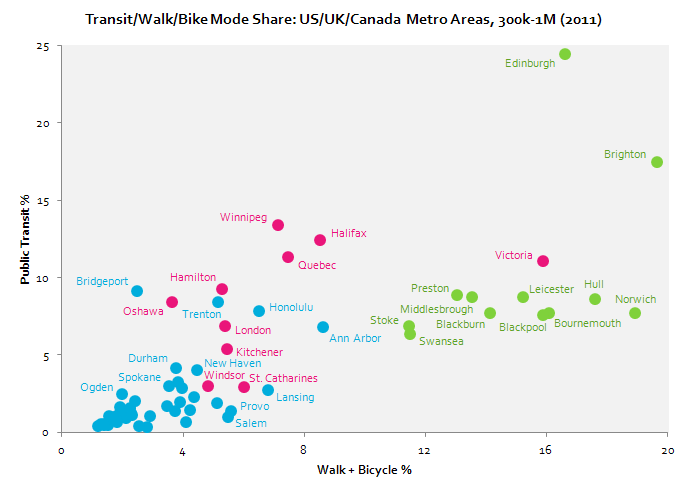
Rapid transit isn't either/or, but on a continuum. Everything is in grey area, I don't think we need hard and discrete boundaries and definitions, let alone use them to judge the quality of Canadian transit. Looking at the ridership, Winnipeg's transit system is actually better than a lot of UK systems. Winnipeg and its bus system had transit mode share of 13.41% in 2011, higher than the 13.22% mode share for Liverpool and its transit system, including 121km of Merseyrail. Do we really need to "browbeat and shame fellow Canucks" because of this? I don't think so. Again, if we need to spend more money to build more rail transit, it's not because our transit is bad, but rather because our transit already good. Rapid transit is to solve the problem of high ridership, not of low ridership.
|
I think that's mostly true in that people often try to define rapid transit in terms of trip times that end users experience when in reality is isn't about the end user experience but rather about the ability to move large numbers of people (bandwidth rather than latency). However, while rapid transit tends to be the most effective way of doing that, it doesn't follow that any and every way of doing that is therefore rapid transit. A 12 car bi-level commuter train like what GO currently uses packed full enough that there are just as many people standing as seated could only carry about 10k people an hour which is at 20 minute frequency which is on the low end for rapid transit despite the enormous 300m+ trains. In fact, you can achieve that just with buses if you have a full articulated bus every ~45 seconds. By comparison, a metro line with just 100m long trains running at 30tph can carry around 2.5x that much and that's less than maximum train frequency or length. In other words, just being able to carry a large number of people doesn't mean a technology is suited to doing it well in the way rapid transit is.
I would also push back on the idea that our transit systems are "good" just because of higher mode share. One issue is that ridership depends on a variety of variables with transit quality being just one. There's also the quality of the alternatives (car, active transport), culture (stigma/respectability/normalization of riding), geometry of city (density, centralization) etc. are equally important. The other main issue is that "good transit" involves a variety of things including how well the infrastructure is matched to its purpose. A transit system with a high level of ridership paired with disproportionately low meager infrastructure is not what I'd call "good".
Your description of rapid transit as a way to solve the "problem" of high ridership is very apt because it is indeed a problem. And problems make things worse rather than better if they're not properly addressed. A city may have good bus service, but cities over a certain size and ridership levels should have stronger infrastructure in response. Especially if the buses don't have extensive priority measures. Not having it means a poorer experience for riders with less comfort and longer trip times, and it also means a poorer experience for transit service providers in that they spend more in labour and energy while losing out on potential efficiencies. So even if a city has good bus service, the overall system might not be that good because of the lack of a strong, higher-order backbone.





 Prev
Prev




 Linear Mode
