HomeDiagramsDatabaseMapsForum About
     

Go Back   SkyscraperPage Forum > Regional Sections > Canada


Closed Thread

 
Thread Tools Display Modes
     
     
  #16681  
Old Posted Jun 18, 2022, 9:39 AM
canucklehead2 canucklehead2 is offline
Sex Marxist of Notleygrad
 
Join Date: Feb 2004
Location: YEG
Posts: 6,846
Quote:
Originally Posted by ssiguy View Post
It would also be a great way to bankrupt the country.

Catenary all over the country is laughable. The only option for freight or long distance passenger rail in terms of zero emissions is hydrogen.
Both. A study showed wiring is cheap. A million per km to wire a line. Subtract from a carbon tax grant? Done.
     
     
  #16682  
Old Posted Jun 18, 2022, 9:41 AM
canucklehead2 canucklehead2 is offline
Sex Marxist of Notleygrad
 
Join Date: Feb 2004
Location: YEG
Posts: 6,846
Only worth it on the MAIN main lines. Aka the Interstate rail equivalents. Edmonton to Calgary. Windsor to Quebec City. Vancouver to Seattle. Need power for fast and furious service power drain cycles.
     
     
  #16683  
Old Posted Jun 18, 2022, 1:48 PM
MalcolmTucker MalcolmTucker is offline
Registered User
 
Join Date: May 2007
Posts: 11,578
If the hydrogen trials fail, then yeah. Overhead cat on the mainlines. Might need to have third rail option so tunnels don’t need to be replaced again.

If hydrogen works, like the economics of it, it will be THE use case. Like, one Canadian railroad will use more cells than have been produced worldwide in 40 years. The scale needed is amazing.
     
     
  #16684  
Old Posted Jun 18, 2022, 2:27 PM
canucklehead2 canucklehead2 is offline
Sex Marxist of Notleygrad
 
Join Date: Feb 2004
Location: YEG
Posts: 6,846
Fuck trials. Invest already. We need action. Not sampling tech. Full stop.
     
     
  #16685  
Old Posted Jun 18, 2022, 9:56 PM
MalcolmTucker MalcolmTucker is offline
Registered User
 
Join Date: May 2007
Posts: 11,578
Quote:
Originally Posted by canucklehead2 View Post
Fuck trials. Invest already. We need action. Not sampling tech. Full stop.
Choosing the right one two years later is better than the risk of the wrong one today.

Fortunately India did a bunch of the tech implementation proving for CAT.
     
     
  #16686  
Old Posted Jun 19, 2022, 1:25 AM
swimmer_spe swimmer_spe is offline
BANNED
 
Join Date: Apr 2014
Posts: 10,743
Quote:
Originally Posted by ssiguy View Post
It would also be a great way to bankrupt the country.

Catenary all over the country is laughable. The only option for freight or long distance passenger rail in terms of zero emissions is hydrogen.
Combination of BEV for the quieter sections and Catenary for the busier sections would be much better than the more unproven Hydrogen.

Quote:
Originally Posted by Al Ski View Post
No mate, the onus is on you to prove me wrong.

And these cheaply gained (and out of date) stats don't include Berlin's extensive RE and RB regional trains.

And please.. buses.. of course all Canadian cities combined will win that battle.

Of course I've already done my homework, time to do yours!

And are you REALLY going to rejoice if all Canadian cities COMBINED have slightly more transit than Berlin?

Ok, surface analysis: they have more subway than Montreal and Toronto combined. We don't have S-Bahn so they win that by default. They have more trams than Toronto.. then there's the aforementioned RE and RB Regio.. High Speed Rail.. all electric..

Prove me wrong.
Well, you show me the total numbers of each and then we can discuss it. I posted some from a reliable source. I can easily show that in all of Canada, we total more than Berlin, outside of HSR.

Quote:
Originally Posted by canucklehead2 View Post
Both. A study showed wiring is cheap. A million per km to wire a line. Subtract from a carbon tax grant? Done.
You mean use government funding for what it was intended for? Bah! That's crazy talk around here.

Quote:
Originally Posted by MalcolmTucker View Post
Choosing the right one two years later is better than the risk of the wrong one today.

Fortunately India did a bunch of the tech implementation proving for CAT.
CAT?

If the study was connected to a guaranteed contract, I would agree. Studies tend to be used to avoid doing anything in Canada outside of placating voters.
     
     
  #16687  
Old Posted Jun 19, 2022, 11:47 AM
Al Ski Al Ski is offline
BANNED
 
Join Date: Apr 2021
Posts: 400
Quote:
Originally Posted by swimmer_spe View Post


Well, you show me the total numbers of each and then we can discuss it. I posted some from a reliable source. I can easily show that in all of Canada, we total more than Berlin, outside of HSR.
Well since I'm not a lazy c*nt like you obviously are and since I don't make baseless claims like you obviously feel comfortable making ..

I spent 15 minutes online gleaning info from only official transit sites..
Just to double check what I already knew..

Added in all the under construction and approved lines in Canada..
(can't really do that with Berlin, they have a continuous funding program where they add 4 km here, 2 km there, all the time, continuously, forever)

I included all forms of higher order transit in Canada in every city.
I included the U-Bahn, S-Bahn and trams in Berlin.

Results:
All of Canada -548 km
Berlin - 668 km

And Berlin has 18 regional rail transfer stations - not including BER airport which has a stunning array of transit unthinkable in Canada.
     
     
  #16688  
Old Posted Jun 19, 2022, 12:19 PM
Truenorth00 Truenorth00 is offline
Registered User
 
Join Date: May 2017
Posts: 28,755
Curious to see what those numbers look like as GO gets the RER treatment, the conversion designed by Deutsche Bahn no less. GO alone has over 500 km of rail.

Berlin does have great transit. Most cities in Europe do. We know we are behind. I'm not sure what belabouring that point accomplishes. You're not going to convince the average Canadian taxpayer to shell out more to catch up to km of rail in Berlin.
     
     
  #16689  
Old Posted Jun 19, 2022, 2:22 PM
swimmer_spe swimmer_spe is offline
BANNED
 
Join Date: Apr 2014
Posts: 10,743
Quote:
Originally Posted by Al Ski View Post
Well since I'm not a lazy c*nt like you obviously are and since I don't make baseless claims like you obviously feel comfortable making ..

I spent 15 minutes online gleaning info from only official transit sites..
Just to double check what I already knew..

Added in all the under construction and approved lines in Canada..
(can't really do that with Berlin, they have a continuous funding program where they add 4 km here, 2 km there, all the time, continuously, forever)

I included all forms of higher order transit in Canada in every city.
I included the U-Bahn, S-Bahn and trams in Berlin.

Results:
All of Canada -548 km
Berlin - 668 km

And Berlin has 18 regional rail transfer stations - not including BER airport which has a stunning array of transit unthinkable in Canada.
Just rail for GO transit is 526 km.

You stated the 'fact' first which does mean you need to prove it first.

Now, if I were to continue with all non Via rail services we would be well close to 1000km.
     
     
  #16690  
Old Posted Jun 19, 2022, 3:22 PM
Truenorth00 Truenorth00 is offline
Registered User
 
Join Date: May 2017
Posts: 28,755
I actually do get Al's point. Having just come back from the UK, I'm reminded that London Underground alone, probably has more trackage and stations than all of the metro and LRT systems in Canada combined. That doesn't include London Overground or London Trams. Having to simply tap on and tap off with my phone, never having to be more than a 10 min walk from a Tube station in most of Central London and having intercity service to Birmingham every 45-60 mins from Euston Station is mobility the average Canadian can't even begin to comprehend. I don't think even people in Toronto, Montreal or Vancouver can imagine this.

But I don't think we can browbeat and shame fellow Canucks into building more transit. We need to sell the idea that kind of service is beneficial. We need to constantly work on explaining the idea that alternatives to car dependency are liberating, not threats.
     
     
  #16691  
Old Posted Jun 19, 2022, 3:44 PM
Athens Athens is offline
Registered User
 
Join Date: Dec 2015
Posts: 56
Quote:
Originally Posted by Al Ski View Post
Well since I'm not a lazy c*nt like you obviously are and since I don't make baseless claims like you obviously feel comfortable making ..

Please be kind. There is no room on this forum for rudeness and name calling
     
     
  #16692  
Old Posted Jun 19, 2022, 4:07 PM
MonkeyRonin's Avatar
MonkeyRonin MonkeyRonin is offline
¥ ¥ ¥
 
Join Date: Sep 2006
Location: Vancouver
Posts: 10,594
Canada's current rail trackage doesn't look too great, but the amount of projects in the works across the country is pretty impressive. At a quick glance:

In Toronto:
23km of subway u/c + 8km planned
48km of LRT u/c
262km of electrified commuter rail u/c & planned

In Montreal:
6km of subway u/c
67km of electrified commuter rail u/c + 32km planned

In Vancouver:
6km of subway u/c + 16km planned

In Ottawa:
43km of LRT u/c & planned

In Calgary:
20km of LRT planned

In Edmonton:
13km of LRT u/c + 14km planned

In Quebec City:
23km of LRT planned

In Hamilton:
14km of LRT planned
__________________
     
     
  #16693  
Old Posted Jun 19, 2022, 7:04 PM
Nouvellecosse's Avatar
Nouvellecosse Nouvellecosse is online now
Volatile Pacivist
 
Join Date: Aug 2005
Location: Nova Scotia
Posts: 11,121
I guess it comes down to the question of at what service level does commuter/suburban rail get counted as higher order urban transit? For routes that are peak only I'd say no. But what about routes that are all day but are only hourly for much of it? I would personally still say no but there's going to some who disagree. For most S-bahn services in Berlin the basic non-peak frequency is every 20 minutes with many services overlapping for large part of their route.

By my personal judgement, any section of track whose stations are served at least every 15 minutes throughout the day for at least 18 hours a day would count. Obviously such a route segment would have a lot more service during busier times of day. By this standard, most of GO wouldn't currently be counted but once GO RER is online there'd probably be a good 50-100km of central corridor that fit the bill. But this also means some parts of the S-Bahn would no longer be counted since it stretches pretty far into the hinterlands with lower service levels. For instance, about 30km of S5 in the east runs on its own at that 20 min frequency. Not that such services aren't valuable, but they're just too different from urban metros and trams to be counted together as the same thing imo.
__________________
"The reasonable man adapts himself to the world; the unreasonable one persists in trying to adapt the world to himself. Therefore all progress depends on the unreasonable man." - George Bernard Shaw
Don't ask people not to debate a topic. Just stop making debatable assertions. Problem solved.
     
     
  #16694  
Old Posted Jun 19, 2022, 7:15 PM
ssiguy ssiguy is offline
Registered User
 
Join Date: Mar 2006
Location: White Rock BC
Posts: 11,883
Quote:
Originally Posted by canucklehead2 View Post
Both. A study showed wiring is cheap. A million per km to wire a line. Subtract from a carbon tax grant? Done.
Except it doesn't matter what VIA wants. They will do as the freight companies force them to. freight companies know hydrogen is the ONLY realistic way to create a zero emissions system as does every other major freight carriers in the world. None of them are even considering catenary or batteries.

The price of hydrogen is plunging as technology increases at an exponential rate as does the infrastructure. VIA can simply piggy-back onto that infrastructure for it's long-haul services.
     
     
  #16695  
Old Posted Jun 19, 2022, 7:59 PM
MalcolmTucker MalcolmTucker is offline
Registered User
 
Join Date: May 2007
Posts: 11,578
Only if hydrogen fails incredibly in trials will we build dedicated freight corridor India style electrification. The $1 million per km, that is a very simple cost. Sure the wires may be $1 million (I doubt that number) but then there are sidings, double tracks, triple tracks, etc, the substations to feed em and power lines. Then there are lines which are used only infrequently which would be closed as not economical to convert.
     
     
  #16696  
Old Posted Jun 19, 2022, 11:31 PM
Innsertnamehere's Avatar
Innsertnamehere Innsertnamehere is online now
Registered User
 
Join Date: Jan 2010
Location: Hamilton
Posts: 12,812
I would split a lot of those out as “light metro” instead of LRT or Electric Commuter Rail. REM, Eglinton Crosstown West, and the Ottawa LRT are really in that category and not LRT in the traditional sense.
     
     
  #16697  
Old Posted Jun 20, 2022, 1:19 AM
Athens Athens is offline
Registered User
 
Join Date: Dec 2015
Posts: 56
Quote:
Originally Posted by MalcolmTucker View Post
Only if hydrogen fails incredibly in trials will we build dedicated freight corridor India style electrification. The $1 million per km, that is a very simple cost. Sure the wires may be $1 million (I doubt that number) but then there are sidings, double tracks, triple tracks, etc, the substations to feed em and power lines. Then there are lines which are used only infrequently which would be closed as not economical to convert.
The maintenance on that in the winter would be hellish
     
     
  #16698  
Old Posted Jun 20, 2022, 3:05 AM
Doady's Avatar
Doady Doady is offline
Registered User
 
Join Date: Apr 2004
Posts: 5,166
If you look at a regular bus in a new subdivision, it's probably as fast as Yonge subway line. Empty buses that never have to stop, so very fast. The speed only starts to decrease when the ridership increases. The highest ridership bus routes, they are also the slowest routes. And that's what "rapid transit" is all about. It's not about increasing speed, but rather about maintaining the same speed as the ridership increases. And that means limited stops, all-door boarding, grade separation, and of course high frequencies.

And I think it is where most people look at rapid transit completely backwards. They see rapid transit as a way to solve the problem of low ridership instead of as a way to solve the problem of high ridership. When a city like Winnipeg ever builds light rail, it won't be because the ridership is too low. Low ridership not a problem in Winnipeg, trust me. Likewise, Mississauga didn't pursue light rail along Hurontario because the buses along Hurontario were empty. Instead, the ridership was just getting too much for the buses to handle, and they needed something higher capacity.

That also means what is true "rapid transit" or metro is a matter of capacity also. Commuter rail trains every 20-minutes might be considered as rapid transit or metro if they remain 12-car double decker trains. Eglinton Crosstown will not have to worry about high frequency or length of trains interfering with other traffic on the street, although the trains will be much narrower than those on the other TTC subway lines. But then again, the Montreal Metro trains are also much narrower the TTC subway trains...

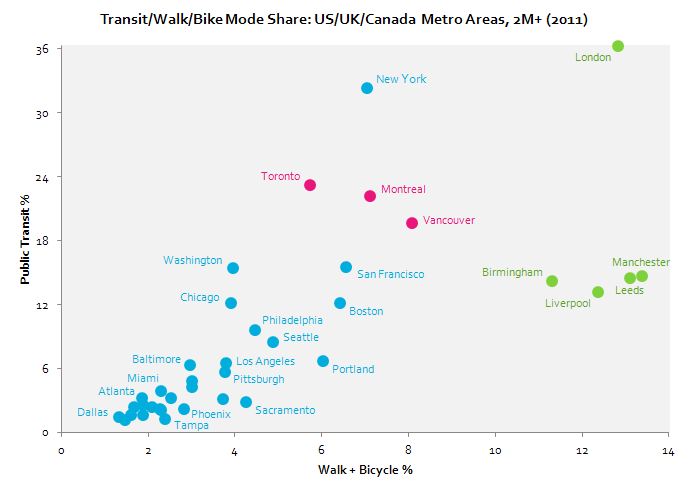
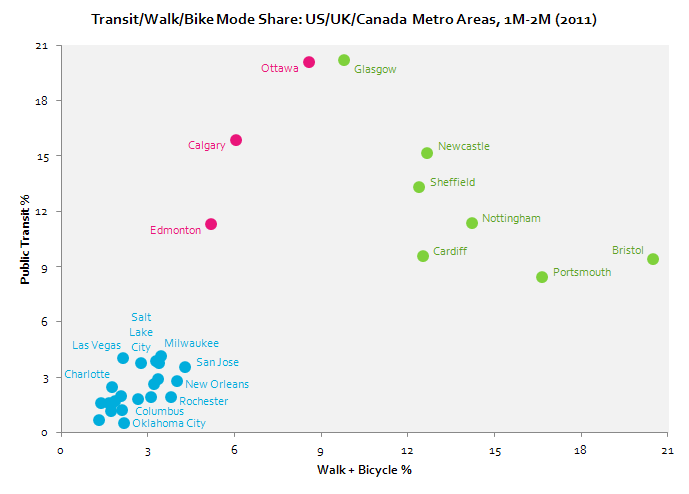
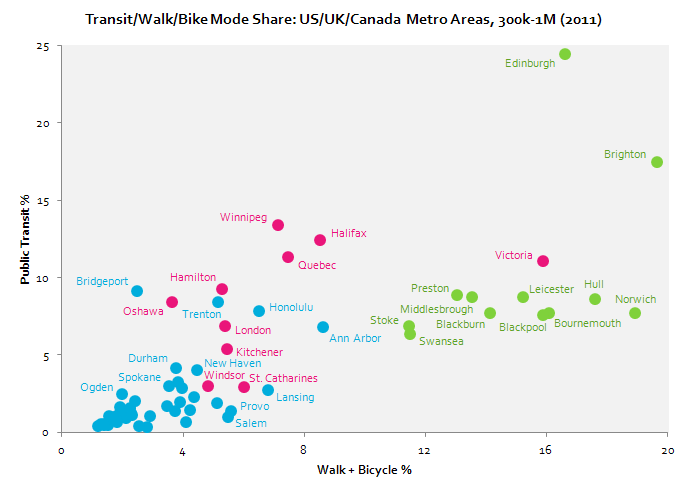
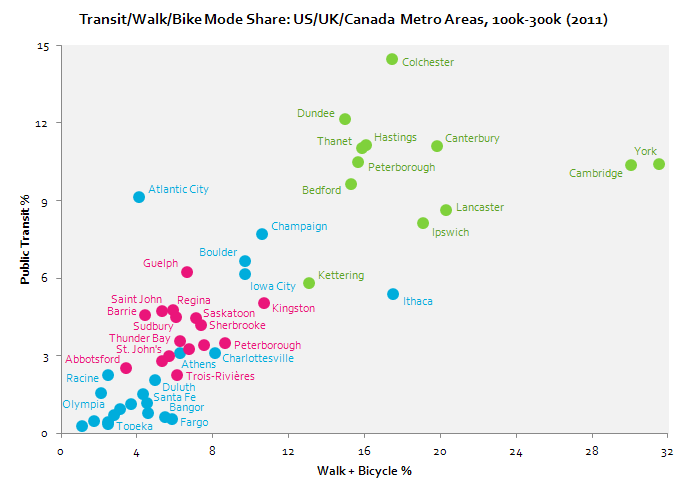
Rapid transit isn't either/or, but on a continuum. Everything is in grey area, I don't think we need hard and discrete boundaries and definitions, let alone use them to judge the quality of Canadian transit. Looking at the ridership, Winnipeg's transit system is actually better than a lot of UK systems. Winnipeg and its bus system had transit mode share of 13.41% in 2011, higher than the 13.22% mode share for Liverpool and its transit system, including 121km of Merseyrail. Do we really need to "browbeat and shame fellow Canucks" because of this? I don't think so. Again, if we need to spend more money to build more rail transit, it's not because our transit is bad, but rather because our transit already good. Rapid transit is to solve the problem of high ridership, not of low ridership.


  #16699  
Old Posted Jun 20, 2022, 3:12 AM
FrAnKs's Avatar
FrAnKs FrAnKs is online now
Registered User
 
Join Date: Jul 2005
Location: Ville de Québec / Quebec city
Posts: 5,926
Quote:
Originally Posted by MonkeyRonin View Post
Canada's current rail trackage doesn't look too great, but the amount of projects in the works across the country is pretty impressive. At a quick glance:

In Toronto:
23km of subway u/c + 8km planned
48km of LRT u/c
262km of electrified commuter rail u/c & planned

In Montreal:
6km of subway u/c
67km of electrified commuter rail u/c + 32km planned

In Vancouver:
6km of subway u/c + 16km planned

In Ottawa:
43km of LRT u/c & planned

In Calgary:
20km of LRT planned

In Edmonton:
13km of LRT u/c + 14km planned

In Quebec City:
23km of LRT planned

In Hamilton:
14km of LRT planned
19.3km in Québec City to be exact.
__________________
PROVINCE OF QUEBEC ==> 9 050 000
MONTREAL METRO ==> 4 600 000
QUEBEC CITY METRO ==> 900 000
     
     
  #16700  
Old Posted Jun 20, 2022, 8:33 AM
biguc's Avatar
biguc biguc is offline
Registered User
 
Join Date: Mar 2003
Location: pinkoland
Posts: 11,850
Quote:
Originally Posted by swimmer_spe View Post
https://en.wikipedia.org/wiki/Berlin#Transport

System Stations / Lines / Net length Annual ridership Operator / Notes
S-Bahn 166 / 16 / 331 km (206 mi) 431,000,000 (2016) DB / Mainly overground rapid transit rail system with suburban stops
U-Bahn 173 / 10 / 146 km (91 mi) 563,000,000 (2017) BVG / Mainly underground rail system / 24h-service on weekends
Tram 404 / 22 / 194 km (121 mi) 197,000,000 (2017) BVG / Operates predominantly in eastern boroughs
Bus 3227 / 198 / 1,675 km (1,041 mi) 440,000,000 (2017) BVG / Extensive services in all boroughs / 62 Night Lines
Ferry 6 lines BVG / Transportation as well as recreational ferries
The Berlin S-Bahn is a strange beast. It's a third-rail powered, heavy metro system that runs mostly in trenches and elevated. Further out, where rail corridors were already established, it runs on the surface, but always on dedicated tracks. The north-south stretch through the city centre is about half tunnelled. Most of the areas it serves--even when suburban--would be the envy of any Canadian city.

Semi-relevant trivia: DB is currently building a second northern tunnel, which will provide north-south S-bahn service to Hauptbahnhof, and will also relieve a capacity problem for north-south lines. Currently, the north-south S-bahn tunnel has 4 platform stations from Potsdamer Platz south. To the north, stations are only 2 platform and basically indistinguishable from any U-bahn station, until Nordbahnhof, which used to be a busy terminus station. Its location at the wall all but killed its function as such, which limited the entire northern S-bahn capacity and, subsequently, that of the N-S lines in general. The new N-S tunnel should allow DB to double frequencies on the S1 and S2 lines.


Anyway, there's been a lot of talk about GO becoming more S-bahn like. This talk isn't wrong, but it has little to do with Berlin's S-bahn.

Most S-bahns are catenary powered. In big cities like Munich and Cologne they provide something like a centralized suburban collector, with high-frequency service connecting outlying areas with the central station. This kind of service is something like RER or a more heavy-duty Skytrain.


In smaller cities, S-bahns work more like light-duty regional trains. Leipzig, for example, has a massive S-bahn network serving a series of villages and a far-flung smaller city. Service isn't terribly frequent but the system is well-coordinated so that riders can make efficient transfers.

However it functions, the S-bahn is always on dedicated tracks.

Regional Bahns are a different story. These pull a lot of weight as commuter rail, but their main function is as regional connectors--think of regional in this sense as "provincial": the Regional Bahn in Brandenburg is to get around Brandenburg.

DB's Regional Bahns are big, double-decker, catenary-powered trains, a lot like GO trains. Hourly, all-day, bidirectional service is typical.

But there are also private or province-run regional-rail providers who tend to run smaller DMUs, sometimes on dinky single-track lines. This is the level of service I expect to be available somewhere like the Lower Mainland, or around any of Canada's mid-sized cities. As ridership grows, it's possible to upgrade this to the kind of service (S-bahn, basically) Canadians think of when they hear "regional rail".

Al mentioned BER airport. This is not only an airport, but a major regional rail hub for Brandenburg, Saxony, and even MecPom. To ease the pain of high gas prices, the German government introduced a 9 Euro monthly rail pass that covers all local and regional transit--in the entire country. Using the BER hub, it's possible to take an express train from north Berlin to the airport and transfer to a Regional Bahn to Dresden--all included in that pass. It's not as fast as an intercity train but it illustrates the layered levels of service available in this country.

__________________
no
     
     
This discussion thread continues

Use the page links to the lower-right to go to the next page for additional posts
 
 
Closed Thread

Go Back   SkyscraperPage Forum > Regional Sections > Canada
Forum Jump


Forum Jump


All times are GMT. The time now is 4:34 PM.

     
SkyscraperPage.com - Privacy Statement - Top

Powered by vBulletin® Version 3.8.7
Copyright ©2000 - 2026, vBulletin Solutions, Inc.