HomeDiagramsDatabaseMapsForum About
     

Go Back   SkyscraperPage Forum > Regional Sections > Canada


Reply

 
Thread Tools Display Modes
     
     
  #2461  
Old Posted Nov 17, 2021, 7:29 PM
hw621 hw621 is offline
Registered User
 
Join Date: Apr 2021
Posts: 150
Another thing is necessary to make Smart Track somewhat useful: continuous services through Union Station. They should not end all trips at Union Station and have passengers transfer to another train.
Reply With Quote
     
     
  #2462  
Old Posted Nov 17, 2021, 7:30 PM
JHikka's Avatar
JHikka JHikka is offline
ハルウララ
 
Join Date: Jul 2009
Location: Toronto
Posts: 12,853
Quote:
Originally Posted by hw621 View Post
Another thing is necessary to make Smart Track somewhat useful: continuous services through Union Station. They should not end all trips at Union Station and have passengers transfer to another train.
The Lakeshore trains continue through Union.
Reply With Quote
     
     
  #2463  
Old Posted Nov 17, 2021, 7:30 PM
Nouvellecosse's Avatar
Nouvellecosse Nouvellecosse is online now
Volatile Pacivist
 
Join Date: Aug 2005
Location: Nova Scotia
Posts: 11,366
Quote:
Originally Posted by biguc View Post
But it would make up for all the suburbanites crowding out the shorter distance riders the subways were designed for.
That's not really a thing though. Even if there was full fare integration between the TTC and the 905 agencies, there wouldn't be as significant a percentage of 905 subway riders compared to those originating from within the TTC service area. Partly because such long subway trips aren't as appealing, and partly because transit usage rates are much lower in the 905 suburbs.

Besides, if anything having more people traveling all the way to the ends of the subway lines actually makes better use of the service since the train is fuller for more of its route. The opposite is true for commuter rail. If most of the passengers on a trip from Union to Mt. Pleasant got off by Weston, the remaining nearly 2/3 of the trip is basically wasted.
__________________
"The reasonable man adapts himself to the world; the unreasonable one persists in trying to adapt the world to himself. Therefore all progress depends on the unreasonable man." - George Bernard Shaw
Don't ask people not to debate a topic. Just stop making debatable assertions. Problem solved.
Reply With Quote
     
     
  #2464  
Old Posted Nov 17, 2021, 8:13 PM
Doady's Avatar
Doady Doady is offline
Registered User
 
Join Date: Apr 2004
Posts: 5,166
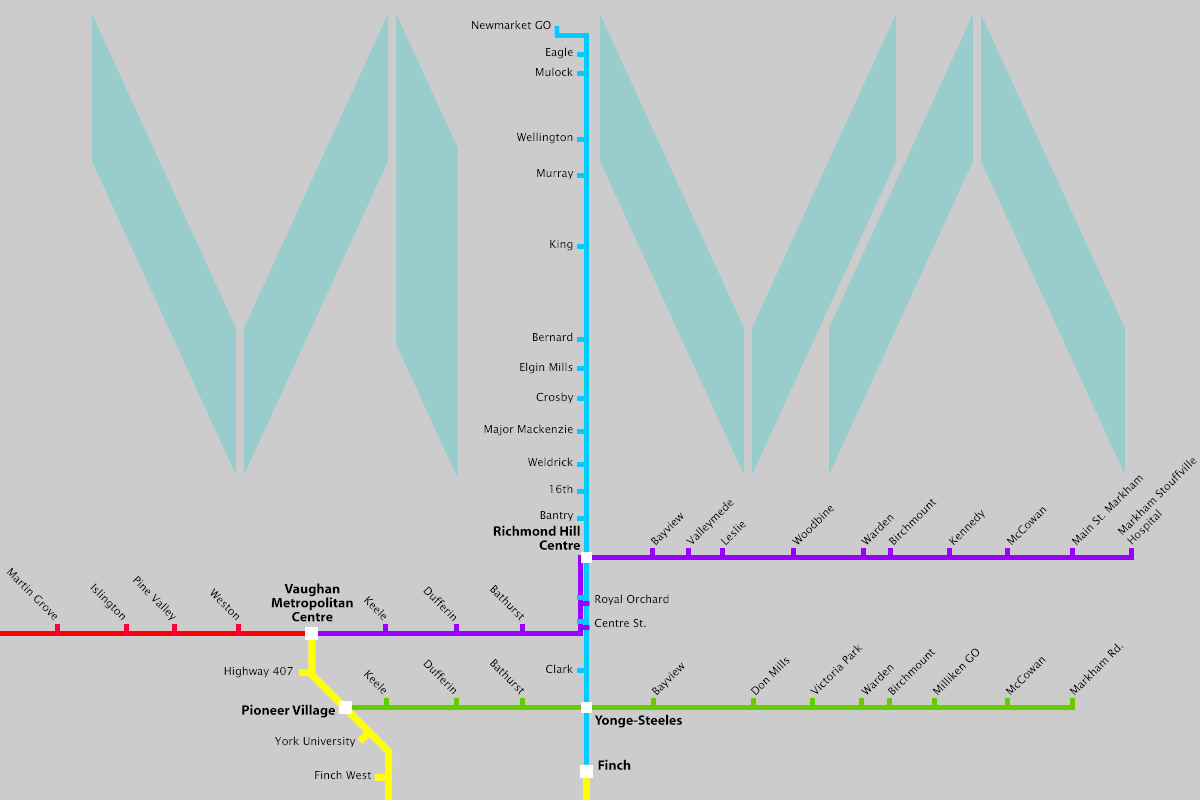
Here is fantasy map for the GTA I drew many years ago:


It's not really about building more rail, but more about integration, all transit in GTA becoming one system, that's the key. The barriers and redundancies are the main thing holding transit in the GTA back, more than anything else.

And I realized recently lack of true regional approach to transit, the lack of regional transit, that is what holding places like Mississauga City Centre, Scarborough City Centre, North York City Centre, etc. from becoming true downtowns. These are still local transit hubs, not regional transit hubs. New office towers still not economical, so these places are dominated by condo towers.

I rode 39 Britannia along Britannia and Matheson in Mississauga yesterday, and bus was PACKED. Even with only 22-25 minute frequency all day, they were already putting articulated buses on this route before the pandemic, and it seems ridership has recovered. Local transit has never been a problem in Mississauga and Brampton and the 905. People living in Mississauga and working in Mississauga, they can ride the bus no problem. Ridership has always been high. It's places along the border with Toronto, or too small systems like Oakville Transit, that struggle. York Region Transit ridership and service 🞵🞵🞵🞵🞵 compared to Mississauga and Brampton Transit, and it's for no reason other than the long border it shares with Toronto. It shouldn't be that way.

Here's another fantasy map I drew to highlight this problem:
Reply With Quote
     
     
  #2465  
Old Posted Nov 17, 2021, 8:22 PM
Nouvellecosse's Avatar
Nouvellecosse Nouvellecosse is online now
Volatile Pacivist
 
Join Date: Aug 2005
Location: Nova Scotia
Posts: 11,366
^Which technology is it that you're proposing for 🞵🞵🞵? Some type of LRT?
__________________
"The reasonable man adapts himself to the world; the unreasonable one persists in trying to adapt the world to himself. Therefore all progress depends on the unreasonable man." - George Bernard Shaw
Don't ask people not to debate a topic. Just stop making debatable assertions. Problem solved.
Reply With Quote
     
     
  #2466  
Old Posted Nov 17, 2021, 8:34 PM
DirectionNorth's Avatar
DirectionNorth DirectionNorth is offline
Registered User
 
Join Date: Oct 2020
Posts: 236
Quote:
Originally Posted by Nouvellecosse View Post
That's not really a thing though. Even if there was full fare integration between the TTC and the 905 agencies, there wouldn't be as significant a percentage of 905 subway riders compared to those originating from within the TTC service area. Partly because such long subway trips aren't as appealing, and partly because transit usage rates are much lower in the 905 suburbs.
I don't think the riders at Finch are mostly from the City of Toronto.

Ditto for the TYSSE.

When Renforth station (Eglinton W) opens in a few years, it will be mostly Mississauga riders.
Quote:
Originally Posted by Nouvellecosse View Post
Besides, if anything having more people traveling all the way to the ends of the subway lines actually makes better use of the service since the train is fuller for more of its route. The opposite is true for commuter rail. If most of the passengers on a trip from Union to Mt. Pleasant got off by Weston, the remaining nearly 2/3 of the trip is basically wasted.
... ?

"Overcrowding local service is better than less overcrowded express service"?

Solution: Short turn trains at Weston, if that's the case. Besides, does anybody (else) think that every transit line that isn't overcrowded is a "waste?"
__________________
My YouTube Channel
Reply With Quote
     
     
  #2467  
Old Posted Nov 17, 2021, 9:04 PM
Doady's Avatar
Doady Doady is offline
Registered User
 
Join Date: Apr 2004
Posts: 5,166
Quote:
Originally Posted by Nouvellecosse View Post
^Which technology is it that you're proposing for 🞵🞵🞵? Some type of LRT?
Unfortunately, traditional light rail in Toronto is branded as "streetcar", and such lines are still exist and continue to operate. So to avoid confusing riders, it only makes sense to continue using the "streetcar" branding for new modern light rail lines that incorporates features of rapid transit, a la "bus rapid transit". Rapid transit or express version of streetcar route, so "streetcar rapid transit" or "streetcar express". But "SRT" might be confusing because of the Scarborough RT, so "🞵🞵🞵" is the obvious choice.

Likewise, those "REX" or "regional express" lines are rapid transit version of GO Train, so high frequency like subway, but for longer distances with longer stop spacing, like S-Bahn or BART. Of course, there many other possibilities for branding a GO/regional rapid transit network, but with "🞵🞵🞵" it only makes sense to have "REX" as well.
Reply With Quote
     
     
  #2468  
Old Posted Nov 17, 2021, 9:58 PM
WhipperSnapper's Avatar
WhipperSnapper WhipperSnapper is offline
I am the law!
 
Join Date: Sep 2002
Location: Toronto+
Posts: 22,895
Speaking of Finch, North York Centre's condo boom is in large part as housing and entertainment for York University. What affect, if any, will that have on ridership with Vaughan Centre poised to takeover that title?


why not just call a slow, mixed traffic streetcar line a streetcar line and modern, commuter focused light rail as light rail? Lets bring back ICTS (intermediate capacity transit system) for the Scarborough RT line while it lasts or just call it Skytrain. 🞵🞵🞵 is to precious to use as an acronym for transit systems.
Reply With Quote
     
     
  #2469  
Old Posted Nov 17, 2021, 10:06 PM
Nouvellecosse's Avatar
Nouvellecosse Nouvellecosse is online now
Volatile Pacivist
 
Join Date: Aug 2005
Location: Nova Scotia
Posts: 11,366
Quote:
Originally Posted by DirectionNorth View Post
I don't think the riders at Finch are mostly from the City of Toronto.

Ditto for the TYSSE.

When Renforth station (Eglinton W) opens in a few years, it will be mostly Mississauga riders.
... ?
But the ridership originating or terminating at those stations is just a small proportion of the total ridership of the lines. They may be among the busiest single stations, but they're still just single stations among many. In the case of the Yonge line eastern arm, the other stations north of Bloor from Rosedale to NY Centre have a combined ridership of 347,460 compared to Finch's 99,350. So Finch accounts for only 22% of the total. So even if 75% of Finch's riders were from outside Toronto, they'd account for only 17%.

Quote:
Originally Posted by DirectionNorth View Post
"Overcrowding local service is better than less overcrowded express service"?
Fully utilizing a whole line is better than just using part of a small part of a line and wasting the available capacity on the rest. I don't think that's difficult to understand.

Quote:
Originally Posted by DirectionNorth View Post
Solution: Short turn trains at Weston, if that's the case.
Which is exactly what I was proposing in my original message when I said "I think full fare integration makes sense once you have services that solely or primarily serve Toronto." I was suggesting that there should be services that provide local transport within Toronto that are separate from those serving the suburbs. Those local services would have full fare integration with the TTC/

Quote:
Originally Posted by DirectionNorth View Post
Besides, does anybody (else) think that every transit line that isn't overcrowded is a "waste?"
Transit service that's underused is a waste. But that has nothing to do with overcrowding unless you think anything not overcrowded in underused. That would be a rather odd idea but hey, we're all different.
__________________
"The reasonable man adapts himself to the world; the unreasonable one persists in trying to adapt the world to himself. Therefore all progress depends on the unreasonable man." - George Bernard Shaw
Don't ask people not to debate a topic. Just stop making debatable assertions. Problem solved.
Reply With Quote
     
     
  #2470  
Old Posted Nov 17, 2021, 10:08 PM
thewave46 thewave46 is offline
Closed account
 
Join Date: Aug 2013
Posts: 3,530
Quote:
Originally Posted by WhipperSnapper View Post
🞵🞵🞵 is to precious to use as an acronym for transit systems.
I'm glad I'm not the only one who immediately thought this, especially in regards to various 'fantasies'.

It's right up there the 🞵🞵🞵 (Communauté Urbaine de Montréal).
Reply With Quote
     
     
  #2471  
Old Posted Nov 17, 2021, 10:11 PM
Nouvellecosse's Avatar
Nouvellecosse Nouvellecosse is online now
Volatile Pacivist
 
Join Date: Aug 2005
Location: Nova Scotia
Posts: 11,366
Quote:
Originally Posted by Doady View Post
Unfortunately, traditional light rail in Toronto is branded as "streetcar", and such lines are still exist and continue to operate. So to avoid confusing riders, it only makes sense to continue using the "streetcar" branding for new modern light rail lines that incorporates features of rapid transit, a la "bus rapid transit". Rapid transit or express version of streetcar route, so "streetcar rapid transit" or "streetcar express". But "SRT" might be confusing because of the Scarborough RT, so "🞵🞵🞵" is the obvious choice.

Likewise, those "REX" or "regional express" lines are rapid transit version of GO Train, so high frequency like subway, but for longer distances with longer stop spacing, like S-Bahn or BART. Of course, there many other possibilities for branding a GO/regional rapid transit network, but with "🞵🞵🞵" it only makes sense to have "REX" as well.
Hey if you can manage to make streetcars sound 🞵🞵🞵🞵, I'm all for it.
__________________
"The reasonable man adapts himself to the world; the unreasonable one persists in trying to adapt the world to himself. Therefore all progress depends on the unreasonable man." - George Bernard Shaw
Don't ask people not to debate a topic. Just stop making debatable assertions. Problem solved.
Reply With Quote
     
     
  #2472  
Old Posted Nov 17, 2021, 10:11 PM
WhipperSnapper's Avatar
WhipperSnapper WhipperSnapper is offline
I am the law!
 
Join Date: Sep 2002
Location: Toronto+
Posts: 22,895
Never had a Risky Business moment
Reply With Quote
     
     
  #2473  
Old Posted Nov 17, 2021, 10:15 PM
swimmer_spe swimmer_spe is offline
BANNED
 
Join Date: Apr 2014
Posts: 10,743
Quote:
Originally Posted by hw621 View Post
Another thing is necessary to make Smart Track somewhat useful: continuous services through Union Station. They should not end all trips at Union Station and have passengers transfer to another train.
With GO having 6 lines, and ST having no less than 2, it would make sense that they are continuous. It would be no different than the subway terminating at Union.
Reply With Quote
     
     
  #2474  
Old Posted Nov 17, 2021, 10:17 PM
swimmer_spe swimmer_spe is offline
BANNED
 
Join Date: Apr 2014
Posts: 10,743
Quote:
Originally Posted by Nouvellecosse View Post
Hey if you can manage to make streetcars sound 🞵🞵🞵🞵, I'm all for it.
Are you saying that streetcars aren't 🞵🞵🞵🞵?
Reply With Quote
     
     
  #2475  
Old Posted Nov 17, 2021, 11:20 PM
WhipperSnapper's Avatar
WhipperSnapper WhipperSnapper is offline
I am the law!
 
Join Date: Sep 2002
Location: Toronto+
Posts: 22,895
Someone posted a Seville tram that can switch to battery power in the Green Line thread on Skyrise Calgary. That's pretty cool. No wires.
Reply With Quote
     
     
  #2476  
Old Posted Nov 18, 2021, 11:08 AM
biguc's Avatar
biguc biguc is offline
Registered User
 
Join Date: Mar 2003
Location: pinkoland
Posts: 11,905
Quote:
Originally Posted by Nouvellecosse View Post

Fully utilizing a whole line is better than just using part of a small part of a line and wasting the available capacity on the rest. I don't think that's difficult to understand.
You seem to be saying it's good to crowd a line on one end and keep it crowded. This renders the line unusable for people on the rest of the line. That means you aren't using the full line, just the stations that fill trains first.

Ideally you'd want the greatest number of fares, not just maximum occupancy. But boarding takes time; too many entrances/exits can really slow a system down. I'm sure there's an equilibrium ridership between the entire train emptying and refilling every stop (and therefore becoming very slow) and riders travelling the entire length of the line (and therefore reducing fares by making stations unusable).
__________________
no
Reply With Quote
     
     
  #2477  
Old Posted Nov 18, 2021, 6:41 PM
rbt rbt is offline
Registered User
 
Join Date: Jun 2006
Posts: 1,387
Quote:
Originally Posted by Innsertnamehere View Post
It’s very confusing but Smart Track stations are basically just regular GO stations that the City is paying to build. Metrolinx / the province is also paying for several new stations themselves in Toronto, which aren’t part of Smart Track. It doesn’t really make much sense.
Even that explanation isn't quite true anymore as East Harbour is now a Smart Track station that the province is paying for (changed with Ontario Line tender plan). Toronto's portion didn't get smaller but it was allotted to another area.
Reply With Quote
     
     
  #2478  
Old Posted Nov 18, 2021, 7:49 PM
WhipperSnapper's Avatar
WhipperSnapper WhipperSnapper is offline
I am the law!
 
Join Date: Sep 2002
Location: Toronto+
Posts: 22,895
Quote:
Originally Posted by biguc View Post
You seem to be saying it's good to crowd a line on one end and keep it crowded. This renders the line unusable for people on the rest of the line. That means you aren't using the full line, just the stations that fill trains first.

Ideally you'd want the greatest number of fares, not just maximum occupancy. But boarding takes time; too many entrances/exits can really slow a system down. I'm sure there's an equilibrium ridership between the entire train emptying and refilling every stop (and therefore becoming very slow) and riders travelling the entire length of the line (and therefore reducing fares by making stations unusable).
Most important to provide service for localized travel as well as fast efficient commuter service to the business district(s) than maximizing the number of fares. A transit system that relies on the farebox will be too financially strapped to be a great system. there will always be deep subsidies no matter how successful the system is at encouraging its use over cars. Localized travel and commuter travel are opposites of each other. I don't think there is an equilibrium. A backbone metro line should have 4 sets of tracks to allow multiple branch lines connected to express service to operate in tandem with a localized service that stops at every stop.

I do think it can be achieved with the TTC Subway and GO service within the city of Toronto
Reply With Quote
     
     
  #2479  
Old Posted Nov 18, 2021, 7:54 PM
Nouvellecosse's Avatar
Nouvellecosse Nouvellecosse is online now
Volatile Pacivist
 
Join Date: Aug 2005
Location: Nova Scotia
Posts: 11,366
Quote:
Originally Posted by biguc View Post
You seem to be saying it's good to crowd a line on one end and keep it crowded. This renders the line unusable for people on the rest of the line. That means you aren't using the full line, just the stations that fill trains first.
I think you're mis-interpreting my use of "fully utilized" to mean filled to max capacity. My usage is similar to the way that a full time job or full employment may be considered 35-40 hours/week, despite that not being the maximum hours a person can work. It just tends to be the minimum number that a person can work and still be considered fully employed. When I say "fully utilized" in terms of a transit line, I just mean the minimum number of riders needed to justify operating a particular route or route segment with a given rolling stock. That should not be read as "crowded" nor as at maximum capacity/unable to hold additional riders. As a rough estimate, I would describe full utilization as the middle 50% of maximum capacity depending on the section of the line in question with the bottom 25% being under-utilization and the top 25% being over-crowding. We're all familiar with the concept of diminishing returns wrt transit route lengths.

I would actually consider it good for a commuter line to only be filled to say, 50% of its absolute maximum for most of the trip since that means all the seats would be occupied but wouldn't require people to stand for long distances. Single level commuter oriented rolling stock tends to have from 2.5-4.0 seats per metre of train while that would be roughly doubled with standing capacity. So there is definitely spare standing capacity to serve people traveling short distances. The problem is that with full fare integration in a city where there is significant latent demand for transit due to under-investment, there's a risk that urban riders wouldn't just use the spare capacity but instead use all of it.

Quote:
Originally Posted by biguc View Post
Ideally you'd want the greatest number of fares, not just maximum occupancy. But boarding takes time; too many entrances/exits can really slow a system down. I'm sure there's an equilibrium ridership between the entire train emptying and refilling every stop (and therefore becoming very slow) and riders travelling the entire length of the line (and therefore reducing fares by making stations unusable).
I don't agree the ideal would be the greatest number of fares. That may be true for a profit-based enterprise where the mandate would be to achieve the greatest profit, but that could also come in the form of more small fares or fewer higher fares. And higher profit also wouldn't necessarily even mean highest fare revenue since one could increase profitability by lowering costs. But in the case of a public service, the profit motive isn't really relevant since that's not the mandate. Generally fares are only even charged to reduce subsidies and to limit frivolous usage. The ideal is providing the greatest total amount of transportation feasible within the available budget (feasible meaning provided in a reasonable way, aka not overcrowded or in otherwise poor conditions).

In the example of a generic route ABC (a line from A to C with one or more intermediate stops B) the maximum feasible transportation would come in the form of full utilization for segment A-C, either by riders making the whole trip or in combination with riders from A-B and B-C. It would not come in the form of full utilization of stretch A-B and under-utilization of stretch B-C because in that case, stretch B-C is made redundant and can be cut or eliminated in favour of a focus on A-B. In other words, the travel pattern would warrant a service from A-B with its own pricing and service levels.
__________________
"The reasonable man adapts himself to the world; the unreasonable one persists in trying to adapt the world to himself. Therefore all progress depends on the unreasonable man." - George Bernard Shaw
Don't ask people not to debate a topic. Just stop making debatable assertions. Problem solved.

Last edited by Nouvellecosse; Nov 19, 2021 at 12:25 PM.
Reply With Quote
     
     
  #2480  
Old Posted Nov 18, 2021, 8:05 PM
Nouvellecosse's Avatar
Nouvellecosse Nouvellecosse is online now
Volatile Pacivist
 
Join Date: Aug 2005
Location: Nova Scotia
Posts: 11,366
Quote:
Originally Posted by WhipperSnapper View Post
Most important to provide service for localized travel as well as fast efficient commuter service to the business district(s) than maximizing the number of fares. A transit system that relies on the farebox will be too financially strapped to be a great system. there will always be deep subsidies no matter how successful the system is at encouraging its use over cars. Localized travel and commuter travel are opposites of each other. I don't think there is an equilibrium. A backbone metro line should have 4 sets of tracks to allow multiple branch lines connected to express service to operate in tandem with a localized service that stops at every stop.

I do think it can be achieved with the TTC Subway and GO service within the city of Toronto
That would really be considered optimal whenever possible. Fortunately the Kitchener line is quad tracked through the urban section all the way to the airport spur so it shouldn't be too difficult in that case. Some of the other GO routes may be trickier.
__________________
"The reasonable man adapts himself to the world; the unreasonable one persists in trying to adapt the world to himself. Therefore all progress depends on the unreasonable man." - George Bernard Shaw
Don't ask people not to debate a topic. Just stop making debatable assertions. Problem solved.
Reply With Quote
     
     
This discussion thread continues

Use the page links to the lower-right to go to the next page for additional posts
 
 
Reply

Go Back   SkyscraperPage Forum > Regional Sections > Canada
Forum Jump


Forum Jump


All times are GMT. The time now is 11:44 PM.


Powered by vBulletin® Version 3.8.7
Copyright ©2000 - 2026, vBulletin Solutions, Inc.


