HomeDiagramsDatabaseMapsForum About
     

Go Back   SkyscraperPage Forum > Regional Sections > Canada > Ontario > Ottawa-Gatineau > Transportation


View Poll Results: Electric Vehicle Ownership Poll
I own a BEV (Battery Electric Vehicle) 7 21.88%
I own a PHEV (Plug-in Hybrid Electric Vehicle) 2 6.25%
I own an HEV (Hybrid Electric Vehicle) 2 6.25%
I'm considering a BEV (Tesla, LEAF, Bolt, etc.) 6 18.75%
I'm considering a PHEV (Volt, etc.) 6 18.75%
I'm considering a HEV (Prius, etc.) 3 9.38%
I would only buy a non-electric gas or diesel car 3 9.38%
I don't want a car 4 12.50%
Multiple Choice Poll. Voters: 32. You may not vote on this poll

Reply

 
Thread Tools Display Modes
     
     
  #681  
Old Posted Jul 5, 2021, 4:47 PM
roger1818's Avatar
roger1818 roger1818 is offline
Registered User
 
Join Date: Feb 2016
Location: Stittsville, ON
Posts: 6,610
Quote:
Originally Posted by Truenorth00 View Post
There should be discussion on it. That's true. But really there isn't. So we are in a situation that absent any real plans, they won't have options. Meanwhile OEMs are actually going to start dialing back ICEV offerings beyond 2025. So the only realistic way to rapidly scale up some infrastructure is the some investment at places where most people congregate regularly.
The problem is the people making decisions about EV infrastructure who don't drive a BEV. It is kind of like how we have a transit commissioner who never takes transit. Sometimes you need to experience things first hand to understand is useful and what isn't.
Reply With Quote
     
     
  #682  
Old Posted Jul 5, 2021, 5:09 PM
Truenorth00 Truenorth00 is online now
Registered User
 
Join Date: May 2017
Posts: 29,105
Quote:
Originally Posted by roger1818 View Post
The problem is the people making decisions about EV infrastructure who don't drive a BEV. It is kind of like how we have a transit commissioner who never takes transit. Sometimes you need to experience things first hand to understand is useful and what isn't.
Is that really the issue? If the argument is that investment decisions on EV infrastructure can't be made without any personal experience with a BEV, we're going to be waiting forever for charging infrastructure investment....

The fundamental problem with wiring up multifamily dwellings is the cost. It's really that simple. And unfortunately, most residents aren't going to see immediate need to wire them up and the government can't realistically afford to subsidize wiring up the bulk of condos. So the question becomes where can they put money to scale infrastructure quickly and efficiently. Shared spaces seems to be the obvious solution. A stand of chargers at a grocery store or mall easily serves the immediate catchment of 5000 residents for that grocery store. It's not the whole solution, but it's an obvious way to move quickly.

Something has to give though. Because unless they come up with a real plan, we're going to be in a situation where there's still a lot of unwired condos and apartments come 2035.
Reply With Quote
     
     
  #683  
Old Posted Jul 5, 2021, 5:49 PM
roger1818's Avatar
roger1818 roger1818 is offline
Registered User
 
Join Date: Feb 2016
Location: Stittsville, ON
Posts: 6,610
Quote:
Originally Posted by Truenorth00 View Post
Is that really the issue? If the argument is that investment decisions on EV infrastructure can't be made without any personal experience with a BEV, we're going to be waiting forever for charging infrastructure investment....

The fundamental problem with wiring up multifamily dwellings is the cost. It's really that simple. And unfortunately, most residents aren't going to see immediate need to wire them up and the government can't realistically afford to subsidize wiring up the bulk of condos. So the question becomes where can they put money to scale infrastructure quickly and efficiently. Shared spaces seems to be the obvious solution. A stand of chargers at a grocery store or mall easily serves the immediate catchment of 5000 residents for that grocery store. It's not the whole solution, but it's an obvious way to move quickly.

Something has to give though. Because unless they come up with a real plan, we're going to be in a situation where there's still a lot of unwired condos and apartments come 2035.
The problem with using public charging on a regular basis is consumer cost. While some retailers provide free public charging, that isn't sustainable. They might be willing to subsidize the charging of a couple vehicles for good PR, but the problem is if it is free, everyone will use it, even if they don't really need to charge. As a result they will fill up and those who need a charge, can't. It is unlikely that those retailers will scale up their charging to match demand and charge dozens of cars at a time.

When there is a cost for charging, the typical rate for a Level 2 charging in Ontario is about $2 per hour. At a peak charging rate of 6.6 kW, that works out to about $0.30 per kWh. By comparison, charging overnight at home, electricity costs about $0.10 per kWh (1/3 the cost). Some of the higher cost for public charging is from higher electricity rates and part of it is markup to cover infrastructure costs.

Also, from a sustainability perspective, charging overnight, when electricity demand is low, is far superior than charging during peak electricity demand.
Reply With Quote
     
     
  #684  
Old Posted Jul 5, 2021, 6:26 PM
OTownandDown OTownandDown is offline
Registered User
 
Join Date: Jul 2018
Posts: 1,636
We're at the cusp of a complete transition where public investment meets sound business investment. Where sales, service and charging hit a critical inflection point and become a profitable business.

As time goes on the obvious need for charging will become apparent and market driven (pun intended). Sure there's going to be growing pains along the way. Full charging stations, no charging stations, etc.

Curious to see how charging station deployments develop over time. 99% of trips will be done from home charging, so I don't see the point of grocery store/mall charge stations other than the novelty at the moment. Nobody needs to charge a Tesla at the Rideau Centre just because they're shopping. They just want to park close to the elevator (lol, ask me how I know!).

Travelling cross-province will require pay-to-charge stations, and more selection than a tesla supercharger, so we'll see very very large charging stations at nodes on major highways. I'm thinking 50-100 stations at the Deep River Canadian Tire, or 50-100 stations at North Bay's Tim Hortons next to Fannies, and even those might scale down over time, as batteries become more efficient and ranges are extended to 1000km+ (similar to how there used to be tons of gas stations at regular intervals when cars had very bad efficiency).

Imagine when 2035 rolls around and all cars leaving Ottawa travelling west will need to charge between Deep River and North Bay. You'll need thousands of available stations. There's going to be a boom, and it's going to be fast!

Speaking of, how do I invest in charge station construction companies?
Reply With Quote
     
     
  #685  
Old Posted Jul 5, 2021, 6:33 PM
Truenorth00 Truenorth00 is online now
Registered User
 
Join Date: May 2017
Posts: 29,105
Quote:
Originally Posted by roger1818 View Post
The problem with using public charging on a regular basis is consumer cost. While some retailers provide free public charging, that isn't sustainable. They might be willing to subsidize the charging of a couple vehicles for good PR, but the problem is if it is free, everyone will use it, even if they don't really need to charge. As a result they will fill up and those who need a charge, can't. It is unlikely that those retailers will scale up their charging to match demand and charge dozens of cars at a time.

When there is a cost for charging, the typical rate for a Level 2 charging in Ontario is about $2 per hour. At a peak charging rate of 6.6 kW, that works out to about $0.30 per kWh. By comparison, charging overnight at home, electricity costs about $0.10 per kWh (1/3 the cost). Some of the higher cost for public charging is from higher electricity rates and part of it is markup to cover infrastructure costs.
I don't think that's an unfair proposition though. That apartment/condo dweller would otherwise need a house to be able to access a charger. And that's a lot more expensive than just paying a bit more to charge.

Personally, as a condo dweller, I'd be just fine paying more for a public charger, as long as:

1) The cost is cheaper than gas for my car.

2) The chargers are located such that it can be concurrent to a regular activity of mine.

Networks like Electrify Canada already meet criteria 1. $15-20/wk would be enough of a fill for the average person. And that's way cheaper than gas for a week. The issue is the second criteria. To date, charging stations seem to be getting built in the worst locations for the general public. You sort have to go out of your way to use one. Who the hell wants to use a charger at a Canadian Tire every week (where Electrify Canada is installing them)?

Presumably, this is where government investment could help. There's about 4000 large grocery stores in Canada between the Loblaws/Shopper's Drug Mart, Empire/Sobey's, Metro, Walmart and Costco groups. How much would the government have to pay to subsidize the construction of say a bank of a dozen 75 kW faster chargers at each location? Would say a grant of $125k per site ($5B spent over a decade) be enough to incentivize the charger networks and grocery stores to team up and put their own capital forward? The grants can also come with conditions on rates, if that's a concern. Though personally, I don't think it's a concern. Added bonus is that you now have networks that taxi drivers, business travelers, etc can use midday.

Quote:
Originally Posted by roger1818 View Post
Also, from a sustainability perspective, charging overnight, when electricity demand is low, is far superior than charging during peak electricity demand.
True. But you gotta remember this is really only targeting a segment of the population that doesn't have home charging. The bulk of charging will still be in a home or industrial garage at night. And the bulk of grocery shoppers are still shopping on weeknights and weekends. So their use would likely be more off-peak than not.
Reply With Quote
     
     
  #686  
Old Posted Jul 5, 2021, 6:50 PM
Truenorth00 Truenorth00 is online now
Registered User
 
Join Date: May 2017
Posts: 29,105
Quote:
Originally Posted by OTownandDown View Post
Curious to see how charging station deployments develop over time. 99% of trips will be done from home charging, so I don't see the point of grocery store/mall charge stations other than the novelty at the moment. Nobody needs to charge a Tesla at the Rideau Centre just because they're shopping. They just want to park close to the elevator (lol, ask me how I know!).
Do apartment and condo dwellers not exist in your world?

Quote:
Originally Posted by OTownandDown View Post
Travelling cross-province will require pay-to-charge stations, and more selection than a tesla supercharger, so we'll see very very large charging stations at nodes on major highways. I'm thinking 50-100 stations at the Deep River Canadian Tire, or 50-100 stations at North Bay's Tim Hortons next to Fannies, and even those might scale down over time, as batteries become more efficient and ranges are extended to 1000km+ (similar to how there used to be tons of gas stations at regular intervals when cars had very bad efficiency).

Imagine when 2035 rolls around and all cars leaving Ottawa travelling west will need to charge between Deep River and North Bay. You'll need thousands of available stations. There's going to be a boom, and it's going to be fast!
I think you might be overestimating how many chargers will be needed. It's not like there are thousands of gas pumps between Deep River and North Bay.

If you want some rough math. A typical gas pump services about 6-8 cars per hour. A charging station can do about 1-2 cars per hour. So a typical service location would need to replace one gas pump with about 4 chargers to fuel the same number of cars. So this would mean that a typical OnRoute service with the Canadian Tire pump that has 16 nozzles, should eventually have 64 chargers put in by say 2040 when we expect the vast majority of cars on the road to be electric.

I wish that the federal and provincial governments would actually come up with a charging strategy to figure out how we are going to build all these chargers over the next two decades. So that we can figure out where public investment is necessary. And where it can be used to activate private sector investment in the buildout.

Quote:
Originally Posted by OTownandDown View Post
Speaking of, how do I invest in charge station construction companies?
Several charging networks are publicly listed (Blink, Chargepoint, etc.) or owned by publicly listed companies (PetroCanada, Electrify Canada, etc.). Though, some of the largest ones are also owned by utilities. Hydro Quebec's massive Electric Circuit network and Ontario's fledgling Ivy Charging come to mind.
Reply With Quote
     
     
  #687  
Old Posted Jul 5, 2021, 8:04 PM
OTownandDown OTownandDown is offline
Registered User
 
Join Date: Jul 2018
Posts: 1,636
1. So you think apartment and condo dwellers will have to seek out public charging stations and not charge when they're at home in the evenings?? That seems incredibly expensive to me. No, apartments and condos will provide either 120 (at old apartments/condos) or 240 (at new builds). This will be a demand from occupants. Yes there's some fannagling regarding costs. I only drive a Volt and I never charge publicly unless I'm on a road trip. I used to charge when I went places, just for the novelty, but its friggin' expensive and I don't usually need any extra electrons to get around town. If I owned a larger battery pack, I would never ever charge out in public due to cost.

A very small contingent of downtown dwellers may not have a parking space and use street parking. I did do this for quite some time, and I sought out plugs with free energy, legal and illegal, wherever I could. I feel for these people, because there will need to be an in-between solution, otherwise costs for public charging is going to 🞵🞵🞵🞵 for them.

2. There's at least 4 gas stations in Deep River, with several nozzles at each. If Canadian Tire has the property available, they're going to install 50-100 chargers, as I said, also by your math. If those restaurants/fast food/tims also want in on the action, I would expect the majority of their parking lot to have at least a level 2 at each parking stall, with a large selection of Level 3 as well. Don't underestimate how lazy and hungry people are. Pretty much everybody will be running on fumes going thru Deep River, with a daunting gap to North Bay.

Edit: AADT for HWY17 is about 4000-8000 vehicles per hour. So... lets say 80% is in the daytime? 6400 during 12 hours or so is 530 per hour (on the high side, yes)

If we're doing 30 minutes per charge, we need 250++ chargers in a 500km segment of highway on HWY17. This requirement is less from Sudbury to Thunder Bay, but more from Sudbury to Ottawa.

This doesn't take into account my consumer habit, that I want to find a charger with no problem. What if there's huge demand and it's frustratingly full everywhere? This will spur additional rollout of stations. I predict north of 300-400 individual stations between here and North Bay. I think if you compare the count of gas pump nozzles, it's probably something like 1/4 of that total, but who knows. This will ALSO accelerate the rollout of ultra-high mileage vehicles, way more than people need day-to-day. Similar to those VW commercials in the 2000's of car owners driving past the lonely gas station attendant.

It's going to be interesting to see if gas stations become 'service centers' with chargers, or if service centers that offer food like restaurants and curiosity shops become the prime source of charging infrastructure and gas stations go the way of the dodo bird.

I don't think it matters anymore whether the government helps out. Change is inevitable, we've passed the tipping point.

Quote:
Originally Posted by Truenorth00 View Post
Do apartment and condo dwellers not exist in your world?


I think you might be overestimating how many chargers will be needed. It's not like there are thousands of gas pumps between Deep River and North Bay.

If you want some rough math. A typical gas pump services about 6-8 cars per hour. A charging station can do about 1-2 cars per hour. So a typical service location would need to replace one gas pump with about 4 chargers to fuel the same number of cars. So this would mean that a typical OnRoute service with the Canadian Tire pump that has 16 nozzles, should eventually have 64 chargers put in by say 2040 when we expect the vast majority of cars on the road to be electric.

I wish that the federal and provincial governments would actually come up with a charging strategy to figure out how we are going to build all these chargers over the next two decades. So that we can figure out where public investment is necessary. And where it can be used to activate private sector investment in the buildout.


Several charging networks are publicly listed (Blink, Chargepoint, etc.) or owned by publicly listed companies (PetroCanada, Electrify Canada, etc.). Though, some of the largest ones are also owned by utilities. Hydro Quebec's massive Electric Circuit network and Ontario's fledgling Ivy Charging come to mind.
Reply With Quote
     
     
  #688  
Old Posted Jul 5, 2021, 8:08 PM
YOWetal YOWetal is offline
Registered User
 
Join Date: Oct 2006
Posts: 7,742
Quote:
Originally Posted by roger1818 View Post
Taxies and other fleet vehicles should definitely be a priority. For taxies, wireless charging will be a game changer. By putting wireless charging at taxi stands would allow them to grab some charge automatically, every time they are waiting for a fare. Wireless charring become especially valuable when there is a taxi queue, like at the airport or train station.


Just because there hasn't been a discussion on broadly rewiring existing multi-unit dwellings, doesn't mean there shouldn't be a discussion on it. It is still early days, but we need to get on it soon.
Taxi stands ? What is is 2008? I mean I realise there are a few left and the juicy fares that come from them are all the plated drivers have left but for most taxis the time in a stand is a small fraction of their day.
Reply With Quote
     
     
  #689  
Old Posted Jul 5, 2021, 8:20 PM
roger1818's Avatar
roger1818 roger1818 is offline
Registered User
 
Join Date: Feb 2016
Location: Stittsville, ON
Posts: 6,610
Quote:
Originally Posted by YOWetal View Post
Taxi stands ? What is is 2008? I mean I realise there are a few left and the juicy fares that come from them are all the plated drivers have left but for most taxis the time in a stand is a small fraction of their day.
As I said, the airport and train station are the two main places where taxis still queue up.
Reply With Quote
     
     
  #690  
Old Posted Jul 5, 2021, 8:28 PM
roger1818's Avatar
roger1818 roger1818 is offline
Registered User
 
Join Date: Feb 2016
Location: Stittsville, ON
Posts: 6,610
Quote:
Originally Posted by Truenorth00 View Post
I don't think that's an unfair proposition though. That apartment/condo dweller would otherwise need a house to be able to access a charger. And that's a lot more expensive than just paying a bit more to charge.
That isn't at all what I suggested. You are the one who is arguing against residential charging infrastructure subsidies.
Quote:
Originally Posted by roger1818 View Post
As for the cost of installing a dedicated circuit of some type, that should be the focus of government subsidies instead of vehicle rebates. Ensuring that anyone with an BEV can charge at home (regardless of the type of housing and parking) should be a priority.
Reply With Quote
     
     
  #691  
Old Posted Jul 5, 2021, 8:37 PM
roger1818's Avatar
roger1818 roger1818 is offline
Registered User
 
Join Date: Feb 2016
Location: Stittsville, ON
Posts: 6,610
Quote:
Originally Posted by OTownandDown View Post
A very small contingent of downtown dwellers may not have a parking space and use street parking. I did do this for quite some time, and I sought out plugs with free energy, legal and illegal, wherever I could. I feel for these people, because there will need to be an in-between solution, otherwise costs for public charging is going to 🞵🞵🞵🞵 for them.
This was posted earlier, but the City is planning to install 24 on-street electric vehicle charging stations at 12 sites across Ottawa for people who don't have access to off street parking at their home. They won't be free, but I seem to remember reading somewhere that they will have discounted overnight rates.

https://engage.ottawa.ca/charging-stations
Reply With Quote
     
     
  #692  
Old Posted Jul 6, 2021, 12:48 PM
nredding nredding is offline
Registered User
 
Join Date: Nov 2009
Posts: 188
Something that would make a lot of sense would be for condo developers to rough-in the wiring for EV charging when building the parking garage. That would be much cheaper than retrofitting at a alter date.
Reply With Quote
     
     
  #693  
Old Posted Jul 6, 2021, 12:51 PM
CanadaGoose CanadaGoose is offline
Registered User
 
Join Date: Sep 2014
Posts: 260
Just going to add this here for the condo / apartment problem.


All new multi-unit properties need to have L2s installed now out in Victoria, BC or (Saanich, BC)

https://www.saanich.ca/EN/main/community...vehicle-infrastructure-requirements.html
Reply With Quote
     
     
  #694  
Old Posted Jul 7, 2021, 11:48 AM
CanadaGoose CanadaGoose is offline
Registered User
 
Join Date: Sep 2014
Posts: 260
Another post, it will soon be a City of Vancouver bylaw shortly to have ev charging at new commercial properties.

https://vancouver.ca/news-calendar/more-...g-in-ready-to-meet-increasing-needs.aspx
Reply With Quote
     
     
  #695  
Old Posted Jul 7, 2021, 5:42 PM
roger1818's Avatar
roger1818 roger1818 is offline
Registered User
 
Join Date: Feb 2016
Location: Stittsville, ON
Posts: 6,610
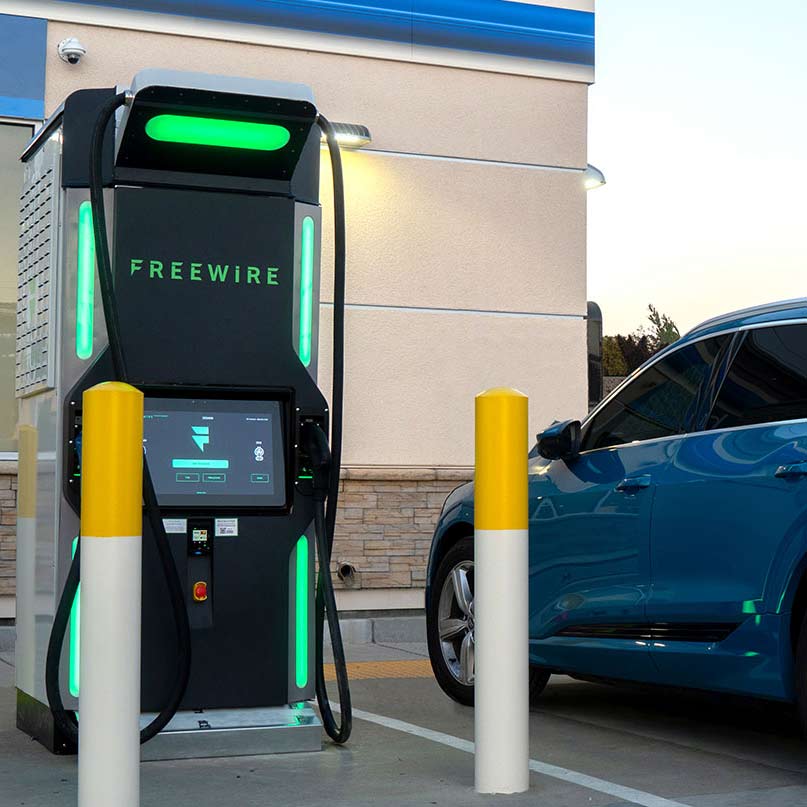
I was listening to the Fully Charged Plus Podcast the other day (episode 105 at 24:18), and one of the things they brought up was a new DC Fast Charger by FreeWire in the USA called the Boost Charger which has integrated batteries. This allows the charger to have a much smaller grid connection (≤ 27 kW) but still provide 120 kW CCS or 100 kW CHAdeMO. The other interesting feature is that, unlike most DC Fast Chargers, both cables can be used simultaneously (though the charging rate is then shared at 60kW each). The reduced shared rate isn't as big a deal as it seems, since many BEVs charging curve will drop below 120 kW at a higher state of charge. The data sheet can be found here.

This charger is very useful for small installations (coffee shops, restaurants, etc.) where they have some reserve capacity on their existing grid connection and thus may not need to pay for a new separate grid connection.

Also, an existing 50kW charger could be upgraded to two 120kW chargers that could charge up to four vehicles simultaneously, instead of just one, without any changes to the grid connection. This could also be done with external batteries, but an integrated solution has advantages.

Reply With Quote
     
     
  #696  
Old Posted Jul 7, 2021, 8:47 PM
Truenorth00 Truenorth00 is online now
Registered User
 
Join Date: May 2017
Posts: 29,105
That thing looks beefy. How much would it cost? Looks like $200k a pop.
Reply With Quote
     
     
  #697  
Old Posted Jul 8, 2021, 11:37 AM
roger1818's Avatar
roger1818 roger1818 is offline
Registered User
 
Join Date: Feb 2016
Location: Stittsville, ON
Posts: 6,610
Quote:
Originally Posted by Truenorth00 View Post
That thing looks beefy. How much would it cost? Looks like $200k a pop.
I’m not sure where you are getting that price guess from. The impression I got from the podcast is that the total installation cost would be similar to or less than a conventional DCFC system, with a dedicated, high powered grid connection.
Reply With Quote
     
     
  #698  
Old Posted Jul 8, 2021, 11:48 AM
Truenorth00 Truenorth00 is online now
Registered User
 
Join Date: May 2017
Posts: 29,105
Quote:
Originally Posted by roger1818 View Post
I’m not sure where you are getting that price guess from. The impression I got from the podcast is that the total installation cost would be similar to or less than a conventional DCFC system, with a dedicated, high powered grid connection.
That's good to know. I was thinking batteries would dramatically boost the cost.

Which episode was this?
Reply With Quote
     
     
  #699  
Old Posted Jul 8, 2021, 12:41 PM
roger1818's Avatar
roger1818 roger1818 is offline
Registered User
 
Join Date: Feb 2016
Location: Stittsville, ON
Posts: 6,610
Quote:
Originally Posted by Truenorth00 View Post
That's good to know. I was thinking batteries would dramatically boost the cost.
It only has 160 kWh of batteries, which even at $150 per kWh (they are cheaper than that these days) works out to $24,000. If you doubled that for markup and added $50k for the other charger circuitry, it is still just under $100k. I am not sure what the actual price is though.

The other advantage is it will even out the power draw, so the utility won't charge them fees for a surge in power consumption like a conventional DCFC without batteries would have.

Quote:
Originally Posted by Truenorth00 View Post
Which episode was this?
As I said in my original post the Fully Charged Plus Podcast, episode 105 at 24:18
Reply With Quote
     
     
  #700  
Old Posted Jul 8, 2021, 12:50 PM
CanadaGoose CanadaGoose is offline
Registered User
 
Join Date: Sep 2014
Posts: 260
Tesla is looking for a supercharger site host for a third location in Ottawa. (and yes, i changed my username)

Details to inquire here:
https://www.tesla.com/en_ca/host-a-supercharger
https://feedback.tesla.com/jfe/form/SV_8InY86zvVpCY1bU
Reply With Quote
     
     
This discussion thread continues

Use the page links to the lower-right to go to the next page for additional posts
 
 
Reply

Go Back   SkyscraperPage Forum > Regional Sections > Canada > Ontario > Ottawa-Gatineau > Transportation
Forum Jump


Forum Jump


All times are GMT. The time now is 5:06 PM.


Powered by vBulletin® Version 3.8.7
Copyright ©2000 - 2026, vBulletin Solutions, Inc.