HomeDiagramsDatabaseMapsForum About
     

Go Back   SkyscraperPage Forum > Regional Sections > United States > Mountain West


Reply

 
Thread Tools Display Modes
     
     
  #9561  
Old Posted Jan 24, 2021, 1:32 AM
bunt_q's Avatar
bunt_q bunt_q is offline
Provincial Bumpkin
 
Join Date: Aug 2002
Location: Denver, CO
Posts: 13,203
Quote:
Originally Posted by rds70 View Post
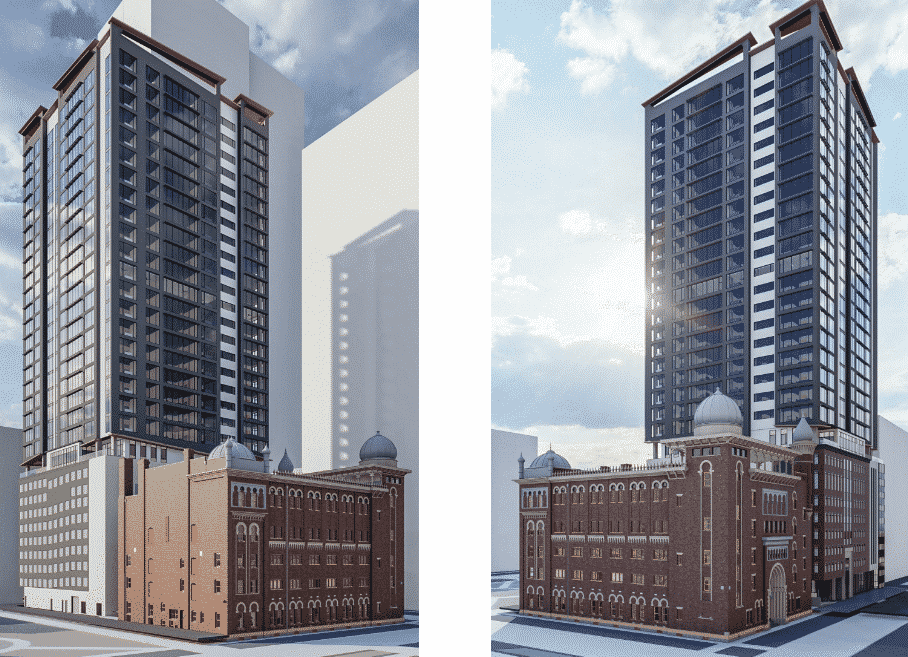
El Jebel Tower is back (although shorter).

Concept review submitted to City:


Architect is listed as DLW Architects, Dunedin, FL
And to think, once upon a time we were excited about a potential Trump Tower in Denver. My, how times have changed.
Reply With Quote
     
     
  #9562  
Old Posted Jan 24, 2021, 6:20 PM
Robert.hampton Robert.hampton is offline
Registered User
 
Join Date: Jul 2015
Posts: 491
Quote:
Originally Posted by rds70 View Post
El Jebel Tower is back (although shorter).

Concept review submitted to City:


Architect is listed as DLW Architects, Dunedin, FL
Hmmm so 4 residential units per floor averaging 2000sf per unit? Certainly would be something totally new and a huge departure from prevailing trends. The architect also has a real doozy of a portfolio of pretty horrid Hampton inns in the suburbs so count me as skeptical (not to mention the sketchy developers)

Last edited by Robert.hampton; Jan 24, 2021 at 7:05 PM.
Reply With Quote
     
     
  #9563  
Old Posted Jan 24, 2021, 6:34 PM
BG918's Avatar
BG918 BG918 is offline
Registered User
 
Join Date: Nov 2002
Posts: 3,554
Quote:
Originally Posted by wong21fr View Post
600 Park Avenue? Did that finally break ground? Still the same 13 story, quarter
block development as a few years back. I believe that Greystar is the developer.

Interestingly, that was the first project to go through the AS (now Downtown) design review.
600 Park Ave is under construction, another Greystar project. Their recent Denver portfolio includes Parq on Speer (Speer & Bannock), The Pullman (19th & Wewatta) and The Fitzgerald (18th & Market) along with the proposed Parq II at 10th & Bannock.

This area also has the 9 story CCH Renaissance Lofts now under construction on California between 21st and 22nd. Rendering:


I noticed Capitol Square Apartments at 13th & Sherman has a tower crane base, we should be seeing a new crane go up there by the end of the month.
Reply With Quote
     
     
  #9564  
Old Posted Jan 24, 2021, 6:42 PM
Robert.hampton Robert.hampton is offline
Registered User
 
Join Date: Jul 2015
Posts: 491
Quote:
Originally Posted by gopokes21 View Post
That Kairoi project is perfect. That stretch around Downing has gone really downhill during the pandemic - all of these delayed/stalled projects are becoming blight. Can't wait to see the Franklin/Colfax Burger King development move forward. Pretty much everything that's vacant/abandoned on that stretch of Colfax is so because of slowly-moving projects. Blight by pre-development, if you will.
I’d call it RNO inflicted blight more so than pre-development blight. Both the Franklin/colfax and smileys laundromat developments were put on hold by objections to demolition from CHUN. Now those building have sat vacant and dilapidated for years and the stretch of colfax has really deteriorated. And both projects had really high quality replacement proposals and were replacing buildings with very questionable historic integrity. Meanwhile CHUN sits on its hand as Victorians are raised at 16th and pearl which are going to be replaced with....a self storage building. Denver’s RNOs probably rival the RTD bord in level of incompetence.

In any case of all three of those developments do go forward - kairoi, smileys, and Franklin/colfax - that will be a generational change for colfax.
Reply With Quote
     
     
  #9565  
Old Posted Jan 24, 2021, 7:53 PM
gopokes21 gopokes21 is offline
Registered User
 
Join Date: Jan 2021
Posts: 169
Quote:
Originally Posted by Robert.hampton View Post
I’d call it RNO inflicted blight more so than pre-development blight. Both the Franklin/colfax and smileys laundromat developments were put on hold by objections to demolition from CHUN. Now those building have sat vacant and dilapidated for years and the stretch of colfax has really deteriorated. And both projects had really high quality replacement proposals and were replacing buildings with very questionable historic integrity. Meanwhile CHUN sits on its hand as Victorians are raised at 16th and pearl which are going to be replaced with....a self storage building. Denver’s RNOs probably rival the RTD bord in level of incompetence.

In any case of all three of those developments do go forward - kairoi, smileys, and Franklin/colfax - that will be a generational change for colfax.
Are you serious? I haven't seen anything about this anywhere, and I'll admit I haven't gone through there since it got cold, but is that a done deal already?

I agree with you that there are good demolitions and bad demolitions. All three of the projects on Colfax aren't just appropriate, but sorely needed in order to improve Colfax - just as in-tact Victorians north or south of Colfax are also good for Colfax.

Last edited by gopokes21; Jan 24, 2021 at 8:03 PM.
Reply With Quote
     
     
  #9566  
Old Posted Jan 25, 2021, 12:00 AM
BG918's Avatar
BG918 BG918 is offline
Registered User
 
Join Date: Nov 2002
Posts: 3,554
Two tower crane bases are now in place at AMLI Broadway Park at Alameda & Bannock. There is a big excavation there so we should start to see that one go vertical soon. 375 apartment units
Reply With Quote
     
     
  #9567  
Old Posted Jan 25, 2021, 12:36 AM
The Dirt The Dirt is offline
Registered User
 
Join Date: Dec 2007
Posts: 3,215
Quote:
Originally Posted by Robert.hampton View Post
I’d call it RNO inflicted blight more so than pre-development blight. Both the Franklin/colfax and smileys laundromat developments were put on hold by objections to demolition from CHUN. Now those building have sat vacant and dilapidated for years and the stretch of colfax has really deteriorated. And both projects had really high quality replacement proposals and were replacing buildings with very questionable historic integrity. Meanwhile CHUN sits on its hand as Victorians are raised at 16th and pearl which are going to be replaced with....a self storage building. Denver’s RNOs probably rival the RTD bord in level of incompetence.

In any case of all three of those developments do go forward - kairoi, smileys, and Franklin/colfax - that will be a generational change for colfax.
As a CHUN delegate, I agree with your general sentiment about RNOs, but you miss the mark on the specifics and overstate our power to protect historic structures or stop new development. Additionally, substantial changes have happened both in CHUN (and other overlapping RNO leaderships) as well as D10 council representation since Smiley's. I'm not aware of the Pearl & 16th Victorians being demolished and I can say that there was considerable concern from historic preservation folks on and off the board when it was first proposed years ago. There are also those that both love and hate the Kairoi project, so it's not fair to paint with such a broad brush. Overall, CHUN is probably the in the top 5 least NIMBY RNOs in the city.
Reply With Quote
     
     
  #9568  
Old Posted Jan 25, 2021, 12:44 AM
The Dirt The Dirt is offline
Registered User
 
Join Date: Dec 2007
Posts: 3,215
Quote:
Originally Posted by gopokes21 View Post
I do not want to oppose more major infill initiatives that truly improve our built environment, but we need to reconsider how auto-dependent these areas of the city are. I'm not sure how I feel right now about major infill at the Park Hill Golf Course, Monaco/Evans, Krisana, Colfax/Colorado, Johnson & Wales campus, Krameria area (super under the radar, but everything around there is being rezoned). Each of those areas will see at least 1,000 new units and we don't have any mass transit in east Denver. That's cumulatively at least 10,000 new units across rail-free east Denver over the next decade. Nobody else is concerned by this, and some people still say subway is "impractical"?
You'll find that blocking development until transit/infrastructure improvements are made is a recipe for making sure that neither happens. You'll find a lot of NIMBY allies whose sole goal is to prevent both in an effort of keeping their neighborhoods completely inaccessible to anyone who is not extremely wealthy (or are not wealthy in their own eyes, while sitting on 5,000% equity gain since the early 1990s).
Reply With Quote
     
     
  #9569  
Old Posted Jan 25, 2021, 3:09 AM
TakeFive's Avatar
TakeFive TakeFive is offline
Registered User
 
Join Date: Jun 2010
Posts: 8,425
What makes Denver go; what has made Denver grow?

Denver has been known in the past to have a boom n' bust economy.

First Catalyst
Most of Denver had been built out by the late 1970's. In the 1st half of the 1980's Denver experienced an oil & gas boom which meant a boom in downtown skyscrapers. Denver's population also boomed but virtually all of the residential growth was in the suburbs.

Then the depression
Starting in late 1986, the O & G boom went bust and the O & G guys all left town; lots of people left town. Downtown Denver's rock remained; the city has always had an amazing number of government jobs from city to state to Federal. Downtown was also the traditional 'financial center' as well as hosting other professional services.

The recovery was slow but slowly into the 1990's thing got better. The benefit of all that vacant office space was it was a bargain waiting for new tenants. Slowly they came, the bargain hunters.

Second catalyst
Denver has been fortunate in one big respect. For the most part, the surrounding suburbs, rather than competing with Denver, have supported the city has the hub for both cultural and sports entertainment. https://sabr.org/bioproj/park/coors-fiel...ball,while%20Coors%20was%20being%20built.
Quote:
Denver and the state of Colorado showed that they were serious by forming the Denver Metropolitan Major League Baseball Stadium District in 1989.(1)

Voters in the six counties that made up metropolitan Denver approved a 0.01 percent sales tax for funding the new ballpark in 1990. This would eventually provide $168 million, or 78 percent of the cost of the ballpark
This was big, really BIG, not only for sports fans but for the city. The Rockies broke all historical records for attendance their 1st two years when fans from all over flocked to Mile High Stadium. When Coors Field opened for the 1995 season with their beautiful retro-park it was awesome. While LoDo had already developed some cachet, the opening of Coors Field provided a bookend. It gave (investment) energy to the area. It got the whole metro area talking about downtown. Downtown was officially back-in-style.

Third Catalyst
On November 2, 1999 Denver voters approve $268 million in bonds for doubling the size of the convention center. Later the city approved building the convention center hotel. The CCC officially opened December 6, 2004. Opening of the Hyatt Regency Convention Center Hotel opened December 1, 2005.

Because bigger conventions book 3 to 5 years out, it wasn't until 2006 when the convention hotel was open that that the convention business started to build. Over time the growth was nothing short of spectacular. The boost to the downtown economy was immense.

__________________
Cool... Denver has reached puberty.

Last edited by TakeFive; Jan 25, 2021 at 3:25 AM.
Reply With Quote
     
     
  #9570  
Old Posted Jan 25, 2021, 4:22 AM
gopokes21 gopokes21 is offline
Registered User
 
Join Date: Jan 2021
Posts: 169
TakeFive - Color me naive, but I don't see how home values in Denver (which have soared from an average of $200K to $600K this decade) ever decrease, especially given the steadfast opposition to new development. Maybe at worst (which would be good) we have a year or two of modest gains. I've literally put my mortgage in forbearance as much as possible and I'm still gaining $100K from sitting on a shitty townhouse for 3 years. This town is insane. We need SO MUCH more housing in the inner east side - literally 100,000 units by tomorrow, meanwhile realistically we may get 20,000 units built each year.

I think boiling this down to singular economic catalysts misses the forrest for the trees. Denver has emerged as an extremely desirable major city, and a lot of that desirability is tied to the historic neighborhoods that make up most of Denver. Secondarily that desirability is tied to historic, redlined neighborhoods where we have to mitigate displacement of the very people who made these neighborhoods creative hotspots. Suburbs are tertiary to all of that, no offense. Nobody is fleeing Palo Alto CA for Aurora or Lakewood. They are coming to Colorado because of the talent and creativity that Denver breeds, regardless of whether they live in Union Station, Cherry Creek, or Breck.

Quote:
Originally Posted by The Dirt View Post
You'll find that blocking development until transit/infrastructure improvements are made is a recipe for making sure that neither happens. You'll find a lot of NIMBY allies whose sole goal is to prevent both in an effort of keeping their neighborhoods completely inaccessible to anyone who is not extremely wealthy (or are not wealthy in their own eyes, while sitting on 5,000% equity gain since the early 1990s).
Well put.

1. We need to be a lot more inclusive toward long-standing residents who have been excluded from some of these 1000-5000% equity gains (depending on how good you are at negotiating I guess).

2. I don't want to play into this game of opposing progress from density versus infrastructure. I prefer my position of supporting all new density but demanding infrastructure in exchange.

3. You all still think subway is impractical for the densest swaths of Denver??


Last edited by gopokes21; Jan 25, 2021 at 4:35 AM.
Reply With Quote
     
     
  #9571  
Old Posted Jan 25, 2021, 5:04 AM
TakeFive's Avatar
TakeFive TakeFive is offline
Registered User
 
Join Date: Jun 2010
Posts: 8,425
The Greatest Catalyst of All
Quote:
Originally Posted by gopokes21 View Post
Almost entirely along the fringes of the City and County of Denver. Still, I appreciate your summary - you're not wrong, but a number of things can be true at once. All of the development is great but there's a lot of existing neighborhoods in Denver (in fact most of the City) and they're starting to get anxious about whether they will ever see mass transit.
Using 2005 as an arbitrary jumping off point, prior to this all of the residential growth was outward, in the growing suburbs. There had been times when nobody cared about downtown Denver - using a wide-angle lens view. Of course there has always been those who preferred living in the city. Prior to 2005 (really 2010) most of the downtown employees lived in the suburbs and commuted to downtown.

For many decades RTD provided suburb to city transportation. Denver has always, ALWAYS been the biggest beneficiary of RTD service. Generally, bus routes that started in the suburbs went through Denver into the heart of the city. Why would it be a surprise that the light rail system was designed similarly? 'We've' already reviewed this; 'nuff said.

In 2008 Denver along with the rest of the country entered into The Great Recession. By 2010, the country started to dust itself off and recover. Then something totally unforeseen happened: The Great Millennial migration to city centers.

Think about it

But why Denver? Millennials moving from Iowa to Ohio knew little about Denver except it was a cool place. But there was also this growing buzz about Denver. There was this under construction really cool light rail system.

Over the last decade most of the developers came from somewhere else. They were 'national' developers but why Denver? Because the metro-wide voters had approved a multi-billion $ light rail system. That Schnitt gets noticed. And the hub of the system was behind the historic Denver Union Station. All the capital needed to fund development started flowing from financial centers like Wall Street, Chicago, the West Coast and to a lesser extent a diversification of assets from oil-rich Texas.

This is a very good historical review of Denver Union Station.
Quote:
When Continuum was selected as Master Developer, the public agencies were grappling with an existing master plan for Denver Union Station that carried a price tag of over $1 billion in transit infrastructure improvements and a phased implementation approach that spanned several decades.

Under Continuum’s leadership, the team reconfigured and redesigned the entire infrastructure, public spaces and transit components, and urban development framework that were part of the pre-existing plan, cutting the public infrastructure costs by more than half, while finding a way to execute construction of the project in four years under one continuous phase.

The first elements, the Light Rail Station, the LRT plaza, the extension of the 16th Street Mall opened in 2011, with the balance of the public infrastructure opening in April 2014.
From Wikipedia:
Quote:
Denver Union Station underwent $200 million worth of facility improvements to turn it into the hub for new commuter and light rail lines as well as bus service in downtown Denver. The underground 22-bay bus concourse at Union Station opened on May 11, 2014, while the restaurants, bars, and hotel officially opened July 26, 2014. The renovation has spurred development and economic expansion in the surrounding area with developers adding 3,500 residential units and 1.5 million square feet of office space to the immediate neighborhood.[4] FasTracks is estimated to have injected $3 billion into the local economy from 2005 to 2013 and is responsible for creating 12,000 direct full-time jobs since 2005.[5]
Denver received lots of positive national press for being a progressive city with its new light rail system. May 19, 2016 Colin Woodard wrote a wonderful feature piece in Politico Magazine.

WHAT WORKS - The Train That Saved Denver
Quote:
A decade ago, travelers arriving at Denver’s sprawling new airport would look out over a vast expanse of flat, prairie dog-infested grassland and wonder if their plane had somehow fallen short of its destination. The $4.9 billion airport—at 53 square miles, larger than Manhattan—was derided as being “halfway to Kansas,” and given the emptiness of the 23-mile drive to the city, it felt that way.

Last month, arriving visitors boarded the first trains headed for downtown, a journey that zips past a new Japanese-style “smart city” emerging from the prairie before depositing passengers 37 minutes later in a bustling urban hive of restaurants, shops and residential towers that only six years ago was a gravelly no man’s land—an entire $2 billion downtown neighborhood that’s mushroomed up around the hub of Denver’s rapidly expanding light rail system.
Back to your regularly scheduled programing.
__________________
Cool... Denver has reached puberty.
Reply With Quote
     
     
  #9572  
Old Posted Jan 25, 2021, 5:37 PM
twister244 twister244 is online now
Registered User
 
Join Date: Aug 2016
Location: Chicago
Posts: 5,299
Maybe my opinion is an odd view, but I feel like Denver has, or is about to approach a point where folks are going to start taking a second look before moving here.

While many people move here to enjoy the craft beer, skiing, and outdoorsy lifestyle, for many others, they come here because they got a job offer. However, with a new age of remote work settling in, some of those people may opt to negotiate doing that job from somewhere they deem more desireable. While I have enjoyed my time in Denver exploring the city, meeting new people, and seeing the beauty of Colorado, I now find myself ready to move on and be a digital nomad of sorts since my company has embraced long-term remote work.

Again, not trying to rag on Denver, but imo, it has crossed into the "stupid" expensive territory. If new construction town homes in the city (around 1500 sq ft) were $400-$500, I would be tempted to stay and invest in one while renting my condo out. But now, those same town homes are north of $550, with many being over $600. I can't keep up with those costs, and frankly, I would rather go work remotely from Chicago, while hopping over to Europe/other placed to work remotely from there for a month or two instead of trying to scrounge together a 20% down payment for a place here.

Denver really needs to get their crap together and address the growing COI here. While there's still a gap between here and the coasts, if we continue to give leverage to the NIMBYs here, and the rest of the metro (looking at you Lakewood), then you're going to see things continue to get prohibitively expensive in the city/metro.
Reply With Quote
     
     
  #9573  
Old Posted Jan 25, 2021, 5:55 PM
laniroj laniroj is offline
[sub]urbanite
 
Join Date: Jun 2015
Posts: 809
Quote:
Originally Posted by gopokes21 View Post
[/b] That's cumulatively at least 10,000 new units across rail-free east Denver over the next decade. Nobody else is concerned by this, and some people still say subway is "impractical"?[/B]
Streetcars on MLK Blvd and/or 13th/14th would be a much more practical alternative than a subway for E Denver. 10,000 units is a fart in the wind of the amount of density you'd need to justify a subway investment though. I get why you want it, but what people want and what is practical or possible are very different things - then again, we vote for impractical things that we want all the time so there's ample precedent for your argument. The only data point going in favor of a subway IMO is the fact that streetcars running through all those SFH NIMBY areas wouldn't stimulate any additional dense development/investment because (just like the West Rail) all of those SFH owners will decry everything and try to fortify their bubble. The ROI on streetcars would be nothing in between west cap hill and stapleton (Central Park?)/lowry.
Reply With Quote
     
     
  #9574  
Old Posted Jan 25, 2021, 6:51 PM
Robert.hampton Robert.hampton is offline
Registered User
 
Join Date: Jul 2015
Posts: 491
Quote:
Originally Posted by twister244 View Post
Maybe my opinion is an odd view, but I feel like Denver has, or is about to approach a point where folks are going to start taking a second look before moving here.

While many people move here to enjoy the craft beer, skiing, and outdoorsy lifestyle, for many others, they come here because they got a job offer. However, with a new age of remote work settling in, some of those people may opt to negotiate doing that job from somewhere they deem more desireable. While I have enjoyed my time in Denver exploring the city, meeting new people, and seeing the beauty of Colorado, I now find myself ready to move on and be a digital nomad of sorts since my company has embraced long-term remote work.

Again, not trying to rag on Denver, but imo, it has crossed into the "stupid" expensive territory. If new construction town homes in the city (around 1500 sq ft) were $400-$500, I would be tempted to stay and invest in one while renting my condo out. But now, those same town homes are north of $550, with many being over $600. I can't keep up with those costs, and frankly, I would rather go work remotely from Chicago, while hopping over to Europe/other placed to work remotely from there for a month or two instead of trying to scrounge together a 20% down payment for a place here.

Denver really needs to get their crap together and address the growing COI here. While there's still a gap between here and the coasts, if we continue to give leverage to the NIMBYs here, and the rest of the metro (looking at you Lakewood), then you're going to see things continue to get prohibitively expensive in the city/metro.
I hear you and I do wonder what decisions people will make in flexible post-covid work environs. I think right now the general feeling in most big cities is 'wtf am I living in this expensive city that I can't even go out in, full of homeless people and proud boys and antifa ruckus all the time. I can be ANYWHERE right now, why am I here?'. But I also think once the world gets back to normal people will probably crave the dynamic social urban fabric that cities like Denver provide, even moreso than before. So even though they won't need to be in citys for work, I think the desire to be in a dynamic city may be even greater than before.

And on Chicago -- won't your $450k townhome in Chicago end up with a similar monthly payment to a $600k townhome here thanks to property tax (and low interest rates).?
Reply With Quote
     
     
  #9575  
Old Posted Jan 25, 2021, 6:57 PM
twister244 twister244 is online now
Registered User
 
Join Date: Aug 2016
Location: Chicago
Posts: 5,299
Quote:
Originally Posted by Robert.hampton View Post

And on Chicago -- won't your $450k townhome in Chicago end up with a similar monthly payment to a $600k townhome here thanks to property tax (and low interest rates).?
Yeah, it would actually. That's the point of my post. Five years ago when I first moved to Denver, the COI was still lower than Chicago, but now the tables have turned since their real estate values haven't gone up nearly as fast as ours. I feel like we actually tipped a year ago before things went up during covid.

I don't plan on buying there right now anyways. I am going to go work remotely from there through at least mid-summer, then maybe hop over to Europe and the Middle East for a few months to go work from there since I can do that now. The rent from here to Chicago is pretty comparable too.
Reply With Quote
     
     
  #9576  
Old Posted Jan 25, 2021, 8:19 PM
bunt_q's Avatar
bunt_q bunt_q is offline
Provincial Bumpkin
 
Join Date: Aug 2002
Location: Denver, CO
Posts: 13,203
Quote:
Originally Posted by gopokes21 View Post

3. You all still think subway is impractical for the densest swaths of Denver??

You guys all need to take a breather and do some math. The entire general fund of the City and County of Denver is between $1.3-1.5 billion/year. All of Denver Public Schools' budget is just over $1 billion/year.

At $500M/mile, how much subway could the City of Denver ever build on its own? The answer is, almost none. You could literally double City taxes and not come close to having the cash for a meaningful system.

Denver is just too small. Wonder why RTD District A is so large? Because it is not dense. Barely denser than some of the suburbs around it. We can speculate about a regional tax going to fund Denver's "densest" neighborhoods, but politically, it is never happening.

We live in a City and a State that can barely scrap together $50 million for capital projects, let alone $5 billion (one subway line, maybe) or $15 billion (rail to the mountains).
Reply With Quote
     
     
  #9577  
Old Posted Jan 25, 2021, 8:25 PM
bunt_q's Avatar
bunt_q bunt_q is offline
Provincial Bumpkin
 
Join Date: Aug 2002
Location: Denver, CO
Posts: 13,203
Quote:
Originally Posted by gopokes21 View Post
What's REALLY concerning - you named a bunch of development hotspots, there is actually more development occurring in neighborhoods NOT served by mass transit. 9th + CO is a great example. Many of us in Congress Park are very concerned about adding 1,000 to 2,000 more units, and a ton of retail, in an auto-dependent area where traffic is already bad.
Stop whining. The additional conveniences we are getting at 9th and Colorado far outweigh any additional traffic. I can shoot down 6th to CVS now with no problem at all, so, so much easier than my options before, it's 5 minutes. Other than *on Colorado* (cry me a river if you can't navigate around that), where exactly is there traffic anywhere around Congress Park? Whine whine whine. That is my reaction when my neighbors try and argue against development that I think will benefit me because they are unskilled drivers. So long as I can get from point A to point B, and park, my big truck in central Denver, it ain't bad yet.

If you really want to address traffic congestion in Congress Park, close down Blue Pan. That place is a menace.
Reply With Quote
     
     
  #9578  
Old Posted Jan 25, 2021, 8:40 PM
The Dirt The Dirt is offline
Registered User
 
Join Date: Dec 2007
Posts: 3,215
Well, count me as one of the folks that's leaving Denver due to other places being comparable in cost and far more interesting to me at this point. The gf and I are both remote, so we can post up in a place like Croatia, pay pennies in rent and food, then hop to the rest of Europe, N Africa, and the Middle East for weekend getaways.
Reply With Quote
     
     
  #9579  
Old Posted Jan 25, 2021, 9:56 PM
wong21fr's Avatar
wong21fr wong21fr is online now
Reluctant Hobbesian
 
Join Date: Feb 2002
Location: Denver
Posts: 13,123
Quote:
Originally Posted by The Dirt View Post
Well, count me as one of the folks that's leaving Denver due to other places being comparable in cost and far more interesting to me at this point. The gf and I are both remote, so we can post up in a place like Croatia, pay pennies in rent and food, then hop to the rest of Europe, N Africa, and the Middle East for weekend getaways.
Why as an employer would I be down with paying someone to live in Croatia unless I can pay them Croatian, or an Eastern European zone pay?


I get the appeal of remote working, but I am in the camp that remote working is ultimately going to end up as gig work for the majority who don't stick their nose in the office a couple of times a week. The siren call of cost savings is just too damn high.
__________________
"You don't strike, you just go to work everyday and do your job real half-ass. That's the American way!" -Homer Simpson

All of us who are concerned for peace and triumph of reason and justice must be keenly aware how small an influence reason and honest good will exert upon events in the political field. ~Albert Einstein

Reply With Quote
     
     
  #9580  
Old Posted Jan 25, 2021, 11:18 PM
The Dirt The Dirt is offline
Registered User
 
Join Date: Dec 2007
Posts: 3,215
Quote:
Originally Posted by wong21fr View Post
Why as an employer would I be down with paying someone to live in Croatia unless I can pay them Croatian, or an Eastern European zone pay?


I get the appeal of remote working, but I am in the camp that remote working is ultimately going to end up as gig work for the majority who don't stick their nose in the office a couple of times a week. The siren call of cost savings is just too damn high.
As long as I'm working hours that are resembling something between EST and PST, and have a permanent US address, then why do they need to know? Sure, I think if it becomes overly prevalent, employers are going to clamp down on it. It's not going to stop me from taking advantage of it for the time being, however.
Reply With Quote
     
     
This discussion thread continues

Use the page links to the lower-right to go to the next page for additional posts
 
 
Reply

Go Back   SkyscraperPage Forum > Regional Sections > United States > Mountain West
Forum Jump


Forum Jump


All times are GMT. The time now is 2:46 PM.


Powered by vBulletin® Version 3.8.7
Copyright ©2000 - 2026, vBulletin Solutions, Inc.