HomeDiagramsDatabaseMapsForum About
     

Go Back   SkyscraperPage Forum > Regional Sections > Canada


Reply

 
Thread Tools Display Modes
     
     
  #521  
Old Posted Feb 9, 2020, 4:51 AM
roger1818's Avatar
roger1818 roger1818 is offline
Registered User
 
Join Date: Feb 2016
Location: Stittsville, ON
Posts: 6,610
Quote:
Originally Posted by swimmer_spe View Post
All this makes me think of modern high speed trains. They have a cab car at each end. Yes, it may be nice to sit at the end of the train and enjoy the view, but having the ease of going either way with a cab car would be better.
The new corridor fleet will be bidirectional with cabs at both ends. That won’t help the Ocean thought, as it needs sleeper cars.
Reply With Quote
     
     
  #522  
Old Posted Feb 9, 2020, 4:53 AM
Urban_Sky Urban_Sky is offline
Registered User
 
Join Date: Feb 2018
Location: Montreal
Posts: 500
Quote:
Originally Posted by roger1818 View Post
It took me a few days but I finally got caught up on this thread after finding it the other day and here are some of my thoughts.
My apologies for posting my big “Why some routes are still served by VIA, whereas others aren't anymore” post directly after your post and thus drawing some attention away from it, because the following is actually an excellent summary of the case for HFR:
Quote:
Originally Posted by roger1818 View Post
I strongly agree that we should work towards re-instating a Calgary-Red Deer-Edmonton train, but it needs to be done right. You only have one chance for a first impression and we can't blow it. Before we can invest that kind of money into this project, we need to get the majority of Canada's population on board. That is where HFR comes in.

If you ask the average Canadian their thoughts of rail travel, while they might have some romantic feelings about it from the glory days, in general most believe it to be an antiquated mode of transport. You can't really blame them with half of VIA's fleet dating back to the 50's, a third from the 70's and the remainder used rust buckets bought from the UK that don't quite work with the rest of their infrastructure. The speed of the trains in the Corridor isn't bad (always room for improvement though), but the on time performance is abysmal and on most routes, it is too infrequent to be convenient (Toronto-Ottawa being an exception, but still isn't optimal).

The new fleet will help with VIA's image, but it won't do anything for the other issues. That is where HFR comes in. With dedicated tracks, VIA has complete control over their schedule and don't have to wait for freight trains.

Another important benefit of HFR is while currently there are 3 independent routes (Montreal-Ottawa, Montreal-Toronto and Ottawa-Toronto). Boosting frequency on any 1 of those routes will do nothing for the other 2. By having one Montreal-Ottawa-Toronto route, they all help each other. This way by using the about same amount of equipment (and labour) as the current 10 trains a day from Ottawa-Toronto, 6 trains from Montreal-Toronto and 5 trains from Montreal-Ottawa, they can have 16 trains a day on all three legs. That improvement in frequency alone will make the train much more popular.

If we continue with the same post:
Quote:
Originally Posted by roger1818 View Post
As for servicing smaller markets, I have seen a lot of "we need to do it to cut our GHG emissions" arguments. For those small markets, that argument doesn't hold water. Trains are big and heavy and as such are heavy emitters of GHG. Their saving grace is that they can carry a lot of people so if it is full (or close to it) the per person emissions are small, but if it is nearly empty, its per person emissions become very large. For small trains, using DMUs can help, but their emissions are still larger than that of a bus. If the train is empty enough, its per person emissions can be worse than a single occupant vehicle.
I tried to explain to him exactly that point on Urban Toronto, but unfortunately with very limited success:


Quote:
Originally Posted by roger1818 View Post
The other issue with longer distance rail travel is it isn't economically competitive with flying. While fuel costs are lower, both infrastructure and labour costs are higher. I won't get into infrastructure costs, but if you assume a train requires just as many employees (on a per passenger basis) as an airplane, but the train takes 4-6 time longer than flying, the labour costs end up being 4-6 times higher (assuming equal salaries). That extra cost becomes very significant in the cost of the ticket. If it is an overnight train, costs get even higher with rotating shifts and sleeper cars carry less than half the number of passengers as a coach, not only increasing infrastructure costs, but requiring more employees per passenger (each car needs a steward).
Exactly, unit costs (i.e. per passenger) for transcontinental travel will never be as low for passenger rail as it is for air travel, just because you have to pay a similar number of crew members (likely more) for a large multiple of time (3+ days on the train vs. 4-6 hours on a plane)...


Quote:
Originally Posted by roger1818 View Post
You are in good company. I only discovered it last Wednesday. Glad to have you in the discussion.
I saw @Dengler Avenue mentioning it in the Ottawa-Gatineau thread 3 weeks ago and it took me one week to extract all the posts I would like to respond to and another week to write above post (#468), so let's see to how much of these posts I'll actually be able to respond...

Quote:
Originally Posted by Dengler Avenue View Post
Oh yea also #461 this thread. We found your paper from a while back. Just as I couldn’t believe that Acajack’s a real last name, likewise with Urbanski.
Heh I’ve always wanted to join the discussions about passenger rails in Canada but too often I feel I’m late to the game already...
That "paper" is actually my Master Thesis, of which I never thought that anyone would find it interesting enough to even access the file, let alone share it in a Forum.

Nevertheless, if anyone wants to watch me rush through my Methodology within the 5-minute limit I was given by my university (they also insisted on me being visible for at least half of the run-time), you can watch my "outreach video" on Youtube (you may want to activate Subtitles, if you struggle to understand my German/British accent).


Quote:
Originally Posted by swimmer_spe View Post
Urban Sky, I am not quoting all of that, or even parts of that, as it is long and very informative.

To me, there are 3 services to return to Canada that would benefit the most and would be most likely well used: CP's Canadian: Vancouver-Winnipeg, Edmonton-Calgary, and a new route that follows the Great Lakes Winnipeg-Thunder Bay - SSM -Toronto.

Doing those would bring rail service to thousands of Canadians without rail. I think I calculated it once to be over a million new people with access that currently are without.
Quote:
Originally Posted by roger1818 View Post
I will be very interested to hear Urban_Sky's response, but I will put my 2 bits in and discuss each one individually.

[...]
I will respond to the 3 routes proposed here (and also to the "we need night trains in the Corridor" discussion) in a separate post, which will be entirely dedicated to timetables (as that's where I will let you face the reality of how limited the utility of a single daily frequency is)...
Reply With Quote
     
     
  #523  
Old Posted Feb 9, 2020, 12:32 PM
Aylmer's Avatar
Aylmer Aylmer is offline
Still optimistic
 
Join Date: Nov 2007
Location: Montreal (C-D-N) / Ottawa (Aylmer)
Posts: 5,407
Just to take down the strawman, I'm definitely not advocating for a single daily night trains to replace any daytime service.
__________________
I've always struggled with reality. And I'm pleased to say that I won.
Reply With Quote
     
     
  #524  
Old Posted Feb 9, 2020, 2:03 PM
Urban_Sky Urban_Sky is offline
Registered User
 
Join Date: Feb 2018
Location: Montreal
Posts: 500
Quote:
Originally Posted by Aylmer View Post
Just to take down the strawman, I'm definitely not advocating for a single daily night trains to replace any daytime service.
Trust me, I've already had enough strawman arguments for this week in post #484 alone!

What I was referring to was the attempt to simultaneously serve any combination of the following intercity markets with the same night train pair: Montreal-Toronto, Ottawa-Toronto, Quebec-Toronto, Montreal-London, Montreal-Windsor...
Reply With Quote
     
     
  #525  
Old Posted Feb 9, 2020, 3:41 PM
J81 J81 is offline
Registered User
 
Join Date: Dec 2013
Posts: 826
Quote:
Originally Posted by roger1818 View Post
Part of the issue is the Renaissance rail car sets can't run in both directions. The sleepers probably aren't much of an issue, but the coaches would all have all the seats facing backwards. It would also be strange having a park car at the front of the train.

Also, all of VIA's locomotives only have cabs at one end, so you would have to find a way to turn it around somewhere. Their F40s are particularly problematic as they are geared such that they can only travel backwards at low speeds. The plan is to fix this so that they can be used in push-pull operations.

I have often thought that VIA should have kept some of their LRC locomotives for the purpose of turning them into cab cars. It would mean the elimination of the park cars from the Ocean, it wouldn't solve the issues with the coaches, and they would still need to resolve the issues with running the F40s backwards, but it would be a solution.
The F40s have been mostly converted at this point. There might only be a couple left to do.

Amtrak converted F40s into cabbage cars ( cab + baggage) for their trains and there are plenty around for VIA to pick up. Ontario Northland bought two last summer.
Reply With Quote
     
     
  #526  
Old Posted Feb 9, 2020, 3:50 PM
roger1818's Avatar
roger1818 roger1818 is offline
Registered User
 
Join Date: Feb 2016
Location: Stittsville, ON
Posts: 6,610
Quote:
Originally Posted by Aylmer View Post
I wonder if the Enterprise targeted the wrong demographic. The Renaissance sleepers only have two options: coach seats, or large double-occupancy sleepers.
- The coach seats are only viable for a pretty small group of people who are willing to spend a night barely sleeping in highly mediocre seats.
- The large (i.e expensive) sleepers are only attainable for people who'd have no problem paying a short-haul flight or a night in a nice hotel. The night train doesn't offer them much appeal.
I have a hunch that there's a lot more in the middle: people who are price-sensitive, but still need the comfort of a bed. I fall into this category; I'm no longer willing (or able!) to sleep in a seat for a night and arrive with aches and pains. But at around $300 in 2001 dollars (almost $400 today) for the Enterprise cabins, it'd have been far too much for me to justify.

It seems to be common in Europe to have cabins of 3 or 6 berths. For those who are willing to pay for the privacy or travelling in a group, there's the option of reserving the whole compartment. The more price-sensitive can reserve a single bunk in a gender-specific or mixed compartment, much like a hostel.

I think that a similar approach could have a much wider appeal than the coach/sleeper offering on the Enterprise.
What you are saying makes some sense. For the business traveller, no company is going to insist that their employees must take the overnight train. They will either let them travel the night before and take a hotel or have them catch an early morning flight (if the train doesn't arrive in time). As a result, very few business people would take the overnight train. A similar argument could be made for people of means.

For those on more of a budget, but not wanting to sleep in a coach, maybe the use of Chateau sleepers, which have a larger variety of cabin types and a maximum capacity of 23, would be more appropriate. That isn't all that much higher than the Renaissance cars, which have a maximum capacity of 20, but that is assuming double occupancy and without separate accommodations for those travelling alone, the statistical average will be much lower, even if the train is sold out. Manor sleeper would be another option, but it is biased more towards double cabins, so wouldn't be as good as the Chateau sleepers IMHO.

Yellow = Upper and lower berths (3 of each, 6 total)
Purple = Cabin for one (8)
Olive green = Cabin for two (3)
Dark blue = Cabin for three (1)
Bright green = Shared bathroom (2)
The question still remains, does it make economic sense (it doesn't need to be profitable, but the benefits needs to outweigh the cost). While some of the costs of operation are per train, most are per car. As a result, a result the capacity of the car is very significant for the fare they need to collect. Most coaches have a capacity of 68 (the Renaissance coaches only seat 48, making them more expensive to operate, but considering they are a minority of the corridor fleet and they are being replaced, I will ignore them), which is triple the capacity of a Chateau Sleeper. Now not all accommodation types are equal. Looking at the diagram, I'm guessing the space required relative to a coach seat is (don't forget regular coaches are 4 seats across):
  • Upper and lower berths = 2x,
  • Cabin for one = 3.5x
  • Cabin for two = 6x (3x per person)
  • Cabin for three = 10x (3.3x per person)
Since not all expenses are per car, this can't be mapped directly into ticket price, but there will be a correlation to ticket price in the above regard.

The other factor is labour. Since you need to slow down the train to give people time to sleep, labour costs go up. As a result, even an economy ticket on an overnight train should cost more than a daytime train. Can VIA easily justify this premium to its customers? As daytime travel times get shorter, this extra cost becomes more and more significant and the ability to catch an early morning train to get to your destination at the same time becomes more desirable. That is one reason Europe has abandoned most of its overnight trains, HSR makes them less desirable.

There are also increased costs attending to the sleeping accommodation (cleaning the private washrooms, turning town the beds, cleaning the laundry, etc).

Now maybe there is a case for an overnight train, but the extra costs go beyond buying some dedicated equipment.

Quote:
Originally Posted by Aylmer View Post
Just to take down the strawman, I'm definitely not advocating for a single daily night trains to replace any daytime service.
I didn't expect you were, but without dedicated tracks, this would be a likely outcome.

Last edited by roger1818; Feb 9, 2020 at 4:09 PM.
Reply With Quote
     
     
  #527  
Old Posted Feb 9, 2020, 4:07 PM
swimmer_spe swimmer_spe is offline
BANNED
 
Join Date: Apr 2014
Posts: 10,743
Quote:
Originally Posted by Urban_Sky View Post
Trust me, I've already had enough strawman arguments for this week in post #484 alone!

What I was referring to was the attempt to simultaneously serve any combination of the following intercity markets with the same night train pair: Montreal-Toronto, Ottawa-Toronto, Quebec-Toronto, Montreal-London, Montreal-Windsor...
Mr Sky, I never realized you work for VIA. I have many questions for you (No, not looking for a job.) However, I will comment on your post.

As I understand it, the longest timed train Toronto - Montreal is 9 hours. There is no reason a train going both ways, siding for all freight couldn't be added. Leave each city at 11pm, and be in each station for 9am. The only real issue is CN allowing it.

Quote:
Originally Posted by roger1818 View Post
What you are saying makes some sense. For the business traveller, no company is going to insist that their employees must take the overnight train. They will either let them travel the night before and take a hotel or have them catch an early morning flight (if the train doesn't arrive in time). As a result, very few business people would take the overnight train. A similar argument could be made for people of means.

For those on more of a budget, but not wanting to sleep in a coach, maybe the use of Chateau sleepers, which have a larger variety of cabin types, which has a maximum capacity of 23. That isn't all that much higher than the Renaissance cars, which have a maximum capacity of 20, but that is assuming double occupancy and without separate accommodations for those travelling alone, the statistical average will be much lower, even if the train is sold out. Manor sleeper would be another option, but it is biased more towards double cabins, so wouldn't be as good as the Chateau sleepers IMHO.

Yellow = Upper and lower berths (3 of each, 6 total)
Purple = Cabin for one (8)
Olive green = Cabin for two (3)
Dark blue = Cabin for three (1)
Bright green = Shared bathroom (2)
The question still remains, does it make economic sense (it doesn't need to be profitable, but the benefits needs to outweigh the cost). While some of the costs of operation are per train, most are per car. As a result, a result the capacity of the car is very significant for the fare they need to collect. Most coaches have a capacity of 68 (the Renaissance coaches only seat 48, making them more expensive to operate, but considering they are a minority of the corridor fleet and they are being replaced, I will ignore them), which is triple the capacity of a Chateau Sleeper. Now not all accommodation types are equal. Looking at the diagram, I'm guessing the space required relative to a coach seat is (don't forget regular coaches are 4 seats across):
  • Upper and lower berths = 2x,
  • Cabin for one = 3.5x
  • Cabin for two = 6x (3x per person)
  • Cabin for three = 10x (3.3x per person)
Since not all expenses are per car, this can't be mapped directly into ticket price, but there will be a correlation to ticket price in the above regard.

The other factor is labour. Since you need to slow down the train to give people time to sleep, labour costs go up. As a result, even an economy ticket on an overnight train should cost more than a daytime train. Can VIA easily justify this premium to its customers? As daytime travel times get shorter, this extra cost becomes more and more significant and the ability to catch an early morning train to get to your destination at the same time becomes more desirable.

There are also increased costs attending to the sleeping accommodation (cleaning the private washrooms, turning town the beds, cleaning the laundry, etc).

Now maybe there is a case for an overnight train, but the extra costs go beyond buying some dedicated equipment.

I didn't expect you were, but without dedicated tracks, this would be a likely outcome.

I could see this popular for students or self employed business people. It might be higher than a regular fare, but would it be higher than the combined fare and hotel room cost?
Reply With Quote
     
     
  #528  
Old Posted Feb 9, 2020, 4:33 PM
roger1818's Avatar
roger1818 roger1818 is offline
Registered User
 
Join Date: Feb 2016
Location: Stittsville, ON
Posts: 6,610
Quote:
Originally Posted by J81 View Post
The F40s have been mostly converted at this point. There might only be a couple left to do.
Interesting. VIA's Summary of the 2019-2023 Corporate Plan only says, "F40 fleet will have components modified to permit them to serve in push-pull operations." so I assumed it was still to be done.

Quote:
Amtrak converted F40s into cabbage cars ( cab + baggage) for their trains and there are plenty around for VIA to pick up. Ontario Northland bought two last summer.
True, though optimally they would want to have it replace the Renaissance baggage transition car and thus the cabbage cars would need to be modified to have a European coupler to couple with the Renaissance cars. It still doesn't solve the issue of all the seats facing backwards.

My guess is they will have the train end at Moncton and start up the planned "Eastern Intercity" service between Halifax and Moncton (and on to Campbellton) using newly refurbished RDCs.

From above Corporate Plan:
Quote:
VIA Rail is currently exploring an eastern intercity corridor service from Halifax to Campbellton, which would fill in the frequency gap that was created when the Ocean was reduced from six to three weekly frequencies and benefit local travellers. It would also respond to the travel patterns of regional passengers who remain within the Maritimes (CBTN-MCTN↔HLFX).
Reply With Quote
     
     
  #529  
Old Posted Feb 9, 2020, 4:40 PM
swimmer_spe swimmer_spe is offline
BANNED
 
Join Date: Apr 2014
Posts: 10,743
I was thinking about the fact that VIA is replacing the Renaissance fleet on the Corridor within the next 5 years. What are they doing with the equipment? Could they be refurbished for other routes? Could this be used to add routes to their map?
Reply With Quote
     
     
  #530  
Old Posted Feb 9, 2020, 5:19 PM
roger1818's Avatar
roger1818 roger1818 is offline
Registered User
 
Join Date: Feb 2016
Location: Stittsville, ON
Posts: 6,610
Quote:
Originally Posted by swimmer_spe View Post
I was thinking about the fact that VIA is replacing the Renaissance fleet on the Corridor within the next 5 years. What are they doing with the equipment? Could they be refurbished for other routes? Could this be used to add routes to their map?
Here is what VIA said about them in their Summary of the 2016-2020 Corporate Plan:
Quote:
Renaissance – Corridor portion
  • There are 30 Renaissance Cars assigned to the Corridor, representing the remaining 19% of the Corridor fleet;
  • They were originally manufactured in the UK in 1995-96, with final assembly of a portion of the fleet performed in Canada between 2001 and 2003;
  • They have the lowest reliability of the Corridor fleet;
  • Their mild steel car bodies are corroding at the roof, side sills and posts. The full extent of the corrosion is unknown without a major overhaul (i.e. “opening” vehicle);
  • A major investment to the Corridor Renaissance fleet would be needed to improve their reliability and reduce their burdensome maintenance costs and to extend their useful life and marketability;
  • A minimum overhaul/repair is needed to resolve HVAC problems, interior/exterior roof leaks, corrosion, door/step operation, public address systems and interior conditions;
  • Due to their European design, sourcing of spare parts is an issue; and
  • Remaining service life of these train sets without major investment is less than 10 years.
From this I would say it would be very expensive to refurbish them and you would end up with far from desirable product that will likely continue to have maintenance issues and be expensive to operate.

Don't forget they have about 2/3 the capacity of a regular coach and thus you 1.5 times as many of them on a train to carry the same number of passengers. That adds to the operating cost significantly. They also use a different coupler, so they can't be intermixed with other cars.

If they need more cars, better to buy new ones than throw good money after bad.
Reply With Quote
     
     
  #531  
Old Posted Feb 9, 2020, 8:28 PM
Aylmer's Avatar
Aylmer Aylmer is offline
Still optimistic
 
Join Date: Nov 2007
Location: Montreal (C-D-N) / Ottawa (Aylmer)
Posts: 5,407
Quote:
Originally Posted by roger1818 View Post

Yellow = Upper and lower berths (3 of each, 6 total)
Purple = Cabin for one (8)
Olive green = Cabin for two (3)
Dark blue = Cabin for three (1)
Bright green = Shared bathroom (2)
The question still remains, does it make economic sense (it doesn't need to be profitable, but the benefits needs to outweigh the cost). While some of the costs of operation are per train, most are per car. As a result, a result the capacity of the car is very significant for the fare they need to collect. Most coaches have a capacity of 68 (the Renaissance coaches only seat 48, making them more expensive to operate, but considering they are a minority of the corridor fleet and they are being replaced, I will ignore them), which is triple the capacity of a Chateau Sleeper. Now not all accommodation types are equal. Looking at the diagram, I'm guessing the space required relative to a coach seat is (don't forget regular coaches are 4 seats across):
  • Upper and lower berths = 2x,
  • Cabin for one = 3.5x
  • Cabin for two = 6x (3x per person)
  • Cabin for three = 10x (3.3x per person)
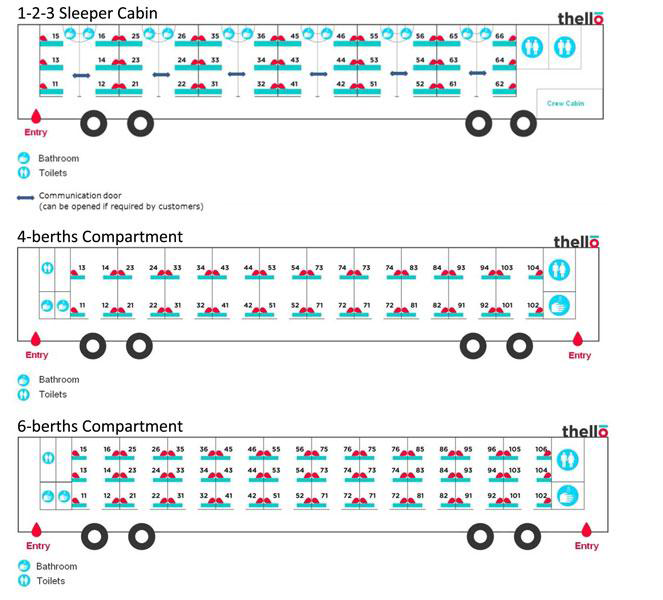
I agree with the space argument. What we're missing is something like the economy couchettes from Thello (which runs routes like Paris-Venice). From the seat map I found, it seems to seats a similar number of people as the VIA economy cars (60 vs 68) in ten shared compartments of six berths.


Quote:
The other factor is labour. Since you need to slow down the train to give people time to sleep, labour costs go up. As a result, even an economy ticket on an overnight train should cost more than a daytime train. Can VIA easily justify this premium to its customers?

[...]

There are also increased costs attending to the sleeping accommodation (cleaning the private washrooms, turning town the beds, cleaning the laundry, etc).

Now maybe there is a case for an overnight train, but the extra costs go beyond buying some dedicated equipment.

I think you're quite right about the additional costs, and that an overnight ticket is likely to be more than a daytime trip. But I think that the price-aware rider is still likely to see it as worth it overall if the trip is better than a night at a hotel, a daytime trip, and the extra time of daytime travel. I don't generally like to spend more than $70 on a ticket to Toronto, but if staying in town costs $150 for a basic room, plus $70 for a daytime train trip, plus the time cost of a morning of travel, then a ticket twice as expensive is still worth it for me.

Quote:
As daytime travel times get shorter, this extra cost becomes more and more significant and the ability to catch an early morning train to get to your destination at the same time becomes more desirable. That is one reason Europe has abandoned most of its overnight trains, HSR makes them less desirable.
I'm not sure if I totally agree with this. I've been on the 5.30am to and from Toronto a number of times, and it's rough. Even if I'm staying within walking distance of the train station, it's a pain to wake up at 5am. And if I'm any distance from it, I'm waking up at 4am or earlier and either dishing out for a cab or relying on night transit, if it exists at all. Generally, I avoid any departures before 7 am unless I have a real good reason to, if only because getting to the station any earlier will be difficult.

Getting to the station for 11pm or midnight is much more desirable for most people I'd expect. Even if the night train got me there no earlier than a crack-of-dawn train, I'd probably go for the overnight option.
__________________
I've always struggled with reality. And I'm pleased to say that I won.
Reply With Quote
     
     
  #532  
Old Posted Feb 9, 2020, 9:46 PM
swimmer_spe swimmer_spe is offline
BANNED
 
Join Date: Apr 2014
Posts: 10,743
Quote:
Originally Posted by Aylmer View Post
I agree with the space argument. What we're missing is something like the economy couchettes from Thello (which runs routes like Paris-Venice). From the seat map I found, it seems to seats a similar number of people as the VIA economy cars (60 vs 68) in ten shared compartments of six berths.


I think you're quite right about the additional costs, and that an overnight ticket is likely to be more than a daytime trip. But I think that the price-aware rider is still likely to see it as worth it overall if the trip is better than a night at a hotel, a daytime trip, and the extra time of daytime travel. I don't generally like to spend more than $70 on a ticket to Toronto, but if staying in town costs $150 for a basic room, plus $70 for a daytime train trip, plus the time cost of a morning of travel, then a ticket twice as expensive is still worth it for me.

I'm not sure if I totally agree with this. I've been on the 5.30am to and from Toronto a number of times, and it's rough. Even if I'm staying within walking distance of the train station, it's a pain to wake up at 5am. And if I'm any distance from it, I'm waking up at 4am or earlier and either dishing out for a cab or relying on night transit, if it exists at all. Generally, I avoid any departures before 7 am unless I have a real good reason to, if only because getting to the station any earlier will be difficult.

Getting to the station for 11pm or midnight is much more desirable for most people I'd expect. Even if the night train got me there no earlier than a crack-of-dawn train, I'd probably go for the overnight option.
First off... the 3 bunk idea.... NO! I am ex navy and our bunks were 3 high. It might make sense if you are trying to fit as many in there, but as far as comfort, they are not much bigger than a coffin.
Reply With Quote
     
     
  #533  
Old Posted Feb 9, 2020, 10:21 PM
Aylmer's Avatar
Aylmer Aylmer is offline
Still optimistic
 
Join Date: Nov 2007
Location: Montreal (C-D-N) / Ottawa (Aylmer)
Posts: 5,407
I have no doubt that it's uncomfortable in a ship! The few times I've been in one, I found the floor-to-ceiling height downright claustrophobia-inducing.

The couple of times I've been in 3-bunk couchettes in Europe, I found them fine (and mind you, I'm 6'4).


You have to keep in mind that this is the base cheapest option. It competes with hostel bunks and cramped night bus seats, and would likely appeal to young adults and families. The first time I took a night train, we booked a full 6-person compartment: my parents slept in the lower bunks, and we young'uns took great pleasure in climbing up to the middle and top bunks.

People with more means might opt for a 3- or 4-person cabin, or rent an entire cabin. And those with yet more means are likely staying at the Four Seasons and flying business, and aren't going to be on the train anyhow. The point is that it offers flexibility, and a continuum of price points and offerings for a continuum of passenger wants and needs.
__________________
I've always struggled with reality. And I'm pleased to say that I won.
Reply With Quote
     
     
  #534  
Old Posted Feb 9, 2020, 11:33 PM
swimmer_spe swimmer_spe is offline
BANNED
 
Join Date: Apr 2014
Posts: 10,743
Quote:
Originally Posted by Aylmer View Post
I have no doubt that it's uncomfortable in a ship! The few times I've been in one, I found the floor-to-ceiling height downright claustrophobia-inducing.

The couple of times I've been in 3-bunk couchettes in Europe, I found them fine (and mind you, I'm 6'4).


You have to keep in mind that this is the base cheapest option. It competes with hostel bunks and cramped night bus seats, and would likely appeal to young adults and families. The first time I took a night train, we booked a full 6-person compartment: my parents slept in the lower bunks, and we young'uns took great pleasure in climbing up to the middle and top bunks.

People with more means might opt for a 3- or 4-person cabin, or rent an entire cabin. And those with yet more means are likely staying at the Four Seasons and flying business, and aren't going to be on the train anyhow. The point is that it offers flexibility, and a continuum of price points and offerings for a continuum of passenger wants and needs.
That might make some sense. Maybe this is what should happen to the Renaissance cars; turned into sleepers for the Corridor.
Reply With Quote
     
     
  #535  
Old Posted Feb 9, 2020, 11:54 PM
roger1818's Avatar
roger1818 roger1818 is offline
Registered User
 
Join Date: Feb 2016
Location: Stittsville, ON
Posts: 6,610
Quote:
Originally Posted by swimmer_spe View Post
That might make some sense. Maybe this is what should happen to the Renaissance cars; turned into sleepers for the Corridor.
Perfect, rust bucket sleeper cars. That way when it rains, everyone will have wet dreams.
Reply With Quote
     
     
  #536  
Old Posted Feb 10, 2020, 12:25 AM
swimmer_spe swimmer_spe is offline
BANNED
 
Join Date: Apr 2014
Posts: 10,743
Quote:
Originally Posted by roger1818 View Post
Perfect, rust bucket sleeper cars. That way when it rains, everyone will have wet dreams.
If they leave them, they have 10 years at the current daily/weekly mileage. Id they refurbished them, and they only run once a day, they would last much longer. So, in fact, for older equipment, this is a good use for them for their golden years.
Reply With Quote
     
     
  #537  
Old Posted Feb 10, 2020, 12:36 AM
roger1818's Avatar
roger1818 roger1818 is offline
Registered User
 
Join Date: Feb 2016
Location: Stittsville, ON
Posts: 6,610
Quote:
Originally Posted by swimmer_spe View Post
If they leave them, they have 10 years at the current daily/weekly mileage. Id they refurbished them, and they only run once a day, they would last much longer. So, in fact, for older equipment, this is a good use for them for their golden years.
They had approx 10 years left 4 years ago. They still need to use them until they get the new ones, which won’t start arriving for another couple years and will take a few years to get all of them. They will be almost at their end of life when retired and won’t be worth refreshing.
Reply With Quote
     
     
  #538  
Old Posted Feb 10, 2020, 1:48 AM
swimmer_spe swimmer_spe is offline
BANNED
 
Join Date: Apr 2014
Posts: 10,743
Quote:
Originally Posted by roger1818 View Post
They had approx 10 years left 4 years ago. They still need to use them until they get the new ones, which won’t start arriving for another couple years and will take a few years to get all of them. They will be almost at their end of life when retired and won’t be worth refreshing.
My mistake. I thought that the date was 2020.

Mind you, there is no real reason they couldn't get refurbished and fix the stress cracked areas and use them as a sleeper for an overnight service. The real question has to do with whether the cost would be worth it.
Reply With Quote
     
     
  #539  
Old Posted Feb 10, 2020, 3:00 AM
Urban_Sky Urban_Sky is offline
Registered User
 
Join Date: Feb 2018
Location: Montreal
Posts: 500
Quote:
Originally Posted by swimmer_spe View Post
That might make some sense. Maybe this is what should happen to the Renaissance cars; turned into sleepers for the Corridor.
Quote:
Originally Posted by swimmer_spe View Post
If they leave them, they have 10 years at the current daily/weekly mileage. Id they refurbished them, and they only run once a day, they would last much longer. So, in fact, for older equipment, this is a good use for them for their golden years.
As passionate as you are about restoring daily service across Canada, you really don't seem to be a good reader, as the fatal problems with the Renaissance fleet were clearly laid out only 4 posts above your first post...:

Quote:
Originally Posted by roger1818 View Post
Here is what VIA said about them in their Summary of the 2016-2020 Corporate Plan:

Renaissance – Corridor portion
  • There are 30 Renaissance Cars assigned to the Corridor, representing the remaining 19% of the Corridor fleet;
  • They were originally manufactured in the UK in 1995-96, with final assembly of a portion of the fleet performed in Canada between 2001 and 2003;
  • They have the lowest reliability of the Corridor fleet;
  • Their mild steel car bodies are corroding at the roof, side sills and posts. The full extent of the corrosion is unknown without a major overhaul (i.e. “opening” vehicle);
  • A major investment to the Corridor Renaissance fleet would be needed to improve their reliability and reduce their burdensome maintenance costs and to extend their useful life and marketability;
  • A minimum overhaul/repair is needed to resolve HVAC problems, interior/exterior roof leaks, corrosion, door/step operation, public address systems and interior conditions;
  • Due to their European design, sourcing of spare parts is an issue; and
  • Remaining service life of these train sets without major investment is less than 10 years.
From this I would say it would be very expensive to refurbish them and you would end up with far from desirable product that will likely continue to have maintenance issues and be expensive to operate.

Don't forget they have about 2/3 the capacity of a regular coach and thus you 1.5 times as many of them on a train to carry the same number of passengers. That adds to the operating cost significantly. They also use a different coupler, so they can't be intermixed with other cars.

If they need more cars, better to buy new ones than throw good money after bad.
It's actually much less than 2/3 of the capacity of a regular coach once you relate the seating capacity to the length of the entire train: with one Renaissance Business car and 3 Renaissance Economy class cars you only have a seating capacity of 192 (48 seats in each of the 4 cars), but a train length of 6 cars, since you have to add the Baggage car (regulatory requirement due to Renaissance cars not being built to FRA crash-worthiness standards) and the Service car (which is the "brain" of the train sets), both of which are essentially useless on Corridor services, which translates to a ridiculous 32 seats per car.

I recall taking a Corridor train which was supposed to be Renaissance, but was replaced by 1 HEP 2 Business car and 2 LRC Economy cars. To my great disbelief, these 3 cars had exactly the same seat count (56+2*68=192) as the 6-car Renaissance set they replaced. IIRC correctly, the Corridor Renaissance sets now operate with a 4th Economy car, thus with 240 seats, but that still translates to only half (240/7=34.3 seats) of the per-car seating capacity offered with LRC Economy cars (68 seats).

But things get even worse once you look at how much (or better: how little) train-mileage the Renaissance fleet actually covers. It's not too difficult to figure out which trains are covered by the 2 Renaissance Corridor Sets in service once you recall that they only operate on the Quebec-Montreal-Ottawa(-Fallowfield) route and are the only trains on these routes to offer checked baggage service (which is noted with a little baggage symbol in every VIA timetable) and how much train-mileage they account for:


Note: the days of operation ("Days") shown in the second column refer to the train on which the train is scheduled to operate with Renaissance equipment, not the days on which the train is scheduled to operate (for instance, trains 29 and 34 operate daily, but only with Renaissance equipment on days indicated above).

To put things into perspective: this means that the Renaissance fleet represents 19% of the Corridor fleet (30 cars out of a Corridor fleet of 160 cars) but covers only 485,241 train-km or a paltry 5.6% of total Corridor mileage (8.7 million train-km in 2018).


Since I just saw that you replied again in the meanwhile:
Quote:
Originally Posted by swimmer_spe View Post
My mistake. I thought that the date was 2020.

Mind you, there is no real reason they couldn't get refurbished and fix the stress cracked areas and use them as a sleeper for an overnight service. The real question has to do with whether the cost would be worth it.
Again, if you had read roger1818's post attentively, you would already know that the obvious answer to that question has only two letters...

Last edited by Urban_Sky; Feb 10, 2020 at 3:20 AM.
Reply With Quote
     
     
  #540  
Old Posted Feb 10, 2020, 4:15 AM
swimmer_spe swimmer_spe is offline
BANNED
 
Join Date: Apr 2014
Posts: 10,743
Quote:
Originally Posted by Urban_Sky View Post
As passionate as you are about restoring daily service across Canada, you really don't seem to be a good reader, as the fatal problems with the Renaissance fleet were clearly laid out only 4 posts above your first post...:


It's actually much less than 2/3 of the capacity of a regular coach once you relate the seating capacity to the length of the entire train: with one Renaissance Business car and 3 Renaissance Economy class cars you only have a seating capacity of 192 (48 seats in each of the 4 cars), but a train length of 6 cars, since you have to add the Baggage car (regulatory requirement due to Renaissance cars not being built to FRA crash-worthiness standards) and the Service car (which is the "brain" of the train sets), both of which are essentially useless on Corridor services, which translates to a ridiculous 32 seats per car.

I recall taking a Corridor train which was supposed to be Renaissance, but was replaced by 1 HEP 2 Business car and 2 LRC Economy cars. To my great disbelief, these 3 cars had exactly the same seat count (56+2*68=192) as the 6-car Renaissance set they replaced. IIRC correctly, the Corridor Renaissance sets now operate with a 4th Economy car, thus with 240 seats, but that still translates to only half (240/7=34.3 seats) of the per-car seating capacity offered with LRC Economy cars (68 seats).

But things get even worse once you look at how much (or better: how little) train-mileage the Renaissance fleet actually covers. It's not too difficult to figure out which trains are covered by the 2 Renaissance Corridor Sets in service once you recall that they only operate on the Quebec-Montreal-Ottawa(-Fallowfield) route and are the only trains on these routes to offer checked baggage service (which is noted with a little baggage symbol in every VIA timetable) and how much train-mileage they account for:


Note: the days of operation ("Days") shown in the second column refer to the train on which the train is scheduled to operate with Renaissance equipment, not the days on which the train is scheduled to operate (for instance, trains 29 and 34 operate daily, but only with Renaissance equipment on days indicated above).

To put things into perspective: this means that the Renaissance fleet represents 19% of the Corridor fleet (30 cars out of a Corridor fleet of 160 cars) but covers only 485,241 train-km or a paltry 5.6% of total Corridor mileage (8.7 million train-km in 2018).


Since I just saw that you replied again in the meanwhile:

Again, if you had read roger1818's post attentively, you would already know that the obvious answer to that question has only two letters...
You make some great insights into the issue.
But, there is a difference between end of life and real end of life.
You can cut out old metal and replace with new.
You can cut out stressed metal and replace with new.
You could retrofit NA stuff to remove the EU stuff.

These stripped down cars could then be filled with bunks.

However, knowing that they will not be in serviceable condition by 2025, scrapping them seems like the only answer.
Reply With Quote
     
     
This discussion thread continues

Use the page links to the lower-right to go to the next page for additional posts
 
 
Reply

Go Back   SkyscraperPage Forum > Regional Sections > Canada
Forum Jump


Forum Jump


All times are GMT. The time now is 4:57 PM.


Powered by vBulletin® Version 3.8.7
Copyright ©2000 - 2026, vBulletin Solutions, Inc.