Quote:
Originally Posted by BillinGlendaleCA

My point is the aesthetic followed the economic. The reason you had boarding houses in the former grand mansions on Bunker Hill is the folk who built those places left, for economic as well as having a more suburban lifestyle.
|
I'd say it was a combo of the two, with both the aesthetic being hurt by the economic, and the economic being hurt by the aesthetic....or a chicken or egg dilemma. what came first? not enough properties being nicely developed in the first place, so that eventually chased out the more demanding ppl? Or not enough money being invested in dt to attract the more demanding ppl?
You can see that even in the late 1880s bunker hill wasn't a mainly impressive area....there were some cheaper bldgs mixed in with some of the victorians....
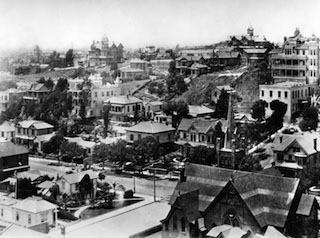 A view of Hill Street (foreground) with the eastern slope
of Bunker Hill behind. ca.1890 (Photo courtesy of the
Los Angeles Public Library Photo Collection)
Quote:
And though Bunker Hill had some two decades as the city's crown jewel, the neighborhood slowly grew more crowded (and undesirable) with apartment buildings and commercial development moving in. The wealthy elite of Los Angeles made their exodus to more remote and exclusive neighborhoods like Angeleno Heights, West Adams, and Westlake through the turn of the 20th century.
With the money now gone, Bunker Hill shifted from being an upper-class enclave to a white-collar one, and, eventually, to a working-class neighborhood. For the early years of the 20th century, Bunker Hill remained a vibrant, flourishing community. That would start to change in 1910s as the hill became an impediment to westward expansion and the free movement of automobiles. The 3rd Street tunnel already bore through the hill in 1901, and talk of completely leveling Bunker Hill grew in the following years.
Raymond Chandler makes note of the neighborhood's dark years in his 1942 novel, The High Window.
Bunker Hill is old town, lost town, shabby town, crook town. Once, very long ago, it was the choice residential district of the city, and there are still standing a few of the jigsaw Gothic mansions with wide porches and walls covered with round-end shingles and full corner bay windows with spindle turrets. They are all rooming houses now, their parquetry floors are scratched and worn through the once glossy finish and the wide sweeping staircases are dark with time and with cheap varnish laid on over generations of dirt.
|
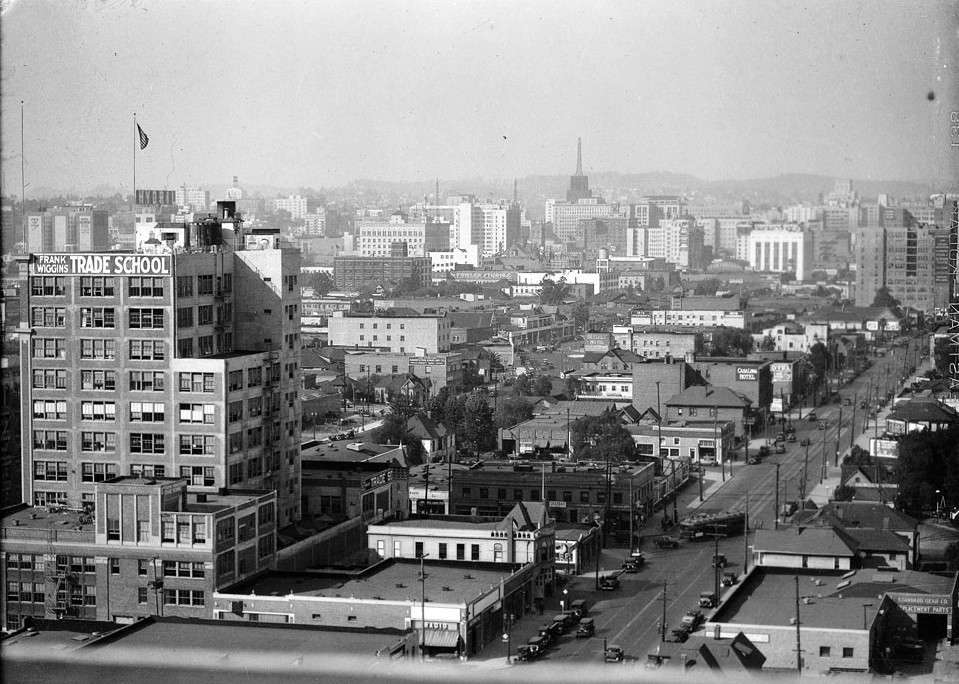
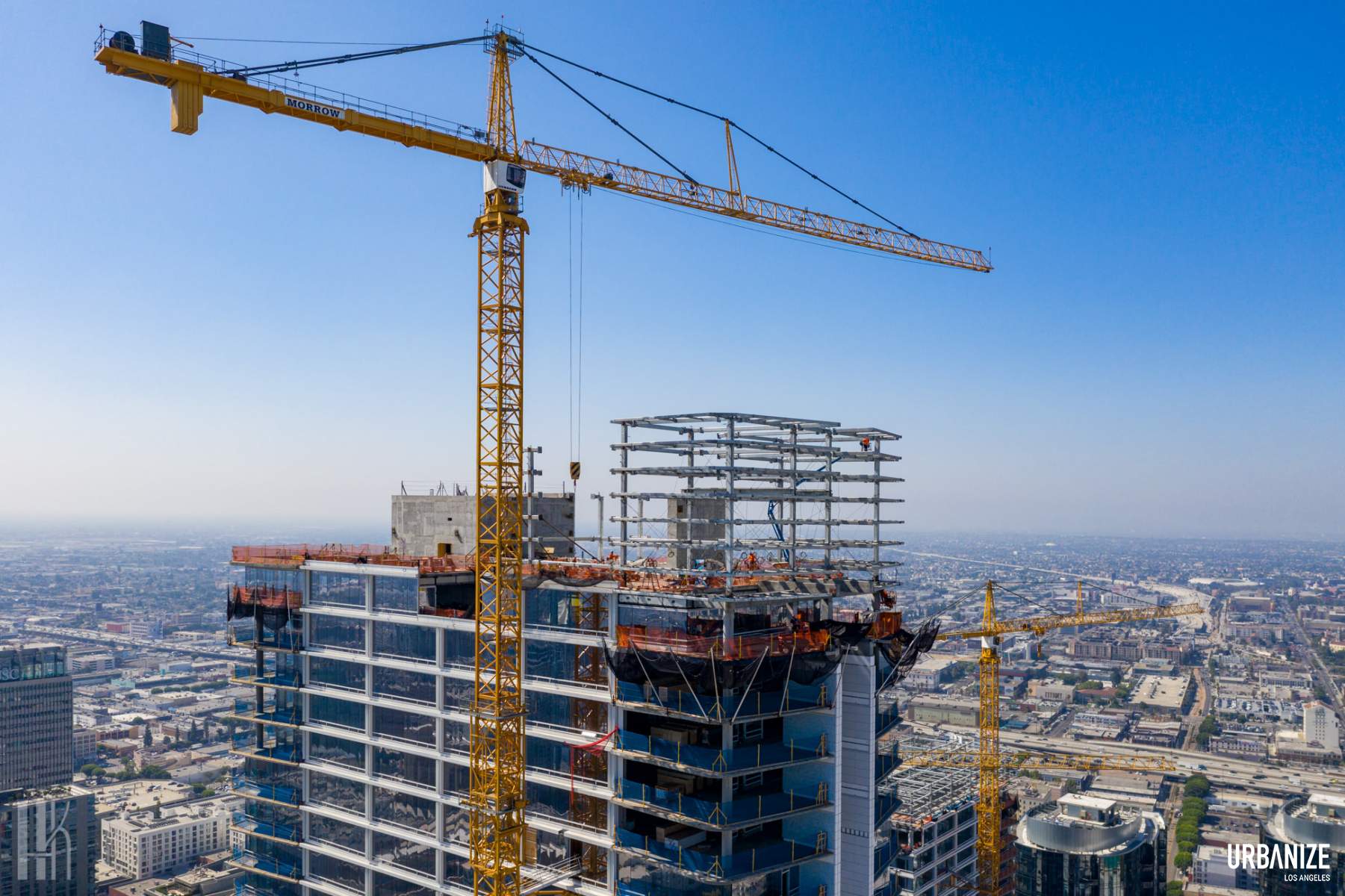
since this thread is devoted to new devlpt, I'll slip this in here.....another example of dtla today being a much more complete community than it was over 70 yrs ago....
Quote:

www.terasakibudokan.org

A crowd of approximately 150 gathered below as crane operator Ricardo Alamillo guided the beam into place atop the gymnasium on Los Angeles Street, and they cheered as “We Are the Champions” by Queen played.
The “topping-off” ceremony was a chance to celebrate the fact that the construction phase on the gymnasium is past the halfway point; the facility is scheduled to open in early spring 2020. Ryan Lee, the project manager for the gymnasium, explained its significance.
“It signifies the last steel beam being raised to the highest point in construction on the structure. This is more than just a gym, this is more than just a facility. The Terasaki Budokan is really a testament to what we can accomplish when we all work together as a community,” said Lee. “When its doors open in spring of 2020, it will show the vibrance and energy that is Little Tokyo.”
Former City Councilmember Jan Perry was recognized for her pivotal role securing the ground lease on the property. She proclaimed that the Terasaki Budokan will be a “legacy project” for Little Tokyo.
“This is a tribute to the resilience of the people who started it, the fact that most of them are still here and that will translate into something that spans the generations,” Perry said.
The facility will feature a two-court gymnasium, an outdoor plaza with a stage, a community room, a toddlers’ playground and a community garden.
“I really think this will provide opportunities and memories for the next generations of youth. Not only Japanese American youth but youth here in Little Tokyo and the surrounding Downtown neighborhood,” Lee said.
|
^ In many ways, dtla today is better than it has ever been. however, mass homelessness, lots of piles of garbage & ppl using the sidewalks as toilets are offsetting that. so it's the best of times, it's the worst of times.
.





 Prev
Prev










 Linear Mode
