HomeDiagramsDatabaseMapsForum About
     

Go Back   SkyscraperPage Forum > Regional Sections > Canada > Ontario > Ottawa-Gatineau > Transportation


Reply

 
Thread Tools Display Modes
     
     
  #521  
Old Posted May 1, 2019, 6:40 PM
Acajack's Avatar
Acajack Acajack is offline
Gros Méchant Loup
 
Join Date: Aug 2006
Location: SSP Graveyard
Posts: 72,949
Quote:
Originally Posted by J.OT13 View Post

I think they could have done more to future-proof the system with further grade separation and/or build rail right off the bat, but it's adequate as is as a transit corridor. Improvements are needed at major intersections, which are being implemented from what I know. I don't think building a bus corridor to Aylmer would be a good idea. The current traffic patterns and lack of space warrants a train ASAP.
I don't think so, and suspect the "logic" of a train to Aylmer/Plateau is more of a self-fulfilling prophecy.

A BRT would likely serve that area as well or maybe better than a train, and most importantly - a hell of a lot sooner.

But what can I say. In terms of decision-making, the train has already left the station. As for an STO train actually leaving a station, that's another story.
Reply With Quote
     
     
  #522  
Old Posted May 2, 2019, 4:02 AM
Gat-Train Gat-Train is offline
BANNED
 
Join Date: Nov 2018
Posts: 508
Quote:
Originally Posted by CityTech View Post
Rapibus is certainly a better implementation of BRT than the Transitway is. For all the talk about how the Transitway was a model for BRT, it is actually one of the worst implementations of it.
Would the transitway have still gone over capacity so quickly if they just had 5 or 6 routes going on it, with the rest of the routes feeding them, rather than the model of shove-every-suburban-express-bus-on-this-corridor?
Reply With Quote
     
     
  #523  
Old Posted May 2, 2019, 2:40 PM
Truenorth00 Truenorth00 is offline
Registered User
 
Join Date: May 2017
Posts: 29,120
Quote:
Originally Posted by J.OT13 View Post
The Plateau area is very dense. Huge proportion of housing is in three storey condo and apartment buildings, the south side of the corridor is big box stores and empty fields with huge potential for redevelopment. A proper town centre is currently under development. The ridership today is very low because of excess parking availability and terrible transit service. With a train providing good service (15 minutes or less), ridership could skyrocket pretty easily.

I'm not a fan of the streetcar model being proposed however. It could work along the wide Plateau Boulevard if done right, but not Aylmer Street or downtown Hull.

I wouldn't put too much emphasis on the sketch with trains on each side of the road. Ottawa started its planning with 180 meter long centre platforms. Things change, for better or worse.
Quote:
Originally Posted by Acajack View Post
I don't think so, and suspect the "logic" of a train to Aylmer/Plateau is more of a self-fulfilling prophecy.

A BRT would likely serve that area as well or maybe better than a train, and most importantly - a hell of a lot sooner.

But what can I say. In terms of decision-making, the train has already left the station. As for an STO train actually leaving a station, that's another story.
Exactly. I just don't see what the benefit of LRT over BRT is in this situation. Plateau, may have some density, but it isn't going to come close to the ridership level justifying LRT for decades. They could build curbside bus lanes today and run buses every 10 min at peak and meet demand for a long time. Meanwhile, not switching Rapibus to BRT results in a larger chunk of STO's ridership moving on smaller, less efficient buses, wasted deadheading, etc.

Note that I am not arguing against building LRT in Gatineau. Just the corridors chosen. To me, building an LRT just for Plateau is like arguing that the Glebe needs its own dedicated tram line.
Reply With Quote
     
     
  #524  
Old Posted May 2, 2019, 3:39 PM
Acajack's Avatar
Acajack Acajack is offline
Gros Méchant Loup
 
Join Date: Aug 2006
Location: SSP Graveyard
Posts: 72,949
Quote:
Originally Posted by Truenorth00 View Post
Exactly. I just don't see what the benefit of LRT over BRT is in this situation. Plateau, may have some density, but it isn't going to come close to the ridership level justifying LRT for decades. They could build curbside bus lanes today and run buses every 10 min at peak and meet demand for a long time. Meanwhile, not switching Rapibus to BRT results in a larger chunk of STO's ridership moving on smaller, less efficient buses, wasted deadheading, etc.

Note that I am not arguing against building LRT in Gatineau. Just the corridors chosen. To me, building an LRT just for Plateau is like arguing that the Glebe needs its own dedicated tram line.
BRT through the Plateau does not have any more space or logistical constraints than LRT through the Plateau.

If OC Transpo can build a Transitway-style BRT corridor through the middle of Barrhaven, it can be done in the Plateau too.
Reply With Quote
     
     
  #525  
Old Posted May 2, 2019, 3:47 PM
Aylmer's Avatar
Aylmer Aylmer is offline
Still optimistic
 
Join Date: Nov 2007
Location: Montreal (C-D-N) / Ottawa (Aylmer)
Posts: 5,407
I think that it basically comes down to the fact that, when the Taché trunk is converted to rail, Plateau buses will have to be either deviated (presumably to Saint-Raymond, a rather significant detour) or terminate at the tram line (but there's no space for a bus terminus at Taché/St Raymond without significant expropriation and cost).

Adding a branch up St-Raymond is only an extra 2 km. In my view, this makes sense from a transportation perspective, since it runs to a place where a bus/tram exchange could be built more easily/inexpensively.

From a development perspective, it could also work if it allows the redevelopment of the Smart Centre to goes ahead. An additional 2 km extension to the Coeur du Plateau 'town centre-type' development might also make sense from that perspective since it's been a major objective of the City in the Plateau. However, I don't see enough justification from either a transportation need or development goals to go any further.
Reply With Quote
     
     
  #526  
Old Posted May 2, 2019, 7:30 PM
Gat-Train Gat-Train is offline
BANNED
 
Join Date: Nov 2018
Posts: 508
Quote:
Originally Posted by Truenorth00 View Post
Exactly. I just don't see what the benefit of LRT over BRT is in this situation. Plateau, may have some density, but it isn't going to come close to the ridership level justifying LRT for decades. They could build curbside bus lanes today and run buses every 10 min at peak and meet demand for a long time. Meanwhile, not switching Rapibus to BRT results in a larger chunk of STO's ridership moving on smaller, less efficient buses, wasted deadheading, etc.
Curbing pollution, for one. Also, we've seen what a headache BRT-LRT conversion is, so putting in BRT now just means kicking the can down the road. People are far more willing to take streetcars and trains than buses.
Reply With Quote
     
     
  #527  
Old Posted May 2, 2019, 8:27 PM
CityTech CityTech is offline
Registered User
 
Join Date: May 2016
Location: Ottawa
Posts: 2,798
Bus electrification isn't far away so there isn't much of an ecological argument for trains over buses anymore.
Reply With Quote
     
     
  #528  
Old Posted May 2, 2019, 11:24 PM
swimmer_spe swimmer_spe is offline
BANNED
 
Join Date: Apr 2014
Posts: 10,743
Quote:
Originally Posted by Truenorth00 View Post
Exactly. I just don't see what the benefit of LRT over BRT is in this situation. Plateau, may have some density, but it isn't going to come close to the ridership level justifying LRT for decades. They could build curbside bus lanes today and run buses every 10 min at peak and meet demand for a long time. Meanwhile, not switching Rapibus to BRT results in a larger chunk of STO's ridership moving on smaller, less efficient buses, wasted deadheading, etc.

Note that I am not arguing against building LRT in Gatineau. Just the corridors chosen. To me, building an LRT just for Plateau is like arguing that the Glebe needs its own dedicated tram line.
Quote:
Originally Posted by CityTech View Post
Bus electrification isn't far away so there isn't much of an ecological argument for trains over buses anymore.
Then convert it to electricity.

There is a tipping point that the ridership warrants rail. The problem is, Ottawa is learning what happens when you convert to rail at that time.
Reply With Quote
     
     
  #529  
Old Posted May 3, 2019, 4:32 AM
Nowhere Nowhere is offline
Registered User
 
Join Date: May 2018
Posts: 228
Quote:
Originally Posted by J.OT13 View Post
And any delays due to the Wellington route will be mostly resolved or improved once Line 1 opens and STO buses are re-routed to Albert and Slater. Though the loop-ta-loop around Lyon might be an issue. We shall see.

The one complaint I've heard is that the rush hour window is too small (example, last bus from downtown leaves at 5:30 p.m.) That of course is not a RapiBus problem but a scheduling problem.

I think they could have done more to future-proof the system with further grade separation and/or build rail right off the bat, but it's adequate as is as a transit corridor. Improvements are needed at major intersections, which are being implemented from what I know. I don't think building a bus corridor to Aylmer would be a good idea. The current traffic patterns and lack of space warrants a train ASAP.
Assuming that trains get transit priority like in Calgary or Edmonton, this would limit the LRT headway to 4 minutes. Each tram would be able to carry a maximum of 260 passengers. This means a maximum PPHPD (passengers per hour per direction) of 3900. This could become a problem pretty fast. As a comparaison, the Confederation Line could carry up to 25 000 PPHPD. You can easily carry far more than that with articulated buses. If we decided to not give transit priority to allow a greater frequency, we would get a very unreliable schedule like the Toronto streetcar. There's no easy solution for Aylmer.
Reply With Quote
     
     
  #530  
Old Posted May 3, 2019, 9:57 AM
OtrainUser OtrainUser is offline
Registered User
 
Join Date: Jul 2017
Posts: 619
Quote:
Originally Posted by Nowhere View Post
Assuming that trains get transit priority like in Calgary or Edmonton, this would limit the LRT headway to 4 minutes. Each tram would be able to carry a maximum of 260 passengers. This means a maximum PPHPD (passengers per hour per direction) of 3900. This could become a problem pretty fast. As a comparaison, the Confederation Line could carry up to 25 000 PPHPD. You can easily carry far more than that with articulated buses. If we decided to not give transit priority to allow a greater frequency, we would get a very unreliable schedule like the Toronto streetcar. There's no easy solution for Aylmer.

Thanks for saying this, that's another good reason why their chosen routes for lrt is not good. I woul have preferred they went with the route that kitchessipi had shown us awhile back which included some grade separated areas and would have served only dense areas.
Reply With Quote
     
     
  #531  
Old Posted May 3, 2019, 10:18 AM
OtrainUser OtrainUser is offline
Registered User
 
Join Date: Jul 2017
Posts: 619
Quote:
Originally Posted by Kitchissippi View Post
Here's a fantasy build out of the idea I posted earlier:


It skips the low density areas and golf courses in southern Aylmer in favour of the still malleable future development in the Plateau. It connects Gatineau's three sectors and funnels them into downtown Hull to hopefully spurring redevelopment and densification. It would virtually connect all of Gatineau's major commercial areas within walking distance from the bifurcated line.
this is what I'm talking about that I think is a better route
Reply With Quote
     
     
  #532  
Old Posted May 3, 2019, 11:03 AM
Truenorth00 Truenorth00 is offline
Registered User
 
Join Date: May 2017
Posts: 29,120
Quote:
Originally Posted by Acajack View Post
BRT through the Plateau does not have any more space or logistical constraints than LRT through the Plateau.

If OC Transpo can build a Transitway-style BRT corridor through the middle of Barrhaven, it can be done in the Plateau too.
The Plateau doesn't need Transitway style BRT. Literally curbside bus lanes and signal priority would be enough. Max would be what VIVA has in York.

It's unfortunate that most in Ottawa equate BRT with the Transitway.
Reply With Quote
     
     
  #533  
Old Posted May 3, 2019, 11:03 AM
Aylmer's Avatar
Aylmer Aylmer is offline
Still optimistic
 
Join Date: Nov 2007
Location: Montreal (C-D-N) / Ottawa (Aylmer)
Posts: 5,407
Quote:
Originally Posted by Nowhere View Post
Assuming that trains get transit priority like in Calgary or Edmonton, this would limit the LRT headway to 4 minutes. Each tram would be able to carry a maximum of 260 passengers. This means a maximum PPHPD (passengers per hour per direction) of 3900. This could become a problem pretty fast. As a comparaison, the Confederation Line could carry up to 25 000 PPHPD. You can easily carry far more than that with articulated buses. If we decided to not give transit priority to allow a greater frequency, we would get a very unreliable schedule like the Toronto streetcar. There's no easy solution for Aylmer.
Well-reasoned and researched posts like these are why I like this forum. That said, there are two points which I think need to be considered.

First is that, although each train might have a capacity of 260, you can double or triple that by running sets when the demand warrants it. Similarly, Ottawa's LRVs have a capacity of 300, but will be running with 2- (and eventually 3-) train sets. This is one of the major technological advantages of rail over buses.

The second point is about the capacity of buses. As you pointed out, once you exceed a frequency of about 4 minutes between vehicles, it becomes hard to maintain fast, reliable service because signal priority can't be maintained. This isn't just true for rail. Assuming we're aiming for an equal quality of service, that means that a BRT line shouldn't exceed 15 buses or hour which, at 120 passengers per articulated bus, is 1800 pphpd, well below even current demand. You can go over that, but you start to run into the same problems as LRT without signal priority.

When these two points are taken into account, I think it strengthens the case for light rail; it can maintain fast and reliable signal priority service at much capacities high enough to satisfy demand for decades to come.
Reply With Quote
     
     
  #534  
Old Posted May 3, 2019, 11:04 AM
Truenorth00 Truenorth00 is offline
Registered User
 
Join Date: May 2017
Posts: 29,120
Quote:
Originally Posted by swimmer_spe View Post
Then convert it to electricity.

There is a tipping point that the ridership warrants rail. The problem is, Ottawa is learning what happens when you convert to rail at that time.
My point here is that the Rapibus corridor will be a lot closer to that tipping point than the Plateau neighborhood.
Reply With Quote
     
     
  #535  
Old Posted May 3, 2019, 5:28 PM
Acajack's Avatar
Acajack Acajack is offline
Gros Méchant Loup
 
Join Date: Aug 2006
Location: SSP Graveyard
Posts: 72,949
Quote:
Originally Posted by Truenorth00 View Post
The Plateau doesn't need Transitway style BRT. Literally curbside bus lanes and signal priority would be enough. Max would be what VIVA has in York.

It's unfortunate that most in Ottawa equate BRT with the Transitway.
Even better!
Reply With Quote
     
     
  #536  
Old Posted May 3, 2019, 11:56 PM
Nowhere Nowhere is offline
Registered User
 
Join Date: May 2018
Posts: 228
Quote:
Originally Posted by Aylmer View Post
Well-reasoned and researched posts like these are why I like this forum. That said, there are two points which I think need to be considered.

First is that, although each train might have a capacity of 260, you can double or triple that by running sets when the demand warrants it. Similarly, Ottawa's LRVs have a capacity of 300, but will be running with 2- (and eventually 3-) train sets. This is one of the major technological advantages of rail over buses.

The second point is about the capacity of buses. As you pointed out, once you exceed a frequency of about 4 minutes between vehicles, it becomes hard to maintain fast, reliable service because signal priority can't be maintained. This isn't just true for rail. Assuming we're aiming for an equal quality of service, that means that a BRT line shouldn't exceed 15 buses or hour which, at 120 passengers per articulated bus, is 1800 pphpd, well below even current demand. You can go over that, but you start to run into the same problems as LRT without signal priority.

When these two points are taken into account, I think it strengthens the case for light rail; it can maintain fast and reliable signal priority service at much capacities high enough to satisfy demand for decades to come.
Ottawa's LRT will be fully grade-separated. Is there any city that run 600 or 900 passengers trams in mixed-traffic ? I haven't found anything about Gatineau, but I found a document about Hamilton's planned LRT : "Vehicle length can vary depending on the ridership requirements, length of city blocks, stop spacing, desired headway and power system requirements. Lengths generally vary from 28 m to 40 m. Given Hamilton’s city block length, headway requirements and ridership projections, the cab will most likely be 28 m in length."

As for BRT capacity, Albert/Slater carries over 10,000 PPHPD. As you said, it does causes reliability issues, but I guess we could get a decent reliability if we lowered that number a bit. Buses tend to be more reliable than tramways, since they can accelerate and break faster and they can avoid a closed road. Looking at Toronto's data, streetcars are far less reliable than buses.

If we converted the Rapibus to LRT and built a tunnel under Old Hull and the river linking to the Confederation Line, this would free a lot of space downtown for Aylmer and Plateau buses. The ridership forecast for 2031 is far higher for the Rapibus than either the Aylmer LRT or Plateau LRT.
Reply With Quote
     
     
  #537  
Old Posted May 4, 2019, 12:53 AM
TheMatth69 TheMatth69 is offline
Registered User
 
Join Date: Apr 2019
Posts: 158
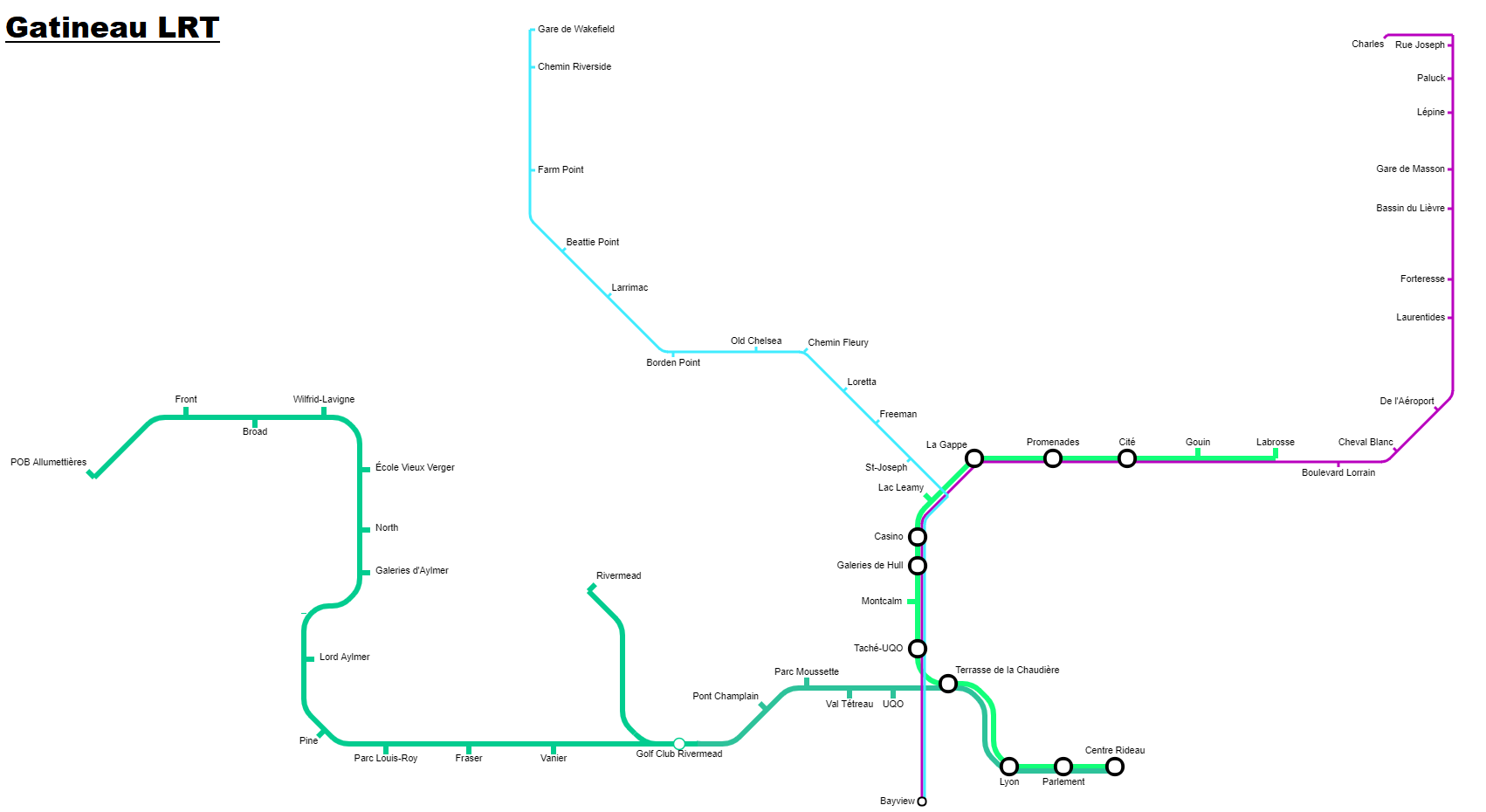
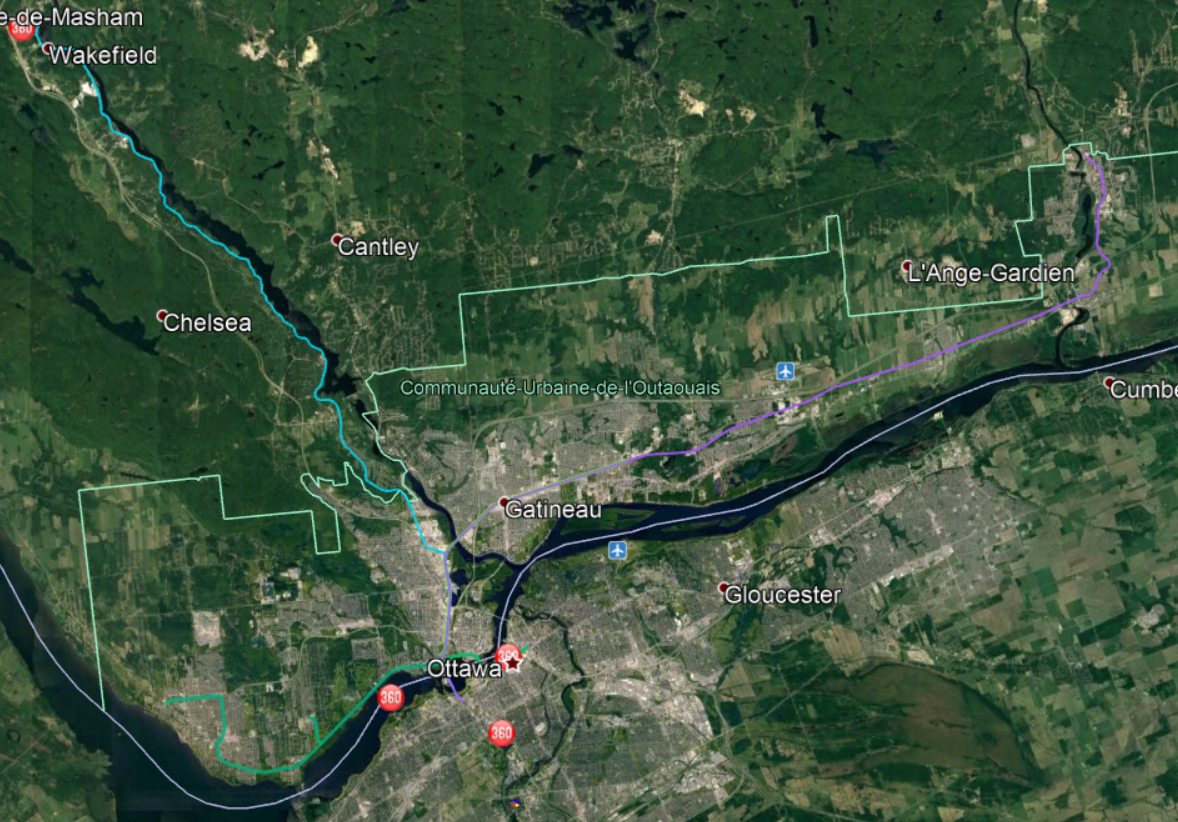
I also had an idea of a full LRT network in Gatineau a little time ago, with 4 lines, two regular 7/7 service and two ''express'' lines going much further and operating on a peak hour schedule. Let me break that down:

Line 1 (From Labrosse to Rideau): Essentially runs on the current Rapibus corridor until Taché-UQO where it would then head east using the old tracks south of Taché Blvd. It would then stop at Terrasse de la Chaudière in a brand-new station using the old industrial depot across the street of the actual bus station. It would then go underground, pass under the Ottawa River and follow Wellington Street all the way to Rideau Station. It would connect to the Confederation Line via underground passage at Lyon and Parliament stations.
Frequency would be of 7min during Peak time, 12min during day and 15min at night.

Line 2 (From Rivermead or Allumetière to Rideau): Would depart from Alllumetière bus stop following Allumetière Blvd on the central turf. It would then head south on Wilfried-Lavigne Blvd, using the central turf again, turn west on Rue Principal and head south again directly on Frank Robinson Street. After joining Lucerne Blvd, it would head East using the wide side turf following Lucerne Blvd. At the Rivermead /Lucerne intersection it would be join by another brench departing from Rivermead station following Rivermead Road. Arriving near UQO it would use a tunnel to pass under the UQO hillock before joining Line 1 south of Taché-UQO. The rest of the line would be like Line 1.
Frequency would be of 7min during Peak time, 15min during day and 20min at night (1 out of 3 trains departing or going to Rivermead)

Line 3 Express (From Buckingham to Bayview): It would be built using the current freight rails going from Buckingham to Gatineau. The line would essentially follow that path until Labrosse station where it would use the already existing rail alongside the today Rapibus and Line 1 in my fictional network (the corridor would use three tracks). Little work would be required as the tracks already exist and it would allow the trains to overpass Line 1 trains at stations Line 3 doesn't stop at (Line 3 only stops a Cité, Promenades, La Gappe, Casino, Galeries and Taché UQO). After Taché-UQO the line heads south using the PoW Bridge ending at Bayview.
Frequency would be of 15min during Peak time, and 1h during day. No service on weekends and holydays.

Line 4 Express (From Wakefield to Bayview): Would use the old Wakefield to Gatineau line, that of course would be refurbished, electrified and retracked in some portions. After St-Joseph station, the line will join Line 3 and follow the same route to Bayview.
Frequency would be of 30min during Peak time, 2h during day. No service on weekends and holydays.


Last edited by TheMatth69; May 6, 2019 at 2:59 AM.
Reply With Quote
     
     
  #538  
Old Posted May 4, 2019, 1:31 AM
Horus's Avatar
Horus Horus is offline
I ask because I Gatineau
 
Join Date: Jul 2013
Location: Aylmer (by way of GTA)
Posts: 1,214
Quote:
Originally Posted by Nowhere View Post


If we converted the Rapibus to LRT and built a tunnel under Old Hull and the river linking to the Confederation Line, this would free a lot of space downtown for Aylmer and Plateau buses. The ridership forecast for 2031 is far higher for the Rapibus than either the Aylmer LRT or Plateau LRT.
Which downtown are you referring to? Peak hour Rapibus routes (route 200) don't even serve downtown Hull as they travel from Montcalm station to Lyon via Allumettières and Maisonneuve without any additional stops. Essentially all of the buses plugging up Portage and Taché are already the Aylmer/Plateau/Hull routes, so a Rapibus LRT tunnel won't change that.

Rapibus vehicles are maybe 1 out of 5 or 6 STO buses on Wellington once they've crossed the bridge, but generally, taking away those buses isn't really going to change much there either.
Reply With Quote
     
     
  #539  
Old Posted May 4, 2019, 7:59 AM
OtrainUser OtrainUser is offline
Registered User
 
Join Date: Jul 2017
Posts: 619
Quote:
Originally Posted by Horus View Post
Which downtown are you referring to? Peak hour Rapibus routes (route 200) don't even serve downtown Hull as they travel from Montcalm station to Lyon via Allumettières and Maisonneuve without any additional stops. Essentially all of the buses plugging up Portage and Taché are already the Aylmer/Plateau/Hull routes, so a Rapibus LRT tunnel won't change that.

Rapibus vehicles are maybe 1 out of 5 or 6 STO buses on Wellington once they've crossed the bridge, but generally, taking away those buses isn't really going to change much there either.
routes 88, 93,94 and 85 still serve downtown hull during peak hours and they do use the rapibus corridor so yes the previous poster was correct in his assessment.
Reply With Quote
     
     
  #540  
Old Posted May 4, 2019, 1:09 PM
Aylmer's Avatar
Aylmer Aylmer is offline
Still optimistic
 
Join Date: Nov 2007
Location: Montreal (C-D-N) / Ottawa (Aylmer)
Posts: 5,407
Quote:
Originally Posted by Nowhere View Post
Ottawa's LRT will be fully grade-separated. Is there any city that run 600 or 900 passengers trams in mixed-traffic ?
.
In terms of cities than run coupled trams at street level, I can think of Munich, Cologne, The Hague, and Berlin off the top of my head. And of course, there's the monster, 56 m Budapest trams which carry upwards of 560 passengers.

Quote:
As for BRT capacity, Albert/Slater carries over 10,000 PPHPD. As you said, it does causes reliability issues, but I guess we could get a decent reliability if we lowered that number a bit. Buses tend to be more reliable than tramways, since they can accelerate and break faster and they can avoid a closed road. Looking at Toronto's data, streetcars are far less reliable than buses.
Ottawa's BRT performed admirably because, save the downtown portion, it opted for near-total grade separation. Operating at street level with dedicated lanes, BRT to the west of Gatineau would have a much lower capacity ceiling. According to the STO's study, we would hit that effective limit within the first 5 years of operation. BRT is certainly cheaper than rail, but it's not so cheap as to be disposable after that short a time.

Street-level LRT also has a lower capacity ceiling than Metro-LRT. But even the lower ceiling is high enough to satisfy capacity needs for decades to come in this case.
Reply With Quote
     
     
This discussion thread continues

Use the page links to the lower-right to go to the next page for additional posts
 
 
Reply

Go Back   SkyscraperPage Forum > Regional Sections > Canada > Ontario > Ottawa-Gatineau > Transportation
Forum Jump


Forum Jump


All times are GMT. The time now is 5:02 PM.


Powered by vBulletin® Version 3.8.7
Copyright ©2000 - 2026, vBulletin Solutions, Inc.
