Quote:
Originally Posted by acottawa

You’re right, I should have said Via loses money on nearly every ticket. Those tickets sold for more than about 150% of the average may be profitable.
However, since the post I was responding to suggested adding a new late night service (so costs are all marginal) and selling tickets at a lower price to encourage people to take that service, then Via would be taking higher than average losses on nearly all of those tickets.
|
I'm still not entirely sure what you exactly mean when you say "profit", but concerning individual trains, it is rather difficult to determine the financial impact of offering one particular departure, as the following example will show:
The 5pm Express train (operating daily except Saturday) was introduced between Montreal and Toronto in
November 1993 as train 66/67 (renumbered to 68/69 in
January 2014) and had a scheduled travel time of initially 3:59h (today: 4:49/4:50h) and is certainly one of the most successful trains on that route. This train was followed by train 68/69, which left TRTO and MTRL daily at 18:00 and 18:30, respectively, and was more of a milk run with an initial travel time of 4:46 and 4:59, respectively. You will not be surprised to learn that this train pair was withdrawn in
January 2012. Nevertheless, the train was reintroduced only one timetable change later (in
December 2012, subsequently renumbered to 668/669 in January 2014), first only on Friday and Sunday evenings and since
June 2015 again as a daily train*. Could it not be possible that people (especially business folks) have to account for meetings overrunning their allocated time when planning their trips and that a 5pm-departure is therefore a lot more attractive if they know they can change their booking to a later departure the same day, while the absence of such a "back-up" would make flying with its hourly departures until the late evening much more attractive? Maybe empty trains fill full trains, which would be yet another argument for HFR...
*For those people doubting my
the-number-of-slots-is-limited theory: the number of weekly departures offered between Montreal and Ottawa decreased on 2015-06-01 by the same 5 departures and on the same day as service increased between Montreal and Toronto. One of the casualties was the Ottawa-Montreal evening train leaving Ottawa at 20:38, which I used regularly on Sundays...
Quote:
Originally Posted by lrt's friend
Considering that LRT runs only from Tunney's Pasture to Blair compared to the much broader Transitway service that accessed the station, I don't know how you can make this statement. There are some odd assumptions concerning LRT.
|
(I'm going to ignore the cognitive dissonance in my head caused by your choice of user name and the argument you are making:)
Concerning residents, even if you don't live within walking distance of a LRT station, I find having a bus every 10 minutes to the next LRT station (with good connections) preferable over a bus which might bring you every 30 minutes to the rail station, especially since you can't really influence what time exactly your train arrives or departs at the train station.
Concerning visitors, having some kind of rail-based transit to get to the city center is much less intimidating than taking a bus, because the fact that rail infrastructure is expensive limits the network to a rather simple layout. That means it's much easier to figure out which trains go downtown and stop where, than how it would be with 20 different bus lines sharing the same route. Even if you are told that all "busses from this platform go to downtown", it's a lot easier to believe for a first-time user if it's a train and not a bus.
Quote:
Originally Posted by JohnnyRenton
The most convenient location for a central station is downtown, where you have the maximum number of transit services feeding into it. For suburbanites, the most convenient location is a suburban station that is a short bus or car ride away (like Fallowfield for Barrhaven residents). The full potential of rail service in the NCR will never be achieved with the current rail network. Whether it is worth spending the money today, or in a few decades, to rationalize it, is something that people will have wildly varying views on. And you could argue that Tremblay is "okay", but I don't think anyone could come up with an argument that it is great, and is ideal for Ottawa future rail needs.
|
Agreed. However, for a operating concept which merges the Montreal-Ottawa and Ottawa-Toronto routes into one single Montreal-Ottawa-Toronto corridor (such as HFR or
any HSR study I've seen so far), the detour via downtown Ottawa would add at least 10 minutes to the schedule of passengers remaining seated in Ottawa...
Quote:
Originally Posted by acottawa
I'm not sure why you're projecting massive cost decreases with HFR. The subsidy would have to be spread over more trains and Via would still be paying to run some sort of parallel lakeshore service. They might save some money by not paying CN, but they would have to cover all of the maintenance, security, upkeep costs that CN currently pays. If they continue to maintain their labour-intensive boarding and ticket verification procedures than those costs will be the same as well.
|
Quote:
Originally Posted by acottawa
Via does not seem to be suggesting that ticket prices will fall dramatically or be cheaper than driving or taking the bus. They have made a vague statement (which, like other statements about HFR is completely unsubstantiated) that this project wiould reduce subsidy requirements. Clearly salaries will be saved on a shorter run, but a few hundred dollars in savings per run would translate into about $1 per ticket, which is not going to substantially change the e$onomics of transportation decisions.
|
Noone is suggesting that costs would decrease. However, the last 3 years have shown that the subsidy can decrease significantly (-16.3% between 2014 and 2017) if revenues rise faster (+30.5%) than costs (+5.6%). We are therefore not talking about a decrease of costs in absolute figures, but a decrease in unit costs (i.e. per passenger or per-passenger-mile), thus Economies-of-scale, not austerity: For instance, a shorter travel time reduces unit labour costs while increasing the customer's willingness to pay, while higher punctuality additionally reduces the need to compensate passengers for delays. A higher frequency reduces the passengers' unwanted waiting time (which again increases the willingness to pay), while increasing the staffing efficiency. Collectively, these two factors allow longer train lengths, which spreads fix costs (such as track access charges or labour costs for the locomotive engineers) over more passengers.
I've expanded the table I've provided
previously by adding passenger and passenger-mile figures, in order to show how the Corridor would become profitable by 2030 if these recent trends could be sustained (note that passenger count would have reached 8.5 million by then, which is still 15% below the
9.9 million projected for HFR for that year):
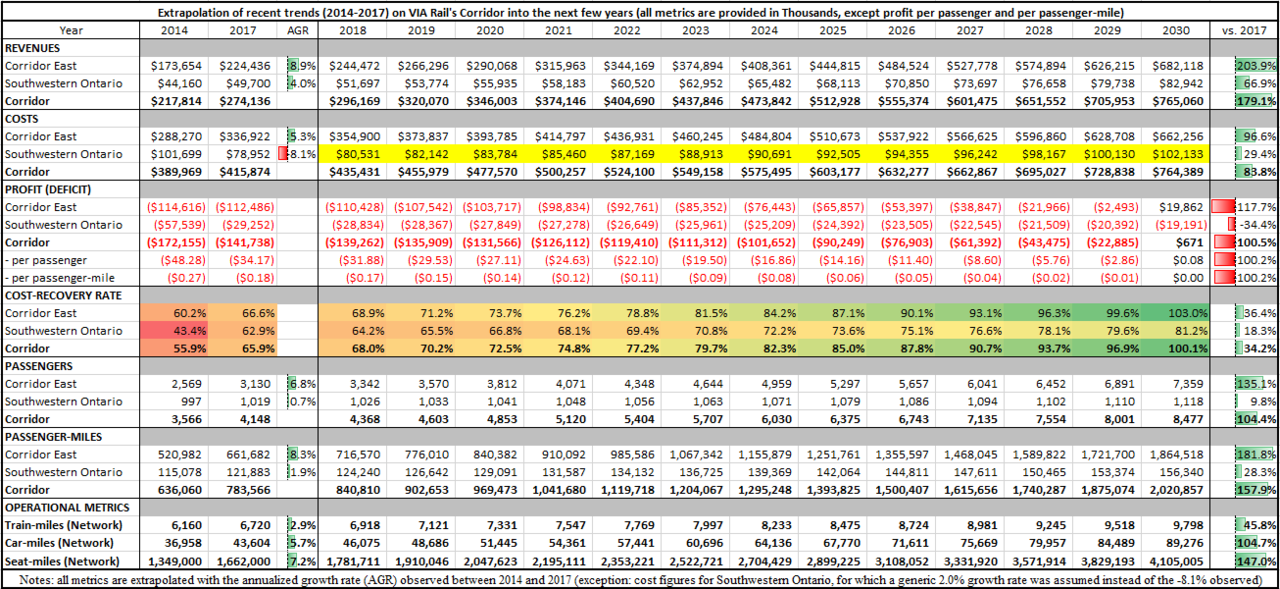
Compiled from:
VIA Rail Annual Reports 2014 and 2017
Quote:
Originally Posted by esquire
Setting off cars is exactly what I had in mind. Why is that no longer realistic? What real difference is there between parking the entire train in Kingston for 3 hours or however long it was as VIA did with the Enterprise, or just picking up and setting off a coach and a sleeping car in Ottawa? There's plenty of room to do it, and I'm assuming all the electrical hookups necessary to power the cars are already in place.
|
As outlined in great detail in the
European Commission report I had
linked, night trains are characterised by significantly higher costs than day trains which is not matched by a comparable increase in revenue potential. Therefore, you can only operate a night train commercially viable if it offers three services at once:
- A late-evening service for passengers returning from the night train's origin (must depart before midnight and reach intermediary cities before 2am)
- An early-morning service for commuters travelling to work at the night train's destination (must depart intermediary city after 5am and arrive between 8 and 9am)
- A night train service for passengers travelling end-to-end (must depart between 8pm and midnight and arrive between 8am and 9am)
That way, the only incremental cost of operating the night train service is the maintenance cost for the sleeper cars and the on-board staff for the sleeper and seating cars with overnight passengers, while the rest of the train can be empty and locked and the locomotive engineers can go off-duty.
A night train which ticks all three boxed might operate with a timetable as follows:
TRTO dep. 23:00
KGON arr. 01:30
KGON dep. 05:45
MTRL arr. 08:30
This of course favours a train splitting in Brockville, so that both, Ottawa and Montreal, can be served with a 8:30 arrival and this is how the "Chavalier" operated until the Ottawa portion was withdrawn in
October 1988 and replaced by a day train (bringing up the count of Toronto-Ottawa frequencies to 4, compared to 10
today).
By insisting on serving Montreal via Ottawa, your night train's timetable will now look more like this:
TRTO dep. 23:00
KGON arr. 01:30
KGON dep. 04:00
FALL dep. 05:45
OTTW arr. 06:00 (set off sleeper cars destined to terminate here)
OTTW dep. 06:30
MTRL arr. 08:30
This means that by insisting on Montreal sleeper cars operating via Ottawa, you are no longer able to serve the early-commuter market from Kingston to Ottawa or Montreal, due to the too early departure time in Kingston. And we haven't even started to talk about what customer group we are actually targeting between Toronto and Ottawa, as a travel time of then only
3:10 (i.e. with HFR) means that a passenger living in Ottawa can return from a dinner with the 9pm train (i.e. arriving home before 1am), while a passenger living in Toronto can take the 5am train to arrive in time for a 9am meeting...
Quote:
Originally Posted by acottawa
|
Given the complex nature of the revenue management systems used by most rail companies in Europe (or airlines worldwide), it is rather pointless to compare fares across companies and countries (let alone: currencies), unless you can determine the yield (i.e. revenue per passenger-mile) for each accommodation type (Economy/Business) and after excluding season pass holders. Also, I haven't been able to identify any attempt to make inter-modal comparisons by providing bus or air fares as comparison with the link you provided...
Urban Sky





 Prev
Prev





 Linear Mode
