HomeDiagramsDatabaseMapsForum About
     

Go Back   SkyscraperPage Forum > Regional Sections > Canada > Ontario > Ottawa-Gatineau > Transportation


Reply

 
Thread Tools Display Modes
     
     
  #1141  
Old Posted Dec 30, 2018, 8:15 PM
Truenorth00 Truenorth00 is offline
Registered User
 
Join Date: May 2017
Posts: 29,046
Quote:
Originally Posted by acottawa View Post
Via loses money on every ticket already. I’m not sure it would be a good idea to lose even more money to encourage people to arrive in the middle of the night. As you say there already alternatives for people into late night arrivals.
Today. The entire point of HFR is to fix that problem by increasing asset utilization. Under that situation, reaching Ottawa in 3.5 hours will most certainly draw customers. Even for those late slots.

The goal here isn't to get everybody flying to switch to rail. It's not HSR. But if they can get most of the bus traffic, some of the car traffic and some of the airline traffic to switch, they certainly will have a good business case. And part of that business case demands increasing frequency to hourly and offering more options for departures, so that people aren't standing around for hours after they are done their business.

The most time sensitive travelers will still fly. The families taking a roadtrip will still do that. Everybody else however could take the train. Look how many students, and unaccompanied travelers already take the bus and the train or resort to rideshare. HFR would vastly expand these groups and shift them to rail. Ditto for the cost sensitive. If you're driving alone or even in a pair, the train could well be cheaper with HFR. Especially in an era of increasing gas prices (considering carbon taxes). If you're a same day business traveler, you'll fly. If you're overnighting in Toronto, even for work, the savings from not flying, would pay for the hotel room. I doubt many companies would suddenly pass that up, for basically 3-4 hrs of total travel time savings over a roundtrip flight.
Reply With Quote
     
     
  #1142  
Old Posted Dec 30, 2018, 11:09 PM
acottawa acottawa is offline
Registered User
 
Join Date: Aug 2009
Posts: 18,863
Quote:
Originally Posted by Truenorth00 View Post
Today. The entire point of HFR is to fix that problem by increasing asset utilization. Under that situation, reaching Ottawa in 3.5 hours will most certainly draw customers. Even for those late slots.

The goal here isn't to get everybody flying to switch to rail. It's not HSR. But if they can get most of the bus traffic, some of the car traffic and some of the airline traffic to switch, they certainly will have a good business case. And part of that business case demands increasing frequency to hourly and offering more options for departures, so that people aren't standing around for hours after they are done their business.

The most time sensitive travelers will still fly. The families taking a roadtrip will still do that. Everybody else however could take the train. Look how many students, and unaccompanied travelers already take the bus and the train or resort to rideshare. HFR would vastly expand these groups and shift them to rail. Ditto for the cost sensitive. If you're driving alone or even in a pair, the train could well be cheaper with HFR. Especially in an era of increasing gas prices (considering carbon taxes). If you're a same day business traveler, you'll fly. If you're overnighting in Toronto, even for work, the savings from not flying, would pay for the hotel room. I doubt many companies would suddenly pass that up, for basically 3-4 hrs of total travel time savings over a roundtrip flight.
The post I was responding to suggested an 8 pm departure that would get to Ottawa after 12. Yeah, if there was a 3.5 hour travel time available there would probably be demand for a 7:30 or 8:00 train. I don't think a shorter trip time would be any more likely to induce an interest in middle of the night arrivals. Stockholm/Goteborg has similar travel times to what Via is projecting and the last trail leaves at 20:19, getting in at 23:40.

I'm not sure why you're projecting massive cost decreases with HFR. The subsidy would have to be spread over more trains and Via would still be paying to run some sort of parallel lakeshore service. They might save some money by not paying CN, but they would have to cover all of the maintenance, security, upkeep costs that CN currently pays. If they continue to maintain their labour-intensive boarding and ticket verification procedures than those costs will be the same as well. Again, if you look at Western Europe, train trips are not usually cheaper than flying, bus or a car with passengers (even with high European gas prices). This blog has a pretty good comparison of costs in different countries. https://www.seat61.com/uk-europe-train-fares-comparison.html
Reply With Quote
     
     
  #1143  
Old Posted Dec 31, 2018, 1:09 AM
lrt's friend lrt's friend is online now
Registered User
 
Join Date: Dec 2006
Posts: 12,797
A train taking 1 hour less travel time, means that the same equipment can make more trips with more passengers. This means the service is more efficient and cost less per passenger.
Reply With Quote
     
     
  #1144  
Old Posted Dec 31, 2018, 3:28 AM
acottawa acottawa is offline
Registered User
 
Join Date: Aug 2009
Posts: 18,863
Quote:
Originally Posted by JohnnyRenton View Post
Exactly. And LRT will not change the fact that the Tremblay location is not great. In fact, you could even argue that when it had Transitway service it was at least marginally better as you could catch buses other than the 95. Where as with LRT, there is only a single set of destinations.

The most convenient location for a central station is downtown, where you have the maximum number of transit services feeding into it. For suburbanites, the most convenient location is a suburban station that is a short bus or car ride away (like Fallowfield for Barrhaven residents). The full potential of rail service in the NCR will never be achieved with the current rail network. Whether it is worth spending the money today, or in a few decades, to rationalize it, is something that people will have wildly varying views on. And you could argue that Tremblay is "okay", but I don't think anyone could come up with an argument that it is great, and is ideal for Ottawa future rail needs.
It is really hard to see how a downtown station would improve convenience. Most people would have to get on the LRT anyway, there is little room for taxis, or Uber, or private buses (for tour groups, etc) and it makes pickups and drop offs much more difficult.

I guess guests at the Weston and Chateau Laurier would save an LRT or taxi ride, but that is a pretty small number of beneficiaries.

In an alternate history where Mackenzie King’s crystal ball had told him to implement the Holt Plan instead of Greber then a downtown station would be useful, but the way the city is presently configured it doesn’t do much.
Reply With Quote
     
     
  #1145  
Old Posted Dec 31, 2018, 3:41 AM
esquire's Avatar
esquire esquire is offline
Registered User
 
Join Date: Oct 2001
Posts: 37,480
Quote:
Originally Posted by Urban_Sky View Post
Back in the days, this issue was solved by setting off cars at an intermediary station in the middle of the night and letting passengers stay on board until a more reasonable time and by letting them board earlier in the evening before the car is picked up again in the middle of the night. One such train is shown in the April 1950 CN timetable as trains 57 and 58, with train 58 leaving Montreal at 19:20 and setting off a sleeper car in Riviere-du-Loup at 2:10, where passengers can detrain until 7am while the train continues to Metis Beach and train 57 picking up the Sleeper car again in the evening at 23:35 (with passengers being able to board in Riviere-du-Loup from 9pm onwards), before arriving in Montreal at 6:25:
Setting off cars is exactly what I had in mind. Why is that no longer realistic? What real difference is there between parking the entire train in Kingston for 3 hours or however long it was as VIA did with the Enterprise, or just picking up and setting off a coach and a sleeping car in Ottawa? There's plenty of room to do it, and I'm assuming all the electrical hookups necessary to power the cars are already in place.
Reply With Quote
     
     
  #1146  
Old Posted Dec 31, 2018, 5:28 AM
Truenorth00 Truenorth00 is offline
Registered User
 
Join Date: May 2017
Posts: 29,046
Quote:
Originally Posted by acottawa View Post
I don't think a shorter trip time would be any more likely to induce an interest in middle of the night arrivals. Stockholm/Goteborg has similar travel times to what Via is projecting and the last trail leaves at 20:19, getting in at 23:40.
You've clearly never taken VIA's last train or late Greyhound or late flight. They fill up. I have zero doubt about VIA filling any train that arrives in Ottawa before midnight. I might even say 1am.

Quote:
Originally Posted by acottawa View Post
I'm not sure why you're projecting massive cost decreases with HFR. The subsidy would have to be spread over more trains and Via would still be paying to run some sort of parallel lakeshore service. They might save some money by not paying CN, but they would have to cover all of the maintenance, security, upkeep costs that CN currently pays. If they continue to maintain their labour-intensive boarding and ticket verification procedures than those costs will be the same as well.
It's not me projecting. It's VIA. They've said they want to pull ridership from people who drive today. That requires some firm cost reductions.

I look at this the same way I look at aviation. Some of the biggest determinants of airline profitability are cycles per day per aircraft and average hours flown per day per aircraft. If your airline flies more turns and more hours per frame per day, the likelihood you'll make a healthy profit is higher.

Likewise, higher average speed for VIA means the same train and same crew doing 1.5 runs with HFR vs. one run today. That increased asset utilization means that their fixed costs will be spread over more passenger-km while the increased productivity means anb additional reduction in unit costs, even while they see some increase in operating costs. This means offering more seats at lower prices.

Quote:
Originally Posted by acottawa View Post
Again, if you look at Western Europe, train trips are not usually cheaper than flying, bus or a car with passengers (even with high European gas prices). This blog has a pretty good comparison of costs in different countries. https://www.seat61.com/uk-europe-train-fares-comparison.html
It's not as clear cut as you portray it:

https://www.smartertravel.com/europe-plane-train/

Those discount airlines have lots of fees. And they often fly to airports far from your actual destination. The luggage charges can be steep to. Also, Europeans have a ton of tolls on their highways. The concept of just driving for hundreds or even thousands of kms without paying any tolls would be foreign to them. Good read here on tolls:

https://www.holidaystoeurope.com.au/home...-blog/848-are-there-toll-roads-in-europe

Imagine paying $60 annually just for the privilege to use 400 series highways for example. And then imagine buying a new sticker for every state/province you enter. This is what roadtrips in Europe are like.

Yet in Europe and Asia rail certainly seems to winning market share:

https://www.bloomberg.com/news/articles/...l-now-rivals-flying-on-key-global-routes

And Canada isn't Europe. Flying is so much more expensive here. There's probably a healthy market for trips that aren't as fast as air but faster than driving, but marginally more expensive than single pax driving.

Also, VIA has specifically cited the cost of HSR service in Europe as part of their rationale for not pursuing a plan as capital intensive.

Last edited by Truenorth00; Dec 31, 2018 at 7:10 AM.
Reply With Quote
     
     
  #1147  
Old Posted Dec 31, 2018, 7:03 AM
acottawa acottawa is offline
Registered User
 
Join Date: Aug 2009
Posts: 18,863
Quote:
Originally Posted by Truenorth00 View Post
You've clearly never taken VIA's last train or late Greyhound or late flight. They fill up. I have zero doubt about VIA filling any train that arrives in Ottawa before midnight. I might even say 1am.


It's not me projecting. It's VIA. They've said they want to pull ridership from people who drive today. That requires some firm cost reductions.

I look at this the same way I look at aviation. Some of the biggest determinants of airline profitability are cycles per day per aircraft and average hours flown per day per aircraft. If your airline flies more turns and more hours per frame per day, the likelihood you'll make a healthy profit is higher.

Likewise, higher average speed for VIA means the same train and same crew doing 1.5 runs with HFR vs. one run today. That increased asset utilization means that their fixed costs well be spread over passenger-km while the increased productivity means a reduction in unit costs, even while they see some increase in operating costs. This means offering more seats at lower prices.


Canada isn't Europe. Flying is so much more expensive here. Also, Europeans have a ton of tolls on their highways. The concept of just driving for hundreds or even thousands of kms without paying any tolls would be foreign to them.

Also, VIA has specifically cited the cost of HSR service in Europe as part of their rationale for not pursuing a plan as capital intensive.
Via does not seem to be suggesting that ticket prices will fall dramatically or be cheaper than driving or taking the bus. They have made a vague statement (which, like other statements about HFR is completely unsubstantiated) that this project wiould reduce subsidy requirements. Clearly salaries will be saved on a shorter run, but a few hundred dollars in savings per run would translate into about $1 per ticket, which is not going to substantially change the e$onomics of transportation decisions.

Greyhound has a different target market and load factor. The esistance of a red eye or late night bus service is not proof there would be demand to fill a train at that time.
Reply With Quote
     
     
  #1148  
Old Posted Dec 31, 2018, 12:08 PM
Urban_Sky Urban_Sky is offline
Registered User
 
Join Date: Feb 2018
Location: Montreal
Posts: 500
Quote:
Originally Posted by acottawa View Post
You’re right, I should have said Via loses money on nearly every ticket. Those tickets sold for more than about 150% of the average may be profitable.

However, since the post I was responding to suggested adding a new late night service (so costs are all marginal) and selling tickets at a lower price to encourage people to take that service, then Via would be taking higher than average losses on nearly all of those tickets.
I'm still not entirely sure what you exactly mean when you say "profit", but concerning individual trains, it is rather difficult to determine the financial impact of offering one particular departure, as the following example will show:

The 5pm Express train (operating daily except Saturday) was introduced between Montreal and Toronto in November 1993 as train 66/67 (renumbered to 68/69 in January 2014) and had a scheduled travel time of initially 3:59h (today: 4:49/4:50h) and is certainly one of the most successful trains on that route. This train was followed by train 68/69, which left TRTO and MTRL daily at 18:00 and 18:30, respectively, and was more of a milk run with an initial travel time of 4:46 and 4:59, respectively. You will not be surprised to learn that this train pair was withdrawn in January 2012. Nevertheless, the train was reintroduced only one timetable change later (in December 2012, subsequently renumbered to 668/669 in January 2014), first only on Friday and Sunday evenings and since June 2015 again as a daily train*. Could it not be possible that people (especially business folks) have to account for meetings overrunning their allocated time when planning their trips and that a 5pm-departure is therefore a lot more attractive if they know they can change their booking to a later departure the same day, while the absence of such a "back-up" would make flying with its hourly departures until the late evening much more attractive? Maybe empty trains fill full trains, which would be yet another argument for HFR...

*For those people doubting my the-number-of-slots-is-limited theory: the number of weekly departures offered between Montreal and Ottawa decreased on 2015-06-01 by the same 5 departures and on the same day as service increased between Montreal and Toronto. One of the casualties was the Ottawa-Montreal evening train leaving Ottawa at 20:38, which I used regularly on Sundays...

Quote:
Originally Posted by lrt's friend View Post
Considering that LRT runs only from Tunney's Pasture to Blair compared to the much broader Transitway service that accessed the station, I don't know how you can make this statement. There are some odd assumptions concerning LRT.
(I'm going to ignore the cognitive dissonance in my head caused by your choice of user name and the argument you are making:)
Concerning residents, even if you don't live within walking distance of a LRT station, I find having a bus every 10 minutes to the next LRT station (with good connections) preferable over a bus which might bring you every 30 minutes to the rail station, especially since you can't really influence what time exactly your train arrives or departs at the train station.
Concerning visitors, having some kind of rail-based transit to get to the city center is much less intimidating than taking a bus, because the fact that rail infrastructure is expensive limits the network to a rather simple layout. That means it's much easier to figure out which trains go downtown and stop where, than how it would be with 20 different bus lines sharing the same route. Even if you are told that all "busses from this platform go to downtown", it's a lot easier to believe for a first-time user if it's a train and not a bus.

Quote:
Originally Posted by JohnnyRenton View Post
The most convenient location for a central station is downtown, where you have the maximum number of transit services feeding into it. For suburbanites, the most convenient location is a suburban station that is a short bus or car ride away (like Fallowfield for Barrhaven residents). The full potential of rail service in the NCR will never be achieved with the current rail network. Whether it is worth spending the money today, or in a few decades, to rationalize it, is something that people will have wildly varying views on. And you could argue that Tremblay is "okay", but I don't think anyone could come up with an argument that it is great, and is ideal for Ottawa future rail needs.
Agreed. However, for a operating concept which merges the Montreal-Ottawa and Ottawa-Toronto routes into one single Montreal-Ottawa-Toronto corridor (such as HFR or any HSR study I've seen so far), the detour via downtown Ottawa would add at least 10 minutes to the schedule of passengers remaining seated in Ottawa...


Quote:
Originally Posted by acottawa View Post
I'm not sure why you're projecting massive cost decreases with HFR. The subsidy would have to be spread over more trains and Via would still be paying to run some sort of parallel lakeshore service. They might save some money by not paying CN, but they would have to cover all of the maintenance, security, upkeep costs that CN currently pays. If they continue to maintain their labour-intensive boarding and ticket verification procedures than those costs will be the same as well.
Quote:
Originally Posted by acottawa View Post
Via does not seem to be suggesting that ticket prices will fall dramatically or be cheaper than driving or taking the bus. They have made a vague statement (which, like other statements about HFR is completely unsubstantiated) that this project wiould reduce subsidy requirements. Clearly salaries will be saved on a shorter run, but a few hundred dollars in savings per run would translate into about $1 per ticket, which is not going to substantially change the e$onomics of transportation decisions.
Noone is suggesting that costs would decrease. However, the last 3 years have shown that the subsidy can decrease significantly (-16.3% between 2014 and 2017) if revenues rise faster (+30.5%) than costs (+5.6%). We are therefore not talking about a decrease of costs in absolute figures, but a decrease in unit costs (i.e. per passenger or per-passenger-mile), thus Economies-of-scale, not austerity: For instance, a shorter travel time reduces unit labour costs while increasing the customer's willingness to pay, while higher punctuality additionally reduces the need to compensate passengers for delays. A higher frequency reduces the passengers' unwanted waiting time (which again increases the willingness to pay), while increasing the staffing efficiency. Collectively, these two factors allow longer train lengths, which spreads fix costs (such as track access charges or labour costs for the locomotive engineers) over more passengers.

I've expanded the table I've provided previously by adding passenger and passenger-mile figures, in order to show how the Corridor would become profitable by 2030 if these recent trends could be sustained (note that passenger count would have reached 8.5 million by then, which is still 15% below the 9.9 million projected for HFR for that year):
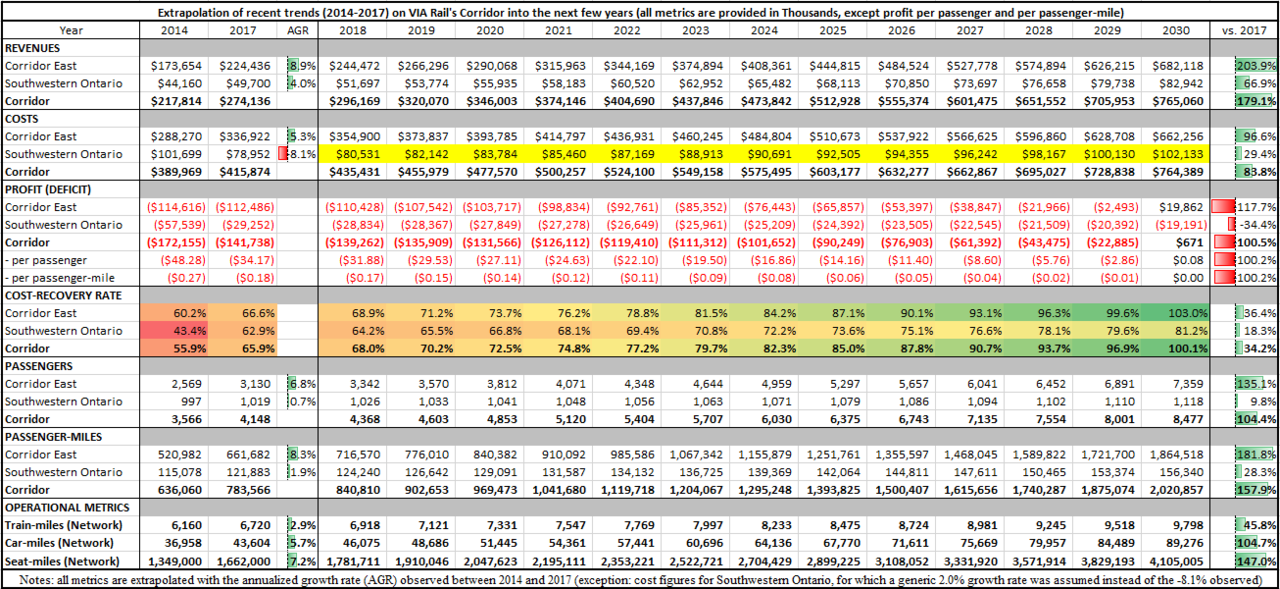
Compiled from: VIA Rail Annual Reports 2014 and 2017

Quote:
Originally Posted by esquire View Post
Setting off cars is exactly what I had in mind. Why is that no longer realistic? What real difference is there between parking the entire train in Kingston for 3 hours or however long it was as VIA did with the Enterprise, or just picking up and setting off a coach and a sleeping car in Ottawa? There's plenty of room to do it, and I'm assuming all the electrical hookups necessary to power the cars are already in place.
As outlined in great detail in the European Commission report I had linked, night trains are characterised by significantly higher costs than day trains which is not matched by a comparable increase in revenue potential. Therefore, you can only operate a night train commercially viable if it offers three services at once:
  1. A late-evening service for passengers returning from the night train's origin (must depart before midnight and reach intermediary cities before 2am)
  2. An early-morning service for commuters travelling to work at the night train's destination (must depart intermediary city after 5am and arrive between 8 and 9am)
  3. A night train service for passengers travelling end-to-end (must depart between 8pm and midnight and arrive between 8am and 9am)
That way, the only incremental cost of operating the night train service is the maintenance cost for the sleeper cars and the on-board staff for the sleeper and seating cars with overnight passengers, while the rest of the train can be empty and locked and the locomotive engineers can go off-duty.

A night train which ticks all three boxed might operate with a timetable as follows:
TRTO dep. 23:00
KGON arr. 01:30
KGON dep. 05:45
MTRL arr. 08:30

This of course favours a train splitting in Brockville, so that both, Ottawa and Montreal, can be served with a 8:30 arrival and this is how the "Chavalier" operated until the Ottawa portion was withdrawn in October 1988 and replaced by a day train (bringing up the count of Toronto-Ottawa frequencies to 4, compared to 10 today).

By insisting on serving Montreal via Ottawa, your night train's timetable will now look more like this:
TRTO dep. 23:00
KGON arr. 01:30
KGON dep. 04:00
FALL dep. 05:45
OTTW arr. 06:00 (set off sleeper cars destined to terminate here)
OTTW dep. 06:30
MTRL arr. 08:30

This means that by insisting on Montreal sleeper cars operating via Ottawa, you are no longer able to serve the early-commuter market from Kingston to Ottawa or Montreal, due to the too early departure time in Kingston. And we haven't even started to talk about what customer group we are actually targeting between Toronto and Ottawa, as a travel time of then only 3:10 (i.e. with HFR) means that a passenger living in Ottawa can return from a dinner with the 9pm train (i.e. arriving home before 1am), while a passenger living in Toronto can take the 5am train to arrive in time for a 9am meeting...

Quote:
Originally Posted by acottawa View Post
Again, if you look at Western Europe, train trips are not usually cheaper than flying, bus or a car with passengers (even with high European gas prices). This blog has a pretty good comparison of costs in different countries. https://www.seat61.com/uk-europe-train-fares-comparison.html
Given the complex nature of the revenue management systems used by most rail companies in Europe (or airlines worldwide), it is rather pointless to compare fares across companies and countries (let alone: currencies), unless you can determine the yield (i.e. revenue per passenger-mile) for each accommodation type (Economy/Business) and after excluding season pass holders. Also, I haven't been able to identify any attempt to make inter-modal comparisons by providing bus or air fares as comparison with the link you provided...

Urban Sky

Last edited by Urban_Sky; Dec 31, 2018 at 8:51 PM.
Reply With Quote
     
     
  #1149  
Old Posted Dec 31, 2018, 4:14 PM
Truenorth00 Truenorth00 is offline
Registered User
 
Join Date: May 2017
Posts: 29,046
Quote:
Originally Posted by acottawa View Post
Via does not seem to be suggesting that ticket prices will fall dramatically or be cheaper than driving or taking the bus. They have made a vague statement (which, like other statements about HFR is completely unsubstantiated) that this project wiould reduce subsidy requirements. Clearly salaries will be saved on a shorter run, but a few hundred dollars in savings per run would translate into about $1 per ticket, which is not going to substantially change the e$onomics of transportation decisions.
Going from 5 hrs to 3.5 hrs per trip is an increase in productivity of over 40%. You think that will reduce the ticket costs by only $1?

Also, borrowing from aviation again, theres two figures that matter: CASM and RASM. Cost per airplane seat-mile. And revenue per airplane seat-mile. Increased productivity lowers CASM. More options, faster trip times, should boost RASM. The net effect should be higher profitability.

Given the millions more in ridership they are projecting, reducing tickets by a buck aren't going to get them those numbers. They've said they want to shift bums from cars to rail, I take them at their word. I expect we'll see shift in pricing with some discounts off-peak while seeing higher charges for service that compete for business travelers. Especially on Ottawa-Toronto.

Quote:
Originally Posted by acottawa View Post
Greyhound has a different target market and load factor. The esistance of a red eye or late night bus service is not proof there would be demand to fill a train at that time.
Why not? People travel these routes late already. Yet somehow more options isn't going to translate into ridership?

You seem to still be looking at this from the perspective of a business traveler exclusively. Which would be more applicable for High Speed Rail. This is not HSR. This is normal rail service for a lot of the world. And in the rest of the world, hourly service between the first and fifth largest and second largest metros would not be that unusual. And would certainly be fillable till at least midnight.

Last edited by Truenorth00; Dec 31, 2018 at 4:26 PM.
Reply With Quote
     
     
  #1150  
Old Posted Dec 31, 2018, 7:58 PM
acottawa acottawa is offline
Registered User
 
Join Date: Aug 2009
Posts: 18,863
Quote:
Originally Posted by Truenorth00 View Post
Going from 5 hrs to 3.5 hrs per trip is an increase in productivity of over 40%. You think that will reduce the ticket costs by only $1?
How many of the costs are incurred hourly? I estimated the 5-6 crew members make about $200 an hour, so a 90 minute savings would be about $300. These HFR trainsets look like they hold about 300 pax, so that is a buck a ticket.

To me the problem is that all of this should be included in a public feasibility study, so it isn’t just randos in the internet guessing. To me the lack of such a document 5 years into the proposal is a severe hit to the credibility of this project.
Reply With Quote
     
     
  #1151  
Old Posted Dec 31, 2018, 8:02 PM
acottawa acottawa is offline
Registered User
 
Join Date: Aug 2009
Posts: 18,863
Quote:
Originally Posted by Truenorth00 View Post

You seem to still be looking at this from the perspective of a business traveler exclusively. Which would be more applicable for High Speed Rail. This is not HSR. This is normal rail service for a lot of the world. And in the rest of the world, hourly service between the first and fifth largest and second largest metros would not be that unusual. And would certainly be fillable till at least midnight.
I think that is a fair criticism (although maybe it is an employed in a 9-5 job bias). But just because there are 50 people wanting to take a bus does not mean there are 300 people wanting to take a train.
Reply With Quote
     
     
  #1152  
Old Posted Jan 1, 2019, 2:01 AM
Urban_Sky Urban_Sky is offline
Registered User
 
Join Date: Feb 2018
Location: Montreal
Posts: 500
Quote:
Originally Posted by Truenorth00 View Post
Going from 5 hrs to 3.5 hrs per trip is an increase in productivity of over 40%. You think that will reduce the ticket costs by only $1?

Also, borrowing from aviation again, theres two figures that matter: CASM and RASM. Cost per airplane seat-mile. And revenue per airplane seat-mile. Increased productivity lowers CASM. More options, faster trip times, should boost RASM. The net effect should be higher profitability.

Given the millions more in ridership they are projecting, reducing tickets by a buck aren't going to get them those numbers. They've said they want to shift bums from cars to rail, I take them at their word. I expect we'll see shift in pricing with some discounts off-peak while seeing higher charges for service that compete for business travelers. Especially on Ottawa-Toronto.
Kudos for actually knowing about RASM and CASM (the two metrics which rule revenue management in the air and rail passenger transport business), but the actual price level (i.e. the yield or revenue per seat-mile) is mostly determined by demand and supply: A decrease in travel time or an increase in frequencies, punctuality and amenities (new fleet!) all increase the perceived value to the passenger and thus the price, whereas an increase in capacity (resulting from an increase in frequency and fleet cycling efficiency) represents an increase in supply, which will reduce the price. Conversely, "cost plus markup" pricing is unsuitable for products subject to instantly-perishable inventories (as you can't "save" unused seats for a later, more popular, departure)...

Quote:
Originally Posted by Truenorth00 View Post
Why not? People travel these routes late already. Yet somehow more options isn't going to translate into ridership?

You seem to still be looking at this from the perspective of a business traveler exclusively. Which would be more applicable for High Speed Rail. This is not HSR. This is normal rail service for a lot of the world. And in the rest of the world, hourly service between the first and fifth largest and second largest metros would not be that unusual. And would certainly be fillable till at least midnight.
To provide an example: in the Netherlands, rail service between the four largest cities (Amsterdam, Rotterdam, The Hague and Utrecht - pop. 860k, 640k, 530k and 350k, respectively) is at least every 15 minutes between 6am and 1am (half-hourly after 11pm) and there is an hourly night train network operated between 1am and 6am every (!) night of the week...

Quote:
Originally Posted by acottawa View Post
How many of the costs are incurred hourly? I estimated the 5-6 crew members make about $200 an hour, so a 90 minute savings would be about $300. These HFR trainsets look like they hold about 300 pax, so that is a buck a ticket.
You don't seem to realise that we are not talking about cost savings as much as we are talking about Economies of Scale, that is that the unit costs (per train-mile or seat-mile) decrease as your output (in this case: capacity) increases, while your fixed costs (and these are substantial in a capital-intense industry like railroading) are spread across more train-miles, seat-miles and (one would hope) passenger-miles...

Quote:
Originally Posted by acottawa View Post
I think that is a fair criticism (although maybe it is an employed in a 9-5 job bias). But just because there are 50 people wanting to take a bus does not mean there are 300 people wanting to take a train.
As I tried to explain to you earlier, the presence of a late train does not only help attracting demand for itself, but also for earlier departures, which are becoming "safer" for passengers who's business in a certain city is subject to delay risks and will rather book a plane (which operate hourly until almost midnight) than the last train departure of a day. The best way to make a departure attractive is by making sure there is a later alternative, so that passengers don't have to fear getting stranded.

Also, you don't need a train to be anywhere close to selling all seats to make an additional departure break-even as a large proportion of operating costs is fixed costs (like admin costs and other overheads, including myself) and the marginal cost of increased service is therefore much lower than average costs.

Anyways, happy new year everyone and I'm looking forward to continue this discussion in 2019!

Urban Sky

Last edited by Urban_Sky; Jan 1, 2019 at 3:54 AM.
Reply With Quote
     
     
  #1153  
Old Posted Jan 1, 2019, 2:56 PM
acottawa acottawa is offline
Registered User
 
Join Date: Aug 2009
Posts: 18,863
Quote:
Originally Posted by Urban_Sky View Post


To provide an example: in the Netherlands, rail service between the four largest cities (Amsterdam, Rotterdam, The Hague and Utrecht - pop. 860k, 640k, 530k and 350k, respectively) is at least every 15 minutes between 6am and 1am (half-hourly after 11pm) and there is an hourly night train network operated between 1am and 6am every (!) night of the week...


You don't seem to realise that we are not talking about cost savings as much as we are talking about Economies of Scale, that is that the unit costs (per train-mile or seat-mile) decrease as your output (in this case: capacity) increases, while your fixed costs (and these are substantial in a capital-intense industry like railroading) are spread across more train-miles, seat-miles and (one would hope) passenger-miles...


As I tried to explain to you earlier, the presence of a late train does not only help attracting demand for itself, but also for earlier departures, which are becoming "safer" for passengers who's business in a certain city is subject to delay risks and will rather book a plane (which operate hourly until almost midnight) than the last train departure of a day. The best way to make a departure attractive is by making sure there is a later alternative, so that passengers don't have to fear getting stranded.

Also, you don't need a train to be anywhere close to selling all seats to make an additional departure break-even as a large proportion of operating costs is fixed costs (like admin costs and other overheads, including myself) and the marginal cost of increased service is therefore much lower than average costs
The Ranstaad is a contiguous urban area of 8 million people. Service with in the Ranstaad isn’t equivalent to an intercity service in Canada (or most countries).

Ticket savings from economies of scale require a massive increase in scale. I don’t think there is any evidence that that would happen. A 3.5 hour train service occupies the same market niche as a 4.5 hour service. It is still faster to fly, still cheaper to take the bus, there are still economies of scale from driving if there is more than one person in a group and there are still advantages to having a car at the destination in many cases.

Wrapping up intercity services before midnight is a pretty common practice, so I am not sure why rates of “fear of getting stranded” would be higher in Ontario.
Reply With Quote
     
     
  #1154  
Old Posted Jan 1, 2019, 5:40 PM
Urban_Sky Urban_Sky is offline
Registered User
 
Join Date: Feb 2018
Location: Montreal
Posts: 500
Quote:
Originally Posted by acottawa View Post
The Ranstaad is a contiguous urban area of 8 million people. Service with in the Ranstaad isn’t equivalent to an intercity service in Canada (or most countries).
Agreed, even though my intent was to provide an example of where intercity rail is heading towards in other parts of the world, not to provide an example particularly applicable to the Corridor.

Quote:
Originally Posted by acottawa View Post
Ticket savings from economies of scale require a massive increase in scale. I don’t think there is any evidence that that would happen. A 3.5 hour train service occupies the same market niche as a 4.5 hour service. It is still faster to fly, still cheaper to take the bus, there are still economies of scale from driving if there is more than one person in a group and there are still advantages to having a car at the destination in many cases.
I was referring to the economies of scales which let revenues grow faster than costs when the service levels (i.e. frequencies) increase, as can be observed by comparing VIA Rail's Annual Reports of 2014 and 2017 (all figures relate to the Corridor, except train-miles, car-miles and seat-miles, which refer to the entire network):
  • Revenues: +30.5%
  • Costs: +5.6%
  • Subsidy: -16.3%
  • Cost-Recovery Rate: +11.0%-points
  • Passengers: +15.6%
  • Passenger miles: +18.1%
  • Subsidy per passenger: -27.6%
  • Subsidy per passenger-mile: -29.1%
  • Train-miles: +9.1%
  • Car-miles: +18.0%
  • Seat-miles: +23.2%
Note: Refer to Post 1148 for more details.
Quote:
Originally Posted by acottawa View Post
Wrapping up intercity services before midnight is a pretty common practice, so I am not sure why rates of “fear of getting stranded” would be higher in Ontario.
You are right, elsewhere in the world the last intercity trains of the day arrive their destination a few minutes before or after midnight. However, these are the currently scheduled arrival times of the last VIA Corridor trains:
  • OTTW=>KGON: arr. 20:38 [#59]
  • OTTW=>MTRL: arr. 20:57 [#38]
  • QBEC=>MTRL: arr. 21:00 [#29]
  • MTRL=>OTTW: arr. 21:02 [#39]
  • MTRL=>KGON: arr. 21:12 [#669]
  • WDON=>TRTO: arr. 21:51 [#78]
  • TRTO=>LNDN: arr. 21:52 [#79]
  • MTRL=>QBEC: arr. 21:54 [#28]
  • TRTO=>KGON: arr. 21:56 [#650]
  • TRTO=>SARN: arr. 22:20 [#87]
  • TRTO/KGON=>MTRL: arr. 22:56 [#668]
  • OTTW=>TRTO: arr. 23:07 [#59]
  • TRTO/KGON=>OTTW: arr. 23:16 [#48]
  • LNDN=>TRTO: arr. 23:17 [#88]
  • MTRL/KGON=>TRTO: arr. 23:33 [#669]
  • TRTO=>WDON: arr. 23:44 [#79]
Out of 16 "last train of the day" connections identified above, only 2 arrive their destination after 23:30, only 5 after 23:00, only 6 after 22:30 and only 7 after 22:00, thus placing the median at 21:55. This is two hours earlier than when intercity rail service closes in Europe...

-

Urban_Sky

Last edited by Urban_Sky; Jan 1, 2019 at 5:57 PM.
Reply With Quote
     
     
  #1155  
Old Posted Jan 1, 2019, 6:07 PM
acottawa acottawa is offline
Registered User
 
Join Date: Aug 2009
Posts: 18,863
Quote:
Originally Posted by Urban_Sky View Post

I was referring to the economies of scales which let revenues grow faster than costs when the service levels (i.e. frequencies) increase, as can be observed by comparing VIA Rail's Annual Reports of 2014 and 2017 (all figures relate to the Corridor, except train-miles, car-miles and seat-miles, which refer to the entire network):
  • Revenues: +30.5%
  • Costs: +5.6%
  • Subsidy: -16.3%
  • Cost-Recovery Rate: +11.0%-points
  • Passengers: +15.6%
  • Passenger miles: +18.1%
  • Subsidy per passenger: -27.6%
  • Subsidy per passenger-mile: -29.1%
  • Train-miles: +9.1%
  • Car-miles: +18.0%
  • Seat-miles: +23.2%
Note: Refer to Post 1148 for more details.
I am not sure that a straight-line extrapolation based on three years results is an effective way to project future results.

I will again say that this is why the lack of a public feasibility study for HFR is a problem.
Reply With Quote
     
     
  #1156  
Old Posted Jan 1, 2019, 7:40 PM
roger1818's Avatar
roger1818 roger1818 is offline
Registered User
 
Join Date: Feb 2016
Location: Stittsville, ON
Posts: 6,610
Quote:
Originally Posted by Truenorth00 View Post
On the topic of sleeper trains.... These are pointless on 500km trips. They only existed on the corridor because our trains are ridiculously slow. With HFR, that shouldn't be a problem. You don't need a bed for a 3.5 hr trip to Toronto.
It is less about distance and more about travel time. With a 3.5 hour trip, you would need to catch a 5:00 am train (or earlier) to get to your destination in time for a 9:00 am meeting. For tourists, a sleeper train allows you to "save"* a night's accommodation and sleep while you travel (3.5 hours is a good chunk of your day).

* admittedly, the cost would be paid the the railway instead.

Quote:
Originally Posted by Urban_Sky View Post
Gosh, I wish I had seen this thread when I signed up to this Forum 10 months ago!
Great to have you in the discussion!

Quote:
Originally Posted by Urban_Sky View Post
It's not just about the number of connections offered between these cities and Toronto (or Ottawa or Montreal), it's about the number of connections offered between these intermediary cities:
Agreed. I had thought of it, but didn't mention it.

Quote:
Originally Posted by Urban_Sky View Post
There is currently not a single connection between Montreal and Gananoque, Napanee, Trenton Junction or Port Hope (and v.v.), just like there is no connection from Ottawa to Napanee or Port Hope and Ottawa (though there are 2 connections in the opposite direction).
To be fair, many of those connections would be broken with Kingston as a hub, unless some trains continued past Kingston. Even if they didn't, you would likely get a decent connection in Kingston though.

Quote:
Originally Posted by Urban_Sky View Post
Well, if you try to think up a possible schedule, this might be easier to answer: What time do you want to board a night train? At some point between 10 and midnight (i.e. late enough for fine dining, but early enough to go to bed at a decent time). And what time do you want to arrive at your destination?
I agree that without a split train, Ottawa would end up with a departure later than optimal and an arrival earlier than optimal, but that is better than having the train bypass Ottawa and provide that compromised service to Cornwall instead.

Quote:
Originally Posted by Urban_Sky View Post
If you are on business (or returning from a long weekend away), then probably before 9am. So, if the night train departs Montreal at 10pm (on the dot) and it takes 2 hours to travel to Ottawa, then what is the earliest time passengers in Ottawa can check into their cabin and go to sleep?
Obviously midnight. As I said, that is later than optimal, but but better than nothing.

Quote:
Originally Posted by Urban_Sky View Post
With the train arriving at 8:30 in Toronto (just like it did when the Enterprise ran between January 2000 and September 2005) and having to clear the platform shortly after (because it's rush hour and all these GO trains need a place to stop), passengers might almost get their 8 hours of sleep and a breakfast and a shower).
If coming from home, they could shower the evening before and eat breakfast in the station.

Quote:
Originally Posted by Urban_Sky View Post
However, in the opposite direction you would already have to leave the train at 6:30 in Ottawa so that passengers continuing to Montreal can arrive their by 8:30. That means getting up well before 6am, in order to have a shower and breakfast before train arrival.
Once again, not optimal, but what time would they need to get up to catch train 50, which departs Toronto at 6:40 and doesn't arrive until 11:29? This way they can have a nice leisurely breakfast at a restaurant in Ottawa and still get to the office in plenty of time for that 9:00 meeting or get in line for tickets to tour Parliament and watch the changing of the guards.

Quote:
Originally Posted by Urban_Sky View Post
the European Commission has recently released a 228-page long report which provides and analyses many reasons why night trains are close to extinction in Europe (and beyond)...
An interesting report. Admittedly I haven't read all of it yet, but from what I have read, many of the issues there don't apply (or won't apply):
  • Travel times between Toronto and Montreal (and to a lesser extent Ottawa) will still be long enough to make it work (no plans for HSR anytime soon).
  • if we get HFR, conflicts with freight aren't an issue,
  • Conflicts with commuter rail will still be an issue in Toronto and Montreal (unless VIA builds its own stations) though it could act as the first train of the day from Ottawa to Montreal and from Peterborough (or Tweed) to Toronto, which VIA would probably want anyway.
  • It would also act as the last train of the day from Montreal to Ottawa and Toronto to Peterborough (or Tweed),
  • Operating costs would be higher, but that would hopefully be offset by higher fares (especially for those with some type of sleeping accommodation),
  • as for equipment, VIA already needs it for long distance services, so it can be bundled with it.

Quote:
Originally Posted by Urban_Sky View Post
PS: any suggestions about how to convert screenshots into a URL which can actually be embedded as pictures in posts in this forum (Images linked via Dropbox don't work - tried and tested) are welcome...
I tend to use use imgur and have it give me a BB Code link. If you want to use another website, copy the link to the actual image (not the page the image is displayed on) and surround that by opening and closing IMG tags.

Quote:
Originally Posted by Urban_Sky View Post
This means that by insisting on Montreal sleeper cars operating via Ottawa, you are no longer able to serve the early-commuter market from Kingston to Ottawa or Montreal, due to the too early departure time in Kingston.
True, but you will serve the early-commuter market from Ottawa to Montreal (effectively replacing train 22). The eastbound train could overnight in or near Ottawa, on track that VIA owns, saving the need to lease a siding from someone else.

Given that there are no early morning trains from Kingston to Ottawa or Montreal, I don't understand why that would be considered a valuable commuter route.

Quote:
Originally Posted by Urban_Sky View Post
And we haven't even started to talk about what customer group we are actually targeting between Toronto and Ottawa, as a travel time of then only 3:10 (i.e. with HFR) means that a passenger living in Ottawa can return from a dinner with the 9pm train (i.e. arriving home before 1am), while a passenger living in Toronto can take the 5am train to arrive in time for a 9am meeting...
Are you talking about HFR, as there currently is no 5am train to Ottawa from Toronto? Even if there was, that would likely mean getting up at 4am (or earlier) to catch the train. As I said above, even if it didn't split, you could sleep until 6am (to depart at 6:30), and if it did, you could sleep in until 7:30 or 8am.


Wrong thread to discuss this, but where I do see value in replacing some of the overnight trains with daytime trains is in Western Canada. It would be much cheaper to run a series of regional trains with coaches and it would better serve the communities that currently only get service in the middle of the night. Frequencies along each leg could be adjusted to meet the demand (some busier legs could get daily service while others continue to only get a couple trains a week). Some legs might still require overnight service where there isn't a good city to terminate the train.

VIA would loose some of the tourists who want to take the train across Canada, but I question how much value that adds to the Canadian economy as many just stay on the train most of the time flying in and out of the end points so it does little to foster much domestic tourism.

The schedule could be designed to allow packages to be built that has people stay in hotels along the way. This would greatly enhance tourism in those cities, especially if they stay an extra night in some cities.
Reply With Quote
     
     
  #1157  
Old Posted Jan 1, 2019, 8:07 PM
roger1818's Avatar
roger1818 roger1818 is offline
Registered User
 
Join Date: Feb 2016
Location: Stittsville, ON
Posts: 6,610
Quote:
Originally Posted by acottawa View Post
I am not sure that a straight-line extrapolation based on three years results is an effective way to project future results.
It shows that increasing frequency makes it more likely that the train will work for more people. With an infrequent schedule, there are 4 options:
  1. Trains in both directions don't work with your schedule,
  2. Outbound train works with your schedule but return doesn't
  3. Return train works with your schedule but outbound doesn't
  4. Trains in both directions work with your schedule.

People will most likely only take the train under option 4, otherwise they will likely use another mode of transport in both directions. Increasing the frequency will significantly improve the odds of option 4 happening, thus increasing the number of passengers.

By having the Toronto-Montreal train also serve Toronto-Ottawa and Ottawa-Montreal, you could (in theory) actually decrease the total number of trains and still get an increase in frequency along all of those routes. Having said that, with dedicated tracks, the probability of delays decreases, decreasing scheduled travel time, allowing VIA to increase (not decrease) the number trains using the same amount of equipment and labour.

Quote:
I will again say that this is why the lack of a public feasibility study for HFR is a problem.
I agree it would be nice to see the study that was commissioned, but patience is a virtue and as long as the government officials can see it, an appropriate decision can be made.
Reply With Quote
     
     
  #1158  
Old Posted Jan 1, 2019, 8:24 PM
Truenorth00 Truenorth00 is offline
Registered User
 
Join Date: May 2017
Posts: 29,046
Who really runs sleeper for 450km trips in the developed world? It's moronic. It's asking VIA to essentially run a hotel on wheels. And when they are subsidized that's a poor formula. Essentially asking the government to subsidize hotel service. I'd rather they put that towards better, more frequent and faster service.
Reply With Quote
     
     
  #1159  
Old Posted Jan 1, 2019, 8:33 PM
roger1818's Avatar
roger1818 roger1818 is offline
Registered User
 
Join Date: Feb 2016
Location: Stittsville, ON
Posts: 6,610
Quote:
Originally Posted by Truenorth00 View Post
Who really runs sleeper for 450km trips in the developed world? It's moronic. It's asking VIA to essentially run a hotel on wheels. And when they are subsidized that's a poor formula. Essentially asking the government to subsidize hotel service. I'd rather they put that towards better, more frequent and faster service.
If you read the report that Urban_Sky linked to, you would see that Austria still has overnight domestic trains. Given that at its widest (Liechtenstein to Slovakia), Austria is only about 575km, I would expect that most routes are well under 450km.

I agree that given limited access to tracks, overnight service is a low priority, but with dedicated tracks, we could re-consider overnight trains and see if they can be made profitable.

Last edited by roger1818; Jan 1, 2019 at 8:59 PM. Reason: Changed wording
Reply With Quote
     
     
  #1160  
Old Posted Jan 1, 2019, 9:28 PM
acottawa acottawa is offline
Registered User
 
Join Date: Aug 2009
Posts: 18,863
Quote:
Originally Posted by roger1818 View Post
If you read the report that Urban_Sky linked to, you would see that Austria still has overnight domestic trains. Given that at its widest (Liechtenstein to Slovakia), Austria is only about 575km, I would expect that most routes are well under 450km.

I agree that given limited access to tracks, overnight service is a low priority, but with dedicated tracks, we could re-consider overnight trains and see if they can be made profitable.
They seem to only have one domestic service, from Vienna to Bregenz, which is a 7.5 hour trip.

https://www.nightjet.com/en/dam/jcr:6a8041cb-0131-4ad3-84fd-25154548e5dd/nightjet-streckennetz.pdf
Reply With Quote
     
     
This discussion thread continues

Use the page links to the lower-right to go to the next page for additional posts
 
 
Reply

Go Back   SkyscraperPage Forum > Regional Sections > Canada > Ontario > Ottawa-Gatineau > Transportation
Forum Jump


Forum Jump


All times are GMT. The time now is 10:28 PM.


Powered by vBulletin® Version 3.8.7
Copyright ©2000 - 2026, vBulletin Solutions, Inc.

