The final SNG LRT business case documents have been up on the LRT website for awhile now in case anyone wanted to look them over. The two documents of note are the
"Project Business Case" and the
"Strategic Analysis Options", which includes comparisons of the selected LRT alternative with BRT.
https://surreylightrail.ca/DocumentLibrary
The strategic options report is interesting. This is the one trying to explain why LRT was chosen and why Bus Rapid Transit (BRT) as an alternative is rejected. In almost all areas the BRT alternative matches the performance of the LRT (same travel times, etc.) and has far lower operating costs (in fact their expectation is that building BRT would result in an operating PROFIT of $13 million each year). The argument against BRT banks on the assumption that a BRT would be "at capacity" and unexpandable, and would have to be replaced by/upgraded to LRT at some point.
However, the study is
based on the assumption that the BRT alternative is capped at under 2,000 pphpd.
The study's explanation is that frequencies of over 5 minutes are considered to be unreliable (going to, say, 3 minutes would constrain the traffic signal priority and would cause delays for other road users). However, it's clear that the capabilities of BRT as a technology are completely underestimated. Here's where I take issue:
- No consideration of different high-capacity vehicle types (i.e. 24m bi-articulated buses, double decker buses)
- No consideration of interlining benefits (i.e. routes could extend beyond Newton & Guildford termini, removing transfer penalty to other routes)
- Ignores that the frequency issue could be addressed by employing bus platooning (scheduling convoys of two or more buses together). This solution is being considered by Los Angeles's Metro Orange Line to increase capacity. Another way to justify platooning is that buses could split towards different destinations beyond the busway.
- Ignores capital cost headroom to add features like station passing lanes and aerial (elevated) stations. Where is the "enhanced BRT" alternative?
- Ignores operating cost headroom (again, $13m operating PROFIT with BRT) to double or triple capacity any time by employing bus platooning
- Concedes that BRT at over 5 minutes would cause "worsening congestion" even though the LRT would cause same worsening congestion by-design.
- Vehicle capacity used in the study appears to be grossly understated (the "planning capacity" for a bus on the BRT option is 85 passengers. This is less than the stated maximum capacity for both double decker buses (~100) and articulated buses (~120) and far less than the maximum capacity for bi-articulated buses (~180).)
- Doesn't consider offset to negative impacts if BRT is phased (i.e. delay 104 Ave portion until certain that a busway can be built while retaining 4 lanes of traffic)
- Little consideration of upcoming technological advances (i.e. autonomous rail rapid transit).
----------------------
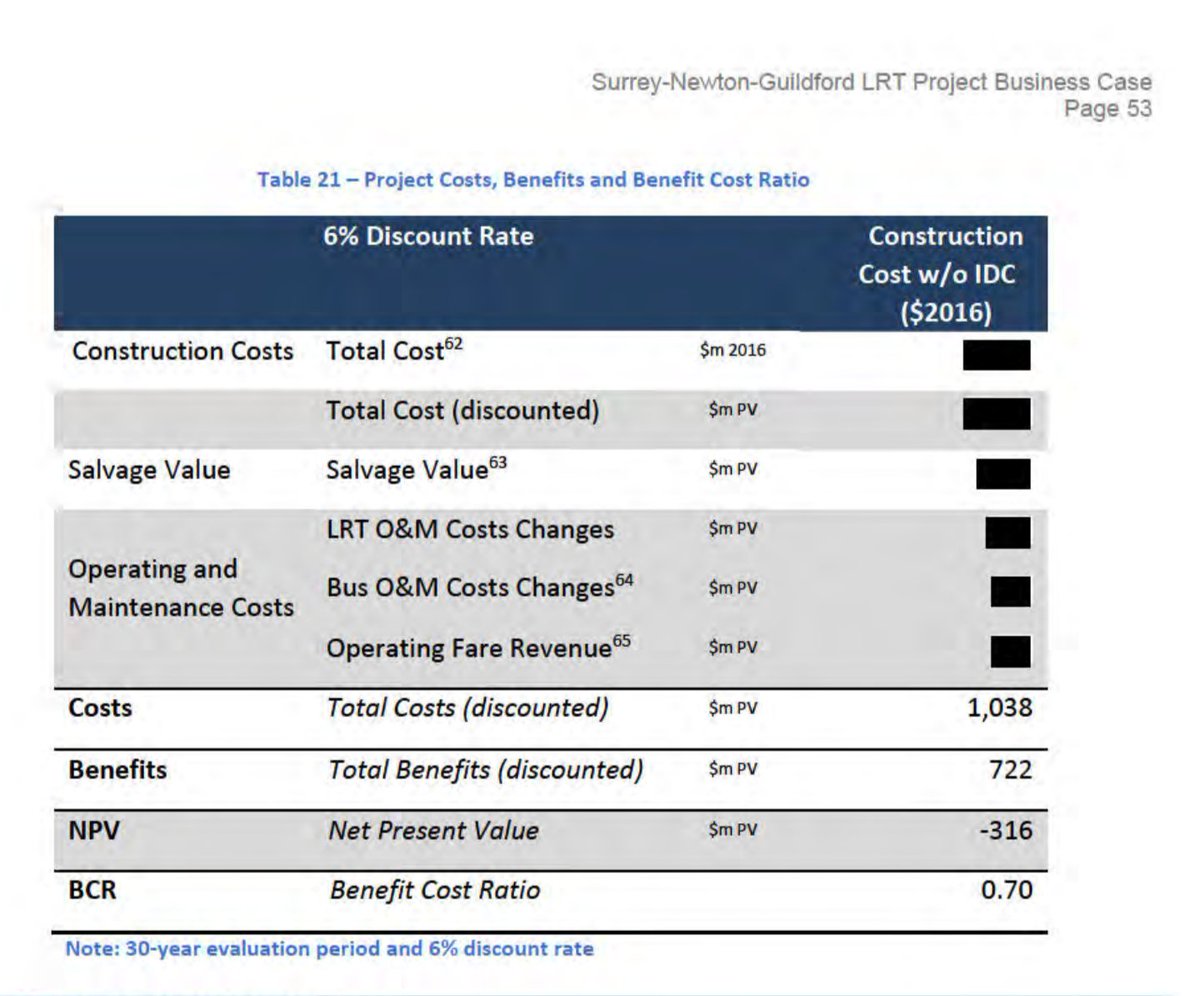
For everyone curious about the expected benefit-cost ratio (BCR) for the SNG LRT, yes, it is below 1.0.





 Prev
Prev





 Linear Mode
