Quote:
Originally Posted by acottawa

I agree the downtown portion (and particularly the decision to add trams to a already-overcrowded bus streets) was probably the straw that broke the camel's back because people perceived (probably correctly) that it would make the transit worse overall.
But overall it was a weird project.
The route was a weird reverse zed shape that was a cobbling together of a bunch of different ideas (and about 30% longer than the transitway route from Barrhaven to the Rideau Centre).
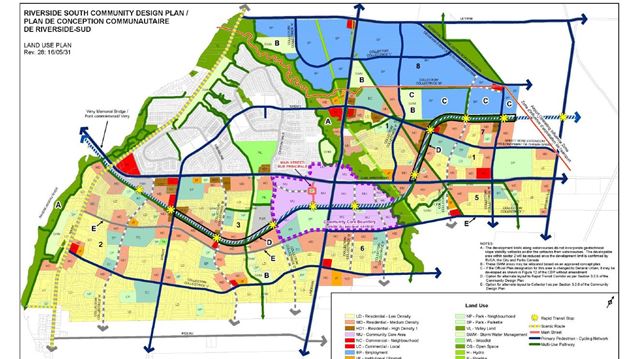
Despite all of the talk of Riverside South being a transit-oriented community, no provisions were made in the design on the community to facilitate that. It was (and remains) indistinguishable from other suburbs of the era (big box retail separated from the tram by a large parking lot, rows of empty grass boulevards and sound barriers along the route, housing mostly detached homes and duplexes, etc).
Much of the route either ran parallel to existing rapid transit services (the central transitway, the southeast transitway, the southwest transitway) without really improving travel times or replaced an existing service with only marginally better frequency (the o-train). The primary beneficiary of the project was Riverside South, which is less than 2% of the city's population (and was even less when this project was under consideration).
More importantly its prioritization was bizarre. The central transitway was bursting at the seams and desperately needed to be addressed. The decision to ignore that problem and focus on something else showed a pretty fundamental problem with the city's ranking of priorities.
|
Were you actually around when this was all taking place?
Have you really studied the Riverside South community plan? Most of Riverside South was to be within walking distance of a station. The Riverside South Town Centre was to be tightly integrated with light rail and was to have more of a main street feel instead of big boxes. What we have done guarantees that we will only have big boxes.
Have you really examined how the plan was going to tightly integrate into the Barrhaven community and how it was going to compliment the southwest Transitway in Barrhaven?
Why did it get priority?
1. Because of the success of the pilot O-Train, they wanted to extend service into part of the city that did not have rapid transit service and to move the O-Train beyond its pilot design
2. The area to be served was about to grow rapidly. This is exactly what has happened.
3. The federal and provincial government only offered a relatively small amount of money, not enough to build a downtown tunnel. That extra money did not come until some years later, and even then, they underfunded Phase 1.
4. It was going to be a full demonstration project in order to secure more funding for a more ambitious project. As it stands, we lost $100M for cancellation and we were punished for that cancellation with underfunding of Phase 1, probably another $100M.
5. It was guaranteed to generate significant new transit ridership.
6. Part of the route was to use an existing rail corridor, which would keep costs down.
7. The project would help get a multi-use bridge across the Rideau River built. That project was eventually built after years of delay.
8. The project would have removed 30% of the buses off of Albert and Slater Street, reducing the so called crunch, at least temporarily. Remember this was to open 2009 or 2010, 8 or 9 years before the tunnel will open.
9. It was to be built in place of road expansion. The city is still saying this but will an attractive light rail alternative ever arrive?
10. In order to deal with the limited transportation routes from the south into the city caused by the presence of the airport.
I see your criticism of that plan, but I don't see your criticism of the city's subsequent plan for the south end. I wonder why.





 Prev
Prev




 Linear Mode
