Quote:
Originally Posted by colemonkee

^ Which is funny, because Gehry has spent the vast majority of his career rejecting architectural history and more symbolically mimicking nature in a local context. Disney Hall, for example, purposefully resembles a desert rose from above, which is a direct nod to LA's civic history is the context of it's geography.
|
I think Gehry is referencing his own history, more than he is referencing any other building or architectural history in general.
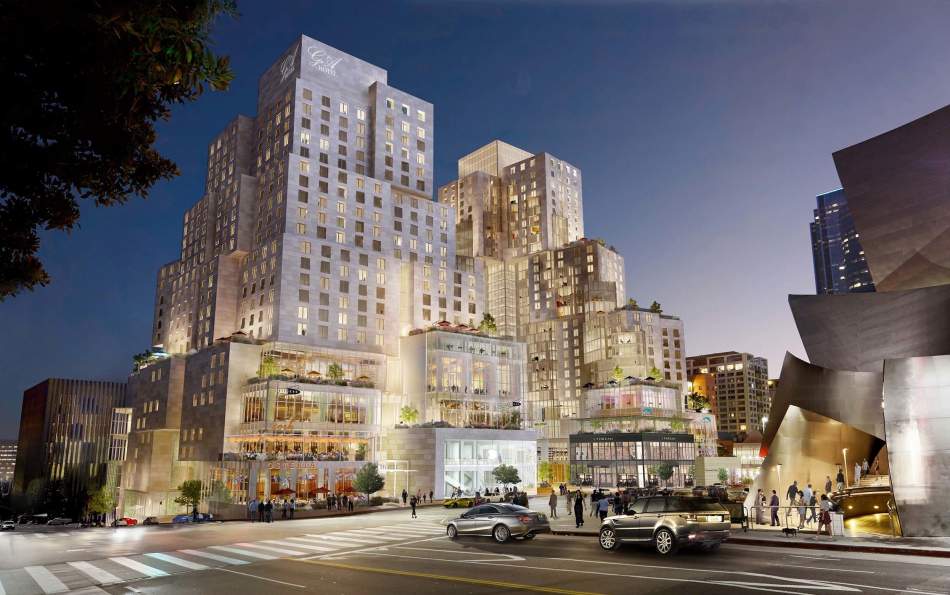
The original design for WD Hall was a building made up of a series of stacked boxes, rotated on axis one on top of the other. The model of the building was shown in the Getty's Overdrive exhibition. The Grand Avenue (GA) towers with their stacked boxes and setbacks pay homage to the original design.
So too does the curtain wall of the towers. WD Hall was supposed to be clad in the same limestone as the administrative building in the back. Gehry even developed code for cutting the limestone blocks into the curved pieces required by the final design. In the end, however, it became too expensive.
As to the rose, I forget exactly when the association with roses happened. I am not sure Gehry knew that Lillian Disney had an affection for roses before he submitted his competition entry, the one with the stacked boxes. Of course, as the design evolved, he did play with the metaphor of a rose more, but he never made it literal. He's also compared the hall to a galleon (ship)
As to architectural history in general, one could probably compare the GA towers to any New York tower with setbacks. It became a type there, it is sort of an anomaly here especially in the context of the structural steel towers of Bunker Hill.
The more interesting comparison, however, might be to the Battery Park City development in New York. Like Battery Park City, the GA complex serves as a podium for the buildings around them, providing them with context, grounding them. That's what Battery Park did for the original Twin Towers. This is a rare posture for Gehry. His building usually create their own context. But here it is more about what surrounds the complex than the complex itself. In short, it seems that Gehry wanted to create a place that expresses some solidarity with the boxy and stone-clad forms of Isozaki's MOCA and that establishes a scalar transition between the Bunker Hill towers, his own Walt Disney Hall, and the County/Federal Buildings. Back to basics for Gehry and very well done.





 Prev
Prev






 Linear Mode
