Quote:
Originally Posted by iheartphilly

I think it's the attitude of "me first." More of self-interest and preservation rather than for the greater good of the whole.
|
The irony, in my opinion, is that the"self-interest" is a short-sighted self interest. Over the the longer term, these kinds of decisions devalue their neighborhood incrementally and make it more prone to decline in the long run . . . though many of them will still be living there in the long run:
If you gear your inner city neighborhood primarily around preservation of parking, low density, and low business activity, then over time other neighborhoods that embrace the opposite (reasonable density, non-car-orientation, availability of amenities and street life) will incrementally become safer, more attractive, more sought after, more targeted for investments and improvements, less blighted by parking lots and garage doors.
The reason Rittenhouse Square is the most sought after neighborhood in the region is (obviously) because it is dense, pedestrian oriented, and can therefore support the fantastic array of amenities and conveniences that less dense, more insular car-oriented neighborhoods (like Logan Square) cannot support. Extend this notion to Manhattan or most European cities and of course it is obvious why those places are so great, the most valuable places on earth on average.
Basically, many of the people in Logan Square (and to a lesser degree, in Society Hill and a few other predominantly residential inner city Philly neighborhoods) suffer from a sort of cognitive dissonance: they like certain conveniences of both the city and the burbs, yet cannot fully embrace either. So they linger for decades in this lame quasi-suburban liminal state.
I understand the historical origins of this psychological condition, and in many ways I think it is peculiar to Philadelphia: unlike most cities, Philly still had a real, livable, if shabby downtown by 1970. During the 1970s, 80s, and 90s, it was a given - and largely true - that the only way to attract new, upper middle class gentrifying baby-boomer yuppies to Center City and environs (whether as workers, shoppers, diners, entertainment-seekers, or residents) was to ensure the availability of ample, inexpensive parking. They needed cars to take care of errands that could were no longer doable in downtowns anywhere but perhaps NYC, SF, or maybe Boston.
The popularity of Center City gradually increased over the ensuing decades, but amenities were slow to catch up. Cars were still needed. Naturally residents became very protective whenever they felt their cheap parking was threatened.
Unfortunately, as we all know, inexpensive availability of parking enabled residents to do their shopping further afield (say, Columbus Blvd, Cherry Hill, etc.) rather than in their neighborhood. Simultaneously, this enabled residents to maintain the suburban mentality that totally residential neighborhoods = good, nearby urban commercial activity = bad, while making it more difficult for local pedestrian-oriented businesses to do well when they had to compete with nearby, car-accessible suburban strip centers. This is a mutually reinforcing dynamic: more dependence on cars, less incentive for pedestrian oriented business to set up shop, in turn forcing residents to be more car/parking dependent, etc., etc. This is a pretty well recognized and established pattern.
And it leads to urban dead zones like Logan Square, where almost everyone has a garage and leads a quasi-suburban lifestyle - because they like it, for one, and because their previous decades of fighting denser development and commercial amenities pushes them to live that way: it would be relatively inconvenient to live in Logan Sq compared to many other Center City neighborhoods because people there always need to go someplace else (other than Trade Joe's) to do anything or get anything done. There is almost NOTHING in that neighborhood to serve its own residents' needs. Not even a decent cafe.
A similar dynamic is playing itself out in Society Hill in a most ridiculous manner.
There is a one-story 1980s suburban-style Superfresh with an ugly parking lot at 5th and Delancey.
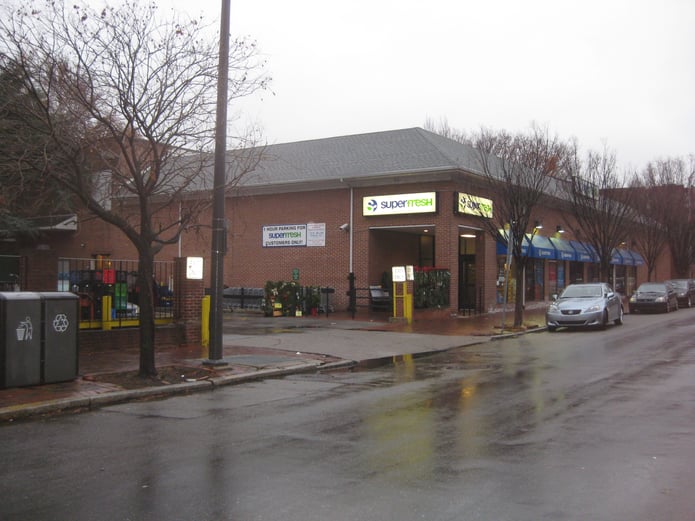 source
Nice, right?
Alterra has apparently purchased the underutilized sit and proposed a 5-story residential building with a supermarket on the first floor and underground parking for 36 cars - more than in the existing parking lot. Win all around, right? Of course not. Of course some neighbors freaked and started fighting tooth and nail against the proposal.
https://www.generosity.com/community-fundraising/5th-street-development-fundraiser--2
They are fighting to keep a one-story suburban-style 1980s supermarket box and parking lot in the most historic neighborhood in the country.
You see bumber stickers on cars [cue: irony] in SH with the slogan: "SOS - Save our Society Hill Village Square" or some such absurdity.
So un-self aware, so blinded by idiotic parochialism are these community activists that they have the audacity to call this a fight to "save the village square". A village square. With a corporate supermarket. And a parking lot. Are they fucking kidding.
This has to be one of the most ridiculous chapters in the endless Annals of Philadelphia NIMBYism.
Given this history, given the mentality of the predominantly baby boomer quasi-suburban people driving these anti-urban activist campaigns, I am not at all shocked by the pending demolition of the former PTM in Logan Square for a ticky-tacky pseudo-urban townehome community.
Sometimes I think the impending demise of the ossified yet still dominant baby boomer generation will open so many doors for positive change by hopefully more progressive, urban-minded and visionary younger generations. One can hope, anyway.





 Prev
Prev


 )
)


 Linear Mode
