HomeDiagramsDatabaseMapsForum About
     

Go Back   SkyscraperPage Forum > Global Projects & Construction > General Development


Closed Thread

 
Thread Tools Display Modes
     
     
  #5961  
Old Posted May 19, 2016, 1:51 PM
City Wide City Wide is offline
Registered User
 
Join Date: Aug 2014
Posts: 1,627
Quote:
Originally Posted by Justin7 View Post
I agree with your post in general, but take some issue with this. Each beautiful old building that is lost makes it easier to tear down the next one. I absolutely agree that cities need to grow, but Philadelphia is full of opportunities for this without tearing down pre-war buildings of a higher quality than anything that will replace them.

There are still many parking lots to build on, many above ground garages to demolish, urban renewal disaster areas to remedy, air rights over rail yards and highways, and let's face it, plenty of ugly buildings that were not built nearly as well as the one we are discussing. There are opportunities for great projects like The Beacon that incorporate historic structures. Philadelphia has so much room to grow.

When all of that is done? Sure, at that point it's time to have a discussion about replacing the quality small scale buildings with more density, but until then it's a folly driven by greed and the city is worse for it.

Amen, several times over
     
     
  #5962  
Old Posted May 19, 2016, 2:31 PM
McBane McBane is offline
Registered User
 
Join Date: Sep 2006
Location: Philadelphia
Posts: 3,708
Quote:
Originally Posted by allovertown View Post
I don't understand your assertion here at all. Why should what replaces a building not matter? The NIMBYS are annoying because they act like they care about saving an historic building, when in actuality they're just opposing denser more urban development and the preservation of an historic building is an easier cause to rally behind. It's a tried and true tool of the NIMBY playbook, but just because it's a tactic that NIMBY's sometimes use doesn't mean it is automatically invalid in all instances.

The difference here is that people actually care about this building. It's not a ruse to get our way, this building has a ton of character and it's a fucking shame that's it's being demolished. That being said, not every old building can be saved just because it is old and beautiful. This is not a city encased in amber, it's living and breathing and changing.

I do believe however that an existing historic building sets a certain bar that new development MUST pass. If you're building on an empty lot, there is nothing to compare a new building to. Even if it's ugly as hell, it's at least something, a place where people can live or work or shop. A building where once there was nothing is always an improvement of the urban fabric. But if you're going to knock down a building, an interesting, historic building with a unique backstory and a place where countless Philadelphians have visited and enjoyed, then you damn sure better replace it with something worthwhile.

Why would we ever want this city to step backward? Why would ever want to lose something loved and have it replaced with something banal and soulless? What is replacing a building ABSOLUTELY matters, and in this case these McMansions don't come close to stacking up.

Totally agree though that the biggest culprit here is the shit zoning. A max of 38'? That is totally out of touch with reality? What a joke. Also fuck the LSNA.
You make some good points and I do actually agree that what replaces a building matters. I would love to see some sort of middle ground for old buildings that doesn't necessarily protect them in perpetuity but does hold the proposed replacement to a higher standard.

The problem is that for the ignorant majority of people out there, this type of shlock is totally acceptable. The fact is, people don't like height, density, or the urban ideals that we all espouse. Just look at what happened at the former Mt. Sinai Hospital. Faced between preserving the hospital into condo building or demolishing it for townhomes, the neighbors went with the latter because of concerns over parking and density! This isn't much different. NIMBYs understand development pressure and know that townhomes, however ugly or anti-urban, are the least impactful on their idyllic "village" lifestyle.

While I welcome an approach that takes into consideration what is replacing a demolished old building, I just don't see how such a policy could work so long as the NIMBYs wield such power.
     
     
  #5963  
Old Posted May 19, 2016, 3:38 PM
VikingDutchman VikingDutchman is offline
Registered User
 
Join Date: Feb 2014
Posts: 99
Quote:
Originally Posted by McBane View Post
You make some good points and I do actually agree that what replaces a building matters. I would love to see some sort of middle ground for old buildings that doesn't necessarily protect them in perpetuity but does hold the proposed replacement to a higher standard.

The problem is that for the ignorant majority of people out there, this type of shlock is totally acceptable. The fact is, people don't like height, density, or the urban ideals that we all espouse. Just look at what happened at the former Mt. Sinai Hospital. Faced between preserving the hospital into condo building or demolishing it for townhomes, the neighbors went with the latter because of concerns over parking and density! This isn't much different. NIMBYs understand development pressure and know that townhomes, however ugly or anti-urban, are the least impactful on their idyllic "village" lifestyle.

While I welcome an approach that takes into consideration what is replacing a demolished old building, I just don't see how such a policy could work so long as the NIMBYs wield such power.
Sadly true. The busy bodies who control most neighborhood groups do care at least a little about Historical Preservation, but not nearly as much as they care about protecting their god given right to ultra convenient parking, and keeping their neighborhood exactly as they conceive it to be. To these people "historical preservation" means "keeping things how I imagine they were when I moved in, which may or may not reflect the actual history of the neighborhood or even how things actually were when I moved in."

The problem here is the idea that local neighbors (specifically, the vocal complaining minority who outdo the rest of us at mobilizing) should have a near total veto over everything. You see this all through politics, especially it seems in PA. Our country may be a federation of states, but Pennsylvania is not a federation of counties, counties are not federations of towns, and our cities are certainly not federations of neighborhoods. There is no reason to abdicate a role for the common good in these policies, except that changing things would be hard, and apparently nobody wants to do things that are hard anymore
     
     
  #5964  
Old Posted May 19, 2016, 4:11 PM
iheartphilly's Avatar
iheartphilly iheartphilly is offline
Philly Rising Up!
 
Join Date: Nov 2012
Location: motherEarth
Posts: 3,263
Quote:
Originally Posted by VikingDutchman View Post
Sadly true. The busy bodies who control most neighborhood groups do care at least a little about Historical Preservation, but not nearly as much as they care about protecting their god given right to ultra convenient parking, and keeping their neighborhood exactly as they conceive it to be. To these people "historical preservation" means "keeping things how I imagine they were when I moved in, which may or may not reflect the actual history of the neighborhood or even how things actually were when I moved in."

The problem here is the idea that local neighbors (specifically, the vocal complaining minority who outdo the rest of us at mobilizing) should have a near total veto over everything. You see this all through politics, especially it seems in PA. Our country may be a federation of states, but Pennsylvania is not a federation of counties, counties are not federations of towns, and our cities are certainly not federations of neighborhoods. There is no reason to abdicate a role for the common good in these policies, except that changing things would be hard, and apparently nobody wants to do things that are hard anymore
I think it's the attitude of "me first." More of self-interest and preservation rather than for the greater good of the whole.
     
     
  #5965  
Old Posted May 19, 2016, 4:41 PM
Boku Boku is offline
Registered User
 
Join Date: Jul 2014
Posts: 770
The U.S. Census Bureau's 2015 Population Estimates are in.

Philly as of July 1, 2015: 1,567,442

Philly as of July 1, 2014: 1,560,297

Census 2010: 1,526,006
     
     
  #5966  
Old Posted May 19, 2016, 4:59 PM
3rd&Brown 3rd&Brown is offline
Registered User
 
Join Date: Oct 2007
Posts: 3,058
Quote:
Originally Posted by Boku View Post
The U.S. Census Bureau's 2015 Population Estimates are in.

Philly as of July 1, 2015: 1,567,442

Philly as of July 1, 2014: 1,560,297

Census 2010: 1,526,006
Interesting.

If these stats hold true (year over year growth rate of 0.45% and a 5 year growth rate of 2.7%), we'll grow at somewhere between 4.5 and 5.5% in this decade. Not bad for a city that only a few years ago was losing population by the tens of thousdands. Further, whether the low end or the high end of the growth spectrum is right, either has us eclipsing 1.6MM somewhere in 2020.

Exciting.

I've been thinking about this, as well, of late, in terms of where the growth is coming from. I think it's being driven primarily by 3 things. 1. Migration form NYC, 2. Suburbs, 3. Puerto Rico.

I know it sounds crazy, but with the crisis in Puerto Rico, a lot of people are leaving. And Philadelphia, with it's large Puerto Rican population, is a natural place for people to go. I also read recently, in response to my own curiosity, that Philadelphia, has 1. eclipsed Chicago as the second largest (urban) population of Puerto Ricans in the states, after NYC, and 2. become the number 1 destination for Puerto Rican migration, meaning, 40% of all Puerto Ricans who move from anywhere (Puerto Rico, NY, FL, Chicago, etc) are moving here. Anecedotally, this makes sense to me, for a number of reasons, but I'll also say that there are areas of West Kensington, Juniata Park, and Hunting Park that feel more robust and full, if you will, than they have for a long time. I have to think it is for this very reason. Whereas population in West Kensington used to be concentrated along the EL, it now feels like it goes further out into North Philly now. I drove down Lehigh Avenue last week from Fishtown and it felt alive all the way to 8th or 9th Street, whereas it used to deaden around say, 2nd or 3rd Street.
     
     
  #5967  
Old Posted May 19, 2016, 5:13 PM
VikingDutchman VikingDutchman is offline
Registered User
 
Join Date: Feb 2014
Posts: 99
Wish the rate were higher, but growth is growth.

Now if we only we could make some progress on the political, economic, land use, taxation, etc... issues holding it from going higher.
     
     
  #5968  
Old Posted May 19, 2016, 5:48 PM
Cro Burnham's Avatar
Cro Burnham Cro Burnham is offline
Registered User
 
Join Date: Jun 2005
Location: delco
Posts: 2,396
Quote:
Originally Posted by iheartphilly View Post
I think it's the attitude of "me first." More of self-interest and preservation rather than for the greater good of the whole.
The irony, in my opinion, is that the"self-interest" is a short-sighted self interest. Over the the longer term, these kinds of decisions devalue their neighborhood incrementally and make it more prone to decline in the long run . . . though many of them will still be living there in the long run:

If you gear your inner city neighborhood primarily around preservation of parking, low density, and low business activity, then over time other neighborhoods that embrace the opposite (reasonable density, non-car-orientation, availability of amenities and street life) will incrementally become safer, more attractive, more sought after, more targeted for investments and improvements, less blighted by parking lots and garage doors.

The reason Rittenhouse Square is the most sought after neighborhood in the region is (obviously) because it is dense, pedestrian oriented, and can therefore support the fantastic array of amenities and conveniences that less dense, more insular car-oriented neighborhoods (like Logan Square) cannot support. Extend this notion to Manhattan or most European cities and of course it is obvious why those places are so great, the most valuable places on earth on average.

Basically, many of the people in Logan Square (and to a lesser degree, in Society Hill and a few other predominantly residential inner city Philly neighborhoods) suffer from a sort of cognitive dissonance: they like certain conveniences of both the city and the burbs, yet cannot fully embrace either. So they linger for decades in this lame quasi-suburban liminal state.

I understand the historical origins of this psychological condition, and in many ways I think it is peculiar to Philadelphia: unlike most cities, Philly still had a real, livable, if shabby downtown by 1970. During the 1970s, 80s, and 90s, it was a given - and largely true - that the only way to attract new, upper middle class gentrifying baby-boomer yuppies to Center City and environs (whether as workers, shoppers, diners, entertainment-seekers, or residents) was to ensure the availability of ample, inexpensive parking. They needed cars to take care of errands that could were no longer doable in downtowns anywhere but perhaps NYC, SF, or maybe Boston.

The popularity of Center City gradually increased over the ensuing decades, but amenities were slow to catch up. Cars were still needed. Naturally residents became very protective whenever they felt their cheap parking was threatened.

Unfortunately, as we all know, inexpensive availability of parking enabled residents to do their shopping further afield (say, Columbus Blvd, Cherry Hill, etc.) rather than in their neighborhood. Simultaneously, this enabled residents to maintain the suburban mentality that totally residential neighborhoods = good, nearby urban commercial activity = bad, while making it more difficult for local pedestrian-oriented businesses to do well when they had to compete with nearby, car-accessible suburban strip centers. This is a mutually reinforcing dynamic: more dependence on cars, less incentive for pedestrian oriented business to set up shop, in turn forcing residents to be more car/parking dependent, etc., etc. This is a pretty well recognized and established pattern.

And it leads to urban dead zones like Logan Square, where almost everyone has a garage and leads a quasi-suburban lifestyle - because they like it, for one, and because their previous decades of fighting denser development and commercial amenities pushes them to live that way: it would be relatively inconvenient to live in Logan Sq compared to many other Center City neighborhoods because people there always need to go someplace else (other than Trade Joe's) to do anything or get anything done. There is almost NOTHING in that neighborhood to serve its own residents' needs. Not even a decent cafe.

A similar dynamic is playing itself out in Society Hill in a most ridiculous manner.

There is a one-story 1980s suburban-style Superfresh with an ugly parking lot at 5th and Delancey.
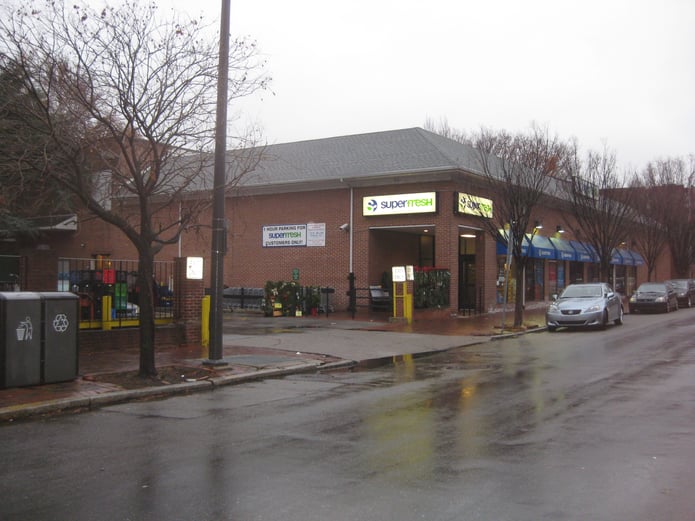
source

Nice, right?

Alterra has apparently purchased the underutilized sit and proposed a 5-story residential building with a supermarket on the first floor and underground parking for 36 cars - more than in the existing parking lot. Win all around, right? Of course not. Of course some neighbors freaked and started fighting tooth and nail against the proposal.

https://www.generosity.com/community-fundraising/5th-street-development-fundraiser--2

They are fighting to keep a one-story suburban-style 1980s supermarket box and parking lot in the most historic neighborhood in the country.

You see bumber stickers on cars [cue: irony] in SH with the slogan: "SOS - Save our Society Hill Village Square" or some such absurdity.

So un-self aware, so blinded by idiotic parochialism are these community activists that they have the audacity to call this a fight to "save the village square". A village square. With a corporate supermarket. And a parking lot. Are they fucking kidding.

This has to be one of the most ridiculous chapters in the endless Annals of Philadelphia NIMBYism.

Given this history, given the mentality of the predominantly baby boomer quasi-suburban people driving these anti-urban activist campaigns, I am not at all shocked by the pending demolition of the former PTM in Logan Square for a ticky-tacky pseudo-urban townehome community.

Sometimes I think the impending demise of the ossified yet still dominant baby boomer generation will open so many doors for positive change by hopefully more progressive, urban-minded and visionary younger generations. One can hope, anyway.

     
     
  #5969  
Old Posted May 19, 2016, 5:53 PM
Milksteak Milksteak is offline
Registered User
 
Join Date: Mar 2016
Posts: 534
Quote:
Originally Posted by 3rd&Brown View Post
I've been thinking about this, as well, of late, in terms of where the growth is coming from. I think it's being driven primarily by 3 things. 1. Migration form NYC, 2. Suburbs, 3. Puerto Rico.
You could probably factor in college grads that make Philly their permanent home post graduation (a portion of which come from the burbs). Philly is where it's at these days...still affordable and with character bursting at the seams.

For my own niche interests, the amount of new (and old) concert venues just north of center city is amazing...you've got small bars running hardcore shows and the Electric Factory hosting some pretty big names. It's a great place to be.
     
     
  #5970  
Old Posted May 19, 2016, 7:25 PM
Justin7 Justin7 is offline
Registered User
 
Join Date: Jan 2013
Posts: 900
Quote:
Originally Posted by 1487 View Post
Your statement doesn't take into account location and neighborhood desirability. While it is true that Philly still has many surface parking lots and ugly garages, they typically are NOT located in the heart of very desirable residential neighborhoods. And those that are typically will be built on eventually. developers are going to try to build luxury housing in established neighborhoods that have shown they can support the pricing. You aren't going to find anyone offering to build million dollar townhomes on parking lots on North Broad or near 10th and Vine since there is no evidence that anyone would buy such a product at those locations. So saying that developers should steer clear of older buildings in nicer areas when there are plenty of parking lots on the outskirts of Center City waiting for them to build on ignores the realities of the housing market.
You and I have very different priorities.

The vast majority of developers would do anything to make a buck. They'd tear down city hall if there was money in it. I'm not suggesting otherwise. I'm suggesting the city step in and protect these buildings.
     
     
  #5971  
Old Posted May 20, 2016, 1:31 AM
Frontst17 Frontst17 is offline
Registered User
 
Join Date: Nov 2014
Posts: 304
To continue the point i saw today as probably many of you did on UrbanPHL that we now designate only 3 or so percent of our buildings as historic or to be preserved, while the average American city designated 5%? Something is wrong with that to me given as we are perhaps the most historic city in the country arguably (or not so)
     
     
  #5972  
Old Posted May 20, 2016, 2:26 AM
logansquare logansquare is offline
Registered User
 
Join Date: Jul 2006
Posts: 66
Quote:
Originally Posted by Cro Burnham View Post
Dead on (with all due respect to our SSP friend logansquare )
Totally with you with respect to the LSNA!
     
     
  #5973  
Old Posted May 20, 2016, 12:27 PM
1487 1487 is offline
BANNED
 
Join Date: Jun 2014
Posts: 3,401
Quote:
Originally Posted by Justin7 View Post
You and I have very different priorities.

The vast majority of developers would do anything to make a buck. They'd tear down city hall if there was money in it. I'm not suggesting otherwise. I'm suggesting the city step in and protect these buildings.
It has nothing to do with my personal priorities, its about the realities of a market based economy for new housing. The locations of undesirable parking lots often do not coincide with the locations where folks are willing to pay top dollar. So saying no old buildings should ever be demolished in Philly until every parking lot is covered with luxury rentals or townhouses doesn't make much sense in the real world. A parking lot in a hot residential area won't last long, but a lot or garage in an area that has little history of supporting residential development is likely to remain that way for an extended period of time.
     
     
  #5974  
Old Posted May 20, 2016, 1:27 PM
PHL10's Avatar
PHL10 PHL10 is online now
Registered User
 
Join Date: Jun 2010
Location: Philadelphia
Posts: 1,771
Quote:
Originally Posted by Cro Burnham View Post
Basically, many of the people in Logan Square (and to a lesser degree, in Society Hill and a few other predominantly residential inner city Philly neighborhoods) suffer from a sort of cognitive dissonance: they like certain conveniences of both the city and the burbs, yet cannot fully embrace either. So they linger for decades in this lame quasi-suburban liminal state.
Really nice post, Cro and the paragraph above really captures the heart of the problem in my mind.
__________________
I've been living under a rock.
     
     
  #5975  
Old Posted May 20, 2016, 2:01 PM
McBane McBane is offline
Registered User
 
Join Date: Sep 2006
Location: Philadelphia
Posts: 3,708
Quote:
Originally Posted by Frontst17 View Post
To continue the point i saw today as probably many of you did on UrbanPHL that we now designate only 3 or so percent of our buildings as historic or to be preserved, while the average American city designated 5%? Something is wrong with that to me given as we are perhaps the most historic city in the country arguably (or not so)
Historic preservation is a very restrictive status meant to preserve our city's history, not limit development. Though that's increasingly the case. Recently, there was a story about a row of townhomes being threatened by demolition in Powelton Village and the city's answer was to designate them historical. Keep in mind that that the Phila Historical Commission was established in the 1950's and yet over the last 60+ years, no one ever deemed those buildings to have historical value. Don't you think that after all this time, buildings that deserve to be called historic are protected and those that are not are just not that important?

Of course, we don't want to lose what makes our city special but at the same time, the city isn't a museum. Certifying a building as historic is a heavy handed, lazy, and oversimplified response to a very complex issue. Can the problem be fixed through zoning? Should the planning commission be involved (and be given teeth)? Do taxes play a part? Maybe the city shouldn't permit tax abatements in situations where developers tear down perfectly inhabitable structures?

I don't have an exact answer but designating more buildings as historic, in my opinion, is not the solution.
     
     
  #5976  
Old Posted May 20, 2016, 2:21 PM
Cro Burnham's Avatar
Cro Burnham Cro Burnham is offline
Registered User
 
Join Date: Jun 2005
Location: delco
Posts: 2,396
Quote:
Originally Posted by PHL10 View Post
Really nice post, Cro and the paragraph above really captures the heart of the problem in my mind.
Why thanks. I will pretend your profile signature does not apply in this case. It is not often that an ornery crank like me gets a compliment.
     
     
  #5977  
Old Posted May 20, 2016, 2:50 PM
hammersklavier's Avatar
hammersklavier hammersklavier is offline
Philly -> Osaka -> Tokyo
 
Join Date: Apr 2008
Location: The biggest city on earth. Literally
Posts: 5,630
Quote:
Originally Posted by Boku View Post
The U.S. Census Bureau's 2015 Population Estimates are in.

Philly as of July 1, 2015: 1,567,442

Philly as of July 1, 2014: 1,560,297

Census 2010: 1,526,006
Let's play with these numbers some.

Delta (2014) = 7,145

Delta (2010-2014) = 41,436

mean of Delta (2) = 8,287.2

% off mean: ~13.8% less than the mean

Is this a stochastic effect (i.e. just noise in the system)? I can't tell without knowing the individual deltas of the last five years. And clearly one of those years we gained ~10k people in order to make up for the fact that we didn't gain the five-year average last year. There's a pretty good chance that that productive year raised the overall in-migration rate over its long-term mean.
__________________
Urban Rambles | Hidden City

Who knows but that, on the lower levels, I speak for you?’ (Ralph Ellison, Invisible Man)
     
     
  #5978  
Old Posted May 20, 2016, 3:45 PM
Frontst17 Frontst17 is offline
Registered User
 
Join Date: Nov 2014
Posts: 304
I'm not sure an answer either but definitely agree that swiftly deeming something historic shouldn't be the answer but maybe some sort of incentive to repurpose or restore buildings instead?
     
     
  #5979  
Old Posted May 20, 2016, 7:16 PM
1487 1487 is offline
BANNED
 
Join Date: Jun 2014
Posts: 3,401
Quote:
Originally Posted by hammersklavier View Post
Let's play with these numbers some.

Delta (2014) = 7,145

Delta (2010-2014) = 41,436

mean of Delta (2) = 8,287.2

% off mean: ~13.8% less than the mean

Is this a stochastic effect (i.e. just noise in the system)? I can't tell without knowing the individual deltas of the last five years. And clearly one of those years we gained ~10k people in order to make up for the fact that we didn't gain the five-year average last year. There's a pretty good chance that that productive year raised the overall in-migration rate over its long-term mean.
One thing is for sure, Phoenix will pass Philly by 2020. They added over 100k in the same span. And San antonio is only behind by 100k as of last year. Obviously their density is MUCH lower, but still #5 sounds better than #7 in population.

I looked at the estimates for the region. No local county added more people than Philadelphia. Bucks barely grew, Montco added about 20k and Chester added about 15k. Larger gains % wise, but still modest by their historical standards. DC and Boston have experienced explosive growth this decade, especially DC. +72k in 5 years.
     
     
  #5980  
Old Posted May 20, 2016, 8:35 PM
cafeguy cafeguy is offline
Registered User
 
Join Date: May 2014
Posts: 346
Quote:
Originally Posted by 1487 View Post
One thing is for sure, Phoenix will pass Philly by 2020. They added over 100k in the same span. And San antonio is only behind by 100k as of last year. Obviously their density is MUCH lower, but still #5 sounds better than #7 in population.

I looked at the estimates for the region. No local county added more people than Philadelphia. Bucks barely grew, Montco added about 20k and Chester added about 15k. Larger gains % wise, but still modest by their historical standards. DC and Boston have experienced explosive growth this decade, especially DC. +72k in 5 years.
I went to San Antonio for a conference...I remember being there for the week and seeing very few cars on the street and absolutley no one walking around. The hotel and riverwalk had people...but outside of that, it seemed like a noman's land of a city.
     
     
This discussion thread continues

Use the page links to the lower-right to go to the next page for additional posts
 
 
Closed Thread

Go Back   SkyscraperPage Forum > Global Projects & Construction > General Development
Forum Jump


Forum Jump


All times are GMT. The time now is 1:06 PM.


Powered by vBulletin® Version 3.8.7
Copyright ©2000 - 2026, vBulletin Solutions, Inc.

