After reading Isaac's recent blog post:
http://www.slcitynews.com/urban-expert-downtown-needs-more-residential-growth/
I noticed the following: (Isaac, hopefully this is okay as it is just a snippet).
Quote:
|
Nelson presented what he calls the “Nelson’s rule,” that argues that even poorly maintained downtowns, have a market demand of at least one percent of the metro population, while a maintained downtown will attract at least two percent of the metro population. That means that of the Salt Lake metro’s estimated 1.2 million people, there is a market demand for at least 12,000 people. Nelson argues that for Salt Lake that demand could be higher because downtown Salt Lake is also the regional urban center for the entire Wasatch Front, with an estimated population of 2.4 million. Applying Nelson’s rule to the Wasatch Front would indicate a market demand of least 24,000 residential units in downtown Salt Lake.
|
*Italics and Bolding are mine...
I tend to lean more into Nelson's views and think that there is pent up demand for housing and think the 24,000 units might be close to if not still a little low.
I think that the demand is there, the problem is the costs. All current market rate or lower apartments that come online are filling up quickly. Only higher cost apartment and condos are slower to fill up.
This shows the demand is there but the problem is still the costs. Nelson talks about incentives could be used for this but one point he brings up is to reduce the impact fees as the money would be made up in other areas.
This got me thinking a bit and I know we have talked about it in the past. Currently the fees are around $2400 per residential unit.
This means that a developer would need to build more to market rate and high end or get grants for lower end.
I keep coming back to this but think that the more it is talked about the more likely it is that action could be taken.
Let's lower the impact fees dramatically as density increases. By this, once density tops 30 units an acre, lets start dropping the fees. At 31 units an acre, fees are dropped 10%. At 40 units an acre, fees are down 25%, at 50 units an acre fees are down 50%. 75 units an acre would be an 80% decrease in fees. 100+ units an acre would be $0.00 impact fee per residential unit.
The goal of this is to increase density but also height. You can't build tall without profits being there and if impact fees eat up to much of the profits, investors won't fund it.
I think that with this, we would start to see taller residential building, retail and residents.
Developers would still be able to get grants for lower income options in the building but it would make the building more mixed income.
Retail would increase as there would be more built in demand at the 75+ units per acre threshold.
Most of City Creek residential is within the 75+ units per acre threshold so we know that people will live in higher densities, developers just need the incentives.
Maybe the city would offer further incentives such as tax abatement for increased densities near Trax, streetcar, high frequency bus routes, within downtown. Increase the tax abatement if the project replaces surface parking.
Lower the parking requirements down to .5:1 (stalls to units) or lower. Maybe even let the developer decide on the parking requirements. Parking in structured units outside of the building footprint wouldn't receive the same incentives. This would put the parking within the confines of the building footprint for incentives to take place.
This would help to remove the surface lots while also reducing the separated parking garages. Developers could still build excess parking and then use it for paid public parking if they wanted.
I think with this, we may also see more midblock walkways open up as developers work to receive as much incentives as possible while also making the biggest profit quickly for their investors.





 Prev
Prev


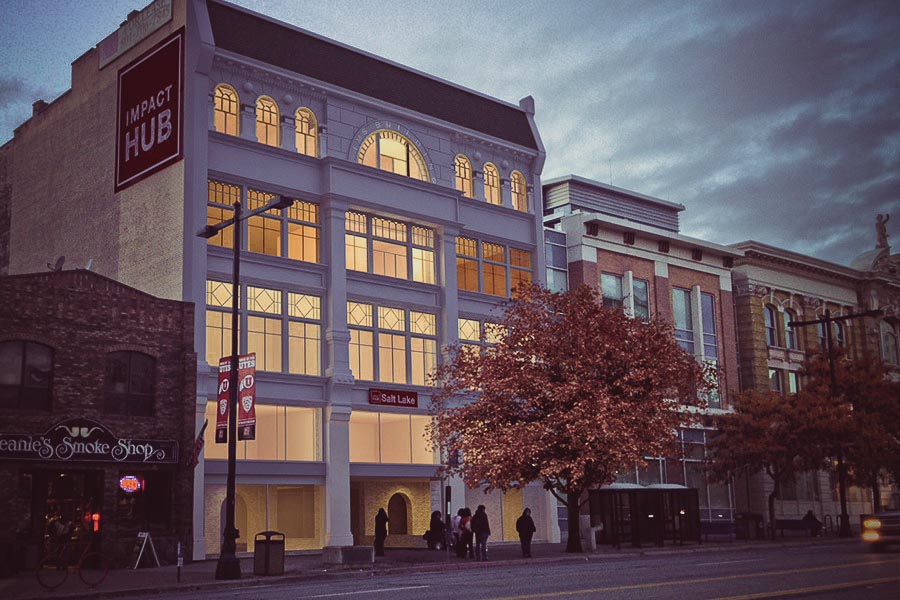


 and I too hope and expect to see 151 break ground by early next year. I would be completely happy seeing a new office tower start to rise every 1.5 - 2 years. 111 S Main broke ground late 2014, 151 breaking ground early 2016, and new tower late 2017. Here is my wish list of sites, (Carl's jr, Zions Lotr, Harmons, City Center{400 S State}), any of those sites would be fine with me.


 Linear Mode
