| |
 Posted Apr 3, 2015, 2:18 AM
|
|
Registered User
|
|
Join Date: Feb 2002
Posts: 6,732
|
|
Quote:
Originally Posted by Docjalby

It was just announced on Instagram that the Bloc roof will start to come off between April 27th and May 10th.
|

Quote:
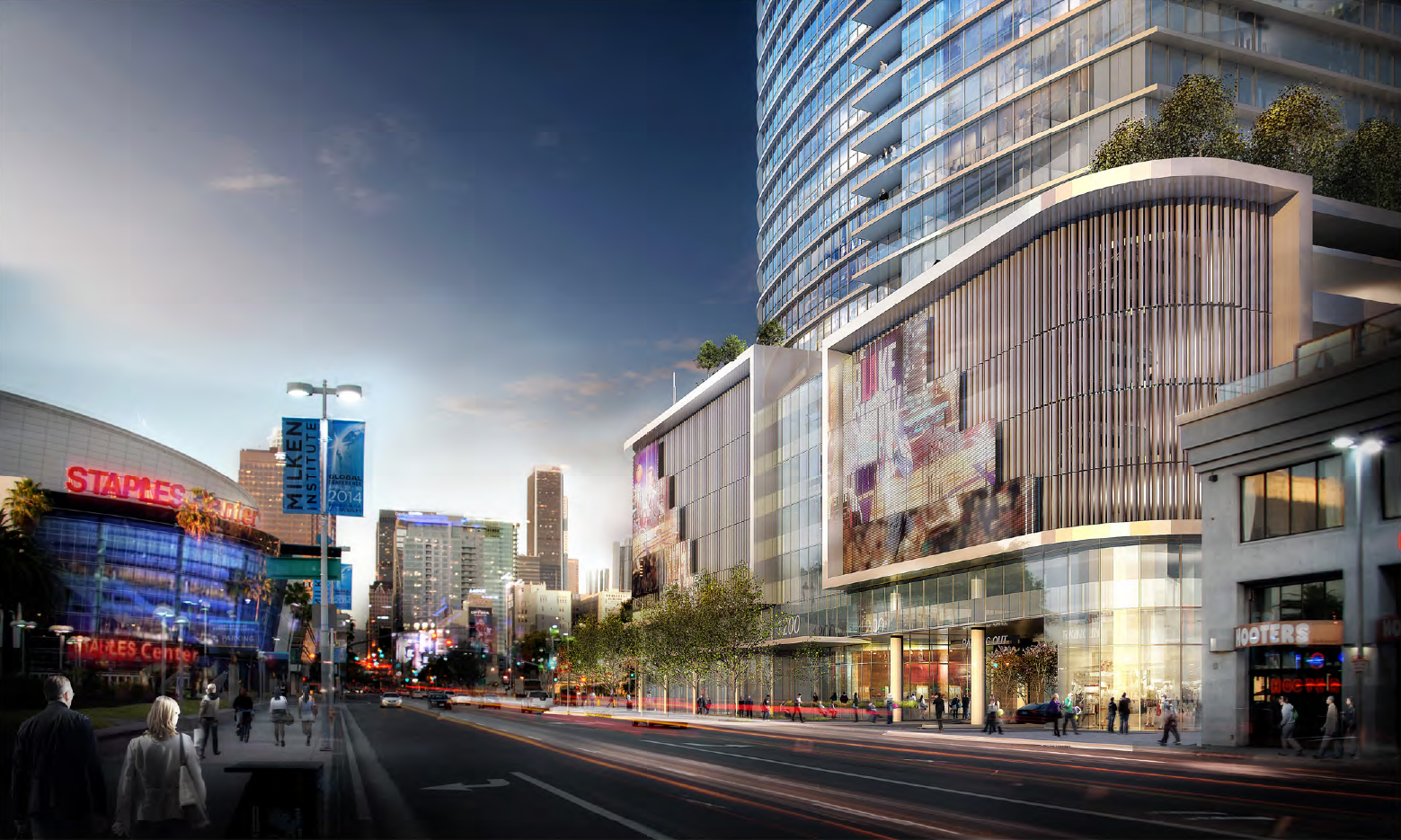
At the request of the builder of the massive Metropolis Los Angeles development, state legislation has been introduced that would exempt signs and giant electronic billboards in that section of downtown Los Angeles from state restrictions. The bill requested by Greenland USA is causing a stir among those who worry it will result in distractions for motorists and visual blight.
The measure by Assemblyman Miguel Santiago (D-Los Angeles) would exempt signs allowed by a city of Los Angeles ordinance from state restrictions on the number and location of billboards in an area bounded by West 8th Street on the northeast, South Figueroa Street on the southeast, Interstate 10 on the southwest, and State Route 110 on the northwest.
“It’s another attempt to clear the way for unlimited signage in the downtown area,” said Dennis Hathaway, president of the Coalition to Ban Billboard Blight.
Santiago noted that the legislation would require the city of Los Angeles to set limits on the size, location and number of billboards allowed downtown.
The Metropolis project owner, Greenland Group of Shanghai, is spending $1 billion on a development along the Harbor Freeway just north of Staples Center that includes a 38-story residential skyscraper and a four-star luxury hotel.
Santiago said his bill will help boost downtown. “AB 1373 is an important step towards the continued economic revitalization of downtown Los Angeles,” he said in a statement. “It will spur the construction of much-needed hotels, meeting space, and housing, and will provide good jobs -- all while empowering the city of Los Angeles to control its own urban landscape moving forward.”
|
Quote:
Gensler: Defining the Skyline of Downtown LA
csq.com
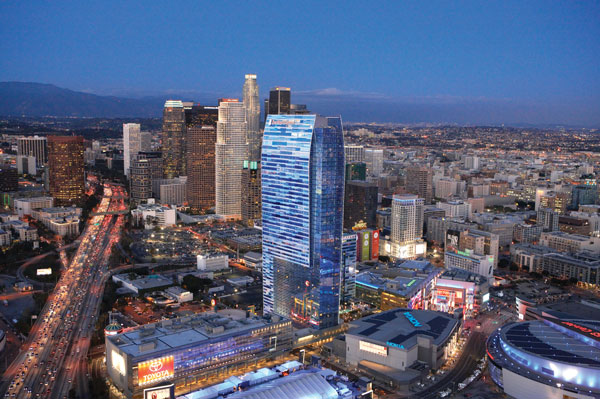
When driving past Downtown Los Angeles on the 110 or 10 Freeways, it is nearly impossible to ignore the Ritz-Carlton Hotel & Residences and JW Marriott that stand 55 stories above the city’s L.A. Live–STAPLES Center entertainment complex. The tower’s façade appears to be sea glass that Pacific Ocean waves took decades to weather into blue hues. With its smooth, angular shape, reminiscent of a surfboard, it is a quintessential Los Angeles building. Children and adults alike look at it and marvel, “Wow, that’s cool.”
More than just cool, its architectural design reveals what is happening inside. As its shape expands and the ascending glass changes colors, the building’s inhabitants switch from JW Marriott guests to Ritz-Carlton Downtown Los Angeles (DTLA) guests and residents – residents being afforded the luxury of rooms that are five feet deeper and views that expand from the San Bernardino Mountains to the ocean. That it is a mixed-use structure is a new characteristic of Downtown’s buildings and of urban architecture overall.
“We are constantly pushing the envelope on design innovation, focusing on performance-based design that is all about the user experience,” says Andy Cohen, one of Gensler’s three co-CEOs. Cohen joined the firm in 1980, and for the past 10 years has shared top leadership duties with David Gensler (who is based in San Francisco) and Diane Hoskins (in Washington, D.C.).
“The key is how we use the power of design to make a better world,” adds Robert Jernigan, regional managing principal at Gensler. “There should be more substance behind design than ‘it looks cool.’” The firm’s DTLA office is an example of “substance behind design” and serves to showcase the firm’s belief that the best office cultures provide areas that support four different work modes: focus, collaboration, learning, and socialization. “LA, as a city, was once the world’s largest office park – people came to work and [after work] people left [the city],” says Jernigan. “You’re going to start to see that buildings over 50 stories are no longer mono-functional and are generally mixed use.”
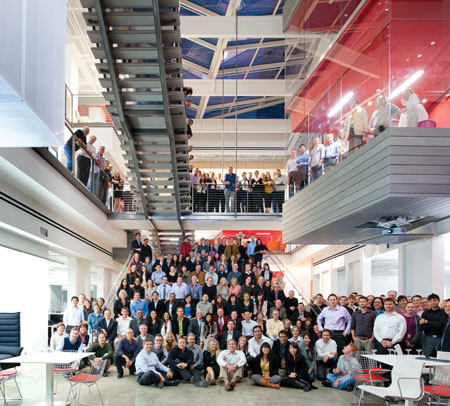
Gensler’s Downtown Los Angeles office houses 521 employees csq.com
The building in which Gensler is housed is a case in point. The firm moved to DTLA from Santa Monica in 2011, into the street-level floor of the 52-floor City National Plaza. Gensler’s space once housed a retail bank, occupying 50,000 square feet and two floors, the top level used for storage. A tour of the office today reveals the only evidence of the former bank is the structure’s granite core. Inside, Gensler cut a hole in the roof and installed an expansive skylight, then suspended a third floor from hangers and built stairs that spill out onto the first-floor amphitheater that is regularly used for a speaker series that is open to the community.
Gensler’s success in China has led to partnerships with Chinese firms developing domestically. In DTLA Gensler is working with China-based Greenland on the $1 billion Metropolis project just north of L.A. Live. It is also working with the Chinese firm Wanda that owns AMC theaters and is working on hotel projects throughout the United States, says Cohen.
Echoing a common sentiment among Gensler employees, Cohen considers the firm an extended family. “We’re all tied together as an integrated network of people and leaders and offices,” he says. “We’re in 46 cities, but we’re all one big family.”
Their families also take much pride in the firm’s accomplishments. Jernigan remembers a time when the JW Marriott-Ritz Carlton was just complete, and his son was on an elementary class field trip to the Grammy Museum in DTLA. As students stepped off their bus they were awed by the brand new glass tower that shimmered like a surfboard covered with sea glass.
“His classmates said, ‘Wow, look at that building!’” Jernigan recalls his son telling him. “And he looked up and said, ‘My dad did that.’”
|
• Video Link
|
|
|





 Prev
Prev










 Linear Mode
