It's been an interesting conversation (or debate or argument or whatever it was) about 'forcing' people to use transit and if the subsidies paid to transit riders are really worth it. For the record, I'm not in favor of 'forcing' anybody to do anything they don't want to do, but I
am in favor of 'nudging' people towards a certain behavior or habit when the cause is just.
I'm thinking mainly about air pollution, which is caused mostly by cars and is undeniably bad for our city - as in, it hurts our reputation and people actually
die from it occasionally. One could argue that allowing cars to dump their exhaust gasses into the atmosphere for others to deal with (Elon Musk is
on record saying it is akin to letting people just dump their garbage in the streets - interesting read) is the ultimate subsidy, but because that deals with qualitiative values more than quantitative ones it is usually not included.
Obviously banning cars with odd or even-ending license plates goes way too far (and is probably illegal as I-215 pointed out), and I never really want things to come to that point anyway... so here's what I think is a fair and modest proposal:
On Red-air days, the Highway Patrol will be allowed to set up a series of speed cameras (the type that automatically send a small fine to car's owner) along I-15, simply to enforce the speed limits already in place. If drivers were to actually
follow the posted speed limit and all drive at a consistent and uniform flow, there would be less traffic congestion and therefore less pollution and smog. And only on red-air days, mind you. And Transit will be free on those days.
The idea is to add just enough inconvenience to driving to 'nudge' those who are 'on the fence' to at least give transit a second look. We're not concerned with people who are determined that transit 'won't work' for them, because nothing will incentivize them to change; instead we're only concerning ourselves with the people who have considered transit in the past and would take it again if only driving were a tiny bit more annoying than it already is. Speed cameras seem like the perfect annoyance to me, because they inflict no financial penalty against those people who simply follow the rules. I have no idea what rules stand in the way of their being used on red-air days, but I'm sure I-215 would know.
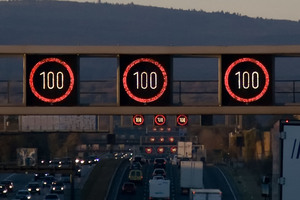
Future phases of this concept could include placing a Variable Message Board (VMB) at each Freeway entrance that could display a lower speed limit - again,
only on red-air days. By lowering the speed limit, car engines would run more efficiently, producing less pollution.
55-60 mph are the most efficient speeds, and by lowering the speed limit to these levels when air pollution gets
really bad could go a long way to addressing this problem. And of course people would have to follow these new speed limits, or get an automatic speeding fine in the mail.
And of course transit on red-air days would be free, because it would be (partially) subsidized by the extra speeding fines!
What do you think? Is this something people could agree to?
 A portable speed trap in Cleveland (ABOVE) and Variable Message Boards with Variable Speed Limits on the German Autobahn (BELOW)
Quote:
Originally Posted by Wasatch Wasteland

Thinking about all of this 'cost to ride/cost to operate" has gotten me curious.
TRAX and Frontrunner have been frequently said to cost significantly less to operate than regular bus service. However, they do cost much more to construct. In turn, buses cost almost nothing to construct/establish, yet cost more to operate.
For all you math geniuses out there (I am hopelessly lost when it comes to math), this is my question: at what point does the amount of money saved in operating costs cover the total construction costs for rail transit? That is to say, when do TRAX and Frontrunner start to "make" money?
|
The math would seem to be pretty straight forward. Start with the cost of transporting a certain projected number of riders by bus - we'll call it X. Then calculate the cost of transporting all those people by light rail; we'll call it Y. Then we need to calculate the total cost of design and construction and the monthly payments the transit agency would need to pay per month to pay those, and call this number Z. If X is greater than Y+Z, then it makes sense to run buses. If it is less, it makes sense to build light rail.
It does get more complicated than that, because once the bonding is all paid off, the infrastructure costs go away. I read some time ago that the original SLC-Sandy TRAX is all 'paid off,' meaning that UTA completely paid off all the construction costs for that project (meaning they no longer have to consider the cost of Z, just Y). Also, light rail attracts more riders than a regular bus does, meaning you get a much higher return on the investment than you do by simply running the current buses.
I'll have to do my homework and get back to this later...




 Threaded Mode