HomeDiagramsDatabaseMapsForum About
     

Go Back   SkyscraperPage Forum > Regional Sections > United States > Mountain West


Reply

 
Thread Tools Display Modes
     
     
  #6261  
Old Posted Mar 13, 2015, 4:56 PM
Future Mayor's Avatar
Future Mayor Future Mayor is offline
 
Join Date: Jun 2007
Posts: 4,803
2022 is a very very very very very very very slim chance, because the US wants to try for the 2024 Summer Games, so the USOC won't support a 2022 bid because if we were awarded the 2022 Winter Games there is no chance for the 2024 Summers Games to be hosted in the US. The best chance for SLC is 2026, if the US isn't awarded the 2024 Summer Games, or if another host city doesn't get their facilities completed in time, and SLC hosts by default.
Reply With Quote
     
     
  #6262  
Old Posted Mar 13, 2015, 5:45 PM
Makid Makid is offline
 
Join Date: Jun 2006
Posts: 2,109
Quote:
Originally Posted by Hatman View Post
Fantastic! To quote another group very happy with the legislature this cycle, "what a difference one year makes!"

Question: how soon will these local votes on the tax take place?
Based on the previous legislation and voting times, I would expect that the vote would be this November on the local tax increase.

This would give enough time for packaging up the planned improvements, cost analysis as well as completion of any other outstanding analysis that would be needed for the first phase projects, 2nd phase projects would just have the analysis sped up so that it would be able to be included and scheduled after the first phase has begun.

As most of the slated projects either have had the environmental analysis' and alternative analysis' completed, I do think that from a transportation standpoint, it would just be the phasing which has mostly been completed in the 2040 plan. It would just be assigning new dates and enhanced ridership estimates.

Once the language for the ballot is finalized, UTA would be able to begin the work with the FTA and possibly the FRA to discuss proposal request language regarding new starts, small starts and expansion grants and availability to assist with completing more of the projects quickly as opposed to doing it all with local funding.

Now, my understanding is that some of the above has been started especially with 5600 West BRT, Orem/Provo BRT (which is in the Presidents transportation proposals budge and isn't expected to be removed by Congress) and I think the Murray/Taylorsville BRT lines. So I am unsure if these would be included together in the ballot language and grant proposals or would be separated due to their current status in the process.
Reply With Quote
     
     
  #6263  
Old Posted Mar 19, 2015, 1:35 AM
asies1981 asies1981 is offline
 
Join Date: Apr 2009
Posts: 1,173
City council is briefed on the Transit Master Plan for Salt Lake City. It would be amazing for every resident to live 1/4 mile from at least two transit routes.
Reply With Quote
     
     
  #6264  
Old Posted Mar 19, 2015, 4:41 AM
jubguy3's Avatar
jubguy3 jubguy3 is offline
 
Join Date: May 2014
Posts: 984
Quote:
Originally Posted by asies1981 View Post
City council is briefed on the Transit Master Plan for Salt Lake City. It would be amazing for every resident to live 1/4 mile from at least two transit routes.
Reference - that's about 2 blocks, which would be so amazingly expensively awesome to have
Reply With Quote
     
     
  #6265  
Old Posted Mar 23, 2015, 3:10 PM
Hatman's Avatar
Hatman Hatman is offline
 
Join Date: Aug 2013
Posts: 1,434
How well do you think this sort of thing would go over if we tried it here in Salt Lake City?
Paris Bans Some Cars For A Day To Battle Smog
Quote:
Paris has banned cars with license plates that end with even numbers from its roads today after smog that last week briefly made the City of Lights among the world's most polluted.

NPR's Eleanor Beardsley, who is reporting on the story for our Newscast unit, says the Paris Metro and other public transportation is free for the next few days to encourage people to use it. The ban on cars doesn't extend to electric, hybrid or emergency vehicles.

Eleanor says: "Pollution spiked in the Paris region and northern France ... According to one company that measures air quality, the French capital briefly dethroned [New] Delhi and Beijing as the world's most polluted city."

The steps are not unprecedented. The city took similar measures on March 17, 2014, when pollution from smog reached dangerous levels.
LINK

I've heard many people suggest that transit should be made free on 'red' air days. In general terms I think its a fine idea, but it doesn't go far enough. This idea from Paris, however, does exactly what it needs to. Carrot (free transit) and stick (ban on certain autos).
My new stance is that transit should not be made free on red air days unless there is some type of restriction placed on cars as well. I understand that this pretty much ensures that it will never happen here in Utah, but since it likely wouldn't happen anyway, this is my new philosophy nonetheless.
Reply With Quote
     
     
  #6266  
Old Posted Mar 23, 2015, 4:03 PM
i-215's Avatar
i-215 i-215 is offline
 
Join Date: Sep 2003
Posts: 3,499


That will never happen in any United States city. The unique way US law is written prevents it.
Reply With Quote
     
     
  #6267  
Old Posted Mar 23, 2015, 4:09 PM
Future Mayor's Avatar
Future Mayor Future Mayor is offline
 
Join Date: Jun 2007
Posts: 4,803
Pain is the only thing that will get people to use their cars less. Pain at the pump, but obviously with only a $.05 increase in gas tax it's not going to happen unless the overall price of gas goes up. Or if commuting gets more painful time wise.

I do like the idea of free or substantially reduced fairs on UTA on Red air days. While it won't be as affective as the Paris ban, I think it will get more people on transit, and while the majority of them won't change to using transit on a regular basis, I think it would help to get a couple of transit converts. Maybe the optional tax increases, that will go to city, county and UTA, could cover the expenses that UTA fears losing by doing free rides on those days.

Along that same line of that potential tax increase, I would like to see extended hours and services, along with reducing fairs. I really think that UTA would be able to increase there ridership with a reduction in fairs.
Reply With Quote
     
     
  #6268  
Old Posted Mar 25, 2015, 6:29 PM
Hatman's Avatar
Hatman Hatman is offline
 
Join Date: Aug 2013
Posts: 1,434
This could potentially be a very big deal:
Salt Lake City regulations for taxis, ridesharing could soon be moot

Quote:
Don't get in that taxi cab without negotiating a price — you could be in for a bad trip.

If Gov. Gary Herbert signs SB294 into law, taxi cabs would no longer be regulated in Salt Lake City — meaning fares, too, would not be set.

Salt Lake City's transportation regulations are now between the devil and the deep blue sea after the Utah Legislature passed a bill earlier this month — at the behest of so-called rideshare companies Uber and Lyft — that rolled back regulation.
LINK

As I read it, this means that rideshare services will be allowed, but at the expense of a dependable rate (price) and dependable cars/drivers. We'll have to see how this works before I decide if I like this or not.
Reply With Quote
     
     
  #6269  
Old Posted Mar 26, 2015, 11:38 PM
i-215's Avatar
i-215 i-215 is offline
 
Join Date: Sep 2003
Posts: 3,499
I agree. I could see this backfiring in a major way.

That said, I've never taken a cab in my life. But it's quite possible I'd try Uber of Lyft at some point in the coming years.
Reply With Quote
     
     
  #6270  
Old Posted Mar 26, 2015, 11:53 PM
scottharding scottharding is offline
 
Join Date: Oct 2008
Posts: 1,681
Does this change if one can hail a cab or not in Salt Lake? Cuz that regulation is stupid as — when downtown.
Reply With Quote
     
     
  #6271  
Old Posted Mar 27, 2015, 12:53 AM
SLC Projects's Avatar
SLC Projects SLC Projects is offline
 
Join Date: Dec 2006
Posts: 6,108
WOW. Reading some of the comments on here it would seem some of you wish gas prices were $5 per gallon or more! Very selfish thinking since Mass transit doesn't work for everybody including myself. So no, I for one don't want to pay more at the pumps just so you guys can be one step closer to your fantasy of having every single person in Utah force out of their cars and ride Trax. I thank my lucky stars that you guys are not lawmakers or in office.
Reply With Quote
     
     
  #6272  
Old Posted Mar 27, 2015, 2:11 AM
CountyLemonade's Avatar
CountyLemonade CountyLemonade is offline
 
Join Date: Jul 2011
Posts: 394
Quote:
Originally Posted by SLC Projects View Post
WOW. Reading some of the comments on here it would seem some of you wish gas prices were $5 per gallon or more! Very selfish thinking since Mass transit doesn't work for everybody including myself. So no, I for one don't want to pay more at the pumps just so you guys can be one step closer to your fantasy of having every single person in Utah force out of their cars and ride Trax. I thank my lucky stars that you guys are not lawmakers or in office.
It's fascinating that over in the MSA thread you rightfully lamented at the transformation of Vista Station from TOD to typical, sprawl-oriented suburban office park—and then in the same breath call out those who think gas is too cheap.

Cheap gas is a hugely key ingredient in the recipe for sprawl. Cheap gas is part of the reason why sprawl-oriented developments like the new Vista Station almost always prevail over transit-oriented or otherwise walkable development. Have you ever considered the connection between how cheap gas is in the US compared to other western countries, and how we sprawl more than any other western country? Underpriced fuel makes that possible.

Check out this list. See who we're wedged between? Pakistan and Guatemala. See where nations like the Netherlands, Norway, and Italy are? At and around the $7/gallon range. All nations that consistently build walkable, human-scaled, livable communities and shun projects like Vista Station. That's all we want, SLC Projects. Vibrant cities that contribute to a robust quality of life, not sprawl-only landscapes that make our nation one of the unhealthiest in the western world. You're sure as hell not going to get that with gas as inexpensive as it is in the United States of America.

Hey, and is there really any need to strike the tone you did in your post? Disagree with people on this forum all you want, but don't make them sound criminally insane doing it.
Reply With Quote
     
     
  #6273  
Old Posted Mar 28, 2015, 6:41 AM
LeVaJe LeVaJe is offline
 
Join Date: Nov 2014
Posts: 30
I live in a small farming community and we very much feel the pain at the pump when gas prices are high. But no matter how much pain we feel, it will not get us to use transit more, because it is not an option in most cases. Gas prices also affect the price of food and other goods.

I think that instead of inflicting pain to cause change, it would be better to have more convenient service available. For instance, if Frontrunner was actually extended up here, we would use it more. Also, today my family spent the entire day in Salt Lake, and some of them hate driving in the city, but they had to, as there was no transit convenient for what we were doing.
Reply With Quote
     
     
  #6274  
Old Posted Mar 28, 2015, 2:07 PM
jtrent77 jtrent77 is offline
 
Join Date: Aug 2008
Posts: 571
Quote:
Originally Posted by LeVaJe View Post
I live in a small farming community and we very much feel the pain at the pump when gas prices are high. But no matter how much pain we feel, it will not get us to use transit more, because it is not an option in most cases. Gas prices also affect the price of food and other goods.

I think that instead of inflicting pain to cause change, it would be better to have more convenient service available. For instance, if Frontrunner was actually extended up here, we would use it more. Also, today my family spent the entire day in Salt Lake, and some of them hate driving in the city, but they had to, as there was no transit convenient for what we were doing.
Extending Front Runner to wherever you are is going to cost some money, even if you are only 1 mile from the nearest station now. Where would you like to get that money from to do that? Any greater convenience for public transit comes at a price. More frequent service? Need to buy more trains, pay more operators, pay more mechanics, and pay for more repairs at the cost of wear and tear. Money has come to from somewhere to pay for this, if you have other suggestions besides raising the gas tax that would be acceptable to the greater part of the community, I am sure many people would be interested to hear what it is.
Reply With Quote
     
     
  #6275  
Old Posted Mar 28, 2015, 5:22 PM
SLC Projects's Avatar
SLC Projects SLC Projects is offline
 
Join Date: Dec 2006
Posts: 6,108
Quote:
Originally Posted by jtrent77 View Post
Extending Front Runner to wherever you are is going to cost some money, even if you are only 1 mile from the nearest station now. Where would you like to get that money from to do that? Any greater convenience for public transit comes at a price. More frequent service? Need to buy more trains, pay more operators, pay more mechanics, and pay for more repairs at the cost of wear and tear. Money has come to from somewhere to pay for this, if you have other suggestions besides raising the gas tax that would be acceptable to the greater part of the community, I am sure many people would be interested to hear what it is.
Here's a crazy idea, how about we rise the cost to use transit. Why do those who don't/can't use it are the ones having to pay for it?

Why do I feel like that for those who don't or can't use mass transit are the ones getting punished here?
Reply With Quote
     
     
  #6276  
Old Posted Mar 29, 2015, 12:23 AM
Stenar's Avatar
Stenar Stenar is offline
 
Join Date: Jul 2008
Posts: 3,234
Quote:
Originally Posted by SLC Projects View Post
Here's a crazy idea, how about we rise the cost to use transit. Why do those who don't/can't use it are the ones having to pay for it?

Why do I feel like that for those who don't or can't use mass transit are the ones getting punished here?
Everyone is benefitting from transit, whether they ride it or not, in terms of better air quality, less congestion on the roads, less need to spend dollars on new roads. Mass transit benefits everyone.
Reply With Quote
     
     
  #6277  
Old Posted Mar 29, 2015, 12:40 AM
jtrent77 jtrent77 is offline
 
Join Date: Aug 2008
Posts: 571
Quote:
Originally Posted by SLC Projects View Post
Here's a crazy idea, how about we rise the cost to use transit. Why do those who don't/can't use it are the ones having to pay for it?

Why do I feel like that for those who don't or can't use mass transit are the ones getting punished here?
Raising the cost of mass transit will cause less people to use it putting more people in cars. In case you want proof of this, check out Washington DC's numbers when the tax deductible portion went from 240 to 120. Even THAT difference caused people to drop.

If you raise the cost of mast transit, less people use it and more people jump in cars. Fine. If that's the case more people are going to spread to further out places, thus leading to more sprawl that you claim to hate. As you bring in more mass transit, you bring in higher density. Again, if you want proof, look no further than the DC metro system, you'll see that the closer you get to a metro station, the higher buildings get.

Don't get me wrong, I understand your argument of, "hey why are you punishing me when I can't even use the transit." But the idea of mass transit is to benefit the masses, not the individual. It's a cost/benefit analysis.
Reply With Quote
     
     
  #6278  
Old Posted Mar 29, 2015, 10:02 PM
Wasatch Wasteland's Avatar
Wasatch Wasteland Wasatch Wasteland is offline
 
Join Date: Feb 2015
Posts: 312
Thinking about all of this 'cost to ride/cost to operate" has gotten me curious.

TRAX and Frontrunner have been frequently said to cost significantly less to operate than regular bus service. However, they do cost much more to construct. In turn, buses cost almost nothing to construct/establish, yet cost more to operate.

For all you math geniuses out there (I am hopelessly lost when it comes to math), this is my question: at what point does the amount of money saved in operating costs cover the total construction costs for rail transit? That is to say, when do TRAX and Frontrunner start to "make" money?
Reply With Quote
     
     
  #6279  
Old Posted Mar 30, 2015, 1:28 AM
Hatman's Avatar
Hatman Hatman is offline
 
Join Date: Aug 2013
Posts: 1,434
It's been an interesting conversation (or debate or argument or whatever it was) about 'forcing' people to use transit and if the subsidies paid to transit riders are really worth it. For the record, I'm not in favor of 'forcing' anybody to do anything they don't want to do, but I am in favor of 'nudging' people towards a certain behavior or habit when the cause is just.

I'm thinking mainly about air pollution, which is caused mostly by cars and is undeniably bad for our city - as in, it hurts our reputation and people actually die from it occasionally. One could argue that allowing cars to dump their exhaust gasses into the atmosphere for others to deal with (Elon Musk is on record saying it is akin to letting people just dump their garbage in the streets - interesting read) is the ultimate subsidy, but because that deals with qualitiative values more than quantitative ones it is usually not included.

Obviously banning cars with odd or even-ending license plates goes way too far (and is probably illegal as I-215 pointed out), and I never really want things to come to that point anyway... so here's what I think is a fair and modest proposal:

On Red-air days, the Highway Patrol will be allowed to set up a series of speed cameras (the type that automatically send a small fine to car's owner) along I-15, simply to enforce the speed limits already in place. If drivers were to actually follow the posted speed limit and all drive at a consistent and uniform flow, there would be less traffic congestion and therefore less pollution and smog. And only on red-air days, mind you. And Transit will be free on those days.

The idea is to add just enough inconvenience to driving to 'nudge' those who are 'on the fence' to at least give transit a second look. We're not concerned with people who are determined that transit 'won't work' for them, because nothing will incentivize them to change; instead we're only concerning ourselves with the people who have considered transit in the past and would take it again if only driving were a tiny bit more annoying than it already is. Speed cameras seem like the perfect annoyance to me, because they inflict no financial penalty against those people who simply follow the rules. I have no idea what rules stand in the way of their being used on red-air days, but I'm sure I-215 would know.

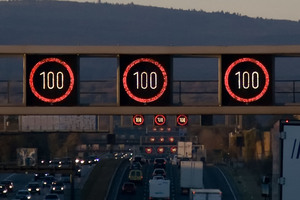
Future phases of this concept could include placing a Variable Message Board (VMB) at each Freeway entrance that could display a lower speed limit - again, only on red-air days. By lowering the speed limit, car engines would run more efficiently, producing less pollution. 55-60 mph are the most efficient speeds, and by lowering the speed limit to these levels when air pollution gets really bad could go a long way to addressing this problem. And of course people would have to follow these new speed limits, or get an automatic speeding fine in the mail.

And of course transit on red-air days would be free, because it would be (partially) subsidized by the extra speeding fines!

What do you think? Is this something people could agree to?


A portable speed trap in Cleveland (ABOVE) and Variable Message Boards with Variable Speed Limits on the German Autobahn (BELOW)
Quote:
Originally Posted by Wasatch Wasteland View Post
Thinking about all of this 'cost to ride/cost to operate" has gotten me curious.

TRAX and Frontrunner have been frequently said to cost significantly less to operate than regular bus service. However, they do cost much more to construct. In turn, buses cost almost nothing to construct/establish, yet cost more to operate.

For all you math geniuses out there (I am hopelessly lost when it comes to math), this is my question: at what point does the amount of money saved in operating costs cover the total construction costs for rail transit? That is to say, when do TRAX and Frontrunner start to "make" money?
The math would seem to be pretty straight forward. Start with the cost of transporting a certain projected number of riders by bus - we'll call it X. Then calculate the cost of transporting all those people by light rail; we'll call it Y. Then we need to calculate the total cost of design and construction and the monthly payments the transit agency would need to pay per month to pay those, and call this number Z. If X is greater than Y+Z, then it makes sense to run buses. If it is less, it makes sense to build light rail.

It does get more complicated than that, because once the bonding is all paid off, the infrastructure costs go away. I read some time ago that the original SLC-Sandy TRAX is all 'paid off,' meaning that UTA completely paid off all the construction costs for that project (meaning they no longer have to consider the cost of Z, just Y). Also, light rail attracts more riders than a regular bus does, meaning you get a much higher return on the investment than you do by simply running the current buses.

I'll have to do my homework and get back to this later...

Reply With Quote
     
     
  #6280  
Old Posted Mar 30, 2015, 2:05 AM
jtrent77 jtrent77 is offline
 
Join Date: Aug 2008
Posts: 571
Quote:
Originally Posted by Hatman View Post
It's been an interesting conversation (or debate or argument or whatever it was) about 'forcing' people to use transit and if the subsidies paid to transit riders are really worth it. For the record, I'm not in favor of 'forcing' anybody to do anything they don't want to do, but I am in favor of 'nudging' people towards a certain behavior or habit when the cause is just.

I'm thinking mainly about air pollution, which is caused mostly by cars and is undeniably bad for our city - as in, it hurts our reputation and people actually die from it occasionally. One could argue that allowing cars to dump their exhaust gasses into the atmosphere for others to deal with (Elon Musk is on record saying it is akin to letting people just dump their garbage in the streets - interesting read) is the ultimate subsidy, but because that deals with qualitiative values more than quantitative ones it is usually not included.

Obviously banning cars with odd or even-ending license plates goes way too far (and is probably illegal as I-215 pointed out), and I never really want things to come to that point anyway... so here's what I think is a fair and modest proposal:

On Red-air days, the Highway Patrol will be allowed to set up a series of speed cameras (the type that automatically send a small fine to car's owner) along I-15, simply to enforce the speed limits already in place. If drivers were to actually follow the posted speed limit and all drive at a consistent and uniform flow, there would be less traffic congestion and therefore less pollution and smog. And only on red-air days, mind you. And Transit will be free on those days.

The idea is to add just enough inconvenience to driving to 'nudge' those who are 'on the fence' to at least give transit a second look. We're not concerned with people who are determined that transit 'won't work' for them, because nothing will incentivize them to change; instead we're only concerning ourselves with the people who have considered transit in the past and would take it again if only driving were a tiny bit more annoying than it already is. Speed cameras seem like the perfect annoyance to me, because they inflict no financial penalty against those people who simply follow the rules. I have no idea what rules stand in the way of their being used on red-air days, but I'm sure I-215 would know.

Future phases of this concept could include placing a Variable Message Board (VMB) at each Freeway entrance that could display a lower speed limit - again, only on red-air days. By lowering the speed limit, car engines would run more efficiently, producing less pollution. 55-60 mph are the most efficient speeds, and by lowering the speed limit to these levels when air pollution gets really bad could go a long way to addressing this problem. And of course people would have to follow these new speed limits, or get an automatic speeding fine in the mail.

And of course transit on red-air days would be free, because it would be (partially) subsidized by the extra speeding fines!

What do you think? Is this something people could agree to?
This might not be such a bad idea. I might add that as an alternative, or in addition to, treat red air days as construction/school zones. In other words, tickets on red air days are more expensive than regular tickets.

As further encouragement, mass transit on red air days is at a reduced fare.
Reply With Quote
     
     
This discussion thread continues

Use the page links to the lower-right to go to the next page for additional posts
   
Reply

Go Back   SkyscraperPage Forum > Regional Sections > United States > Mountain West
Forum Jump


Forum Jump


All times are GMT. The time now is 2:25 PM.


Powered by vBulletin® Version 3.8.7
Copyright ©2000 - 2026, vBulletin Solutions, Inc.

