HomeDiagramsDatabaseMapsForum About
     

Go Back   SkyscraperPage Forum > Regional Sections > United States > Mountain West


Reply

 
Thread Tools Display Modes
     
     
  #6001  
Old Posted Sep 24, 2014, 7:17 AM
Hatman's Avatar
Hatman Hatman is offline
Registered User
 
Join Date: Aug 2013
Location: Salt Lake City, Utah
Posts: 1,434
I too am sad that Salt Lake Central Station does not have more presence. It would have been really cool if it had been possible to use one of the two older stations, the UP depot especially - but it is important to remember that they both had one fatal flaw: they both required passenger trains to run through the street in order to get to them. This lasted well into the Amtrak era, as seen below.


The Pioneer heads south from the UP depot down the center of 4th West (UP depot in the background):


The Pioneer after being rerouted to the Rio Grande depot would travel down 5th west:


Obviously running full-sized trains down city streets could not continue, so the Rio Grande was doomed to become 'land-locked' (without rails in foamer-speak). The UP depot, however, was considered to be reconfigured as a stub-ended station, meaning the tracks would run east-west and terminate at a plaza just behind the UP depot. This idea was no good because 1) the platforms would be extremely short, due to lack of space (so short that Amtrak could not use them) and 2) no train could 'run through' Salt Lake City. FrontRunner would pull into the station, change operating ends, and then leave going the other direction. This added time would have made FrontRunner essentially useless for trips between Murray and Woods Cross, (to name two stations as an example).
I guess another solution would have been to build an underground tunnel to give trains access to one of the stations, but as I said in just my last post: NO SUBWAYS. Tunnels are extremely expensive in general, and even more so here in the Salt Lake Valley because of the high water table.

So instead we have two downtown stations (Salt Lake Central and North Temple), and both are very good stations from a functional point of view. Aesthetically they have nothing on Denver Union Station, but in function, I would argue that we got the better deal.
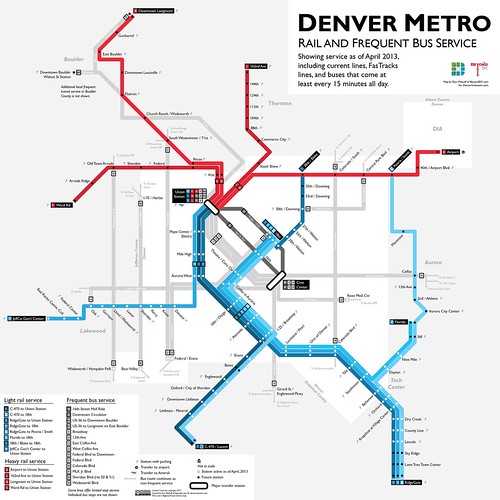
Look, Denver Union Station exists for one reason only, and that is because Denver uses two incompatible forms of rail transit for the northern and southern parts of their metro area - light rail to the south and what they call 'commuter rail' to the north (even though it functions exactly like light rail except within a freight railroad right-of-way (the difference is just who has jurisdiction, the FRA or the FTA)). So, if you're going from the north to the south by rail, you have to transfer. No exceptions. A basic rule in transit is 'don't force your riders to transfer.' but a corollary to this is 'when you have to transfer, make absolutely sure it is a good one.
Example of a bad transfer: transfer from red line to blue or green at courthouse. There's no need for that - just get the Black Line up and running!
Example of a good transfer: riding FrontRunner from Utah County to SLC to see temple square - get off at a place called Salt Lake Central Station, walk 100 feet to a waiting TRAX train, and ride four more stops and you're there.

Denver Union Station is a... well, I haven't decided what it is yet. Get off your commuter train in the Awesome looking train hall, then walk down a set of stairs to the underground bus concourse. Walk the entire length of the 700+ foot underground bus concourse, then climb back up a set of stairs to get to the light rail platform which is sort of tucked away in the back of the whole DUS complex, where your train is waiting (hopefully, I don't know how they work over there).

UTA designed their overall rail system very smart; our commuter rail intersects with our light rail at three stops. All the light rail lines converge on downtown, and all of them connect to the commuter rail at least once. Once the Black Line is added, UTA will have achieved one of the most efficient rail-layouts in the country. There is no central location through which everyone must transfer - transfers are spread out closer to where they are needed. Travelers move more freely around the valley - there is no convergence on one single point in downtown.
My point is that while we miss out on a cool transit-dedicated mega-station with awesome architecture and intimidating transit presence, we get a much better system overall. We don't need a grand central station because that particular inefficiency does not exist in our system.

This:


Verses This:

One has greater system fluidity than the other. (Hint - it's the top one!)

The current Salt Lake Central Station may one day drive a massive west-side downtown growth. Perhaps it will be like Grand Central Station in New York City, which was built far out of town in an industrial area, until the city grew up around it. I would like to see a signature head-house building go up on what is now the circular drop-off area - something unique and memorable like the Salt Lake City Library. This building would have the waiting area, ticketing and luggage for UTA and Amtrak, restrooms, and of course a lot of retail. It will happen one day - maybe when Salt Lake gets the Olympics again.
All I'm trying to say is that the Salt Lake Central Station that we got is a clean slate - we can build something as grand as we like there - it will just take time.

(A really old picture that is still awesome)

Last edited by Hatman; Sep 24, 2014 at 7:49 AM.
Reply With Quote
     
     
  #6002  
Old Posted Sep 24, 2014, 7:43 AM
Hatman's Avatar
Hatman Hatman is offline
Registered User
 
Join Date: Aug 2013
Location: Salt Lake City, Utah
Posts: 1,434
Quote:
Originally Posted by Old&New View Post
I like the idea for a streetcar circle across the street from Salt Lake Central. And the new streetcar routes cutting through the blocks to get to 200 South is pretty clever. Cool concept.
(See? I like streetcars too!) (Sometimes.)
Reply With Quote
     
     
  #6003  
Old Posted Sep 24, 2014, 10:54 AM
RC14's Avatar
RC14 RC14 is offline
Registered User
 
Join Date: May 2007
Location: Salt Lake City, Utah
Posts: 1,149
Quote:
Originally Posted by SLCdude View Post
Salt Lake City's wide two-way streets are ideal for light rail. Other US cities, like Portland do not have the luxury of dedicating two lanes entirely to light rail on the same street, or even running four-car trains through their downtowns. It makes no sense to multiply the cost to bury transit below streets?
I agree with many of the comments that have been said about the practicality of light rail in SLC. I do think light rail works better in Salt Lake than in most cities, not just because of our wide streets and large city blocks but also because of all the old rail lines that allow for dedicated right of way.
However, I would like to clarify my opinion. When I said I would like to see a Metro rail system I didn't mean it would need to be all subways or elevated trains. The system would only need to be below ground going from SLC Central to the east side and part of the West Valley line would have to be elevated but most of the system could stay at the same grade due to the dedicated right of way (I think). I don't think it would be too hard to install a metro rail system if the demand ever existed. However, as has been pointed out, the cost benefit probably will never favor that option given that we already have such an efficient light rail system. In general I just prefer the idea of metro rail to light rail due to it's ability to transport many more passengers very quickly.
Reply With Quote
     
     
  #6004  
Old Posted Sep 24, 2014, 3:23 PM
SLCdude's Avatar
SLCdude SLCdude is offline
Lurker
 
Join Date: Mar 2010
Location: Salt Lake City
Posts: 836
Great post, Hatman!
Reply With Quote
     
     
  #6005  
Old Posted Sep 24, 2014, 7:25 PM
Scottk's Avatar
Scottk Scottk is offline
Denver
 
Join Date: Oct 2008
Posts: 598
Quote:
Originally Posted by Hatman View Post

Denver Union Station is a... well, I haven't decided what it is yet. Get off your commuter train in the Awesome looking train hall, then walk down a set of stairs to the underground bus concourse. Walk the entire length of the 700+ foot underground bus concourse, then climb back up a set of stairs to get to the light rail platform which is sort of tucked away in the back of the whole DUS complex, where your train is waiting (hopefully, I don't know how they work over there).
Great thought provoking post, Hatman. The lack of a true through connection at Union Station is something us Denver forumers constantly lament.

I would like to point out a couple of things, however.

The Denver transit system, as it is currently designed, is really not meant to handle a significant number of transfers. Fastracks is first and foremost, a way to get large numbers of suburbanites into, and out of central downtown Denver. There will be very few transfers from light rail to commuter rail because Union Station will be the final destination for almost everyone. And, by the way, the east line will definitely be true commuter rail.

Very few people are going to be using the escalators through the bus station to connect to lightrail. Anyone making that connection will most likely just walk above ground unless the weather is 🞵🞵🞵🞵🞵🞵. The 700 foot walk in between commuter rail and light rail may seem inconvenient, but it is very convenient for bus passengers making transfers, since the bus station is centrally located between lightrail and commuter rail. And, the bus system is most likely to have people transferring to lightrail / commuter rail.

now, if Denver ever gets around to building actual streetcars.... well, that might be a whole different story.

Also, don't get me wrong. SLCs transit system is something Denver should be envious of, but you guys also had it easier than us.
Reply With Quote
     
     
  #6006  
Old Posted Sep 24, 2014, 10:29 PM
Hatman's Avatar
Hatman Hatman is offline
Registered User
 
Join Date: Aug 2013
Location: Salt Lake City, Utah
Posts: 1,434
I guess I did use a worst-case example for a transfer at Denver Union Station. And that's a good point that the extremely central location of Union Station negates the need for a lot of transfers (both of SLC's commuter rail stations require a transfer to get to 'downtown').
I hope I didn't convey the idea that DUS is a bad thing or is poorly designed. I haven't had the privilege of visiting since the renovation, so I'm just going off what I have read from the Denver threads. Also, no matter what I think of it now, it would be unfair to judge it just yet because none of the commuter lines meant to serve it are open yet.
But it is still only the best solution for a larger problem of system incompatibility (light rail verses commuter rail) and I am glad that Salt Lake City was able to minimize and mostly eliminate this problem.
Reply With Quote
     
     
  #6007  
Old Posted Sep 25, 2014, 12:28 AM
jubguy3's Avatar
jubguy3 jubguy3 is offline
Registered User
 
Join Date: May 2014
Location: SL,UT
Posts: 984
Your point of SLC and NT both requiring a transfer to get in to downtown makes me think that UTA needs to make a route in addition to the 500 STATE CAPITOL that doesnt serve the capitol and runs branded incredibly frequently. I've also outlined the 2C, a bus running from the 200 S state hub and to SLC like a shortened version of the 2 that runs very frequently with branded buses and shuttles people to and fro.
Reply With Quote
     
     
  #6008  
Old Posted Sep 25, 2014, 2:10 AM
CountyLemonade's Avatar
CountyLemonade CountyLemonade is offline
Registered User
 
Join Date: Jul 2011
Location: Salt Lake City
Posts: 394
Quote:
Originally Posted by Hatman View Post
both of SLC's commuter rail stations require a transfer to get to 'downtown'
I wouldn't say so with North Temple. It's still not ideal, but you're within walking distance of the arena and Temple Square.

How I wish the Union Pacific Depot were our central station instead of today's Central Station. What a travesty. Having a stub station would not necessarily have ruined the possibility of a Provo–Ogden via Salt Lake line. The train could have easily arrived at the Union Pacific station and then simply switched directions to continue past Salt Lake. Easy. The Europeans do this all the time.
Reply With Quote
     
     
  #6009  
Old Posted Sep 25, 2014, 3:51 AM
jubguy3's Avatar
jubguy3 jubguy3 is offline
Registered User
 
Join Date: May 2014
Location: SL,UT
Posts: 984
An issue that will be present even with Salt Lake Central and North Temple (with 300 north and 200 south) is that UTA has planned to allow all other stations to be expanded to support 10 Bombardier cars and any locomotive. They won't be able to do this to either Salt Lake Central or North Temple without expensive roadway geometry modifications and doing some weird stuff to the far south part of the NTFR S platform.

This would leave the only option to be submerging it. This would allow the 10 car platform to go in to use (3 or 4 city blocks long - current platforms are only 900 feet downtown) but would mean North Temple or Salt Lake Central would go in to disuse as the platforms would be connected and also there is an issue in that no one is going to walk 4 blocks to the bus terminal. This leaves me saying that UTA shouldn't have considered the expansion of frontrunner platforms without making some changes to Salt Lake Central and North Temple. DUS bus concourse is a fairly short distance to walk in comparison to 10 car bombardier trains. The only place however that these are in use is Go Transit in toronto. I dont know how the platforms are configured there but they certainly dont have two stations so close together. UTA also is most likely not going to make these changes to FR platforms without increasing headways which first needs to be done with double tracking and electrolocomotives which is kinda far out.

I wish UTA had submerged the passenger rail corridor and brought it underground to Union Station, and then had rail terminate there or continue along somewhat. But these changes cant come without completely reconfiguring an 80 million dollar viaduct, a 20 million dollar CRT station, submerging rail under old structures, reconfiguring TRAX including the DT streetcar and U-SLC TRAX, etc. We are stuck with the mess UTA has created so the best option for UTA is to just make two nice commuter rail stations downtown. We will never be able to use Union Station without redoing gateway's road structure and investing 1 billion dollars in a tunnel.
Reply With Quote
     
     
  #6010  
Old Posted Sep 25, 2014, 5:49 AM
Scottk's Avatar
Scottk Scottk is offline
Denver
 
Join Date: Oct 2008
Posts: 598
Quote:
Originally Posted by Hatman View Post
I guess I did use a worst-case example for a transfer at Denver Union Station. And that's a good point that the extremely central location of Union Station negates the need for a lot of transfers (both of SLC's commuter rail stations require a transfer to get to 'downtown').
I hope I didn't convey the idea that DUS is a bad thing or is poorly designed. I haven't had the privilege of visiting since the renovation, so I'm just going off what I have read from the Denver threads. Also, no matter what I think of it now, it would be unfair to judge it just yet because none of the commuter lines meant to serve it are open yet.
But it is still only the best solution for a larger problem of system incompatibility (light rail verses commuter rail) and I am glad that Salt Lake City was able to minimize and mostly eliminate this problem.
Ha! you certainly did not convey the idea that US is a bad thing! In fact, In I think you touched upon a sore subject for many Denver forumers - the lack of a through connection.

I just wanted to point out that the situation at Union Station isn't quite as bad as some denverites might have you believe.

And sorry SLC for hi-jacking the transit thread!
Reply With Quote
     
     
  #6011  
Old Posted Sep 25, 2014, 7:00 PM
Hatman's Avatar
Hatman Hatman is offline
Registered User
 
Join Date: Aug 2013
Location: Salt Lake City, Utah
Posts: 1,434
^^^ Feel free to drop by anytime. The more the merrier, I say.
Reply With Quote
     
     
  #6012  
Old Posted Sep 25, 2014, 7:04 PM
Hatman's Avatar
Hatman Hatman is offline
Registered User
 
Join Date: Aug 2013
Location: Salt Lake City, Utah
Posts: 1,434
Quote:
Originally Posted by jubguy3 View Post
An issue that will be present even with Salt Lake Central and North Temple (with 300 north and 200 south) is that UTA has planned to allow all other stations to be expanded to support 10 Bombardier cars and any locomotive. They won't be able to do this to either Salt Lake Central or North Temple without expensive roadway geometry modifications and doing some weird stuff to the far south part of the NTFR S platform.....
Okay, calm down Jub-man. Salt Lake Central will not need any realignment. It is already built out to its full length of 10 cars + loco. The only thing they will need to do if they choose to buy more bombardier cars is extend the 'high block' portion of the platform. That is the section that is 25" above the rail, rather than the more typical 8" that the rest of the platform is at. Salt Lake Central, Farmington, Layton, and Ogden are all built out to full length already.
Reply With Quote
     
     
  #6013  
Old Posted Sep 25, 2014, 7:30 PM
Hatman's Avatar
Hatman Hatman is offline
Registered User
 
Join Date: Aug 2013
Location: Salt Lake City, Utah
Posts: 1,434
Quote:
Originally Posted by CountyLemonade View Post
I wouldn't say so with North Temple. It's still not ideal, but you're within walking distance of the arena and Temple Square.

How I wish the Union Pacific Depot were our central station instead of today's Central Station. What a travesty. Having a stub station would not necessarily have ruined the possibility of a Provo–Ogden via Salt Lake line. The train could have easily arrived at the Union Pacific station and then simply switched directions to continue past Salt Lake. Easy. The Europeans do this all the time.
They could have done that too. Or they could have run north and south as two separate sections. Logistically that would have been much simpler for them, running two independent rail lines with a transfer in between - if one of the 4 trains in the north section is late, it does not affect the 5 trains in the south section. Operationally it is much more reliable and even cheaper to run two separate sections, rather than one long line.
Or they could have run through like you are suggesting. I'm just saying they would have plenty of excuses not to.
There's also the matter of the amount of time required to change directions. Granted, FrontRunner already stops at SLC for 5 minutes, but theoretically once the line is double-tracked and there are no specific meet-points, it will not have to wait there any longer than necessary. With a stub-end station, there will always be a turn-around time of at least that long.

I'm still torn on this whole UP depot idea. I would love to see it used as a train station like it was meant to, but I also like the operational simplicity of our current run-through system. I like that our current Salt Lake Central could draw downtown development farther west to fill in all the space between state-street and I-15, but I don't like how cheap it looks/feels right now - especially compared to the UP depot.
But it's all hypothetical. What's been done has been done. We'll have to make the best use out of what we have.
But still..
Reply With Quote
     
     
  #6014  
Old Posted Sep 26, 2014, 10:03 PM
Makid Makid is offline
Registered User
 
Join Date: Jun 2006
Posts: 2,108
2014 Second Quarter Ridership Report:

http://www.apta.com/resources/statistics/Documents/Ridership/2014-q2-ridership-APTA.pdf

Q1 2014:

Frontrunner - 15.2K up 18.29% over Q1 2013 at 13.0K
Trax - 65.8K up 11.71% over Q1 2013 at 59.7K
Bus - 71.4K down -7.05% over Q1 2013 at 76.8K

Q2 2014:

Frontrunner - 15.0K up 18.64% over Q2 2013 at 12.7K
Trax - 61.8K up 6.79% over Q2 2013 at 57.6K
Bus - 64.1K down -4.44% over Q2 2013 at 66.6K

Total for all transit options - 149.6K up 2.46% over Q2 2013 at 145.6K

Current Year to date change vs. 2013

Frontrunner: 2,103.9K riders equating a 18.47% gain over 2013
Trax: 9,549.2K riders equating to a 9.23% gain over 2013
Bus: 9,309.0K riders equating a -5.81% loss compared to 2013
All Transit: 22,081.1K riders equaling an increase of 2.73% gain

Even with the further drop in bus ridership, Rail ridership is up in a greater percentage and total than the loss of bus riders. I would expect bus ridership to slow it's loss and begin to gain some ground through the rest of the year, in part with the variable fare being tested in Provo.

There are some errors on the report, such as Denver LRT at 58.1K daily riders with 6,464.4K riders in Q2. The same with St. Louis LRT at 69.8K daily with 4,581.4K riders in Q2. Trax had 4,704.4K riders in Q2 (ahead of St. Louis and behind Denver).

Last edited by Makid; Sep 26, 2014 at 10:16 PM.
Reply With Quote
     
     
  #6015  
Old Posted Sep 27, 2014, 2:58 AM
Hatman's Avatar
Hatman Hatman is offline
Registered User
 
Join Date: Aug 2013
Location: Salt Lake City, Utah
Posts: 1,434
Always good to see new numbers, especially when they are going up (mostly).
"Data data data! I cannot make bricks without clay!"
Reply With Quote
     
     
  #6016  
Old Posted Sep 30, 2014, 7:29 AM
Hatman's Avatar
Hatman Hatman is offline
Registered User
 
Join Date: Aug 2013
Location: Salt Lake City, Utah
Posts: 1,434
Hive Pass ‘pilot’ mass-transit program ends
http://www.sltrib.com/sltrib/politics/58469152-90/benson-hive-lake-pass.html.csp
Quote:
Would-be mass-transit riders who want to take advantage of Salt Lake City’s Hive Pass that offers UTA train and bus service for $360 a year — instead of the normal $1,005 — have until 5 p.m. Tuesday to sign up.

Otherwise, say goodbye for now to Hive, a joint city/UTA program launched March 1 to much fanfare aimed at getting more Salt Lake City residents out of their polluting automobiles.

Although officials said they were hopeful they could sell 6,000 of the passes, only about 3,000 were purchased.

A statement from the office of Mayor Ralph Becker on Monday afternoon called Hive a "pilot" program that would now move into an "analysis" phase. UTA officials said Monday that the Hive program was for six-months of sales only. The passes already purchased will continue to be honored.

"The Hive Pass pilot program, an innovative and experimental transit pass idea — the first of its kind in the country — will conclude the initial phase of study and sales Sept. 30 and move into an analysis and evaluation period," the mayor’s statement said.

Whether that will lead to other discount programs down the road remains unclear.

Salt Lake City Council Chairman Charlie Luke said Monday that he was "quite disappointed" that Hive Pass sales were being terminated.

In order to succeed, mass transit must be accessible and affordable, Luke said. The Hive Pass addressed one of those issues.

"Now we’re back to square one," he said.

Luke said UTA bemoaned the fact that Hive sales were robbing the agency of revenue from riders who previously paid more for transit. Salt Lake City offered to make up the deficit.

"We expressed our intent to do that," he said. "But UTA still said, ‘No.’ That’s concerning."

Jerry Benson, UTA chief operating officer, said UTA is merely doing what it originally agreed to do.

"We set this up to sell passes for six months, and then to take four to six months to analyze the program," he said. "I would remind people that’s what we agreed to do up front. The fact that people are clamoring to continue, that’s a good thing."

Benson said UTA has lost money on the program. That’s because the Hive pass was most popular with people who had been buying more expensive monthly passes or who were regular cash-fare riders, while the program was much slower to attract new riders.

"The mayor requested that the program be extended. UTA General Manager Michael Allegra agreed to extend it one month," Benson said. "There was talk about extending it further on some arrangement where the city would cover UTA’s losses, but the parties were never able to come to terms on what that number was."

Most of the Hive Passes were sold in City Council District 4 where there are more bus and light-rail routes available to residents.

Councilwoman Erin Mendenhall, who also is the policy director for Breathe Utah, a non-profit air-quality advocacy group, said that it is unfortunate that more Salt Lake City residents didn’t take advantage of the Hive Pass.

"As a community, we talk about more affordable mass transit," she said. "But that is only half the pie. The whole pie is we need a convenient system."

According to the statement from Becker’s office: "The Hive Pass program also sought to provide better transit access to lower-income residents by making a monthly payment plan available and by initiating a voucher program to invite broader participation from a variety of organizations who could donate the passes to the needy."

The statement noted survey results that show over 90 percent of Hive Pass users were satisfied with their purchase. (A complete copy of the survey results can be found at www.ridewithhive.com/survey.pdf).

Benson said UTA also found that people who bought the Hive pass rode transit more than they did previously. "So that’s a positive," he said.

Salt Lake City and UTA will work together to process all of the information collected during the pilot and make recommendations about how to apply what’s been learned from the experiment.

While regular Hive Passes will not be available during this evaluation, the voucher program will continue.

Benson said he hopes UTA and the city can find ways to continue to offer discounts. "It might be very different" than the current Hive pass, he said. "It might be something similar," he added, depending on what the analysis shows.

Benson said UTA is not disappointed at selling 3,000 Hive passes, instead of the hoped-for 6,000.

"I think 3,000 is a good number. That’s a lot of passes, and I can say we’ve had an impact with this pilot" toward increasing ridership, he said.
Let's hope the data shows a demand for a broader application of the Hive Pass. This honestly is one of the biggest steps UTA could make to grow their presence and double their ridership. A low-cost all-inclusive transit pass, that is paid for with utility bill payments? It was/could be a serious game-changer.

I have my doubts, though. half the number of people actually bought one, and most of the people who did were probably already buying the more expensive passes - meaning there was certainly not 3000 more regular riders than before the pass.

The whole idea continues to intrigue me. Why do we pay for transit with individual fares when we already pay for most of its costs via taxes (the farebox recovery at UTA does not even pay for UTA's whole payroll, let alone the operating costs!). And why is it SALES TAXES that pay for transit instead of something far more applicable, like a combination of fares and vehicle registration fees? And why is transit funding here in Utah kept completely separate from department of transportation funding? I think it's time to research/rethink a lot of these questions and answers.
Reply With Quote
     
     
  #6017  
Old Posted Oct 7, 2014, 1:02 AM
jubguy3's Avatar
jubguy3 jubguy3 is offline
Registered User
 
Join Date: May 2014
Location: SL,UT
Posts: 984
After putting the mountain accord rail plans to scale, I can be certain that the closest we are going to get to mountain rail is maybe up foothill and I-215. If they built a rail loop through LCWC and PC, they would have to do some very, very intensive earthworks through LCWC and the line would be like 80 miles long. It would most likely be in a separated guideway so the consist can get up the mountain in a timely manner, and a very straight track which means tunnels and bridges - it couldn't be otherwise for safety issues. This would then there is the issue of crossing the I-215/I-80 interchange and the foothill project alone would be like 500 million. I would expect the project to come close to the Boston big dig.
Reply With Quote
     
     
  #6018  
Old Posted Oct 7, 2014, 6:47 PM
Merewether's Avatar
Merewether Merewether is offline
Registered User
 
Join Date: Apr 2011
Location: 8410*
Posts: 201
Transit and pedestrian access to jobs maps

Access America, a report from the Univrsity of Minnesota, has a block level analysis of jobs accessible within a 30 minute walk or transit ride for 46 largest U.S. cities. Salt Lake (they seem to be using SL and Davis Co) is 17th, higher than almost all urban areas of its general size.
http://access.umn.edu/
Reply With Quote
     
     
  #6019  
Old Posted Oct 12, 2014, 5:48 AM
Hatman's Avatar
Hatman Hatman is offline
Registered User
 
Join Date: Aug 2013
Location: Salt Lake City, Utah
Posts: 1,434
^^^
Very cool study and great to see Salt Lake within the top 20. 17th in the nation is by no means bad. There are some obvious improvements that could be made to raise us higher in the rankings, though, and I hope that if this study is done again in a few years that we rank even higher.

Quote:
Originally Posted by Ironweed View Post
What is a tragic comedy is that Utah was once full of existing rail-routes that are now being evaluated to be re-railed. The infrastructure was destroyed by myopic dissidents who believed that the automobile would triumph above all, indefinitely. Could have saved a bundle of money by keeping the routes in tact. Live and learn I suppose.
Agreed. UTA has done very well rebuilding the rail system that once existed, and because it was ripped out and then put back I think we get a better deal in the end, with everything upgraded to a more modern standard of efficiency. One route that will be lost forever, though, is the old Bamburger route between SLC and Ogden. A route equivalent to the south end between North Temple and Woods Cross FrontRunner station is being studied for a BRT line with an eventual upgrade LRT in the distant future - but the entirety of the original right-of-way was lost. Imagine if it hadn't. Imagine TRAX running on a grade-separated corridor between SLC and Ogden like the SLC-Draper Line (to be extended to Orem in the future). That would change things sigificantly, wouldn't it?
Link to UtahRails Google map of the old Right-of-Way:
https://www.google.com/maps/ms?ie=UTF8&m...00477cbebec53d7cba4e&t=m&z=10&dg=feature
Reply With Quote
     
     
  #6020  
Old Posted Oct 13, 2014, 6:54 AM
Reachforthesky Reachforthesky is offline
Registered User
 
Join Date: Feb 2009
Posts: 207
http://www.sltrib.com/sltrib/news/58505758-78/lookback-history-photo-series.html.csp


Look at how much rail was once downtown. Its unbelievable!
Reply With Quote
     
     
This discussion thread continues

Use the page links to the lower-right to go to the next page for additional posts
 
 
Reply

Go Back   SkyscraperPage Forum > Regional Sections > United States > Mountain West
Forum Jump


Forum Jump


All times are GMT. The time now is 6:11 AM.


Powered by vBulletin® Version 3.8.7
Copyright ©2000 - 2026, vBulletin Solutions, Inc.


