Quote:
Originally Posted by Cirrus

Should we stop maintaining the sidewalks in Capitol Hill because commuters from Highlands Ranch don't use them? Can you imagine how little walking anyone would do if we ripped out most of the sidewalks in the city (we could add another lane!)
|
Come now, no red herrings. The difference is simple - those commuters from Highlands Ranch still use our downtown streets, every single day. If you want to look at Central Denver in a bubble, and revamp infrastructure and enact policies to force a 40/30/30 mode split within that bubble, what's left will be sorely inadequate for the real modal split traversing Denver's streets every day.
Denver is still jobs-heavy. Now, if we want to pursue a jobs-housing balance, banish more employment to the burbs, so that we can emphasize urban quality of life and lifestyles we want within the bubble, we can have that discussion. But it does not suffice to embrace the benefits of bringing suburban commuters into the center city while ignoring the costs. The only modal split that matters is what actually exists on our streets, day in and day out.
I think the city's current bicycle plan strike a decent balance here. Many of our more extreme bicycle advocates disagree. They want lanes stripped (not striped, haha) out to force higher bicycle use, as well as to force congestion and "teach those drivers a lesson." That, I disagree with.
Quote:
Originally Posted by dmintz
Compared to boston or the west village in NYC? We have plenty of capacity to spare.
...
If NYC can take lanes from first and second avenues through midtown we can take a lane on 15th st.
|
Not true. For one very simple reason. Take a lane off of 5th Avenue, you have 5 lanes of unidirectional capacity remaining. Take a lane off of 15th Street, you have one lane remaining. One lane is unacceptable on any street but a local street - collectors, arterials, it will not and should not ever happen, not for bicycles, at least. A rail circulator or other dedicated transit ROW, well, that we could discuss.
That is purely the engineering too, and ignores the fact that there are also thousands upon thousands of people who can and will benefit from a 2nd Avenue bikeway. In Denver, that would be measured in hundreds. The cost-benefit calculus isn't remotely the same.
Quote:
Originally Posted by dmintz
Bikers are shunted to side streets and have no safe way to cross speer and I25.
|
Quote:
Originally Posted by Cirrus
One nice thing about bikes as opposed to transit is that you can put your bikeway a block off the major street and it doesn't hurt very much. Cyclists can go that extra block more easily than pedestrians.
|
I agree with Cirrus on this one. I like the 16th Avenue bikeway - I think that is an excellent approach that we could replicate in other places. That's bicycling as transportation. However, if you want to argue for bicycle equity - as if it was some grand civil rights issue - and you take that to mean that a 16th Avenue bikeway isn't good enough; bicycles should get a lane on Colfax because that's what's fair - I simply disagree.
Crossing I-25 and the CPV is tough. There are not always going to be easy answers for moving folks to certain parts of the city. Highland is especially tough, for bicycles, for transit, even for cars. But the answer is not to attack drivers and demand a road lane, which we already have too few of accessing that area, especially post-Fastracks post-DUS buildout. Demanding bicycle lanes on 15th is overly simplistic and lazy. We need to find a tough answer to a tough problem. Most of my how-to-access-Highland brain time has been spent thinking about streetcar access, but the bicycle question presents the same issues.
When I contemplate how RTD would go about coarsely demanding dedicated transit lanes (which they should, perhaps), and then I think about the debate that would ensue... and then I see bicyclists doing that very thing on "cyclists' rights" grounds, and demonizing anybody who would dare to contradict their enlightened ways, it strikes me as immature; college- political activism. Or perhaps just indicative of how American politics works (or doesn't work) these days, who knows. But just as I do not believe the majority of Americans ultimately falls on the side of uncompromising Tea Party extremists, I do not believe the majority of Americans ultimately falls on the side of uncompromising bicycle extremists. I'm an optimist like that.
Quote:
Originally Posted by Cirrus
Ultimately we should be thinking of bike lanes the same way we think of sidewalks. They should be part of the typical street cross section, for local use.
|
And here's the crux of the argument. I still view bicycling as an inferior mode, a bit of an outside-the-mainstream niche, with insurmountable limitations, and I do not believe it justifies the extra 10 feet in a "typical" street cross section. In greenfield areas, sure. On select streets to establish a base network across the city, absolutely. But the costs outweigh the benefits, in my opinion, to try and retrofit established areas wholesale to accommodate bicycles as a "typical" element of every street. That strikes me as extreme. I would prefer a narrower street section, with slower traffic, and bicycles in mixed traffic. Widening street sections to accommodate bicycles is, I think, counterproductive in most areas. Bicycles do not belong on arterials - simply put, they create too much harm to the 'many' the justify the benefit to the 'few'.
If we are going to frame this as a fairness argument - an abstract need for 'respect' - and if a growing network of bikeways on local (thru-)streets is not good enough, then we will have to agree to disagree. If we can expand in areas where bikes can be accommodated the best, with the least inconvenience to transit and autos - well, that's where we can start.
For crying out loud, I would think bicyclists would
prefer not to mix with arterial traffic anyways. I can not countenance placing a cyclist/forumer's hurt-feelings and perceived lack of respect above a balanced mobility solution (and by balanced, I mean a weighted balance - we can slowly adapt the system and shift our modal split without full-scale revolution against the majority of Denverites who are apparently making the 'wrong' decision in how they choose to get from Point A to Point B.)





 Prev
Prev


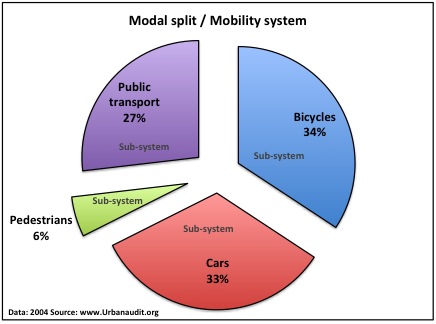
 We will never get to those modal splits (I typically focus on the transit, but the same applies for bicycling too) because of our land use patterns. If anything, that's even more of a detriment to bicycling than transit because of the sheer distances involved.


 Linear Mode
