HomeDiagramsDatabaseMapsForum About
     

Go Back   SkyscraperPage Forum > Regional Sections > Canada


Reply

 
Thread Tools Display Modes
     
     
  #41  
Old Posted Jul 1, 2011, 2:59 PM
SpongeG's Avatar
SpongeG SpongeG is offline
Registered User
 
Join Date: Jun 2006
Location: Coquitlam
Posts: 40,132
Quote:
Originally Posted by logan5 View Post
I've seen hawks here in Van, as well as eagles. I saw an eagle just recently flying over the Cambie street bridge with a seagull in its talons with a bunch of crows flying after it.
I was at canada place a few weeks ago when the cruise ship was in and there was two bald eagles flying around the area - the american's on the cruise ship balconies were enthralled at the sight of the bald eagles snapping away pictures and videos of them

it was like meh i see that all the time to them though i guess it was exciting
Reply With Quote
     
     
  #42  
Old Posted Jul 1, 2011, 6:21 PM
vid's Avatar
vid vid is offline
I am a typical
 
Join Date: Apr 2004
Location: Thunder Bay
Posts: 39,065
Thunder Bay has all sorts of birds of prey. I see eagles rather frequently, and on several occasions have gotten a chance to watch a peregrine falcon eat a smaller bird on a telephone pole beside my apartment. There was an eagle nest on top of a building in the north end, not sure if it is still there though, the building was renovated a couple years ago. The area south of the city is peregrine falcon habitat, so naturally we're building wind turbines there.

Our courthouse construction site has a machine that makes eagle sounds to scare away other birds, and its driving the seagulls downtown nuts. They keep dive bombing people. Probably pisses off the eagles too, I guess, but they usually don't get close to downtown, just circle high above it.
Reply With Quote
     
     
  #43  
Old Posted Jul 1, 2011, 6:40 PM
CanadianCentaur's Avatar
CanadianCentaur CanadianCentaur is offline
Briareos Hecatonchires
 
Join Date: Aug 2002
Location: The Big E
Posts: 3,805
There's a big reason Northern Ontario and Quebec aren't as heavily populated as the Prairies, although they share the same latitude - the Canadian Shield.

It's too rocky for the most part for widespread agriculture, which was one of the biggest drivers of Canadian settlement during the 19th and early 20th Centuries. Glaciation over the last 2.7 million years (This is when Ice Age glaciation began in Greenland, Canada and Northern Europe) has stripped much of Ontario and Quebec of thick topsoil and bedrock to the point where you now have rocky land made up of some of the oldest rocks on the planet.

The areas within the Canadian Shield does have one big thing going for it - mining. After all, the Canadian Shield is rich in metal ores.
Reply With Quote
     
     
  #44  
Old Posted Jul 2, 2011, 12:36 AM
Bassic Lab Bassic Lab is offline
Registered User
 
Join Date: Oct 2005
Location: Calgary
Posts: 1,934
Quote:
Originally Posted by CanadianCentaur View Post
There's a big reason Northern Ontario and Quebec aren't as heavily populated as the Prairies, although they share the same latitude - the Canadian Shield.

It's too rocky for the most part for widespread agriculture, which was one of the biggest drivers of Canadian settlement during the 19th and early 20th Centuries. Glaciation over the last 2.7 million years (This is when Ice Age glaciation began in Greenland, Canada and Northern Europe) has stripped much of Ontario and Quebec of thick topsoil and bedrock to the point where you now have rocky land made up of some of the oldest rocks on the planet.

The areas within the Canadian Shield does have one big thing going for it - mining. After all, the Canadian Shield is rich in metal ores.
There is a clay belt in Northern Ontario with decent soil. They tried to homestead it with returning veterans after the First World War but, at the time, the growing season was pretty short and people gave up. It could probably support agriculture now but finding anyone who would want to could be quite a challenge.
Reply With Quote
     
     
  #45  
Old Posted Jul 2, 2011, 1:06 AM
canadaonstrike canadaonstrike is offline
BANNED
 
Join Date: Jun 2011
Location: Livonia MI
Posts: 31
Simple answer: you can't fix Canada's population void. All the arable land was settled upon long ago. If there had been more arable land available in other areas, and not under harsh conditions, you would see a significant population there. These "void" you see on the map are areas deemed too inhospitable to live, therefore were never settled on back in the day.

Also, isn't this supposed to be an pro-urbanism/densification forum? You shouldn't want to "fix" Canada's population void, you should want to preserve it. Anyways, Canada is going balls out on the densification of their cities so I don't see any areas drastically expanding in the future.
Reply With Quote
     
     
  #46  
Old Posted Jul 2, 2011, 2:43 AM
b31den b31den is offline
Registered User
 
Join Date: May 2008
Location: Calgary
Posts: 167
Quote:
Originally Posted by canadaonstrike View Post
Simple answer: you can't fix Canada's population void. All the arable land was settled upon long ago. If there had been more arable land available in other areas, and not under harsh conditions, you would see a significant population there. These "void" you see on the map are areas deemed too inhospitable to live, therefore were never settled on back in the day.
Last time I drove up to the NWT from Alberta there was forest clearing going on to make land for agriculture north of the peace country.
Reply With Quote
     
     
  #47  
Old Posted Jul 2, 2011, 3:42 AM
Xelebes's Avatar
Xelebes Xelebes is offline
Sawmill Billowtoker
 
Join Date: Nov 2006
Location: Rockin' in Edmonton
Posts: 14,028
Quote:
Originally Posted by Bassic Lab View Post
There is a clay belt in Northern Ontario with decent soil. They tried to homestead it with returning veterans after the First World War but, at the time, the growing season was pretty short and people gave up. It could probably support agriculture now but finding anyone who would want to could be quite a challenge.
Might be good land for swamp berry patches (Ericaceae & Ribes.)
Reply With Quote
     
     
  #48  
Old Posted Jul 2, 2011, 4:08 AM
canadaonstrike canadaonstrike is offline
BANNED
 
Join Date: Jun 2011
Location: Livonia MI
Posts: 31
I've always been fascinated by the Canadian Shield rock formation. Ontario is so huge but a lot of it is covered by the shield. How much of Ontario's portion of the Canadian Shield has been developed for homes? How hard is it to do?
Reply With Quote
     
     
  #49  
Old Posted Jul 2, 2011, 4:22 AM
le calmar's Avatar
le calmar le calmar is offline
Registered User
 
Join Date: Dec 2006
Location: Ottawa
Posts: 5,240
Quote:
Originally Posted by rbt View Post
When I was in Montreal in May I noticed a pair there too though I was unable to figure out where they were nesting.
On the roofs of the tallest buildings... Some of them are nesting on the hills on the South shore but I'm not sure they're the same ones we see in the downtown.

Quote:
Is this common in Canadian cities or just the larger two? Also, I don't remember seeing them more than a few years ago. Is it a new phenomenon?
The first time I heard about them in MTL was at least 15 years ago... So I'm not sure that would be a new phenomenon.
Reply With Quote
     
     
  #50  
Old Posted Jul 2, 2011, 7:18 AM
habfanman habfanman is offline
Closed account
 
Join Date: Jul 2008
Posts: 1,122
Quote:
Originally Posted by SpongeG View Post
i skimmed - someone mentioned having immigrants having to move to underpopulated places first - doesn't australia do this? my moms cousin was immigrating to australia and they had to move to tasmania as part of their immigration and they ended up loving it there and staying

but maybe canada should try that? have immigrants invest or move to say regina or thunderbay for x amount of years
The Aussies have a system called State Specific Regional Migration. You can have you're visa process expedited by emigrating to a region in dire need of your services for a period of 3 years. The hope is that you'll establish yourself in that region and decide to stay. It's a relatively new policy so I don't know what the retention rates are but if you've ever been to Taz, you'll know why your mom's cousin decided to stay.
Reply With Quote
     
     
  #51  
Old Posted Jul 2, 2011, 9:07 AM
new age new age is offline
Registered User
 
Join Date: Feb 2011
Posts: 76
Most people in Canada are not employed in Agriculture, and bulding in areas that aren't arable can save farm land.

There are people living in these under developed areas in small towns if you decentralised growth away from the big three you could still see densification of cities; just smaller ones.

The only thing good to come out of Las Vegas is the proof you can make a city in some of the worst places on earth.
Reply With Quote
     
     
  #52  
Old Posted Jul 2, 2011, 12:40 PM
reidjr reidjr is offline
Registered User
 
Join Date: Dec 2009
Posts: 1,237
Quote:
Originally Posted by Coldrsx View Post
I would extend this topic to how do we address severe upcoming labour shortages (Especially in Alberta) and deal with too low of a birth rate.

Give me an

I
M
M
I
G
R
A
T
I
O
N
Part of the issue with your logic is there are many canadians with out work you open the flood gates which some want your going to crete a very big issue sure alot of new canadians would work but some would not and you could be taking jobs from hertiage canadians.Beeing in ontario my biggest fear with opening the flood gates is our all ready over loaded hospitals etc will be far more worse which we can't afford.Now with thats aid i am not aginst smart immergration meaning max a million new canadians a year.
Reply With Quote
     
     
  #53  
Old Posted Jul 2, 2011, 1:10 PM
jmt18325's Avatar
jmt18325 jmt18325 is offline
Heart of the Continent
 
Join Date: Apr 2009
Location: Winnipeg
Posts: 7,286
Quote:
Originally Posted by habfanman View Post
The Aussies have a system called State Specific Regional Migration.
Canadian provinces can choose to do that. Quebec runs their own immigration, and mine has a provincial nominee system.
Reply With Quote
     
     
  #54  
Old Posted Jul 2, 2011, 2:04 PM
drew's Avatar
drew drew is online now
the first stamp is free
 
Join Date: Feb 2004
Location: Hippyville, Winnipeg
Posts: 8,932
Quote:
Originally Posted by Doady View Post
I think Canada needs to look at the US, which ditched the monarchy 300 years ago, and now they are 10 times more populous and powerful than us. So obviously ditching the monarchy is the solution to Canada's "population void."
Take a minute to research the difference in percentage of arable land between Canada and the US.

It's something like 4% to 25%. Not quite 10 times, but that is the main reason Canada and the US have far different populations.

We can't fix this fact, and as a result we will never be as populous as the US.
Reply With Quote
     
     
  #55  
Old Posted Jul 2, 2011, 4:17 PM
vid's Avatar
vid vid is offline
I am a typical
 
Join Date: Apr 2004
Location: Thunder Bay
Posts: 39,065
Quote:
Originally Posted by b31den View Post
Last time I drove up to the NWT from Alberta there was forest clearing going on to make land for agriculture north of the peace country.
Farming in those regions is only possible now because of newly developed species of crops, and the growing season is still short. The land isn't anywhere near as productive as the land in southern Ontario or the prairies, and because the topsoil is so thin here, those farms probably won't do very well after a few years. A lot of Danes moved to a small village called Pass Lake, east of Thunder Bay, in the 1930s, and tried farming on land that is similar to what you'd see in Northern Alberta, but it wasn't very successful. They grow corn there that only gets about 4 feet tall. I like to call it "midget corn".

Berries are successfully grown here (Thunder Bay has a lot of blueberry and strawberry crops) and many people in the area are experimenting with grapes. If the climate keeps warming the way it has been over the past 20 years, we'll be able to produce decent wine by about 2030. Root vegetables like carrots and potatoes also thrive here. The potatoes they sell at Superstore here are grown within the city limits. We can also support livestock, beef is big business in the Rainy River region and Thunder Bay has a lot of dairy farms, including Ontario's only producer of Gouda cheese. I am pretty sure that our Beatrice milk is produced locally. We also produce all of our own eggs. Eggs, potatoes and milk are probably the three things we don't have to worry about importing. Most of our grains are used for cattle feed, the quality isn't high enough for human consumption. (It can be eaten by people but food manufacturers don't want it.) We also grow a lot of corn. We don't produce anywhere near enough food to support the people living here, though. We probably produce enough food in NWO for about 30,000 people at most. We have 250,000.

Quote:
Originally Posted by canadaonstrike View Post
How much of Ontario's portion of the Canadian Shield has been developed for homes? How hard is it to do?
The region is about 800,000km, two thirds are shield (and everyone lives in that region except 6,000 aboriginals in the lowlands), so that region is about 550,000sqkm in size. I would guess around 350sqkm are developed with cities and towns, so about 0.064% of Ontario's Sheild region has been developed for homes and businesses. It probably goes up to 0.1% when you include mines, and about 3% when you include logging. That's just Northern Ontario's part of the shield, the southern Ontario highlands (Muskokas, Algonquin, Peteroborough/Kawartha Lakes/west of Ottawa) are more developed. But probably not more than 3 or 4 per cent overall.

Construction here takes longer (due to climate and terrain), and is probably more expensive than in other regions. You can't just clear land and pour a foundation here. If a building is built on the shield, it requires blasting. If its built on swampy land, it requires piling to anchor it to bedrock. The land always has to be prepared in some way, and that takes a long time. Building that are built without proper anchors have structural problems. A highrise in North Bay had to be imploded shortly after it was built in 1982 because it started tipping over.
Reply With Quote
     
     
  #56  
Old Posted Jul 2, 2011, 9:26 PM
Jamaican-Phoenix's Avatar
Jamaican-Phoenix Jamaican-Phoenix is offline
R2-D2's army of death
 
Join Date: Jun 2007
Location: Downtown Ottawa
Posts: 3,561
Quote:
Originally Posted by jigglysquishy View Post
So I was dicking around on Photoshop and came up with this
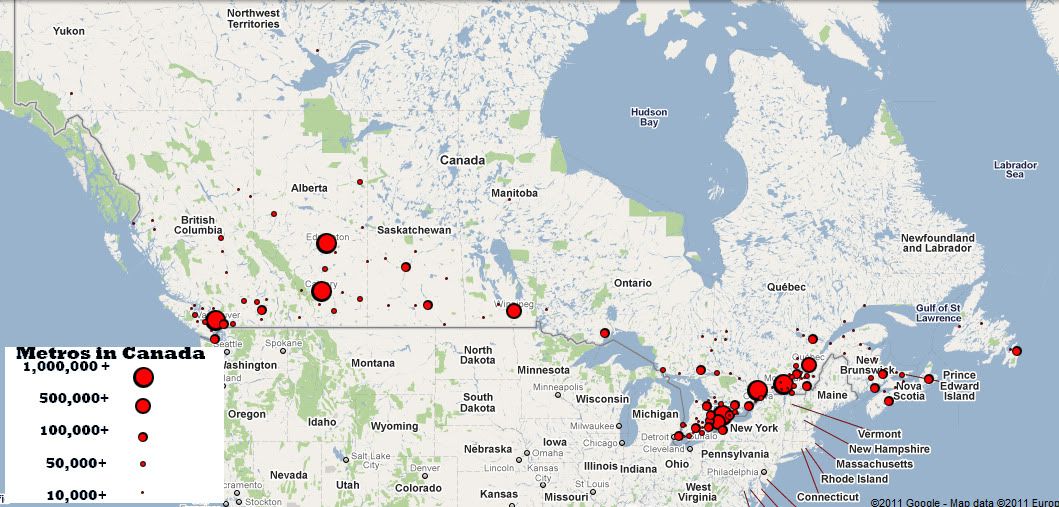


to show how the middle of our country is essentially empty. Between Winnipeg and the Golden Horseshoe there are only 250,000 people with more than half being in Thunder Bay.
There's no way that's right since Sudbury has a population of roughly 158,000, Thunder Bay has around 120,000, Sault-Ste. Marie has roughly 75,000 and North Bay has around 63,000. Not including Barrie and Huntsville/Muskoka Lakes, there's over 416,000 people living in Northern/Northwestern Ontario.

Quote:
To ensure the health of our country we need to ensure the health of all our regions. Every region in our country has significant population except for the territories and north-west Ontario. Obviously the territories will be far harder to populate, but north-west Ontario doesn't have the same environmental factors holding back its growth.
Actually, it does. It has the geographical and development nightmare known as the Canadian Shield.

Quote:
Will we ever see a day when northwestern Ontario boasts a large population? How about other seemingly "empty" areas like northeastern Ontario and northern Quebec?
I hope so, but without the advent of some serious city-building and infrastructure technology, it's incredibly unlikely.

Quote:
We have all this land prime for settlement and its sitting unused.
Feel free to go and settle upon mountains made of granite and pre-Cambrian rock.

Quote:
Originally Posted by jeremy_haak View Post
I'm not sure I really see the problem here. It's easy to look at a map like that and be mystified about why there's a big hole there where people could be living and building cities etc. and imagine that this requires some sort of solution. That giant hole is called the Canadian Shield and people don't live there because there really isn't a whole lot to draw them there. Except in a few pockets that already support a rural population (Kapuskasing, Thunder Bay, Dryden, Fort Frances), most of the shield does not support agriculture. The economic value of the land is principally through mining and forestry, but neither of those requires proximity to settlements in order to be successful. So why go solve a problem which doesn't exist and go put people somewhere where they aren't needed and somewhere they don't want to go?
Beautifully said.

Quote:
Originally Posted by miketoronto View Post
Nothing wrong with keeping parts of Canada wilderness. The charm of northern Ontario is that it is not built up.
Along with the third-world level of infrastructure on reserves and other remote communities.

Quote:
Originally Posted by DizzyEdge View Post
If it actually warranted fixing, I would say the solution is what the government has done in the past to fix such things -> free land.
A very good idea. A couple of ideas I had myself (which I will admit are not that feasible and/or are batshit insane):

- In exchange for leniency on the citizenship test and criteria, we would let immigrants who just barely failed into the country on the condition they live in more remote communities such as Whitehorse, Yellowknife, Churchill, Iqaluit, Inuvik, etc.

- Buy large stocks of Icelandic and Scottish sheep and have shepherd/cowboy communities in the more remote areas of the country. Notably, the Canadian Shield.

Quote:
Originally Posted by vid View Post
What Northern Ontario needs to prosper is the ability to create economic and land use policies that support the region.
This is absolutely crucial.

Quote:
The Ontario Government often creates policies designed with the south in mind since most people live there, but those policies don't fit into the reality of the north. Things like:

-The Far North Act — turning half the north into a protected area but not saying which parts, making investors reluctant to invest here because their investment might be cancelled due to the law. The Mining Act reform and forestry tenure changes — not entirely bad, but not as beneficial as they might have been if Northerners had more control over their creation. Some have accused these laws of being tools of the government to please environmentalists, without having to deal with political ramifications for their actions as the north has only 10 of 107 seats in the legislature.

-Uniform minimum wage at $10.25 — impossible to live on in Toronto but doable here; we used to have a lower minimum wage than the rest of the province which was reasonable and easier on businesses, though that is debatable, and in the far north, the cost of living is far too high for even a minimum wage of 15 dollars to be sufficient.

-Requirements for highway upgrades based on Southern Ontario realities which are nearly unattainable here, which is part of why our highways rarely get upgraded. Outside of the Sudbury to Barrie corridor, they only seem to get upgraded when an MPP is at risk of losing his seat.

-An apparent lack of understanding by southern politicians of the issues faced by the aboriginal population in this region. If Northern Ontario was a province, we would have the highest proportion of aboriginal people of any province in Canada. Thunder Bay's aboriginal population is growing over 8% a year. Growth in the aboriginal population is the primary reason Northwestern Ontario's population grew between 2001 and 2006; immigration played a very small role.

-The province considers aboriginals to be a federal issue and doesn't do much to alleviate their problems, and is very slow to act on aboriginal issues the province should act on. Regional governance for the north would include aboriginals and that should help them become more prosperous. Some of the worst living conditions in first world countries are found in Ontario. Pikangkum, north of Kenora, has 75% unemployment and the highest suicide rate in the world. Reserves in Quebec and Manitoba are doing far better by comparison, but still aren't doing great.

As for immigration, the region is working hard to attract immigrants (we've released a web portal for it), but one of the issues we have is racism against non-whites causing immigrants who aren't white to feel unwelcome here, and so they leave. It isn't discussed openly but several well known figures who immigrated to this city with great fanfare have recently left because of it. The population isn't mostly racist, but the few bad apples we have are very vocal with their hate. The increasing aboriginal population has created some very offensive statements from a few members of the public recently. Most people aren't like that but a few bad apples spoil the bunch.

Our local governments are mostly very progressive, but they have limited tools at their disposal to achieve the things they want to achieve. A government based in a city of 6 million people a thousand miles away has difficulty understanding our issues, but I do know that many of them try.
Rather well said. Having lived in Northern Ontario (North Bay) for several years, it quickly became apparent that it unique compared to southern Ontario and there was a different culture and way of life up there that those in the Golden Horseshoe simply did not and could not understand. Because of this, I've come to support a separate province of Northern Ontario.

Quote:
Originally Posted by caltrane74 View Post
Hey if we go to the extent of splitting Northern Ontario, can we at least get Turks and Caicos to join Canada. Might as well do all the constitutional all at once.
That would be unlikely, but amazing.

Quote:
Originally Posted by PoscStudent View Post
Why would we want to grow the population significantly?
Because it means more money, a larger economy, a larger tax base, and more funds available for services?

Quote:
Originally Posted by rbt View Post
I'm curious, do these cities have Hawks too? I've got 3 pairs (6 hawks) that circle my condo near Bloor and Sherbourne for most of the day. They seem to have nested on the roof of an office building near Yonge. They seem to be eating pigeons.

When I was in Montreal in May I noticed a pair there too though I was unable to figure out where they were nesting.

Is this common in Canadian cities or just the larger two? Also, I don't remember seeing them more than a few years ago. Is it a new phenomenon?
I don't know about others, but Peregrine Falcons are often found in central Ottawa.

Quote:
Originally Posted by SpongeG View Post
i skimmed - someone mentioned having immigrants having to move to underpopulated places first - doesn't australia do this? my moms cousin was immigrating to australia and they had to move to tasmania as part of their immigration and they ended up loving it there and staying

but maybe canada should try that? have immigrants invest or move to say regina or thunderbay for x amount of years
It would be interesting to try, but I can guarantee some would call it unconstitutional and would argue that it impedes of the freedom to live wherever and move to wherever you want.

Reply With Quote
     
     
  #57  
Old Posted Jul 2, 2011, 9:51 PM
someone123's Avatar
someone123 someone123 is offline
hähnchenbrüstfiletstüc
 
Join Date: Nov 2001
Location: Vancouver
Posts: 36,015
Quote:
Originally Posted by Jamaican-Phoenix View Post
Because it means more money, a larger economy, a larger tax base, and more funds available for services?
Perhaps more funds for services, but definitely more people needing services. This line of reasoning is oversimplified if we're interested in standard of living. The real question is whether adding more people generates more economic growth than population growth.

Sometimes it does because of economies of scale but other times adding more people makes things worse because there aren't enough resources to go around.
Reply With Quote
     
     
  #58  
Old Posted Jul 3, 2011, 1:25 AM
SpongeG's Avatar
SpongeG SpongeG is offline
Registered User
 
Join Date: Jun 2006
Location: Coquitlam
Posts: 40,132
Quote:
Originally Posted by habfanman View Post
The Aussies have a system called State Specific Regional Migration. You can have you're visa process expedited by emigrating to a region in dire need of your services for a period of 3 years. The hope is that you'll establish yourself in that region and decide to stay. It's a relatively new policy so I don't know what the retention rates are but if you've ever been to Taz, you'll know why your mom's cousin decided to stay.
ah okay i knew they had some program, my uncle also moved to australia but i don't know if went with that option, he ended up in perth
Reply With Quote
     
     
  #59  
Old Posted Jul 3, 2011, 3:45 AM
vid's Avatar
vid vid is offline
I am a typical
 
Join Date: Apr 2004
Location: Thunder Bay
Posts: 39,065
Quote:
Originally Posted by Jamaican-Phoenix View Post
There's no way that's right since Sudbury has a population of roughly 158,000, Thunder Bay has around 120,000, Sault-Ste. Marie has roughly 75,000 and North Bay has around 63,000. Not including Barrie and Huntsville/Muskoka Lakes, there's over 416,000 people living in Northern/Northwestern Ontario.
In 2006, Ontario has 745,372. Most of them live in small towns. I think only PEI is less urban than Northern Ontario. Only 64% of Northern Ontarians live in communities with more than 10,000 people.

And as Someone123 mentioned, there are downsides to population growth, like this and this. A lot of people in Canada have yet to find out about the mining boom that is beginning to pick up steam here.
Reply With Quote
     
     
  #60  
Old Posted Jul 3, 2011, 4:25 AM
someone123's Avatar
someone123 someone123 is offline
hähnchenbrüstfiletstüc
 
Join Date: Nov 2001
Location: Vancouver
Posts: 36,015
Quote:
Originally Posted by vid View Post
And as Someone123 mentioned, there are downsides to population growth, like this and this. A lot of people in Canada have yet to find out about the mining boom that is beginning to pick up steam here.
Those are examples of growth driven by economic development and so they're far from a worst-case scenario. If the region had similar population growth without new jobs there would be a very significant decline in the standard of living because there wouldn't be enough money to go around.

Some of the native communities are an example of what happens with population growth and no economic growth.

Quote:
I think only PEI is less urban than Northern Ontario
PEI's a very small area and is not very far from cities on the mainland. It is roughly equivalent to any number of other rural areas around Eastern Canada. The only difference is that it happens to be a province for historical reasons.
Reply With Quote
     
     
This discussion thread continues

Use the page links to the lower-right to go to the next page for additional posts
 
 
Reply

Go Back   SkyscraperPage Forum > Regional Sections > Canada
Forum Jump


Forum Jump


All times are GMT. The time now is 1:27 PM.


Powered by vBulletin® Version 3.8.7
Copyright ©2000 - 2026, vBulletin Solutions, Inc.

