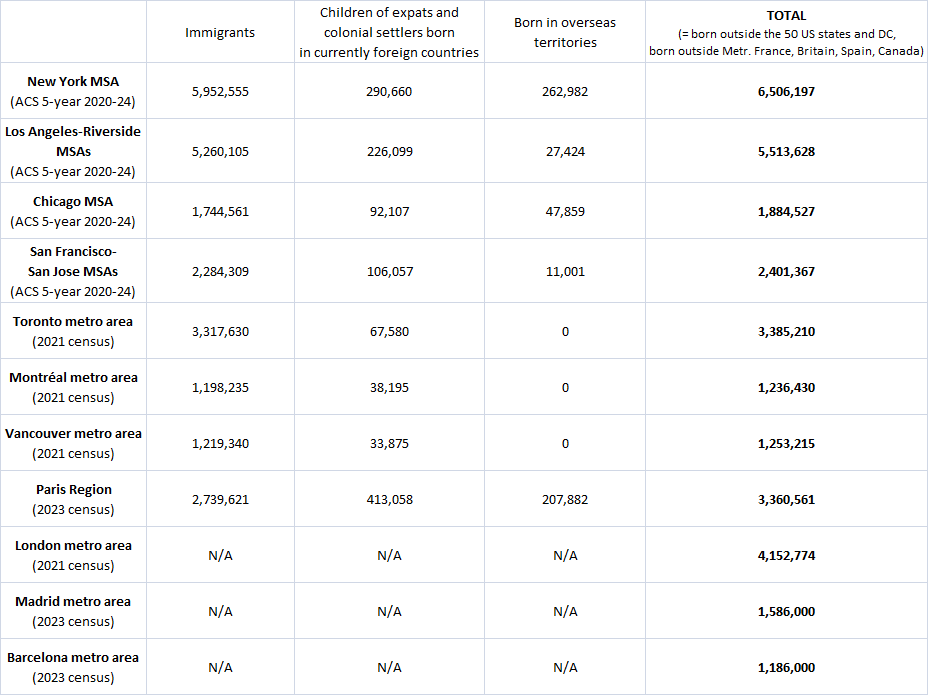
I've added the Toronto, Montréal, and Vancouver metro areas (international definition of the FUAs). I've added all the municipalities within each FUA.
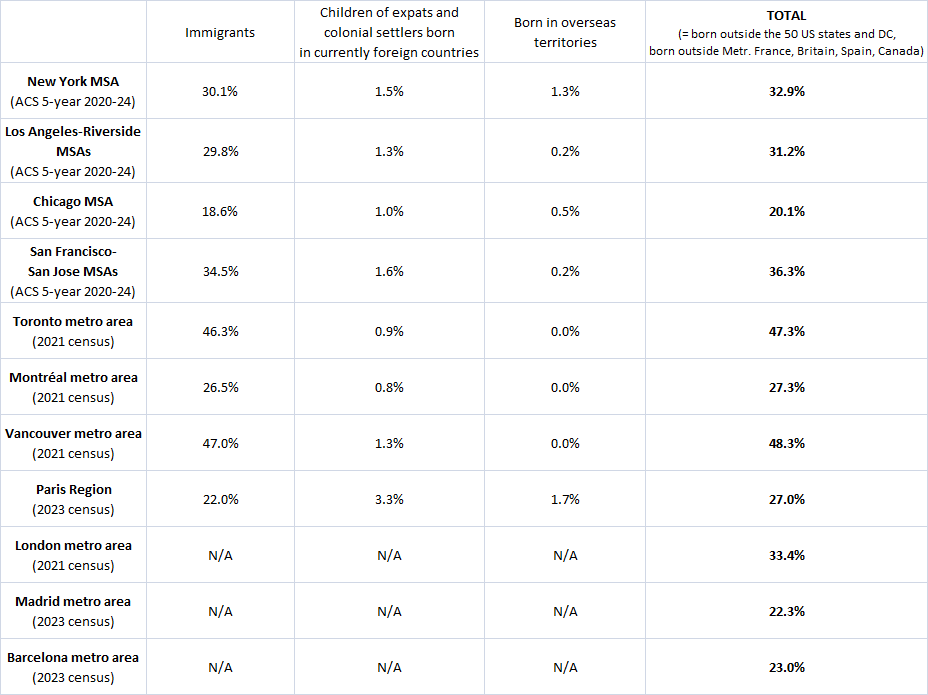
Apples to apples figures, but in the case of Canada, due to government budget cuts, they count immigrants and place of births ONLY in private households, and they sample only 25% of the population (it's not a full census). What that means is the raw figures are probably underestimates (since the non-private households are not included), and on the other hand the % are probably overestimates (since nursing homes, seniors' residences, convents, university dorms, military bases, etc, which allegedly are more predominantly native Canadians, are not included).
In percentage of the total population.
Interestingly, once your remove the immigrants (incl. non-permanent residents), the total population (in private households) of these 3 metro areas become:
- Toronto metro area: 3,845,505
- Montréal metro area: 3,293,200
- Vancouver metro area: 1,375,415
That's the non-immigrant population of these 3 metro areas. Montréal is there very close to Toronto, and much higher than Vancouver. And these figures include the children of immigrants born in recent years. If you removed them, Montréal would probably be at the same level as Toronto. So what this shows is Toronto now dominates Montréal population-wise only due to the recent waves of immigrants (those arrived in the past 40 years or so).





 Prev
Prev






 Linear Mode
