HomeDiagramsDatabaseMapsForum About
     

Go Back   SkyscraperPage Forum > Photography Forums > Found City Photos


Reply

 
Thread Tools Display Modes
     
     
  #2021  
Old Posted Aug 4, 2026, 2:39 AM
Bristolian's Avatar
Bristolian Bristolian is offline
Registered User
 
Join Date: Jul 2015
Location: The Outskirts
Posts: 512


Street takeover, 1928 style
Reply With Quote
     
     
  #2022  
Old Posted Aug 4, 2026, 5:08 AM
Scott Charles's Avatar
Scott Charles Scott Charles is offline
Registered User
 
Join Date: Jan 2018
Location: Los Angeles
Posts: 683
Quote:
Originally Posted by ethereal_reality View Post
.
Someone recently asked me what I knew about Carney's on Sunset and I had to answer "not much'.


eBay

Does anyone know the history behind it?

.
Another place I used to go to with my mom. Like Lwize, I haven't been there for a long time... in my case, the late 1990s.

There's another one on Ventura Blvd, just east of Whitsett.


Quote:
A Train on the Sunset Strip

Carney's opened in December 1975 — a real Union Pacific passenger coach converted into a restaurant on the Sunset Strip, right in the middle of rock-and-roll's golden era.

The Menu Has Never Changed

Thick burgers, snappy hot dogs, house-made chili — that's the whole menu. Carney's has never chased a trend because it never needed to.

Eating Inside a Real Train

The dining room is a genuine vintage railroad car — narrow, warm, lined with booth seats and old photographs, with the Strip rolling past the windows. There's nowhere else in LA quite like it.

An LA Cultural Landmark

Jonathan Gold named Carney's one of his 99 Essential LA Restaurants. Chicago transplants swear the dogs are the real deal. A second train car opened on Ventura Blvd in Studio City in 1981.


https://carneytrain.com/story
Reply With Quote
     
     
  #2023  
Old Posted Aug 4, 2026, 6:01 AM
Alkapone Alkapone is offline
Registered User
 
Join Date: Nov 2016
Posts: 272
Quote:
Originally Posted by ethereal_reality View Post
.
Someone recently asked me what I knew about Carney's on Sunset and I had to answer "not much'.


eBay

Does anyone know the history behind it?

.
As to the car itself, utahrails.net pages on UPRR equipment gives it as an older heavyweight coach (aka Chair Car) which was modernized in 1950 for service in the standardized colors of the lightweight streamliner fleet (i.e. Armour Yellow & Harbormist Grey): https://utahrails.net/pass/heavyweight-modernized.html
Reply With Quote
     
     
  #2024  
Old Posted Aug 4, 2026, 4:42 PM
Scott Charles's Avatar
Scott Charles Scott Charles is offline
Registered User
 
Join Date: Jan 2018
Location: Los Angeles
Posts: 683
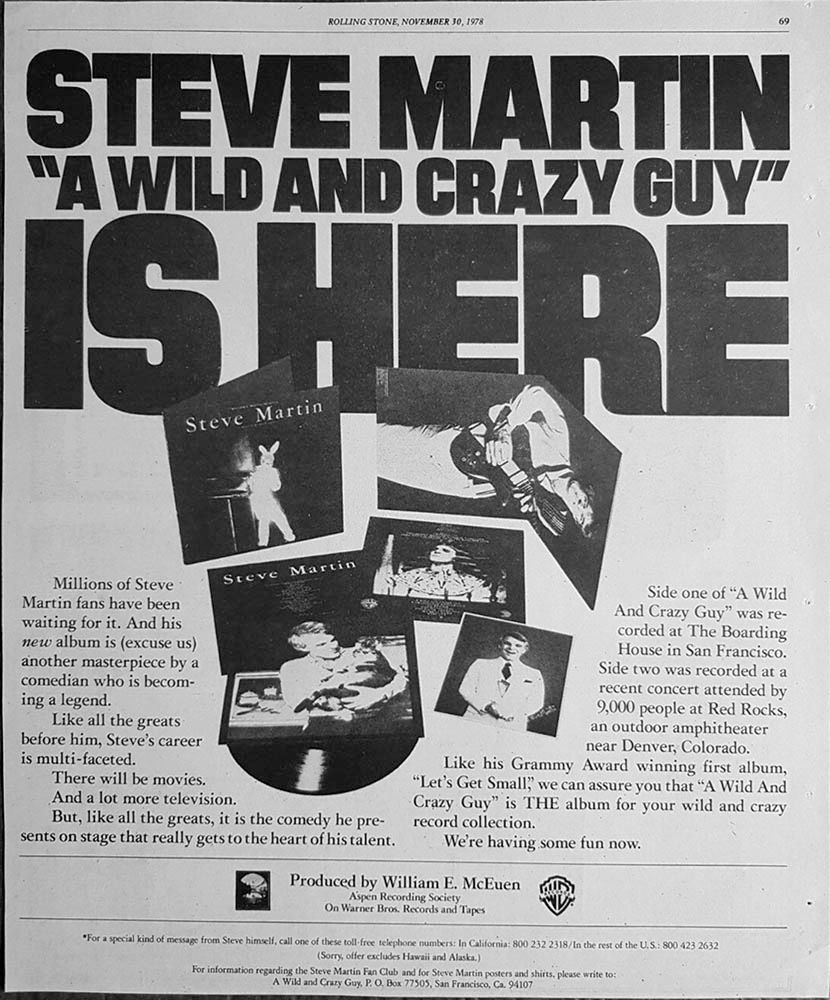
By the way, what's going on with this billboard? It looks like it should say Steve Martin - "A Wild and Crazy Guy", but the text is all misplaced.

Reply With Quote
     
     
  #2025  
Old Posted Aug 4, 2026, 6:18 PM
HossC's Avatar
HossC HossC is offline
Registered User
 
Join Date: Aug 2013
Posts: 4,679


Correct! It was a billboard for Steve Martin's 1978 album, which means that the kitchen car must've been added about three years after the main dining car.


eBay
Reply With Quote
     
     
  #2026  
Old Posted Aug 4, 2026, 6:31 PM
Snix Snix is offline
Registered User
 
Join Date: Jun 2016
Posts: 220

1953 Film Daily Yearbook of Motion Pictures

Looks like Quality Pictures also produced and distributed the precursor to home videos, with these EXPENSIVE 16mm burlesque movies... These cost the equivalent of over $500 a reel today!


"Home Movies" magazine
November, 1946

The PBS show "Locationland" visited the room last year.

https://www.pbs.org/video/ed-woods-plan-9-adventures-ligruh/


Quote:
Originally Posted by JoeParisi View Post
I'm researching the history of the former Quality Studios / Quality Pictures property at 5628½ / 5634 Santa Monica Boulevard (today part of the Gold-Diggers complex) for a documentary on Hollywood's forgotten independent studios.

Like many people, I originally came here because of the Ed Wood connection (Plan 9 from Outer Space, Night of the Ghouls, etc.), but the deeper I dig, the more it seems this building has a much larger story.

Here's what I've documented so far:

Built around 1924–25 (still trying to pin down the original permits).
By 1933, the rear portion appears to have been occupied by Sidney M. Gordon's garage.
By the mid-to-late 1940s it had become Quality Pictures, operated by W. Merle Connell.
Contemporary advertising for George Weiss's Screen Classics Productions (Test Tube Babies) lists the company's address as 5634 Santa Monica Boulevard, suggesting Weiss was operating from Quality rather than "across the street."
The property later housed Mandour International Productions, then Solid Sound, Falcon Sound Studios, and eventually today's Gold-Diggers recording studio.

I'm now trying to reconstruct the building's complete history from roughly 1924 through the 1980s, year by year.

I'm especially looking for:

Building permits or certificates of occupancy
Sanborn maps or insurance records
Historic photographs (especially the rear soundstage)
City directory entries that fill in the missing years
Property ownership history
Memories of Solid Sound or Falcon Sound
Any recollections of George Weiss, W. Merle Connell, or Screen Classics operating there
Information on whether the rear building ever contained apartments or caretaker's quarters (I've only found one apparent residential listing: Medhat Mandour, Room 2, around 1960)

I've searched newspapers, trade journals, AFI, city directories, and planning documents, but I'm convinced there are still records hiding in places I haven't thought to look.

If anyone has old photographs, permits, directory scans, assessor cards, aerial photos, or simply remembers the property from the recording-studio era, I'd love to hear from you.

My hope is to build the definitive documented history of this fascinating little Hollywood building before its story is forgotten.

Again, this research is on the building BEHIND Gold Diggers, that is currently owned by that owner.

Thank you!

Reply With Quote
     
     
  #2027  
Old Posted Aug 4, 2026, 7:55 PM
Alkapone Alkapone is offline
Registered User
 
Join Date: Nov 2016
Posts: 272
Quote:
Originally Posted by Alkapone View Post
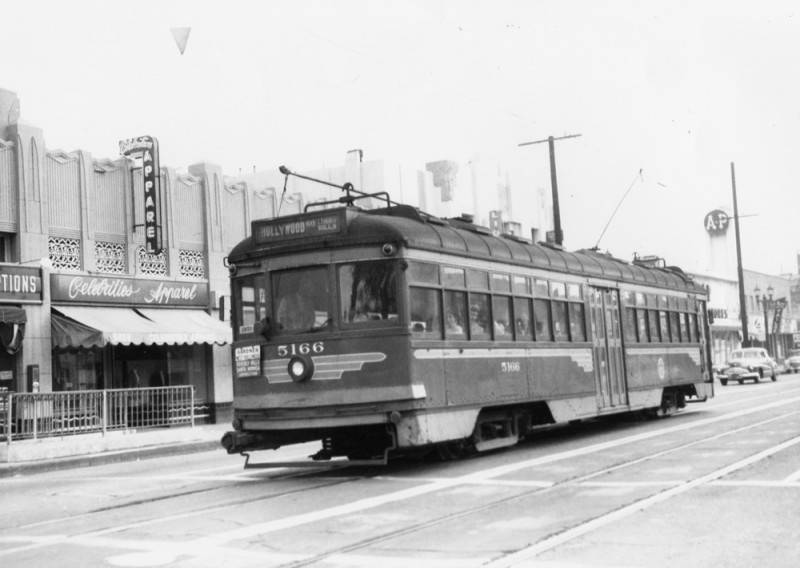
And PE Car #5166 outbound westward at North Wilton Place by Ped. Sub. in undated shot from LAPL files: https://tessa2.lapl.org/digital/collection/photos/id/85405

Car 5166 with A&P Market beyond…


sourced Tessa2/LAPL above.

This might be the block found in Ed Wood (1994) where they had the “movie within a movie” location filming (see SetJetter site and Graham’s blog). They would be east of this corner.
Reply With Quote
     
     
  #2028  
Old Posted Aug 4, 2026, 9:12 PM
Alkapone Alkapone is offline
Registered User
 
Join Date: Nov 2016
Posts: 272
Quote:
Originally Posted by Alkapone View Post
This might be the block found in Ed Wood (1994) where they had the “movie within a movie” location filming (see SetJetter site and Graham’s blog). They would be east of this corner.

For the above, start at JHGraham’s coverage of that A&P Market which later became Carpet Village here: https://jhgraham.com/2023/07/25/5635-hollywood-boulevard-ap-market/

The the Setjetter Ed Wood posts will lead (scrolling down) to the same store as a Carpet Village (at 5635) and the dressed-up appearance during the shooting for Tim Burton’s film.


The store on the east corner, right of the market, was a 5/10/25 cent place in the long past (IIRC).
Reply With Quote
     
     
  #2029  
Old Posted Aug 4, 2026, 10:12 PM
odinthor's Avatar
odinthor odinthor is offline
Registered User
 
Join Date: May 2015
Posts: 1,616

1956 CD

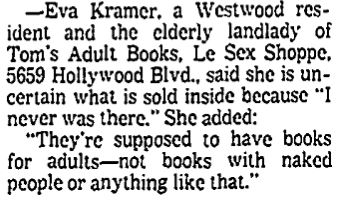
In 1977:


LA Times, 9/7/1977

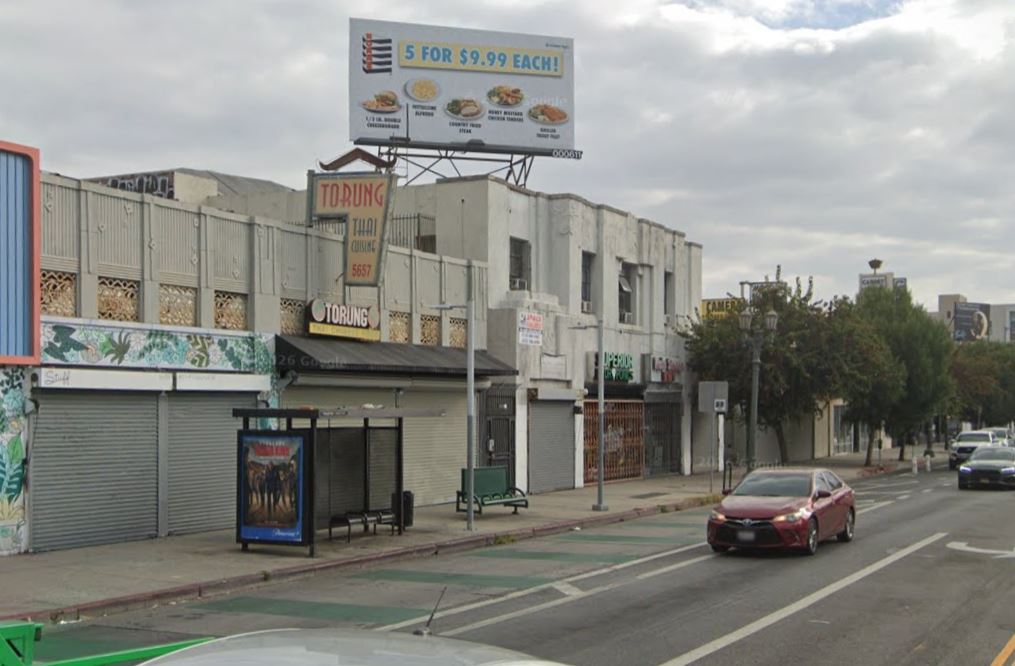
As it is today:


gsv


Last edited by odinthor; Aug 4, 2026 at 10:30 PM.
Reply With Quote
     
     
  #2030  
Old Posted Yesterday, 1:00 AM
Alkapone Alkapone is offline
Registered User
 
Join Date: Nov 2016
Posts: 272
Quote:
Originally Posted by Bristolian View Post
I think this photo was posted some time ago. I recall wondering about what looks like a surfboard on the roof of the Studebaker making the right turn.
Looked at it on Bygonely here: https://www.bygonely.com/hollywood-1950s/

It might be a outdoor folding aluminium lounge chair with webbing and the head part turned upwards at the rear of that” Studentbasher”.
Reply With Quote
     
     
  #2031  
Old Posted Yesterday, 1:10 AM
Alkapone Alkapone is offline
Registered User
 
Join Date: Nov 2016
Posts: 272
Quote:
Originally Posted by odinthor View Post

1956 CD

In 1977:


LA Times, 9/7/1977

As it is today:


gsv


Visions of Jack Nicholson informing old lady Kramer that she was a very wealthy woman who owned lots of land in the San Fernando Valley while asking her about that Albacore Club piece of material in the comforter.
Reply With Quote
     
     
  #2032  
Old Posted Yesterday, 11:02 AM
Alkapone Alkapone is offline
Registered User
 
Join Date: Nov 2016
Posts: 272
Quote:
Originally Posted by ethereal_reality View Post
.
A ROOM WITH A VIEW. [1946]

Here's an angle we don't usually see.......The white building is NBC Radio City on the northeast corner of Sunset and Vine.


vantage point

for search purposes:...Taken from rm 1014 at the Hollywood Plaza, Calif...June, 46


So what's the large building circled below? . . . and are those two radio towers?


.
Perhaps just coincidental, but NLA v.1 history of Holllywood Plaza Hotel is on the same page as the (recently discussed) Hotel Palomar photos:
https://skyscraperpage.com/forum/showthread.php?t=170279&page=1524

(Odd things do pop up when you start playing a game of Kevin Bacon Connects The Dots!)
Reply With Quote
     
     
  #2033  
Old Posted Yesterday, 7:17 PM
Alkapone Alkapone is offline
Registered User
 
Join Date: Nov 2016
Posts: 272
The radio towers in question: KMTR just below Lyon Storage (SM Blvd.) via late John Bengtson’s silent locations blog: https://silentlocations.com/2023/11/11/keaton-and-w-c-fields-cross-paths-again-near-busters-studio/
Reply With Quote
     
     
  #2034  
Old Posted Yesterday, 9:42 PM
Lwize Lwize is offline
Registered User
 
Join Date: Aug 2012
Location: Los Angeles
Posts: 585
From LA Times

Quote:
When department stores defined class
ROBINSONS-MAY and its retail rivals once were the measure of social status.

By Shelby Grad

As a kid growing up in Los Angeles, there was no greater barometer of class than the department store.
As my grandmother loved to explain, May Co. was affordable when there was a sale. Broadway was a bit pricier but you might find a deal on a good day. Bullock’s was for the Buick and Lincoln crowd. Robinsons: strictly Cadillacs. And I. Magnin: the land of Mercedes and Rolls-Royce.
She was mostly a window shopper. But department stores were her passport into the different strata of postwar L.A., a chance to aspire to a different life even if all she left with was a perfume sample sprayed on her palm.
This summer marks 20 years since the classic L.A. department store died. It was this time in 2006 when workers removed the last of the Robinsons-May signs from stores and malls across Southern California, marking the end of an era in more ways than one. Rob-May outlived Bullock’s and Buffums and Orbachs , but it was no match for the national chains and changing consumer behavior that favored discounters like Target and Kohl’s.
In a world of one-click purchasing and window-shopping on Instagram, it’s hard to imagine the status and influence these brick-and-mortar stores imparted on 20th century Los Angeles.
Their ads dominated the pages of the newspapers, and even there you detected a caste system.
Mid-market chains like May Co. and Broadway advertised in the news sections with pages and pages of photos showing off their wares. The upscale chains like Robinsons were reserved for the features sections, with glorious hand-drawn sketches of beautiful women and handsome men against dramatic landscapes that were worthy of framing.
The stores got their start with huge emporiums in downtown L.A., a street car ride away. But the stores easily adapted to the car and postwar suburbia. With every new tract, they would anchor the shopping malls that became the downtowns of suburban life.
The arrival of a Bullocks or a Robinsons in your community was a mark of status, that you were living in a sophisticated place.
My grandmother’s Disneyland
What we forget is that they were more than places to shop. My grandmother bought all her clothes at the down-market Fedco , usually “half-size” polyester blouses with the brand name “The Discriminating Woman.”
The fancy stores were her amusement park.
She took us to the ornate tea room atop the art deco masterpiece Bullock’s Wilshire, where we lunched and marveled at the one place in late 1980s L.A. where women still wore hats and gloves.
She made the rounds at the Robinsons in Beverly Hills, spying for celebrities and likely unaware of all that went into the edifice: Travertine stone from Peru. Rose marble from Portugal. Black granite from Brazil. Rosewood from Madagascar.
When the outpost closed in 2006, longtime employees lamented L.A. was losing not just an expensive store but a unique public space. “I did ladies’ shoes and later men’s shoes and clothing. Now I’m doing demolition,” one said.
My grandmother died a few years before Rob-May. But I cannot help but think about her when I roam through the stores of my youth.
A few years ago, two friends and I got inside the empty building on Wilshire that once housed I. Magnin. It was a symphony of marble, grand etchings and elegant curves.
Now, it’s boarded up, the black marble exterior faded by graffiti and neglect. Down the block, the Bullock’s Wilshire has been lovingly restored and protected by the Southwestern Law School. But the last time I walked into the property, I was shooed away by a security guard.
Like so many in her generation, my grandmother saw those iconic names as markers of discriminating taste without considering the dark side of all that exclusivity.
The tea room whose pretensions she so loved was the subject of protests and lawsuits in the 1940s by Black people who were refused service there. They eventually prevailed and got to join my grandmother in the escapism (and tyranny) of these retail temples that insisted they represented the L.A. ideal.
Seeing ‘how the other half lives’
One of the last places you can experience the department store the way my grandmother did is on Lake Avenue in Pasadena . The Bullock’s (now Macy’s) was one of her favorites: a whimsical space that transports you back in time with vintage fixtures and furniture, an old-fashioned elevator, and murals and wallpaper galore.
My grandmother would pile us into the car and head to Pasadena “to see how the other half lives.”
Every time Macy’s announces another round of store closures, I hold my breath to see if 401 S. Lake Ave. will be on this list. It’s surviving for now.
Reply With Quote
     
     
End
 
 
Reply

Go Back   SkyscraperPage Forum > Photography Forums > Found City Photos
Forum Jump


Forum Jump


All times are GMT. The time now is 4:41 AM.


Powered by vBulletin® Version 3.8.7
Copyright ©2000 - 2026, vBulletin Solutions, Inc.