Quote:
Originally Posted by New Brisavoine

Barcelona's FUA covers 4,256 km² of land area (not 2,600 km²). That's very large, considering it's a coastal metro area, so half of its territory would be the sea. In terms of distance from the city center, it's more or less equivalent to a metro area of 8,510 km² that is fully inland. Toulouse's FUA covers just 6,520 km², which means it's less extended than Barcelona's.
15% is low, but they wanted to catch the wider influence of cities. The French statistical office used a 40% threshold before finally adopting the international FUA definition. But the difference is not that large anyway. For Paris, switching from 40% to 15% threshold only increased the metro area population by a few hundreds of thousands of inhabitants (certainly less than 1 million).
And for London, I hope you realize that if they had used a 40% threshold, or even a 50% threshold that would sound intuitive (majority of people commuting to the core city), then the London FUA would have had a considerably smaller population, because most of the districts surrounding Greater London have rather smallish percentages of people in employment commuting to Greater London. It's only thanks to a low 15% threshold that London's FUA could include many districts around Greater London.
There's a reason why the international FUA was developped. That's because the old urban area (as defined by the UN) is increasingly meaningless. For example a Cairo-Alexandria urban area that encompasses all the delta of the Nile due to now near complete contiguous settlements is a meaningless thing. Someone from Alexandria and someone from Cairo do not belong in any respect to the same city (whatever meaning we give to the word city). Same for a Guangzhou-Hong Kong urban area, it's a meaningless thing. Or in England a Manchester-Liverpool urban area. Or along the Rhine a Bonn-Cologne-Düsseldorf-Rotterdam urban area. The traditional concept of urban area has long stopped making any sense due to the sprawl of urban areas.
|
Yep by the 40-50% threshold would make ALL cities considerably smaller too, and imo that would be more accurate and representative for what makes a 'functional' city - not 15%. Once again it's not about trying to inflate city size, London or not, but accuracy -what do the other 85% of people do?
Tbh I don't really buy that people commuting into a city makes that an extension of the city, they are their own towns and villages themselves, in their own right. I don't see the small town of Newbury and think, ah London (or even ah, a dormitory of London). It has its own functioning centre full of shops, its own attractions, schools, nightlife, council, office parks.
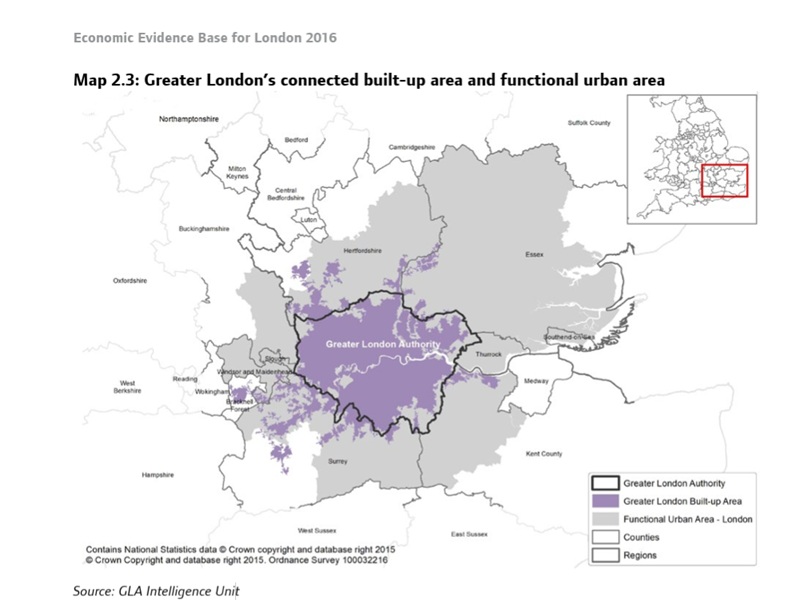
London has a high amount of commuting for the region, however the FUA will not consider the further parts unlike a MSA/ CSA due to the bittyness of the Green Belt. 900,000 commute into it every day, just like Paris or NYC.
This, half of which would look very similar to a regional CSA:
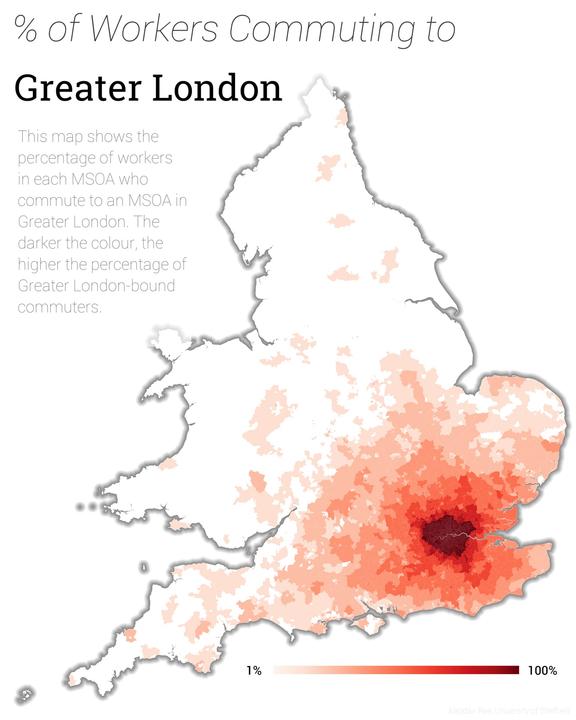
...compared to this, which weirdly only really captures the north east side, that's much more sparse than the hyper-dense west. Not even parts of the FUA are included:
And a contiguous city does count imo, it makes it the one urban entity. You can literally walk from one end to another should you wish, you can go in and out of all the centres in it (not like there's some kind of invisible barrier of separation). Otherwise you'd need to excise Yokohama from Tokyo, Foshan from Guangzhou, Long Beach from LA etc. We're not talking the 220km between Alexandria to Cairo, dotted with towns and villages in between, but the places that are one contiguous, continuous city, where you can walk on streets surrounded by buildings from one end to another. That's what's happening in the Pearl River City (not to be confused with the wider Pearl River Delta), which the World BAnk considers the world's largest city. It's not like the Nile Delta, not like a typical megalopolis like the Eastern Seabord or Blue Banana, with gaps.
For example, Hong Kong, Macau, Huizhou are part of the PRD, but not the PRC:






 Prev
Prev





 Linear Mode
