| |
 Posted Jun 23, 2026, 2:58 PM
|
 |
Moderator
|
|
Join Date: Aug 2002
Location: Winnipeg, Manitoba
Posts: 8,392
|
|
Quote:
Change Agents: Canada’s New Wave of “Heritage” Developers – Part 2
Like the first Change Agents article in July 2025, Part 2 seeks to capture the new spirit of an up-and-coming generation of developers capitalizing on heritage buildings and quietly remaking Canada’s real estate development scene.
But what is a “developer,” really? The dictionary definition is, “a person or company that buys land or buildings in order to build new houses, shops, etc. or to improve the old ones, and makes a profit.” This definition seems too narrow. Many projects are the result of actors – consultants, community land trusts, governments, etc. – who are often out of sight but no less influential and visionary. Here are three organizations instigating or shepherding brave heritage transformations across Canada.
Fisher River Cree Nation (Winnipeg, Manitoba)
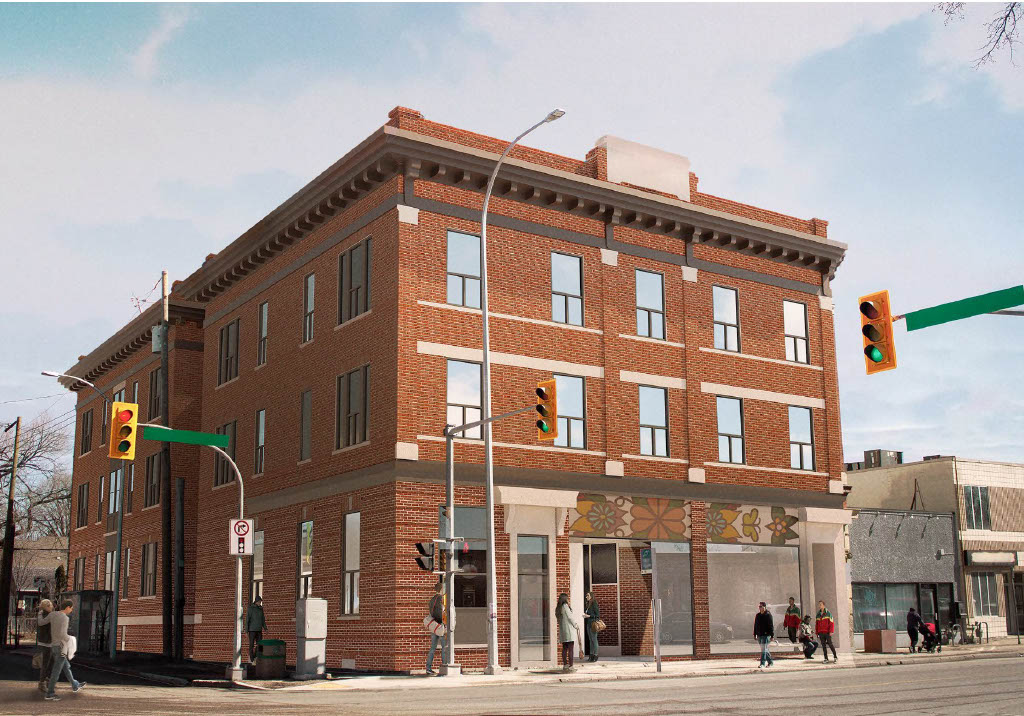
A rendering of the First Nation Healing Centre, set to open in Fall 2026 – Credit: AtLRG Architecture Inc.
“We call our building Kapāpak, which is butterfly in Cree,” says Katina Cochrane, Executive Director of First Nation Healing Centre about Winnipeg’s former Rubin Block. “Our vision was to create a place where residents can feel protected and nurtured, like a cocoon, and eventually emerge as beautiful butterflies.” It is a wonderful metaphor amplified by the fact the building itself has undergone a breath-taking metamorphosis. Placed on the National Trust’s Endangered Places list in 2019, the Rubin Block, a 3-storey mixed use building from 1914 on Winnipeg’s South Osborne Street, had stood vacant, boarded up, and fire-damaged since 2014. In September 2026, after a two-year, $17.8 million transformation, the Healing Centre will welcome the first residents to its 13 housing units, for women and their children, many escaping domestic violence and transitioning to urban life in Winnipeg.
The rehabilitated building will have community gathering space, a shared kitchen, daycare, laundry facilities, and there will be on-site programming and round-the-clock staff in one of the building’s storefront commercial spaces. Workers will help people find independent living spaces after they reach the residency limit. The facility will be shepherded by an all-woman governance board.
“If you look at the stories of the missing and murdered Indigenous women in Winnipeg, most of them had just re-located to the city,” Cochrane explains. “When people move to the city they lose their support systems. On top of that, social assistance on reserve is through the federal government, and there is often a gap as they shift to the provincial social system. All this leaves them very vulnerable.”
Fisher River Cree Nation has offered women shelter services for over 30 years in their community 200 kms north of Winnipeg and had recently expanded it. So when a wave of new federal funding for housing was recently released, Healing Centre leadership thought it would be a great opportunity to build something in Winnipeg where many community members lived. When they hesitated due to the complexity and risk, Chief David Crate and Council pushed them to take on the challenge,
Finding a safe neighborhood was crucial. “We looked at buildings in 22 other Winnipeg locations, but we loved this heritage building, the neighborhood with its parks and canoe club, and good schools,” says Cochrane. “Historically Indigenous peoples have not been welcomed in these kinds of middle-class areas. There are no other Indigenous organizations in Riverview [the area where the Rubin Block is located]. But we thought of it as an act of Reconciliation to locate here and help families heal.”
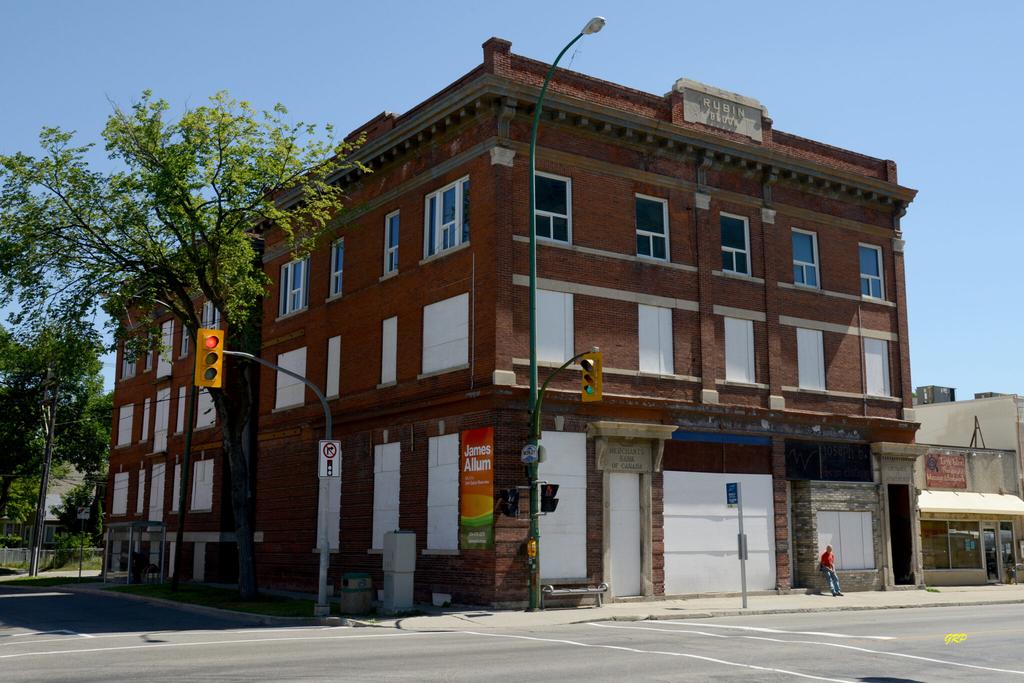
The Rubin Block in 2019 when it first appeared on the National Trust Endangered Places List – Credit: George Penner.
Cochrane is excited about the quality of the rehabilitated building. They are leaving exposed brick in many places, and salvaged pressed tin ceiling tiles from the old bank space to reuse as a feature wall. A former lightwell in the residential section was cleverly repurposed as an elevator shaft. They also worked hard to integrate traditional teachings into its creation. For instance, when they learned that someone had died in the building many years before, an Elder conducted a traditional pipe ceremony, buried tobacco under the building, and blessed the construction workers.
“We envision a welcoming place where residents can have feasts, and overcome their culture shock,” Cochrane explains. With this in mind, they have introduced a special round room into the Rubin Block so community members can gather in a more traditional style of space. The Healing Centre is also making their public presence felt by installing works by two Anishinaabe artists: Jordan Stranger and Storm Angeconeb.
It was initially daunting to pull together the $17.8 million in funding required for the project from federal, provincial, and municipal sources. Cochrane and her Fisher River team received indispensable help strategizing, navigating the funding sources, and creating a pro forma [a financial tool used to assess whether a real estate project is viable] from the non-profit University of Winnipeg Community Renewal Corporation 2.0, underscoring the gaps underserved communities face when launching into development projects. With vision and determination, it all fell into place, and a grand opening for the Healing Centre will take place in September 2026.
|
National Trust for Canada / Stories
|
|
|





 Prev
Prev




 Linear Mode
