HomeDiagramsDatabaseMapsForum About
     

Go Back   SkyscraperPage Forum > Regional Sections > Canada


Reply

 
Thread Tools Display Modes
     
     
  #4581  
Old Posted Jun 17, 2026, 7:51 PM
BlackDog204's Avatar
BlackDog204 BlackDog204 is offline
Registered User
 
Join Date: Oct 2020
Location: west
Posts: 3,202
Quote:
Originally Posted by haljackey View Post
The time to grow is now- with most countries seeing lower and lower birth rates, they are going to do more to reduce their emigration rates.

For Canada, our window to attract mass immigration is closing, and faster than most of us think. We really shot ourselves in the foot not building enough cheap housing and infrastructure to support this growth.

Without enough immigration, along with a low birth rate, Canada won't be able to develop a lot of key areas / industries we need to succeed in the longer term. There will be less people paying taxes and more people to service with them due to aging demographics
Attracting immigrants is a good thing. Letting in so many people that it strains the infrastructure, housing, health care, and social system is not. Ideally, immigration should be capped at 1% of the population annually (410,000). IN the last few years, we have been admitting over 1,000,000 people per year.

Mass migration created too many problems from 2021-25.
Reply With Quote
     
     
  #4582  
Old Posted Jun 17, 2026, 8:04 PM
craner's Avatar
craner craner is online now
Go Tall or Go Home
 
Join Date: Mar 2007
Location: Calgary
Posts: 7,368
Canada’s population fell slightly in 1st quarter of 2026: StatCan
http://https://globalnews.ca/news/11909730/canada-population-lowers-again-first-quarter-2026/

The interview mentions this will be the first population decrease y/y since confederation.
Reply With Quote
     
     
  #4583  
Old Posted Jun 17, 2026, 9:37 PM
Changing City's Avatar
Changing City Changing City is offline
Registered User
 
Join Date: Nov 2016
Posts: 8,055
Housing starts in Canada are significantly higher in the past six years than in the previous thirty years.

CMHC show data back to 1990.

The average annual housing starts for each decade are
1990s - 123,662
2000s - 174,873
2010s - 183,433
2020s - 230,266

Statistics Canada show the components of the population change estimates. Here's the data since 1990, to match the housing starts.

Natural change is pretty much a wash in the 2020s. These days births and deaths pretty much cancel each other out, and it's been a falling component of population change over the past 36 years.

1990s - 167,968
2000s - 122,058
2010s - 117,635
2020s - 37,040
(net annual natural growth of population)

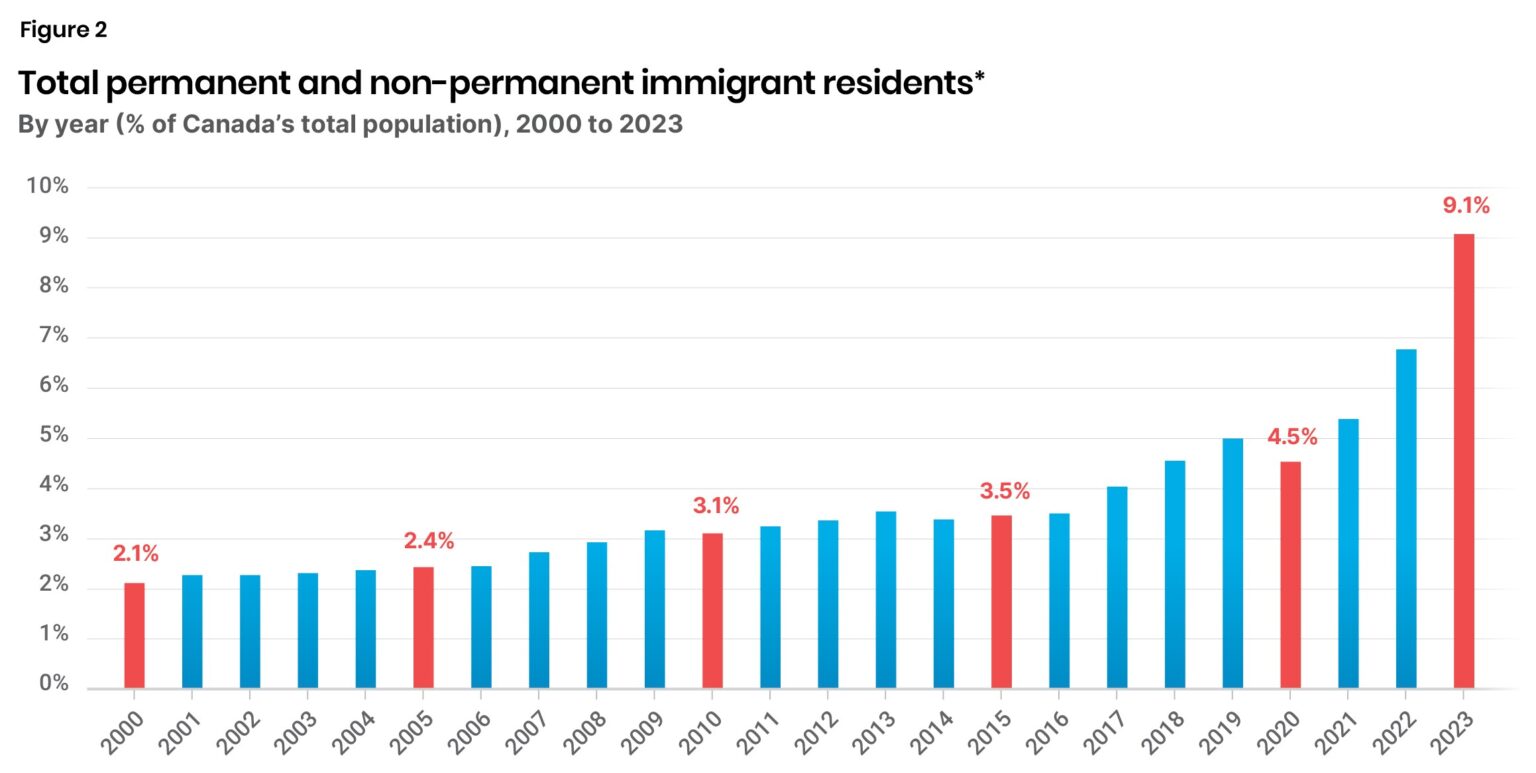
Immigration was, as we know, much greater in the 2020s than in recent decades. (These are permanent residents arriving in Canada)

1990s - 220,433
2000s - 241,446
2010s - 282,367
2020s - 396,246

Emigration on the other hand has barely changed over the decades. (This is net emigration - about half of emigrants have returned to Canada over the past 36 years).

1990s - 49,949
2000s - 51,273
2010s - 48,083
2020s - 51,867

The other big increase, as we also know, was temporary non-permanent residents, including TFWs and those studying here.

1990s - 16,269
2000s - 32,952
2010s - 73,301
2020s - 207,359

The Interactive dashboard shows the big numbers for immigration and temporary workers were in the early 2020s, and the numbers are much lower, or negative now (hence the falling population). Net international immigration has been negative over the past three quarters, and net non-permanent residents have been negative for a year and a half. The number of immigrants being allowed to enter has also been falling, in line with recent government policy.

__________________
Contemporary Vancouver development blog, https://changingcitybook.wordpress.com/ Then and now Vancouver blog https://changingvancouver.wordpress.com/
Reply With Quote
     
     
  #4584  
Old Posted Jun 17, 2026, 11:10 PM
BlackDog204's Avatar
BlackDog204 BlackDog204 is offline
Registered User
 
Join Date: Oct 2020
Location: west
Posts: 3,202
Quote:
Originally Posted by Changing City View Post
Housing starts in Canada are significantly higher in the past six years than in the previous thirty years.

CMHC show data back to 1990.

The average annual housing starts for each decade are
1990s - 123,662
2000s - 174,873
2010s - 183,433
2020s - 230,266

Statistics Canada show the components of the population change estimates. Here's the data since 1990, to match the housing starts.

Natural change is pretty much a wash in the 2020s. These days births and deaths pretty much cancel each other out, and it's been a falling component of population change over the past 36 years.

1990s - 167,968
2000s - 122,058
2010s - 117,635
2020s - 37,040
(net annual natural growth of population)

Immigration was, as we know, much greater in the 2020s than in recent decades. (These are permanent residents arriving in Canada)

1990s - 220,433
2000s - 241,446
2010s - 282,367
2020s - 396,246

Emigration on the other hand has barely changed over the decades. (This is net emigration - about half of emigrants have returned to Canada over the past 36 years).

1990s - 49,949
2000s - 51,273
2010s - 48,083
2020s - 51,867

The other big increase, as we also know, was temporary non-permanent residents, including TFWs and those studying here.

1990s - 16,269
2000s - 32,952
2010s - 73,301
2020s - 207,359

The Interactive dashboard shows the big numbers for immigration and temporary workers were in the early 2020s, and the numbers are much lower, or negative now (hence the falling population). Net international immigration has been negative over the past three quarters, and net non-permanent residents have been negative for a year and a half. The number of immigrants being allowed to enter has also been falling, in line with recent government policy.

Admitting so many TFWs in the past 5 years was foolish.
Reply With Quote
     
     
  #4585  
Old Posted Jun 17, 2026, 11:23 PM
Taeolas Taeolas is offline
Registered User
 
Join Date: Oct 2009
Location: Fredericton
Posts: 5,014
Quote:
Originally Posted by BlackDog204 View Post
Attracting immigrants is a good thing. Letting in so many people that it strains the infrastructure, housing, health care, and social system is not. Ideally, immigration should be capped at 1% of the population annually (410,000). IN the last few years, we have been admitting over 1,000,000 people per year.

Mass migration created too many problems from 2021-25.
Plus, Climate Change tends to favour Canada in the future, due to our available space and temperate climate (we have more room to warm up with). So that window for population increasing isn't likely to close that much in the years and decades to come, if we want more people.

Still, it's never nice to see numbers going down (at least not population numbers). Hopefully this is more a stabilization and not a trend.
Reply With Quote
     
     
  #4586  
Old Posted Jun 17, 2026, 11:25 PM
Changing City's Avatar
Changing City Changing City is offline
Registered User
 
Join Date: Nov 2016
Posts: 8,055
Quote:
Originally Posted by BlackDog204 View Post
Admitting so many TFWs in the past 5 years was foolish.
It was really only 2022-2024, and I suspect it was as much overseas students as it was TFWs. It was also partly playing catch up after 2020 and COVID, but 2023 was crazy. Here's the annual numbers for 10 years of net non-permanent residents.

2016 88,722
2017 138,034
2018 154,917
2019 189,781
2020 -96,066
2021 77,487
2022 538,711
2023 789,106
2024 396,606
2025 -461,688
__________________
Contemporary Vancouver development blog, https://changingcitybook.wordpress.com/ Then and now Vancouver blog https://changingvancouver.wordpress.com/
Reply With Quote
     
     
  #4587  
Old Posted Jun 18, 2026, 12:36 AM
kwoldtimer kwoldtimer is offline
Registered User
 
Join Date: Jan 2008
Location: La vraie capitale
Posts: 26,145
Quote:
Originally Posted by BlackDog204 View Post
Attracting immigrants is a good thing. Letting in so many people that it strains the infrastructure, housing, health care, and social system is not. Ideally, immigration should be capped at 1% of the population annually (410,000). IN the last few years, we have been admitting over 1,000,000 people per year.

Mass migration created too many problems from 2021-25.
Immigration and the number of people admitted are two different things.
Reply With Quote
     
     
  #4588  
Old Posted Jun 18, 2026, 1:08 AM
Nouvellecosse's Avatar
Nouvellecosse Nouvellecosse is online now
Volatile Pacivist
 
Join Date: Aug 2005
Location: Nova Scotia
Posts: 11,160
Quote:
Originally Posted by BlackDog204 View Post
Attracting immigrants is a good thing. Letting in so many people that it strains the infrastructure, housing, health care, and social system is not. Ideally, immigration should be capped at 1% of the population annually (410,000). IN the last few years, we have been admitting over 1,000,000 people per year.

Mass migration created too many problems from 2021-25.
I wouldn't say letting in immigrants caused the problems when choosing not to invest enough in housing, infrastructure and services is both a choice and a long term trend. We were behind in those areas for a long time even without increased levels of immigration so these were problems either way. While at the same time, if we were investing enough, we could support a lot more growth. So it isn't like those things are fixed and the only lever we control is the immigration spigot.
__________________
"The reasonable man adapts himself to the world; the unreasonable one persists in trying to adapt the world to himself. Therefore all progress depends on the unreasonable man." - George Bernard Shaw
Don't ask people not to debate a topic. Just stop making debatable assertions. Problem solved.
Reply With Quote
     
     
  #4589  
Old Posted Jun 18, 2026, 1:39 AM
BlackDog204's Avatar
BlackDog204 BlackDog204 is offline
Registered User
 
Join Date: Oct 2020
Location: west
Posts: 3,202
Quote:
Originally Posted by Changing City View Post
It was really only 2022-2024, and I suspect it was as much overseas students as it was TFWs. It was also partly playing catch up after 2020 and COVID, but 2023 was crazy. Here's the annual numbers for 10 years of net non-permanent residents.

2016 88,722
2017 138,034
2018 154,917
2019 189,781
2020 -96,066
2021 77,487
2022 538,711
2023 789,106
2024 396,606
2025 -461,688
Ideally, 500,000 return to their respective countries in 2026.

Playing catch up for COVID? "PM Trudeau, we saw a loss of nearly 100,000 TFWs in 2000 due to COVID"

Trudeau: "OK, I have a solution. Admit 20 times the amount we lost this year by the end of 2024."
Reply With Quote
     
     
  #4590  
Old Posted Jun 18, 2026, 1:50 AM
Changing City's Avatar
Changing City Changing City is offline
Registered User
 
Join Date: Nov 2016
Posts: 8,055
Quote:
Originally Posted by BlackDog204 View Post
Ideally, 500,000 return to their respective countries in 2026.
The estimates say over 950,000 non-permanent residents returned to their respective countries in 2025, and around half a million were admitted. There's no reason to think that 2026 will be significantly different, unless current policy gets changed.
__________________
Contemporary Vancouver development blog, https://changingcitybook.wordpress.com/ Then and now Vancouver blog https://changingvancouver.wordpress.com/
Reply With Quote
     
     
  #4591  
Old Posted Jun 18, 2026, 2:42 AM
BlackDog204's Avatar
BlackDog204 BlackDog204 is offline
Registered User
 
Join Date: Oct 2020
Location: west
Posts: 3,202
Quote:
Originally Posted by kwoldtimer View Post
Immigration and the number of people admitted are two different things.
Dude, you're reading something in my post that does not exist.
Reply With Quote
     
     
  #4592  
Old Posted Jun 18, 2026, 3:26 AM
isaidso isaidso is offline
North of Gilead
 
Join Date: Dec 2008
Location: North of Gilead
Posts: 11,060
Quote:
Originally Posted by BlackDog204 View Post
Ideally, 500,000 return to their respective countries in 2026.

Playing catch up for COVID? "PM Trudeau, we saw a loss of nearly 100,000 TFWs in 2000 due to COVID"

Trudeau: "OK, I have a solution. Admit 20 times the amount we lost this year by the end of 2024."
Surely, it's common knowledge that rebounding after COVID was only part of the rationale for the big intake numbers? Demographers had been pleading with Canadian Federal governments for 25+ years to significantly raise immigration numbers due the impending demographic time bomb.

With Boomers retiring, the worker to retired ratio kept declining leading leaving the national pension system under funded. Cutting benefits was a non-starter as workers had paid into the system for decades. No policies seemed able to raise the TFR (birth rate) to replacement levels so the only option left was to significantly increase the number of work aged people coming into Canada. The caveat had always been that the longer we waited, the more dire the situation became. With government after government ignoring pleas, the issue had become unavoidable by 2020.

The Trudeau govenment was the first to take this seriously but was absolutely careless and reckless in their execution. It caused chaos but also a backlash to immigration in general. The problem is we still need to keep padding the size of our labour force but the appetite for it has evaporated.

I'm not suggesting a return to the extreme numbers we saw a few years ago but we wiill be in trouble a decade from now if we don't get back to large scale immigration. The 1% figure we often point to (410,00/annually) will have to increase because we'll soon see Natural Decrease (more deaths than births). Eventually, we'll need large scale immigration just to keep the population stable.
__________________
ELBOWS UP CANADA, ELBOWS UP UKRAINE, ELBOWS UP GREENLAND
CANADA, EUROPE, NZ, AUSTRALIA, JAPAN, MEXICO STRONG

US REPUBLICANS/MAGA/ICE NOT WELCOME HERE, STAY OUT

Last edited by isaidso; Jun 18, 2026 at 3:40 AM.
Reply With Quote
     
     
  #4593  
Old Posted Jun 18, 2026, 8:13 AM
ToxiK ToxiK is offline
Registered User
 
Join Date: Oct 2006
Posts: 1,499
Quote:
Originally Posted by Nouvellecosse View Post
I wouldn't say letting in immigrants caused the problems when choosing not to invest enough in housing, infrastructure and services is both a choice and a long term trend. We were behind in those areas for a long time even without increased levels of immigration so these were problems either way. While at the same time, if we were investing enough, we could support a lot more growth. So it isn't like those things are fixed and the only lever we control is the immigration spigot.
The problem with that is that (with some exceptions) the federal government gets the people in but the provinces have to pay for the services and housing. On occasion, Ottawa sent some money (with a lot of boasting on how the federal government is there to help out the cheap provinces who dont want to help the immigrants...) but it is not enough.
__________________
"Monster," I shrieked, "be thou juggler, enchanter, dream, or devil, no more will I endure thy mockeries. Either thou or I must perish." And saying these words I precipitated myself upon him.
A. Square
Reply With Quote
     
     
  #4594  
Old Posted Jun 18, 2026, 8:40 AM
BlackDog204's Avatar
BlackDog204 BlackDog204 is offline
Registered User
 
Join Date: Oct 2020
Location: west
Posts: 3,202
Quote:
Originally Posted by isaidso View Post
Surely, it's common knowledge that rebounding after COVID was only part of the rationale for the big intake numbers? Demographers had been pleading with Canadian Federal governments for 25+ years to significantly raise immigration numbers due the impending demographic time bomb.


You have absolutely no idea what you are talking about.

Quote:
With Boomers retiring, the worker to retired ratio kept declining leading leaving the national pension system under funded. Cutting benefits was a non-starter as workers had paid into the system for decades. No policies seemed able to raise the TFR (birth rate) to replacement levels so the only option left was to significantly increase the number of work aged people coming into Canada. The caveat had always been that the longer we waited, the more dire the situation became. With government after government ignoring pleas, the issue had become unavoidable by 2020.
Dude, it's like this EVERYWHERE. In every country on Earth, there is a significant decline in birth rates in the past 30 years. Not only that, but Canada(per-capita), has arguably admitted the most immigrants of any First World Country.

Quote:
The problem is we still need to keep padding the size of our labour force but the appetite for it has evaporated.
If this means adding one million migrants (both permanent and temporary), then our social system will collapse, since we do not have the infrastructure or social supports (schools, roads, hospitals, housing, etc) to accommodate them.

Quote:
I'm not suggesting a return to the extreme numbers we saw a few years ago but we wiill be in trouble a decade from now if we don't get back to large scale immigration. The 1% figure we often point to (410,00/annually) will have to increase because we'll soon see Natural Decrease (more deaths than births). Eventually, we'll need large scale immigration just to keep the population stable.
No it won't. We admitted roughly 1% of our population for years, and there has been no "collapse" that you speak of.

Last edited by BlackDog204; Jun 18, 2026 at 10:32 AM.
Reply With Quote
     
     
  #4595  
Old Posted Jun 18, 2026, 2:16 PM
jonny24 jonny24 is offline
Registered User
 
Join Date: Aug 2017
Location: Caledonia, often in Hamilton and Norfolk
Posts: 1,721
Quote:
Originally Posted by haljackey View Post

We need to declare war on housing and build as much cheap / affordable residences as we can..
Sure.

Quote:
once we have sufficient supply...
Determined by affordability for the average current Canadian, right?


Quote:
then turn the immigration knob to max
attract whatever we can
Being non-selective is how we turned the average person against the idea of immigration being universally good. You'd just do the same thing again?
__________________
Mods: Don't delete my posts without explaining why. I broke no rules. I wasn't inappropriate.

Don't ruin what is a good forum.
Reply With Quote
     
     
  #4596  
Old Posted Jun 18, 2026, 6:39 PM
someone123's Avatar
someone123 someone123 is offline
hähnchenbrüstfiletstüc
 
Join Date: Nov 2001
Location: Vancouver
Posts: 35,725
I wonder about the government spreadsheet view that populations are fungible and immigration or temporary workers are the same as natural increase in the primary ways that matter.

I am not talking about value judgements about culture or country of origin or similar.

My impression is that people who come here are likely more mobile and less likely to stick around as things go south. Furthermore, I wonder about a social contract that involves younger people paying to support and older generation they're not related to. How will this work out as society atomizes further?

Another aspect is that some people want kids.
Reply With Quote
     
     
  #4597  
Old Posted Jun 19, 2026, 12:27 AM
WayneShuster WayneShuster is offline
Registered User
 
Join Date: Apr 2026
Posts: 84
Quote:
Originally Posted by haljackey View Post
The time to grow is now- with most countries seeing lower and lower birth rates, they are going to do more to reduce their emigration rates.

For Canada, our window to attract mass immigration is closing, and faster than most of us think. We really shot ourselves in the foot not building enough cheap housing and infrastructure to support this growth.

Without enough immigration, along with a low birth rate, Canada won't be able to develop a lot of key areas / industries we need to succeed in the longer term. There will be less people paying taxes and more people to service with them due to aging demographics

We need to declare war on housing and build as much cheap / affordable residences as we can, then turn the immigration knob to max once we have sufficient supply. We can then attract whatever we can before countries tighten their belts to slow or even stop their emigration.
It sounds like you want to re-establish the open door policy for Immigration a la Justin Trudeau, you know, since it worked out so well the first time.

No thanks.
Reply With Quote
     
     
  #4598  
Old Posted Jun 19, 2026, 1:53 AM
Nouvellecosse's Avatar
Nouvellecosse Nouvellecosse is online now
Volatile Pacivist
 
Join Date: Aug 2005
Location: Nova Scotia
Posts: 11,160
Quote:
Originally Posted by someone123 View Post
My impression is that people who come here are likely more mobile and less likely to stick around as things go south. Furthermore, I wonder about a social contract that involves younger people paying to support and older generation they're not related to. How will this work out as society atomizes further?
I think those type of impressions contain some unsubstantiated assumptions. For one, it's common for people who adopt a new home to be among the strongest cheerleaders for it and most strongly attached to it. I'm sure we've all encountered that at the municipal level where some of a city's biggest "boosters" are transplants from other places. I'm not sure of the psychology behind it; it could be over-compensation to ward off feelings of imposter syndrome and to prove (sometimes to themselves) tht one is fully attached to the new place. Or it could be that relocation is a huge process and therefore becomes a big part of one's identity representing a central accomplishment they're very proud of. Or some could be selection bias in that if you go through the effort of selecting something and working to achieve it, it can mean you want it and value it more than people who were given it without effort. Obviously it doesn't apply to all people but we can't assume one way or the other without some way f actually knowing.

The other is that many immigrants do have direct relatives here since we've been a country of immigrants for so long. And even when they don't, it's very common for immigrants to move near people who are from the same region of ancestral origin. So many do have a connection to parts of the older generations here. And since we've been a country of immigrants for so long, the question of people feeling connected to the country is nothing at all new.
__________________
"The reasonable man adapts himself to the world; the unreasonable one persists in trying to adapt the world to himself. Therefore all progress depends on the unreasonable man." - George Bernard Shaw
Don't ask people not to debate a topic. Just stop making debatable assertions. Problem solved.
Reply With Quote
     
     
  #4599  
Old Posted Jun 19, 2026, 1:56 AM
Nouvellecosse's Avatar
Nouvellecosse Nouvellecosse is online now
Volatile Pacivist
 
Join Date: Aug 2005
Location: Nova Scotia
Posts: 11,160
Quote:
Originally Posted by ToxiK View Post
The problem with that is that (with some exceptions) the federal government gets the people in but the provinces have to pay for the services and housing. On occasion, Ottawa sent some money (with a lot of boasting on how the federal government is there to help out the cheap provinces who dont want to help the immigrants...) but it is not enough.
Yes Ottawa "downloaded" the responsibility of housing to the provinces in the early 90s as part of their war on the deficit. That's a big part of what I meant when talking about poor infrastructure and housing investment. Not just the dollar amounts but the structure of planning and spending itself because the squabbling and confusion over who is or should be doing what makes it harder to spend even when the money is potentially there.
__________________
"The reasonable man adapts himself to the world; the unreasonable one persists in trying to adapt the world to himself. Therefore all progress depends on the unreasonable man." - George Bernard Shaw
Don't ask people not to debate a topic. Just stop making debatable assertions. Problem solved.
Reply With Quote
     
     
  #4600  
Old Posted Jun 19, 2026, 2:20 PM
haljackey's Avatar
haljackey haljackey is offline
User Registered
 
Join Date: Apr 2010
Location: London, Ontario
Posts: 3,449
Quote:
Originally Posted by WayneShuster View Post
It sounds like you want to re-establish the open door policy for Immigration a la Justin Trudeau, you know, since it worked out so well the first time.

No thanks.
I do, but only after a herculean housing effort to actually house everyone. That was a miss on Trudeau's front. Second time we will learn from that and other mistakes.

Canada is running out of time to get a lot of people here. Imagine the industries we could set up if we had 100 million people.

Canada will still be able to attract enough to keep our population relatively stable in the longer term, but if we want growth, our window is closing.
__________________
My Twitter

My Simcity Stuff
Reply With Quote
     
     
This discussion thread continues

Use the page links to the lower-right to go to the next page for additional posts
 
 
Reply

Go Back   SkyscraperPage Forum > Regional Sections > Canada
Forum Jump


Forum Jump


All times are GMT. The time now is 12:17 AM.

     
SkyscraperPage.com - Privacy Statement - Top

Powered by vBulletin® Version 3.8.7
Copyright ©2000 - 2026, vBulletin Solutions, Inc.