HomeDiagramsDatabaseMapsForum About
     

Go Back   SkyscraperPage Forum > Regional Sections > United States > Pacific West > Portland > Transportation & Infrastructure


Reply

 
Thread Tools Display Modes
     
     
  #901  
Old Posted Jul 19, 2024, 7:13 PM
babs babs is offline
Registered User
 
Join Date: Nov 2014
Posts: 494
Quote:
Originally Posted by uncommon.name View Post
I'm fairly sure that tunnel was briefly looked at and the costs and limitations far exceeded the cost of a new bridge. I agree, if the money was there it would certainly be my choice. Tunnels are very expensive.
Bob Ortblan says a tunnel would actually be cheaper. He has a forum on X about it
Reply With Quote
     
     
  #902  
Old Posted Jul 19, 2024, 10:03 PM
PhillyPDX PhillyPDX is offline
Registered User
 
Join Date: Aug 2022
Posts: 826
Quote:
Originally Posted by babs View Post
Bob Ortblan says a tunnel would actually be cheaper. He has a forum on X about it
Not sure this guys credentials, but per an online search he seems to be a budget minded concerned citizen.

From my knowledge of the project is the tunnel was scrapped for more than just cost, it was really the difficulty (impossibility) of connecting to 14 in WA. 🞵🞵🞵🞵, that’s tough enough as is (if you’ve ever taken the exit to US14 EB from I5 NB). Tying to a tunnel is that much more difficult.
Reply With Quote
     
     
  #903  
Old Posted Jul 22, 2024, 12:10 AM
aquaticko aquaticko is offline
Registered User
 
Join Date: Mar 2021
Posts: 155
Quote:
Originally Posted by PhillyPDX View Post
The bridge in its current state would collapse in a major seismic event, there is much more to the bridge's purpose than at-best a few thousand people commuting to where a single rail line goes. Trucks, etc.
A. The goal should be to get more than an "at-best a few thousand people" commuting; revitalizing the region's center--i.e., downtown Portland--is of paramount importance given how essential agglomeration is to efficient economics

B. Getting trucks off the road and putting freight on rails should also be a priority. We need to start viewing transportation holistically, and given the PNW's geography, it's an environment well-suited to being much more rail-based than it currently is.

Again I say, if we're actually serious about things like fiscal responsibility, efficient transportation networks, averting climate change, equity, etc., any prolongation of the current paradigm should be anathema to us.
Reply With Quote
     
     
  #904  
Old Posted Sep 21, 2024, 12:14 AM
maccoinnich maccoinnich is offline
Moderator
 
Join Date: Jan 2009
Location: Portland
Posts: 8,114
Quote:
Megaproject’s impact document now receiving public comments


The Interstate Bridge Replacement (IBR) Program team released the project’s Draft Supplemental Environmental Impact Statement (SEIS) on Friday. That marked the start of the 60-day public comment period, which will run through Nov. 18.

During this period, community members are encouraged to review and provide feedback on the document. Public input will help inform technical analysis and design options that will refine the Modified Locally Preferred Alternative (LPA) that will advance into the final SEIS phase.

The Draft SEIS is a key milestone for the project and the community, IBR Program administrator Greg Johnson said during a press conference on Friday. The document compares the Modified LPA to a no-build alternative, which is what the team would pursue if it does not receive adequate investments for the Modified LPA, Johnson said.

...continues at the DJC ($).
__________________
"Maybe to an architect, they might look suspicious, but to me, they just look like rocks"

https://bsky.app/profile/maccoinnich.bsky.social
Reply With Quote
     
     
  #905  
Old Posted Sep 21, 2024, 12:15 AM
maccoinnich maccoinnich is offline
Moderator
 
Join Date: Jan 2009
Location: Portland
Posts: 8,114
__________________
"Maybe to an architect, they might look suspicious, but to me, they just look like rocks"

https://bsky.app/profile/maccoinnich.bsky.social
Reply With Quote
     
     
  #906  
Old Posted May 20, 2025, 9:04 PM
Jakz Jakz is offline
Registered User
 
Join Date: Feb 2022
Posts: 87
https://www.clarkcountytoday.com/news/ib...aging-the-project-to-replace-i-5-bridge/

This doesn't bode well for cost control. Also, 15 years?!

The article also has an interesting breakdown of component cost. One of the problems with mega-projects like this is that they end up getting stuffed full of components that, on their own, would never pass a benefit-cost analysis. For example:

$550-$850 million to rebuild the Mill Plain interchange. The new interchange will be exactly the same as the current interchange. The only difference is the bridge will be wider, allowing a future 10-lane configuration. The present bridge would support 8 lanes. Even if it were to be granted that we want a 10-lane width here, that's only useful capacity if it feeds into a widened I-5 in North and downtown Portland. That's decades and billions of dollars away, at the very least. It would make far more sense to replace this bridge when it reaches the end of its service life in 40 years (it was built in the 80s). This scope amounts to paying nearly $1 billion (potentially) for 20-ft shoulders instead of 8-ft shoulders at a single bridge.

$180-$270 million for "Washington North". This section of highway is already wide enough for 10 lanes. The scope is entirely about braiding the 4th Plain exit ramp with the SR500 onramp. Granted, the exits are a bit close. But this is just a huge cost for a very minor benefit. If it really is a concern, removing the 4th Plain interchange--there are interchanges within 3/4 miles in each direction--would accomplish the same goal at a fraction of the cost.

$240-$360 million for rebuilding the Marine Dr. interchange. I'm sure just looking at this interchange gives a traffic engineer an aneurysm. But it's a functional interchange, and the bridge is only 40 years old. Rebuilding this interchange, at this cost, would never be considered if it were an independent project.

I could go on. Replacing the Portland Harbor bridge, rebuilding I-5 for miles in each direction. All told, I think half the project cost is going to interchange improvements with very questionable benefit-cost ratios and extra-wide shoulders that might be useful in 40 years. I get the case for building bridges with some extra length/width. It's a small extra cost for future flexibility. But this mindset of replacing a bunch of other bridges and infrastructure decades before it's due just so the extra space can sit empty for decades makes no sense.


Last edited by Jakz; May 20, 2025 at 9:22 PM.
Reply With Quote
     
     
  #907  
Old Posted May 21, 2025, 2:06 PM
PhillyPDX PhillyPDX is offline
Registered User
 
Join Date: Aug 2022
Posts: 826
Quote:
Originally Posted by Jakz View Post
https://www.clarkcountytoday.com/news/ib...aging-the-project-to-replace-i-5-bridge/

This doesn't bode well for cost control. Also, 15 years?!

The article also has an interesting breakdown of component cost. One of the problems with mega-projects like this is that they end up getting stuffed full of components that, on their own, would never pass a benefit-cost analysis. For example:

$550-$850 million to rebuild the Mill Plain interchange. The new interchange will be exactly the same as the current interchange. The only difference is the bridge will be wider, allowing a future 10-lane configuration. The present bridge would support 8 lanes. Even if it were to be granted that we want a 10-lane width here, that's only useful capacity if it feeds into a widened I-5 in North and downtown Portland. That's decades and billions of dollars away, at the very least. It would make far more sense to replace this bridge when it reaches the end of its service life in 40 years (it was built in the 80s). This scope amounts to paying nearly $1 billion (potentially) for 20-ft shoulders instead of 8-ft shoulders at a single bridge.

$180-$270 million for "Washington North". This section of highway is already wide enough for 10 lanes. The scope is entirely about braiding the 4th Plain exit ramp with the SR500 onramp. Granted, the exits are a bit close. But this is just a huge cost for a very minor benefit. If it really is a concern, removing the 4th Plain interchange--there are interchanges within 3/4 miles in each direction--would accomplish the same goal at a fraction of the cost.

$240-$360 million for rebuilding the Marine Dr. interchange. I'm sure just looking at this interchange gives a traffic engineer an aneurysm. But it's a functional interchange, and the bridge is only 40 years old. Rebuilding this interchange, at this cost, would never be considered if it were an independent project.

I could go on. Replacing the Portland Harbor bridge, rebuilding I-5 for miles in each direction. All told, I think half the project cost is going to interchange improvements with very questionable benefit-cost ratios and extra-wide shoulders that might be useful in 40 years. I get the case for building bridges with some extra length/width. It's a small extra cost for future flexibility. But this mindset of replacing a bunch of other bridges and infrastructure decades before it's due just so the extra space can sit empty for decades makes no sense.

I had to laugh at this in the article:

"This increase in construction time was attributed to the need to keep I-5 open during the construction."

Like, wut? This whole time they were thinking of shutting down I5 during construction?
Reply With Quote
     
     
  #908  
Old Posted May 21, 2025, 3:37 PM
mhays mhays is online now
Never Dell
 
Join Date: Jul 2001
Posts: 21,264
The fact of keeping I-5 open isn't the same as knowing the detailed phasing necessary to keep it open, with the latest design in mind, and mitigation for all the various impacts.
__________________
"Alot" has never been a word.
Reply With Quote
     
     
  #909  
Old Posted May 22, 2025, 2:34 AM
Jakz Jakz is offline
Registered User
 
Join Date: Feb 2022
Posts: 87
I'm sure keeping the I-5/SR-14 interchange open while building a new interchange above it will be a logistical nightmare.

It really makes me wonder why they didn't choose an upstream alignment. AFAIK the only constraint is the Pearson runway. That runway could easily be shifted 600 ft east. Might require acquiring an office building and a warehouse or two, but that would be peanuts...
Reply With Quote
     
     
  #910  
Old Posted May 22, 2025, 2:05 PM
PhillyPDX PhillyPDX is offline
Registered User
 
Join Date: Aug 2022
Posts: 826
Quote:
Originally Posted by Jakz View Post
I'm sure keeping the I-5/SR-14 interchange open while building a new interchange above it will be a logistical nightmare.

It really makes me wonder why they didn't choose an upstream alignment. AFAIK the only constraint is the Pearson runway. That runway could easily be shifted 600 ft east. Might require acquiring an office building and a warehouse or two, but that would be peanuts...
Yeah. That's going to be crazy complicated and mess for a decade. Temp lane shifts and such, if it's not already bad enough during rush hour.

One thing I'm wondering, is how will they even implement tolling? Is there actually a plan in place, or just some generic "electronic tolling" concept? Installing and planning tolls at this location itself will be an involved an expensive endeavor. It's not just as "simple" as building 150-200' long structure (that also needs to accommodate the construction staging).
Reply With Quote
     
     
  #911  
Old Posted May 22, 2025, 8:15 PM
mhays mhays is online now
Never Dell
 
Join Date: Jul 2001
Posts: 21,264
Electronic seems to be the way. The two highway replacements in my area both have that, with no structures or stops involved. (520 Bridge/corridor and 99 Tunnel in Seattle)

Edit: I guess we need to highlight our links manually now.
__________________
"Alot" has never been a word.
Reply With Quote
     
     
  #912  
Old Posted Jun 3, 2025, 10:22 PM
aquaticko aquaticko is offline
Registered User
 
Join Date: Mar 2021
Posts: 155
It sure would be nice if they'd take a more holistic approach to the I5 bridge replacement as just an aspect of the transportation network in the PNW. How much of the traffic--current and projected, car and freight truck--could be abated by working with the freight railroads to increase capacity along the rail line and divert traffic to it?

Especially if we could focus on improving transit in both Portland and Seattle and the cities along the corridor, it'd probably make the whole thing easier insofar as just designing a similar bridge to what's there now to replace the obsolete structures, rather than making it a megaproject to absorb essentially all projected transportation growth along the corridor.

I know this is more or less just wish-casting given the state of things right now, but it's also just...a lot more logical to consider all possible modes of transportation, rather than putting all of our eggs in the roads-and-cars/trucks basket.
Reply With Quote
     
     
  #913  
Old Posted Jun 4, 2025, 12:04 AM
subterranean subterranean is offline
Registered Ugly
 
Join Date: Oct 2003
Location: Portland
Posts: 3,855
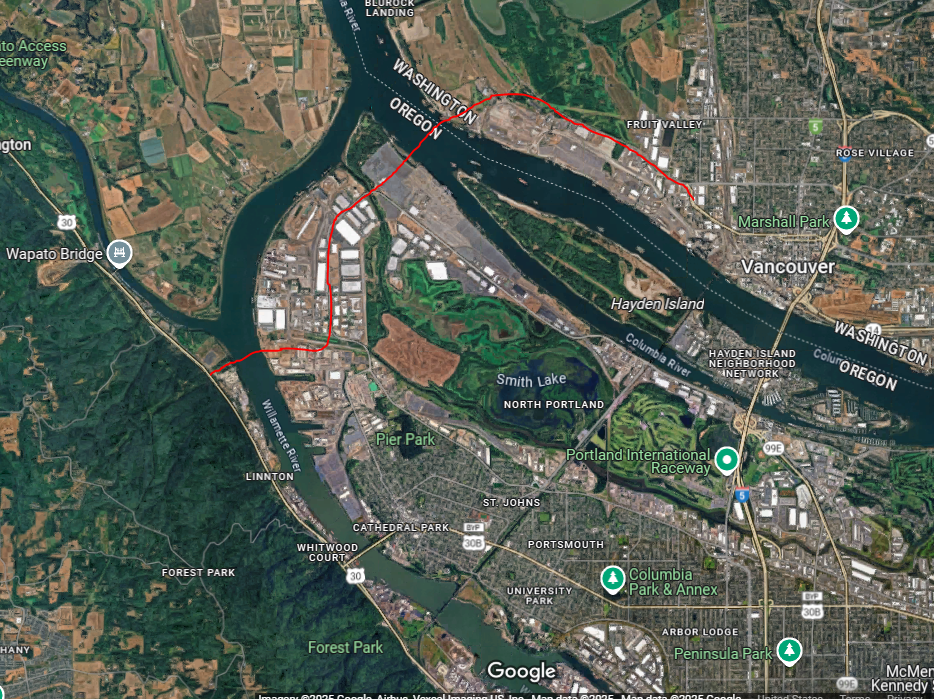
While we're wish-casting, a partial "Westside Bypass" would've been a good phase I to replacing this bridge. Done correctly, it could have taken a lot of pressure off this facility, and constructed without impacting current volumes at all.

A proposed route: 501/Lower River Road on the Washington side, shot across the Columbia River from NW Old Lower River Rd. to approx. Columbia Blvd on the Oregon side, hitting the cargo, shipping, distribution center, and industrial areas in St. Johns before crossing the Willamette and connecting with 30/St. Helens just south of Sauvie Island. This would have the additional benefit of relieving congestion on the St. Johns Bridge and providing an alternative route for the NW industrial area.

Reply With Quote
     
     
  #914  
Old Posted Jan 9, 2026, 2:16 AM
truebaru truebaru is offline
Registered User
 
Join Date: May 2022
Posts: 27
Reporting from Willamette Week and Joe Cortright that IBR team has been withholding updated cost information regarding the bridge from the state legislature, and that new estimates are *13.6 billion* for this thing.

https://www.wweek.com/news/state/2026/01...allooning-cost-of-giant-highway-project/

I support the replacement bridge and light rail, but why do we need the highway projects north and south of the bridge?
Reply With Quote
     
     
  #915  
Old Posted Jan 9, 2026, 2:54 PM
PhillyPDX PhillyPDX is offline
Registered User
 
Join Date: Aug 2022
Posts: 826
Quote:
Originally Posted by truebaru View Post
Reporting from Willamette Week and Joe Cortright that IBR team has been withholding updated cost information regarding the bridge from the state legislature, and that new estimates are *13.6 billion* for this thing.

https://www.wweek.com/news/state/2026/01...allooning-cost-of-giant-highway-project/

I support the replacement bridge and light rail, but why do we need the highway projects north and south of the bridge?
Is this escalation actually enough to derail the entire thing, again? It seemed like it was most def moving forward, but this is a MAJOR uh-oh moment. Well beyond what any party was proposing to pay. As far as I can see each state was only in for $1b.
Reply With Quote
     
     
  #916  
Old Posted Jan 9, 2026, 6:38 PM
truebaru truebaru is offline
Registered User
 
Join Date: May 2022
Posts: 27
Quote:
Originally Posted by PhillyPDX View Post
Is this escalation actually enough to derail the entire thing, again? It seemed like it was most def moving forward, but this is a MAJOR uh-oh moment. Well beyond what any party was proposing to pay. As far as I can see each state was only in for $1b.
I don't know.

Before this news Johnson leaving the project seemed benign.

But after seeing this it makes me wonder whether he saw the updated pricetag and dipped.

I understand Kotek's political motivations for putting a moratorium tolling, but we can't pay for needed highway projects without it. I would say this project IS needed (or at least the bridge replacement itself is) because of earthquake readiness.
Reply With Quote
     
     
  #917  
Old Posted Jan 9, 2026, 9:54 PM
Jakz Jakz is offline
Registered User
 
Join Date: Feb 2022
Posts: 87
Quote:
Originally Posted by truebaru View Post
Reporting from Willamette Week and Joe Cortright that IBR team has been withholding updated cost information regarding the bridge from the state legislature, and that new estimates are *13.6 billion* for this thing.

https://www.wweek.com/news/state/2026/01...allooning-cost-of-giant-highway-project/

I support the replacement bridge and light rail, but why do we need the highway projects north and south of the bridge?
It's a mind-numbingly stupid waste of resources. It's not even about reducing congestion. Those segments are already wide enough they can be striped for 8 lanes, meaning they won't be the pinch points in the highway network in the reasonably forseeable future. And most likely they never will be, given the staggering amount of resources it would take to widen I-5 to 8 mainline lanes through Portland.

Honestly it makes the proposed 8-lane width at the Rose Quarter look reasonable by comparison. There is a possible (but bad) forseeable future where ODOT figures out its funding woes and widens freeways downtown and a six-lane section right downtown re-emerges as a choke point. There is no reasonably forseeable future in which an 8-lane highway between Marine Dr. and SR-500 is not adequate.
Reply With Quote
     
     
  #918  
Old Posted Jan 9, 2026, 11:37 PM
PhillyPDX PhillyPDX is offline
Registered User
 
Join Date: Aug 2022
Posts: 826
Quote:
Originally Posted by Jakz View Post
It's a mind-numbingly stupid waste of resources. It's not even about reducing congestion. Those segments are already wide enough they can be striped for 8 lanes, meaning they won't be the pinch points in the highway network in the reasonably forseeable future. And most likely they never will be, given the staggering amount of resources it would take to widen I-5 to 8 mainline lanes through Portland.

Honestly it makes the proposed 8-lane width at the Rose Quarter look reasonable by comparison. There is a possible (but bad) forseeable future where ODOT figures out its funding woes and widens freeways downtown and a six-lane section right downtown re-emerges as a choke point. There is no reasonably forseeable future in which an 8-lane highway between Marine Dr. and SR-500 is not adequate.
What a mess. I had actually thought the same thing about Johnson when I saw the costs. He was getting out of Dodge.

Makes me wonder, what is the cost to seismically upgrade the current bridge? I haven't followed closely enough to know, how feasible that is.

I do like the ideas I've seen online, for alternative solutions. Like local access bridge to Hayden Island, etc. Of course, surely those big box stores would complain if there's no easy access for the tax evader shoppers to come in from Washington.
Reply With Quote
     
     
  #919  
Old Posted Jan 10, 2026, 6:46 AM
truebaru truebaru is offline
Registered User
 
Join Date: May 2022
Posts: 27
Quote:
Originally Posted by PhillyPDX View Post
Makes me wonder, what is the cost to seismically upgrade the current bridge? I haven't followed closely enough to know, how feasible that is.
Looking through project documents, there is shockingly little about this. If they formally studied the costs of a seismic retrofit, it's not readily accessible on IBR program website.

Some of the documents briefly mention that retrofitting is "cost prohibitive" but without more details it feels like they dismissed that from the beginning without studying it thoroughly.

Ultimately the big issue in my opinion is that the IBR's purpose and need statement does not include reducing costs. In other words, cost was not considered in the "purpose" and "need". Even though these costs may give us yet another "no build".
Reply With Quote
     
     
  #920  
Old Posted Jan 10, 2026, 3:36 PM
PhillyPDX PhillyPDX is offline
Registered User
 
Join Date: Aug 2022
Posts: 826
Quote:
Originally Posted by truebaru View Post
Looking through project documents, there is shockingly little about this. If they formally studied the costs of a seismic retrofit, it's not readily accessible on IBR program website.

Some of the documents briefly mention that retrofitting is "cost prohibitive" but without more details it feels like they dismissed that from the beginning without studying it thoroughly.

Ultimately the big issue in my opinion is that the IBR's purpose and need statement does not include reducing costs. In other words, cost was not considered in the "purpose" and "need". Even though these costs may give us yet another "no build".
“Cost prohibitive”. $14b IBR bridge replacement chuckles. Ha!
Reply With Quote
     
     
This discussion thread continues

Use the page links to the lower-right to go to the next page for additional posts
 
 
Reply

Go Back   SkyscraperPage Forum > Regional Sections > United States > Pacific West > Portland > Transportation & Infrastructure
Forum Jump


Forum Jump


All times are GMT. The time now is 7:59 PM.


Powered by vBulletin® Version 3.8.7
Copyright ©2000 - 2026, vBulletin Solutions, Inc.