HomeDiagramsDatabaseMapsForum About
     

Go Back   SkyscraperPage Forum > Regional Sections > Canada > Ontario > Ottawa-Gatineau > Transportation


Reply

 
Thread Tools Display Modes
     
     
  #1301  
Old Posted Oct 4, 2023, 12:39 AM
Truenorth00 Truenorth00 is offline
 
Join Date: May 2017
Posts: 29,143
You can't build a city without ambition. A downtown choking on cars will always be a — 9-5 district. That's reality. And you can see that everywhere you go in the world. Hopefully, adding more residents (and therefore voters) downtown will start to make some difference to the politics of all this.

In the interim, I would agree that pedestrianization needs to be pushed where possible. Like the Market. And a close second to that: no more investment in streets that can't be traffic calmed or pedestrianized. What the hell is the point of spending tens of millions on rebuilding streets substantially just to have a single digit percent of commuters use it like they would (as a thoroughfare) anyway? If they need a road to drive one, there's no need to spend tens of millions making it nice.

Something we all need to start understanding is the value of space. Two street parking spots can generate maybe $100/day (generous estimate)in revenue for the city from parking fees ($0 if free parking). Meanwhile a restaurant can put half a dozen tables in the same space and generate $1000-2000/day in revenue from those tables, and they'll gladly give the city $3k per month to use that space. This is something businesses and individuals in cities with less car brain understand.
Reply With Quote
     
     
  #1302  
Old Posted Oct 4, 2023, 3:06 AM
lrt's friend lrt's friend is online now
 
Join Date: Dec 2006
Posts: 12,817
No city in the world can operate without functional streets. You can pedestrianize small areas, a square, a single street, or improve pedestrian infrastructure, but streets still need to move traffic, whether transit, uber, taxis, delivery or emergency vehicles. There needs to be a way to reach every address in some way with vehicles.

We can reduce car use, but that means that we need to invest in attractive infrastructure that gives people an alternate choice on how to move around. Do we wish to set this as a priority? Do we wish to fund it? Many cities have found a way to make these changes. How have they done it while we have failed so far?

The great cities that choose to not be overrun by cars have one or more central railway station to bring people into the city for work or play. Ottawa got rid of its station in 1966, so it will be a challenge to recreate this in some fashion.

We can densify downtown (which is happening) but that is limited without effective ways to move around. Only so many people can live within walking distance of downtown. We see a major new development at Cummings Bridge, but even that is too far out to reach downtown on foot.

Do we have the political will to intensify our city yet still provide ways to efficiently move around?
Reply With Quote
     
     
  #1303  
Old Posted Oct 4, 2023, 1:59 PM
DogsWithJobs DogsWithJobs is offline
 
Join Date: Oct 2017
Posts: 71
Quote:
Originally Posted by lrt's friend View Post
. We see a major new development at Cummings Bridge, but even that is too far out to reach downtown on foot.
There should be a dedicated transit lane along Rideau and Montreal road. That would have been the simple solution to that issue. Of course the city made that impossible with he Montreal road redo.

I don't see the city taking any steps to reduce car use, and everything that has come out of Sutcliffe actually shows the opposite intention. Our only hope is the increased density forces their hand to provide better transit, but I am sure there are some more fields with proposed smart centres we can build transit to first.
Reply With Quote
     
     
  #1304  
Old Posted Oct 4, 2023, 3:47 PM
YOWetal YOWetal is offline
 
Join Date: Oct 2006
Posts: 7,764
Quote:
Originally Posted by DogsWithJobs View Post
T
I don't see the city taking any steps to reduce car use, and everything that has come out of Sutcliffe actually shows the opposite intention. Our only hope is the increased density forces their hand to provide better transit, but I am sure there are some more fields with proposed smart centres we can build transit to first.
He won the election and with a strong mandate to not move away from cars. Elections do have consequencs.
Reply With Quote
     
     
  #1305  
Old Posted Oct 4, 2023, 11:47 PM
Truenorth00 Truenorth00 is offline
 
Join Date: May 2017
Posts: 29,143
Quote:
Originally Posted by lrt's friend View Post
No city in the world can operate without functional streets. You can pedestrianize small areas, a square, a single street, or improve pedestrian infrastructure, but streets still need to move traffic, whether transit, uber, taxis, delivery or emergency vehicles. There needs to be a way to reach every address in some way with vehicles.

We can reduce car use, but that means that we need to invest in attractive infrastructure that gives people an alternate choice on how to move around. Do we wish to set this as a priority? Do we wish to fund it? Many cities have found a way to make these changes. How have they done it while we have failed so far?

The great cities that choose to not be overrun by cars have one or more central railway station to bring people into the city for work or play. Ottawa got rid of its station in 1966, so it will be a challenge to recreate this in some fashion.

We can densify downtown (which is happening) but that is limited without effective ways to move around. Only so many people can live within walking distance of downtown. We see a major new development at Cummings Bridge, but even that is too far out to reach downtown on foot.

Do we have the political will to intensify our city yet still provide ways to efficiently move around?
Folks like you will never get it. Catering to cars even for suburbanites always leads to worse outcomes. Here's an example:

Quote:
One of the craziest findings in urban planning is that you can reach more jobs faster by car in Dutch cities than American cities — *and* walking, cycling, and transit are faster in Dutch cities.

Building cities for cars fails even cars.

https://www.nature.com/articles/s42949-021-00020-2


https://twitter.com/LUrbaniste/status/1709643820613189791?t=5KOUtZ7H-29KbJzl0EmhxA&s=19

Understand this. Vibrant urban areas cannot and have never been built with dependency on suburbanites who drive through them or simply earn a paycheque there while spending the bulk of their income elsewhere. Any city that has a vibrant core, has one because of local population in the core. Ottawa foolishly built its core for commuters. COVID showed how terrible a strategy this was. New condos and office conversions will populate downtown and finally provide a decent base of residents. There's no point wasting money on trying to improve accessibility for suburbanites. We'll have to spend $10 on roads and transit spending for every $1 a suburbanite might spend in the core. It's not worthwhile.
Reply With Quote
     
     
  #1306  
Old Posted Oct 5, 2023, 3:04 PM
Richard Eade Richard Eade is offline
 
Join Date: Mar 2008
Posts: 2,685
Quote:
Originally Posted by Truenorth00 View Post
Folks like you will never get it. Catering to cars even for suburbanites always leads to worse outcomes. Here's an example:

https://twitter.com/LUrbaniste/status/1709643820613189791?t=5KOUtZ7H-29KbJzl0EmhxA&s=19
.
.
.
I must admit that I’m not sure what you are trying to say with all of those graphs, pulled out of the linked study.

My take from looking over the graphs is, basically, that denser cities can offer more jobs within a given commute travel time. No big surprise – but I did go an read the study report. In it, is this interesting paragraph:
Quote:
The automobile provides better access than transit in all cities we compared, except in Shanghai, China, where automobile reaches about 90% of the jobs reachable by transit at 30 min. The disparity between transit and automobile access is greatest in American cities; Oceania and Canadian cities have more comparable levels of access between the two modes, although the gap remains significant. Among the Oceania cities, Perth and Wellington are the two extremes (outliers) for respectively having the largest and smallest gaps between transit and automobile access to jobs.
If you go back and look at the graphs again, you will notice that the number of jobs accessible by automobile FAR exceeds the number of jobs available to folks using other methods of commuting.

Here is that in graph form:
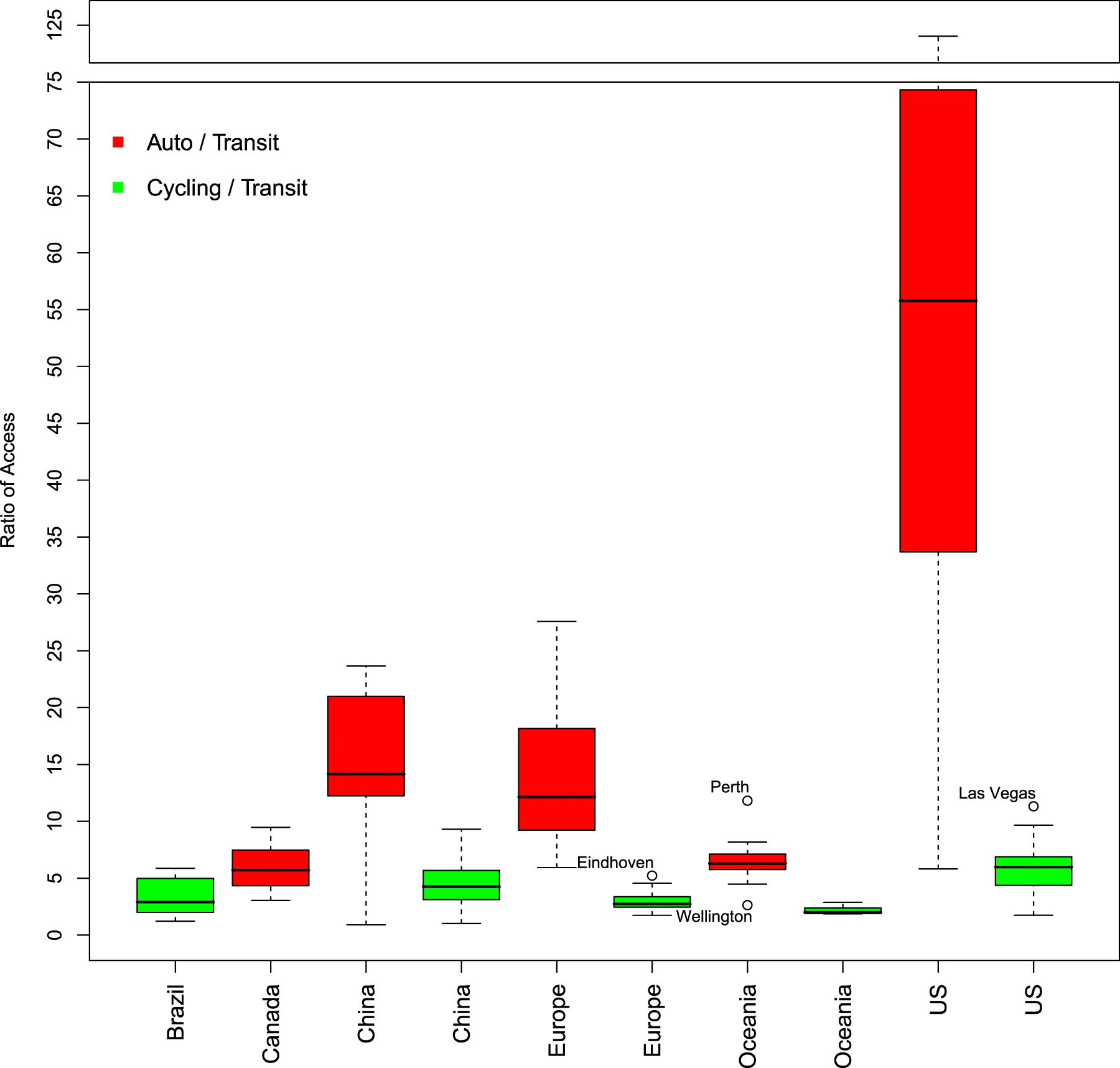

Take-away; Roads are the most important link between people and their jobs, giving them access to far more choices of employment. The road network of every city (except, maybe Shanghai) – regardless of its density – must be maintained to a useful level. Setting up ‘road-blocks’ (pun intended) for automobiles adversely affects cities more than any other form of transportation.

Reply With Quote
     
     
  #1307  
Old Posted Oct 5, 2023, 4:47 PM
YOWetal YOWetal is offline
 
Join Date: Oct 2006
Posts: 7,764
Quote:
Originally Posted by Richard Eade View Post
I must admit that I’m not sure what you are trying to say with all of those graphs, pulled out of the linked study.

My take from looking over the graphs is, basically, that denser cities can offer more jobs within a given commute travel time. No big surprise – but I did go an read the study report. In it, is this interesting paragraph:

If you go back and look at the graphs again, you will notice that the number of jobs accessible by automobile FAR exceeds the number of jobs available to folks using other methods of commuting.

Here is that in graph form:

Take-away; Roads are the most important link between people and their jobs, giving them access to far more choices of employment. The road network of every city (except, maybe Shanghai) – regardless of its density – must be maintained to a useful level. Setting up ‘road-blocks’ (pun intended) for automobiles adversely affects cities more than any other form of transportation.

I think your first point is the key that that anti car folks overlook. To make cities denser you need to change people's housing choices and probably the size of their housing at least at the same cost. For suburban life to continue we need a road network. Arguably the loss of suburban affordability which is shaking our society to its core is the lack of development of our road network. In Toronto how many lanes of freeways have they added since the 1970s? It is not feasible to serve white picket fences SFHs with transit. Switzerland does a bit but they are twice as rich as us. Lots of wealthier than us European states live in housing half the size of us with only communal outside space.

The 15 minute conspiracy folks aren't that wrong if this thread was policy its exactly what they are worried about. We had an election the car centric suburban folks one. I live downtown so personally I'd love to see a congestion charge totally pedestrianised Byward market through parliament and up Elgin. But it's not going to happen unless people don't just say they want to fight climate change and use transit but actually make the sacrifices necessary to do it.
Reply With Quote
     
     
  #1308  
Old Posted Oct 5, 2023, 9:02 PM
Richard Eade Richard Eade is offline
 
Join Date: Mar 2008
Posts: 2,685
Since this is a thread that is supposed to deal with the easterly extension of the Confederation Line (Stage 2), I have copied a couple of previous comments to the Pedestrianization of City Centres thread. I hope that the discussion can continue there.
Reply With Quote
     
     
  #1309  
Old Posted Oct 6, 2023, 3:05 AM
Truenorth00 Truenorth00 is offline
 
Join Date: May 2017
Posts: 29,143
Quote:
Originally Posted by Richard Eade View Post
I must admit that I’m not sure what you are trying to say with all of those graphs, pulled out of the linked study.

My take from looking over the graphs is, basically, that denser cities can offer more jobs within a given commute travel time. No big surprise – but I did go an read the study report. In it, is this interesting paragraph:

If you go back and look at the graphs again, you will notice that the number of jobs accessible by automobile FAR exceeds the number of jobs available to folks using other methods of commuting.

....

Take-away; Roads are the most important link between people and their jobs, giving them access to far more choices of employment. The road network of every city (except, maybe Shanghai) – regardless of its density – must be maintained to a useful level. Setting up ‘road-blocks’ (pun intended) for automobiles adversely affects cities more than any other form of transportation.
Of course cars provide better access than other modes. That's just physics. What you seemed to have missed (did you actually read the tweet and look at the graphs?) is that the cars themselves perform better in cities not designed for cars. So while cars provide better access to employment than transit, the cars in the Netherlands provide even better access than cities of similar size elsewhere. The irony is that trying to cater to drivers actually makes things worse for them.
Reply With Quote
     
     
  #1310  
Old Posted Nov 9, 2023, 1:55 PM
sseguin sseguin is offline
 
Join Date: Aug 2018
Posts: 322
EXCLUSIVE Sneak Peek of Jeanne d'Arc Station: The Eastern Extension of O-Train Lines 1/3.

In this video, Bradley Cooper, Senior Engineer of Stage2LRT Construction at the City of Ottawa, shares his expertise and insights.

• Video Link
Reply With Quote
     
     
  #1311  
Old Posted Nov 9, 2023, 4:50 PM
Kitchissippi's Avatar
Kitchissippi Kitchissippi is online now
 
Join Date: Nov 2005
Posts: 4,703
Quote:
Originally Posted by sseguin View Post
[B]

In this video, Bradley Cooper, Senior Engineer of Stage2LRT Construction at the City of Ottawa, shares his expertise and insights.
I was expecting him to break out in song: "in the sta-a, a-a-a-tion"
Reply With Quote
     
     
  #1312  
Old Posted Nov 19, 2023, 9:45 PM
SidetrackedSue SidetrackedSue is offline
 
Join Date: Jun 2019
Posts: 399
Reply With Quote
     
     
  #1313  
Old Posted Nov 19, 2023, 11:42 PM
lrt's friend lrt's friend is online now
 
Join Date: Dec 2006
Posts: 12,817
Quote:
Originally Posted by SidetrackedSue View Post
At least its not an LRT train.
Reply With Quote
     
     
  #1314  
Old Posted Nov 20, 2023, 2:06 AM
SidetrackedSue SidetrackedSue is offline
 
Join Date: Jun 2019
Posts: 399
Quote:
Originally Posted by lrt's friend View Post
At least its not an LRT train.
I'm not completely sure it was on the line, either. Someone said it was a truck with welding equipment, though.

Since it wasn't right in a station, I can't see this delaying the project any further.
Reply With Quote
     
     
  #1315  
Old Posted Nov 24, 2023, 2:02 PM
OTSkyline OTSkyline is online now
 
Join Date: Jun 2012
Posts: 2,831
Track installation for O-Train Line 1 east extension complete

https://ottawa.ctvnews.ca/track-installa...ge,and%20Beacon%20Hill%20is%20completed.
Reply With Quote
     
     
  #1316  
Old Posted Nov 24, 2023, 3:26 PM
lrt's friend lrt's friend is online now
 
Join Date: Dec 2006
Posts: 12,817
Quote:
Originally Posted by OTSkyline View Post
Track installation for O-Train Line 1 east extension complete

https://ottawa.ctvnews.ca/track-installa...ge,and%20Beacon%20Hill%20is%20completed.
The last time I was out that way in late October, the overhead wiring was in place as far as the west boundary of Orleans.
Reply With Quote
     
     
  #1317  
Old Posted Nov 24, 2023, 6:27 PM
J.OT13's Avatar
J.OT13 J.OT13 is online now
 
Join Date: Mar 2012
Posts: 29,178
Reply With Quote
     
     
  #1318  
Old Posted Dec 15, 2023, 12:03 PM
Truenorth00 Truenorth00 is offline
 
Join Date: May 2017
Posts: 29,143
Anyone know the latest estimate for delivery of this extension?
Reply With Quote
     
     
  #1319  
Old Posted Dec 15, 2023, 1:56 PM
OCCheetos OCCheetos is online now
 
Join Date: Aug 2017
Posts: 2,118
Quote:
Originally Posted by Truenorth00 View Post
Anyone know the latest estimate for delivery of this extension?
Some issues with the catenary support poles pushed it back by about 60 days, but it's still expected in Spring 2025.

They're tentatively expecting the first train to run on the extension by the end of January (2024).
Reply With Quote
     
     
  #1320  
Old Posted Dec 16, 2023, 4:09 PM
Hybrid247 Hybrid247 is offline
 
Join Date: Oct 2009
Posts: 1,320
Quote:
Originally Posted by OCCheetos View Post
Some issues with the catenary support poles pushed it back by about 60 days, but it's still expected in Spring 2025.

They're tentatively expecting the first train to run on the extension by the end of January (2024).
I've heard the train testing might get pushed back again due to the OCS issues you noted. From my limited understanding, part of the OCS issues are related to the positioning of the support arms on the poles and the damage from the fire that occurred a few weeks ago. They're also rushing to get all the necessary operational signage installed along the guideway to get the train testing underway. Not sure if they'll be able to get them installed by January.
Reply With Quote
     
     
This discussion thread continues

Use the page links to the lower-right to go to the next page for additional posts
 
 
Reply

Go Back   SkyscraperPage Forum > Regional Sections > Canada > Ontario > Ottawa-Gatineau > Transportation
Forum Jump


Forum Jump


All times are GMT. The time now is 3:16 PM.


Powered by vBulletin® Version 3.8.7
Copyright ©2000 - 2026, vBulletin Solutions, Inc.